
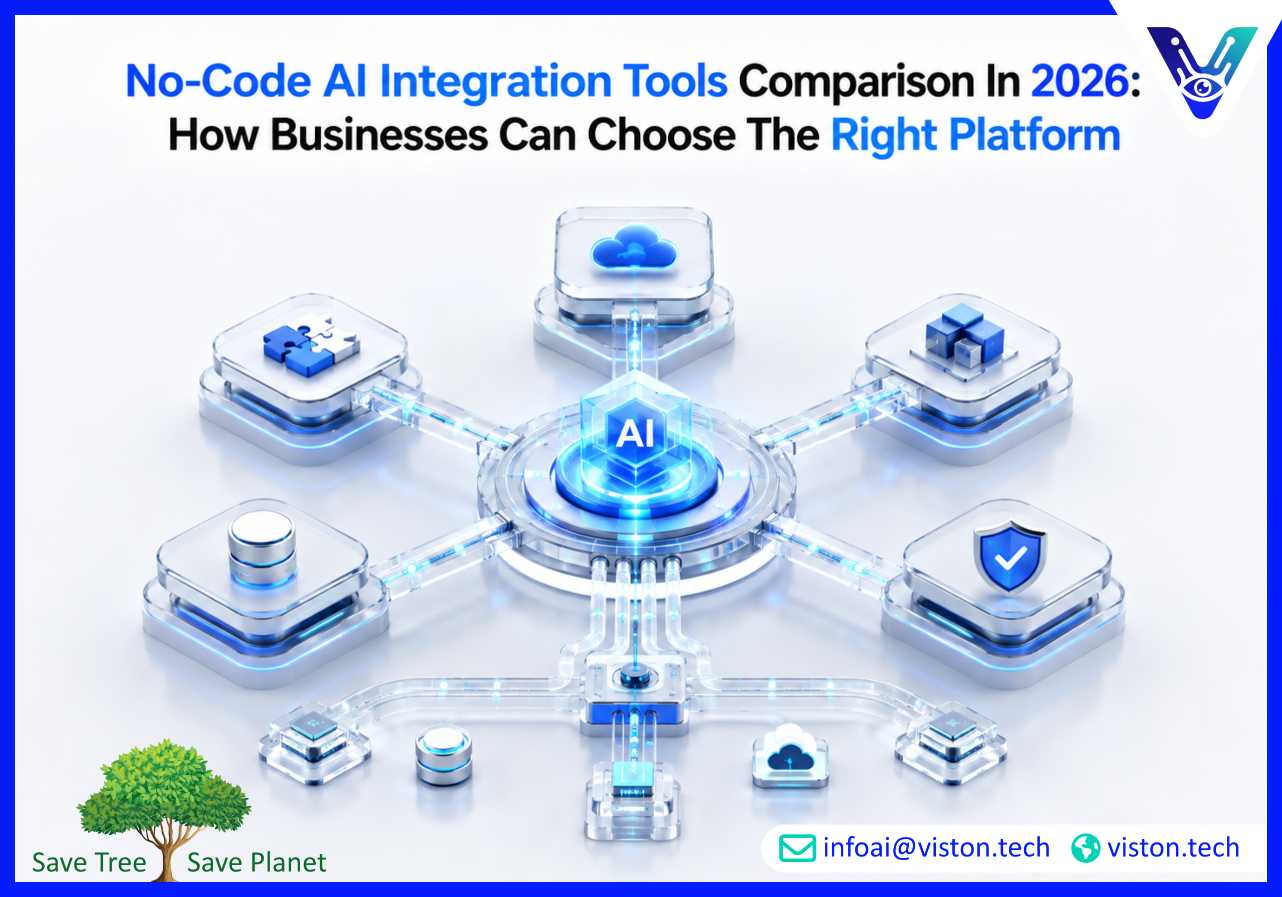
Artificial intelligence is no longer limited to organizations with dedicated development teams. In 2026, no-code AI integration tools allow businesses to connect AI capabilities with existing systems, automate workflows, and improve operational efficiency without extensive software engineering. However, choosing the right platform requires understanding how these tools differ in functionality, scalability, governance, and business fit.
No-code AI integration platforms have evolved from simple automation tools into sophisticated environments capable of connecting AI models, business applications, databases, customer systems, and enterprise workflows. Organizations increasingly adopt these solutions because they reduce development complexity while accelerating AI deployment.
Business teams can now build AI-powered workflows using visual interfaces, pre-built connectors, drag-and-drop automation builders, and configurable AI services. This allows companies to experiment, deploy, and scale AI initiatives faster than traditional custom development approaches.
Key business drivers include:
Despite these benefits, not all no-code AI platforms deliver the same capabilities. Selecting the wrong solution can create scalability limitations, governance challenges, and integration bottlenecks as AI initiatives grow.
Businesses should evaluate no-code AI integration platforms based on practical implementation requirements rather than marketing claims. The most suitable platform depends on organizational goals, workflow complexity, compliance requirements, and existing technology infrastructure.
The primary value of no-code AI platforms comes from their ability to connect systems. Organizations should assess available integrations with CRM platforms, ERP systems, customer support software, productivity tools, databases, cloud services, and custom APIs.
Strong integration capabilities reduce manual work and enable AI to operate within existing business processes.
Some platforms are designed for simple task automation, while others support complex multi-step workflows involving approvals, branching logic, exception handling, and AI-driven decision-making.
Businesses should consider current requirements as well as future workflow expansion needs.
Modern organizations often use multiple AI providers and models. The best no-code platforms support flexibility by allowing integrations with large language models, machine learning services, knowledge retrieval systems, and custom AI solutions.
As AI becomes embedded within business operations, governance becomes increasingly important. Organizations should evaluate:
These capabilities are particularly important for enterprises handling sensitive customer or operational data.
A platform that works well for a small automation project may struggle under enterprise-scale workloads. Businesses should assess workflow volume limits, integration capacity, user management features, and performance reliability before committing to a solution.
Several platforms have established themselves as leading options for no-code AI integration in 2026. Each serves different business requirements and operational priorities.
Power Automate remains a strong option for organizations already invested in the Microsoft ecosystem. It offers extensive integration with Microsoft 365, Dynamics, Azure services, and enterprise workflows.
Best suited for:
Strengths:
Zapier continues to be one of the most accessible no-code automation platforms for businesses seeking rapid deployment. Its strength lies in connecting thousands of applications through simple workflow creation.
Best suited for:
Strengths:
Make offers more advanced workflow design capabilities than many entry-level no-code platforms. It provides visual workflow building with greater flexibility for complex automation scenarios.
Best suited for:
Strengths:
N8N has gained popularity among organizations seeking greater control over automation infrastructure. Its open-source foundation appeals to businesses that require customization and deployment flexibility.
Best suited for:
Strengths:
Workato focuses heavily on enterprise integration and automation. It supports sophisticated business processes and provides governance capabilities suitable for larger organizations.
Best suited for:
Strengths:
The best no-code AI integration tool is not necessarily the most feature-rich platform. It is the one that aligns with business objectives, operational processes, and long-term AI strategy.
Organizations should start by identifying the specific outcomes they want to achieve. Examples may include reducing manual work, improving customer support, accelerating sales operations, automating reporting, or enhancing internal productivity.
The chosen platform should integrate naturally with existing systems. Businesses often achieve better adoption when AI automation complements current workflows rather than forcing major operational changes.
As AI becomes more deeply embedded into business operations, governance and compliance requirements become increasingly important. Businesses should ensure selected platforms support visibility, accountability, and operational controls.
Many organizations begin with a single AI workflow but eventually expand AI across departments. Selecting a scalable platform helps avoid costly migration projects later.
Successful AI integration is often less about the software itself and more about aligning technology choices with business strategy, operational priorities, and organizational readiness.
Choosing between no-code AI integration platforms can be challenging because technology capabilities are only one part of a successful AI initiative. Strategic AI Consulting Services from Viston AI help businesses evaluate opportunities, identify suitable platforms, and develop implementation roadmaps that align with operational goals.
Rather than focusing solely on software selection, Viston AI works with organizations to assess workflows, integration requirements, automation opportunities, governance considerations, and long-term scalability needs. This approach helps businesses avoid investing in tools that may not support future growth or operational complexity.
For companies exploring AI adoption, platform selection often involves balancing ease of implementation, business value, security requirements, and integration capabilities. Viston AI’s consulting expertise supports decision-makers in identifying practical AI opportunities and building strategies that connect AI technologies with real business outcomes.
As AI adoption accelerates across industries in 2026, organizations increasingly benefit from a structured consulting approach that combines technology evaluation with operational planning and implementation guidance.
No-code AI integration tools allow businesses to connect AI capabilities with applications, databases, and workflows using visual interfaces instead of traditional software development.
The best platform depends on business requirements. Enterprise organizations often evaluate solutions such as Microsoft Power Automate, Workato, and advanced workflow platforms based on scalability, governance, and integration needs.
Yes. Modern no-code platforms can support sophisticated workflows involving multiple systems, AI services, approvals, branching logic, and automation processes.
Many enterprise-grade platforms offer security controls, governance features, audit logging, and compliance support. Businesses should evaluate security capabilities before implementation.
Not entirely. While they reduce development requirements, complex integrations, governance frameworks, and enterprise-scale deployments may still benefit from technical expertise.
Viston AI provides Strategic AI Consulting Services that help organizations assess requirements, compare solutions, develop AI integration strategies, and align technology decisions with business objectives.
A no-code AI integration tools comparison is essential for businesses planning AI adoption in 2026. While platforms such as Power Automate, Zapier, Make, N8N, and Workato offer powerful capabilities, the right choice depends on workflow complexity, integration requirements, governance expectations, and scalability goals. Strategic AI Consulting Services play an important role in helping organizations evaluate options beyond feature lists and focus on business outcomes. For companies seeking a structured approach to AI integration planning, Viston AI provides consulting expertise that supports informed decision-making, sustainable implementation, and long-term AI success.
