
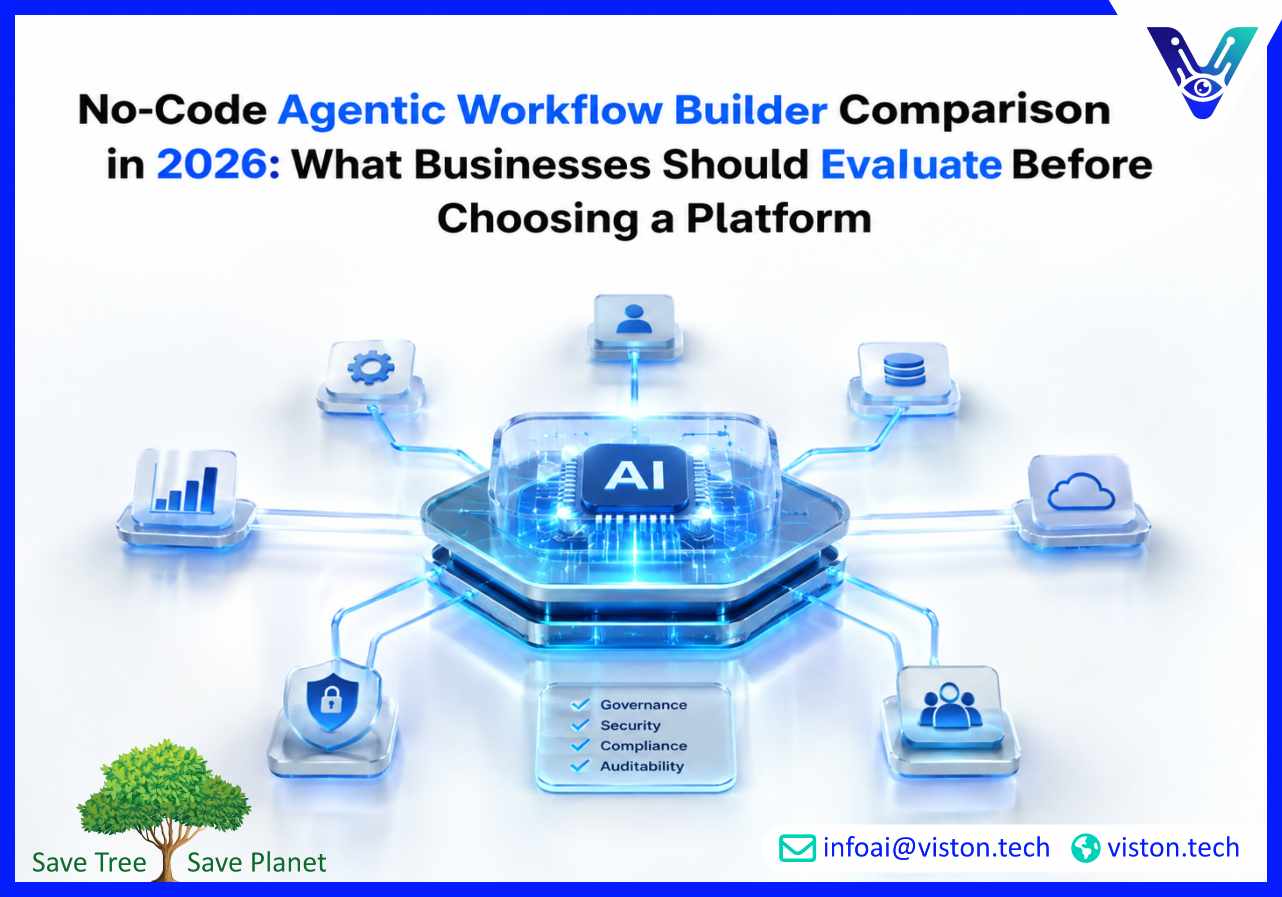
As businesses accelerate AI adoption, no-code agentic workflow builders are becoming a practical way to automate complex processes without requiring extensive software development. Choosing the right platform is no longer just a technology decision—it directly affects scalability, governance, integration capabilities, and long-term business value
A no-code agentic workflow builder is a platform that allows organizations to create, deploy, and manage AI-powered workflows through visual interfaces instead of traditional coding. These platforms enable businesses to design workflows where AI agents can perform tasks, make decisions, access data, interact with systems, and collaborate with other agents.
Unlike traditional automation tools that follow predefined rules, agentic workflows can adapt to context, retrieve information, execute actions, and coordinate multiple steps across business systems.
In 2026, organizations are increasingly using no-code agentic workflow platforms for:
The appeal lies in reducing development complexity while allowing business teams to participate directly in workflow creation and optimization.
Comparing platforms solely based on AI features often leads to poor implementation decisions. Businesses should evaluate no-code agentic workflow builders according to operational requirements, governance needs, and scalability objectives.
The most important factor is how effectively the platform manages workflow orchestration. Businesses should evaluate whether the system can support:
A strong orchestration layer determines whether the workflow remains reliable when business complexity increases.
Agentic workflows rarely operate independently. Most organizations need AI agents to interact with CRMs, ERPs, helpdesk platforms, communication tools, databases, analytics systems, and proprietary applications.
When comparing platforms, businesses should assess:
Integration limitations often become a major barrier to scaling AI initiatives.
As AI agents gain greater operational responsibility, governance becomes essential. Enterprise buyers increasingly prioritize platforms that offer:
Governance features help organizations deploy AI responsibly while maintaining operational oversight.
Not all workflows require the same level of agent autonomy. Some businesses need simple task execution, while others require agents capable of reasoning, planning, and coordinating actions across multiple systems.
Organizations should assess how easily agents can be customized for:
The ability to tailor agent behavior often determines long-term platform suitability.
The market for no-code agentic workflow platforms has evolved rapidly. While individual solutions differ, most platforms fall into several broad categories.
These platforms extend traditional workflow automation by adding AI-powered decision-making and task execution capabilities. They often excel at connecting business applications and automating operational processes.
Strengths typically include:
However, agent capabilities may be less advanced compared to AI-first platforms.
AI-native solutions are built specifically around autonomous agents and multi-agent orchestration. These platforms focus heavily on agent collaboration, reasoning, planning, and adaptive workflow execution.
Benefits often include:
Organizations may require additional integration work depending on existing infrastructure.
These platforms target larger organizations with strict governance, compliance, security, and scalability requirements.
Common strengths include:
They are often preferred for business-critical operations where reliability and oversight are essential.
The best platform depends on business objectives rather than feature lists alone. Organizations should begin by identifying workflows that will benefit most from agentic automation.
Businesses should document:
This creates a clearer foundation for evaluating platform capabilities.
Successful implementations focus on measurable outcomes such as:
Platform selection should align with these objectives rather than emerging technology trends alone.
Many organizations begin with a single workflow but later expand across departments. The chosen platform should support:
Scalability planning prevents costly platform migrations in the future.
Businesses increasingly recognize that isolated AI tools rarely transform operations on their own. The greater opportunity lies in orchestrating AI agents across systems, teams, and processes.
Agentic AI workflows enable organizations to automate complex tasks that involve context, decision-making, collaboration, and execution. This moves businesses beyond simple automation toward coordinated digital operations.
As AI models become more capable, workflow orchestration, governance, integration architecture, and operational control are becoming the true differentiators. Organizations that build strong agentic workflows today are better positioned to scale AI initiatives in a controlled and measurable way.
For organizations evaluating no-code agentic workflow builders, selecting the platform is only one part of the implementation journey. Successful adoption requires workflow analysis, orchestration design, integration planning, governance controls, and long-term optimization.
Viston AI specializes in Agentic AI Workflows, helping businesses design and implement AI-driven processes that connect agents, systems, data sources, and business operations. Rather than focusing solely on tool selection, the approach centers on identifying practical workflow opportunities and building scalable automation frameworks aligned with business objectives.
This includes supporting workflow architecture, multi-agent coordination, AI integration strategies, operational automation, and deployment planning. By aligning agentic systems with real business requirements, organizations can move beyond experimentation and create workflows that deliver measurable operational improvements.
As agentic AI adoption expands in 2026, businesses increasingly need implementation expertise that balances innovation with governance, scalability, and practical business outcomes. Viston AI’s focus on Agentic AI Workflows makes it relevant for organizations seeking structured and sustainable workflow transformation.
A no-code agentic workflow builder is a platform that allows users to create AI-powered workflows using visual interfaces rather than programming. These workflows can include AI agents that perform tasks, make decisions, and interact with business systems.
Traditional automation follows predefined rules, while agentic workflows use AI agents that can interpret context, retrieve information, coordinate tasks, and adapt to changing situations within controlled workflows.
Organizations should evaluate orchestration capabilities, integrations, governance controls, security features, scalability, customization options, and operational monitoring rather than focusing solely on AI functionality.
Many modern platforms support enterprise requirements, including security controls, auditability, governance frameworks, compliance features, and scalable deployment architectures.
Yes. Most platforms support integrations with CRM systems, ERP platforms, communication tools, databases, analytics environments, helpdesk software, and custom applications through APIs and connectors.
Viston AI helps organizations design, integrate, and optimize Agentic AI Workflows by aligning workflow automation strategies with operational goals, system requirements, governance needs, and scalability objectives.
A no-code agentic workflow builder comparison should focus on more than platform features. Businesses must evaluate orchestration capabilities, integration flexibility, governance controls, scalability, and long-term operational requirements. As organizations increasingly adopt Agentic AI Workflows in 2026, success depends on selecting solutions that align with real business processes and measurable outcomes. For companies looking to build scalable, well-governed AI workflows, combining the right platform with implementation expertise can significantly improve the value and sustainability of AI initiatives. Viston AI supports this journey through its specialized focus on Agentic AI Workflows and business-focused automation strategies.
