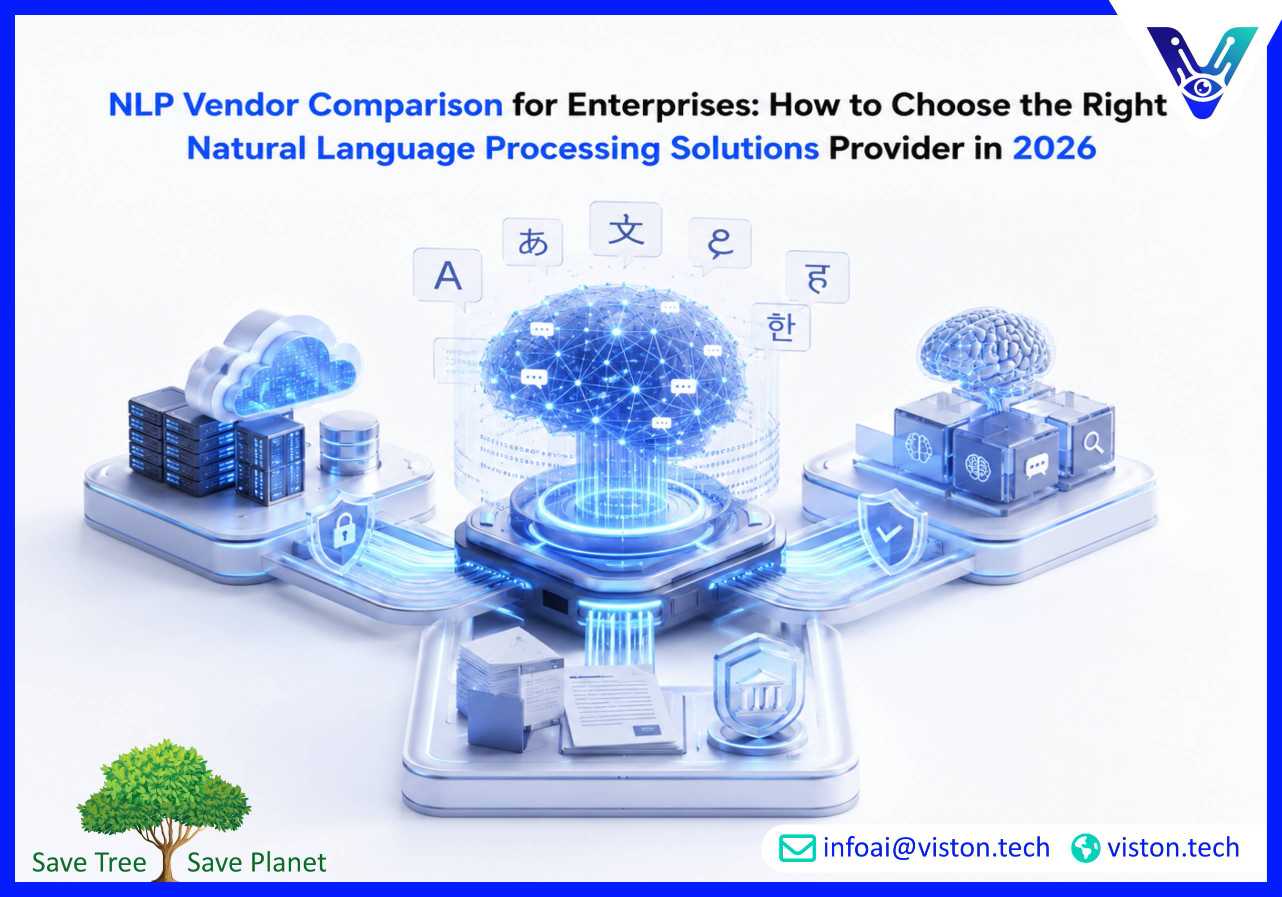
NLP Vendor Comparison for Enterprises: How to Choose the Right Natural Language Processing Solutions Provider in 2026
As enterprises accelerate AI adoption, Natural Language Processing (NLP) has become a critical capability for automating customer interactions, extracting insights from unstructured data, improving operational efficiency, and enhancing decision-making. However, selecting the right NLP vendor is increasingly complex. With numerous providers offering different technologies, deployment models, and service capabilities, enterprises need a structured approach to evaluating NLP solutions in 2026.
Why NLP Vendor Selection Matters for Enterprises
Natural Language Processing technologies now support a wide range of enterprise functions, including customer service automation, document processing, sentiment analysis, intelligent search, knowledge management, compliance monitoring, and conversational AI.The wrong vendor choice can lead to:
Limited scalability
Poor language understanding accuracy
Integration challenges
Data security concerns
High operational costs
Vendor lock-in risks
Difficulty achieving measurable ROI
Enterprises increasingly view NLP investments as long-term strategic initiatives rather than standalone technology purchases. Vendor evaluation should therefore focus on business outcomes, implementation capabilities, and future adaptability.
Key Factors to Evaluate in an NLP Vendor Comparison
Language Understanding Capabilities
The effectiveness of any NLP solution depends on its ability to accurately understand, process, and generate human language.Organizations should assess:
Named entity recognition accuracy
Intent detection performance
Sentiment analysis capabilities
Multilingual support
Context awareness
Domain-specific language understanding
Large language model integration options
Enterprise environments often involve specialized terminology that generic NLP systems may struggle to interpret correctly without customization.
Scalability and Performance
Enterprise NLP deployments must support growing data volumes, user demands, and business requirements.Evaluation criteria should include:
NLP solutions rarely operate in isolation. Successful implementations require seamless integration with existing business systems.Enterprises should assess compatibility with:
CRM platforms
ERP systems
Customer support tools
Knowledge bases
Business intelligence platforms
Data warehouses
Workflow automation systems
Strong API support and integration frameworks are often indicators of long-term implementation success.
Critical Enterprise Considerations in 2026
AI Governance and Compliance
As AI regulations continue evolving globally, enterprises must ensure NLP vendors support responsible AI practices.Key considerations include:
Data privacy controls
Model transparency
Auditability
Bias monitoring
Data retention policies
Regulatory compliance support
Security certifications
Organizations operating in regulated industries should prioritize vendors with mature governance frameworks.
Customization and Domain Adaptation
Enterprise use cases often require NLP models trained on industry-specific language, processes, and terminology.Important evaluation factors include:
Custom model training capabilities
Industry-specific NLP solutions
Fine-tuning options
Knowledge base integration
Prompt engineering support
Retrieval-augmented generation (RAG) capabilities
The ability to adapt NLP systems to business-specific requirements can significantly impact long-term effectiveness.
Total Cost of Ownership
Vendor comparison should extend beyond licensing fees.Enterprises should evaluate:
Implementation costs
Integration expenses
Infrastructure requirements
Training and onboarding costs
Ongoing maintenance
Support services
Future scaling expenses
A lower upfront cost may result in higher long-term operational expenses if scalability and customization are limited.
Common NLP Vendor Categories Enterprises Encounter
Cloud AI Platform Providers
These vendors offer NLP capabilities as part of broader cloud ecosystems. They often provide extensive infrastructure support, scalability, and developer tools but may require significant internal expertise for implementation.
Specialized NLP Solution Providers
Focused NLP vendors typically deliver purpose-built language processing capabilities for specific business use cases such as document intelligence, customer support automation, or conversational AI.
Enterprise AI Development Partners
Some organizations prefer working with solution providers that design, implement, customize, and support NLP systems tailored to specific business requirements.This approach often appeals to enterprises seeking faster deployment and reduced internal technical complexity.
Open-Source-Based Providers
These vendors leverage open-source NLP frameworks while adding enterprise support, security controls, integrations, and deployment services.Open-source approaches can provide flexibility but may require additional governance and technical oversight.
Best Practices for Conducting an NLP Vendor Comparison
Define Business Objectives First
Technology evaluation should begin with business goals rather than vendor features.Organizations should clearly identify desired outcomes such as:
Customer service automation
Document processing efficiency
Knowledge discovery
Employee productivity improvements
Operational cost reduction
Revenue growth opportunities
Run Real-World Proof of Concepts
Vendor demonstrations rarely reflect actual enterprise requirements.Businesses should test NLP solutions using:
Actual business documents
Historical customer conversations
Industry-specific datasets
Operational workflows
Proof-of-concept testing provides a more accurate assessment of vendor performance.
Evaluate Vendor Support and Expertise
Technology alone does not determine project success.Organizations should assess:
Implementation experience
Technical consulting capabilities
Training resources
Ongoing support services
Solution optimization expertise
Industry knowledge
Strong support capabilities often accelerate adoption and reduce implementation risks.
How Viston AI Supports Enterprise NLP Initiatives
As organizations increasingly seek practical and scalable Natural Language Processing Solutions, Viston AI helps businesses bridge the gap between NLP technology and real-world operational outcomes. Rather than focusing solely on language models, successful NLP initiatives require a combination of business process understanding, data strategy, integration expertise, automation design, and ongoing optimization.Viston AI works with organizations to develop NLP-driven solutions that support customer engagement, document intelligence, workflow automation, conversational AI, knowledge management, and business process enhancement. By aligning NLP capabilities with operational goals, businesses can implement solutions that deliver measurable value while integrating effectively with existing technology ecosystems.Enterprise NLP projects often involve challenges related to scalability, data quality, security, governance, and system interoperability. Viston AI’s approach focuses on building practical solutions that address these requirements while supporting long-term growth and adaptability. As NLP technologies continue evolving in 2026, organizations benefit from implementation strategies that prioritize business outcomes, responsible AI practices, and sustainable operational performance.
Frequently Asked Questions
What should enterprises look for in an NLP vendor?
Enterprises should evaluate language understanding accuracy, scalability, integration capabilities, security, compliance support, customization options, implementation expertise, and total cost of ownership.
Why is NLP vendor comparison important?
Vendor comparison helps organizations identify solutions that align with business goals, reduce implementation risks, support future growth, and deliver measurable operational value.
How do enterprises evaluate NLP solution performance?
Performance is typically assessed through proof-of-concept testing, accuracy metrics, processing speed, scalability testing, integration success, and business outcome measurements.
Are custom NLP solutions better than off-the-shelf platforms?
It depends on the use case. Organizations with specialized workflows, industry-specific language requirements, or complex integrations often benefit from customized NLP implementations.
Can Viston AI help enterprises evaluate and implement NLP solutions?
Yes. Viston AI provides Natural Language Processing Solutions that help organizations assess requirements, design NLP strategies, integrate systems, and deploy business-focused AI capabilities.
Conclusion
Conducting an effective NLP vendor comparison requires more than reviewing feature lists or pricing models. Enterprises must evaluate language capabilities, scalability, integration flexibility, governance support, customization options, and implementation expertise to ensure long-term success. As AI adoption continues to expand in 2026, choosing the right Natural Language Processing Solutions provider can significantly impact operational efficiency, customer experiences, and business performance. Organizations seeking practical NLP implementation support can benefit from working with experienced specialists such as Viston AI that understand both the technology and the business processes it serves.