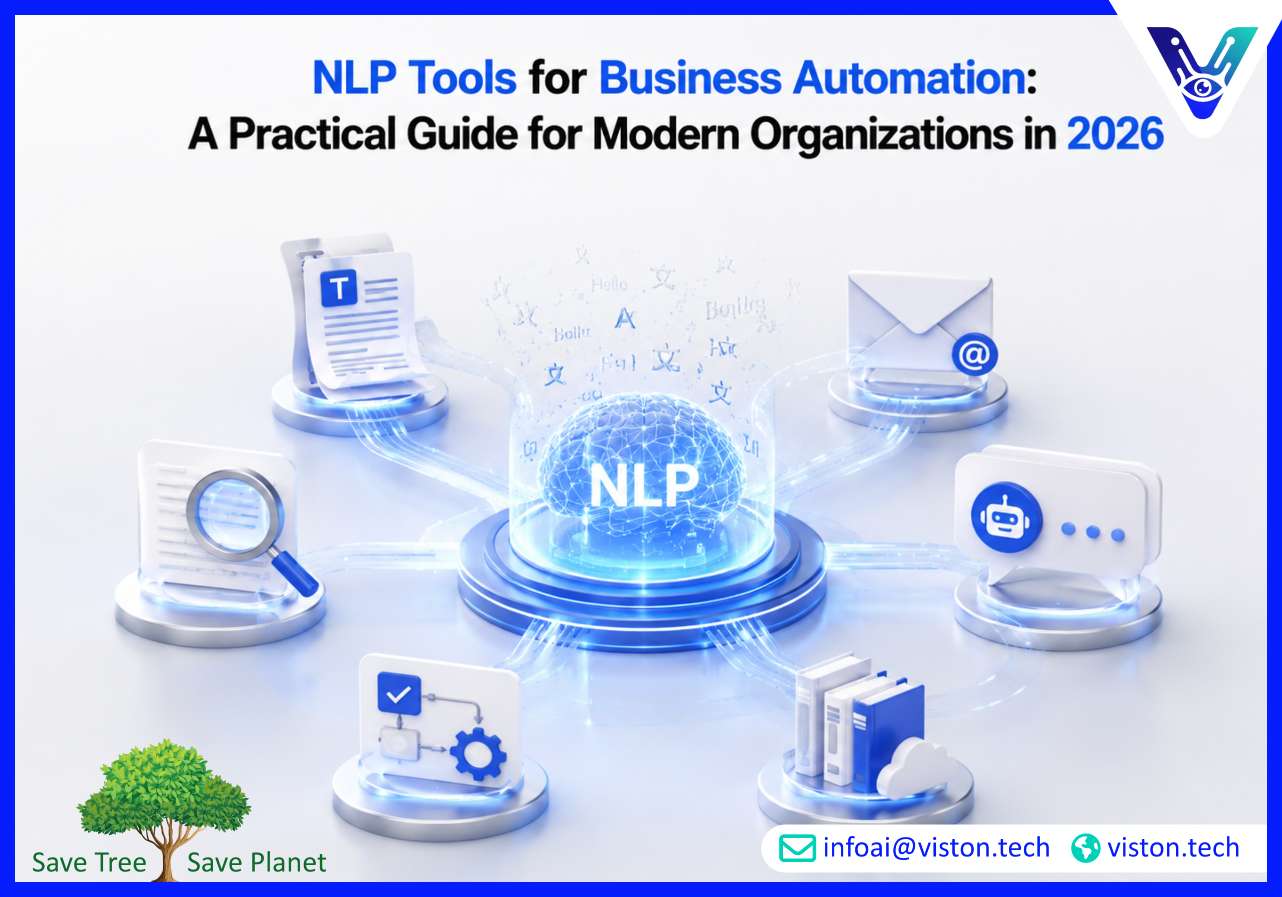
NLP Tools for Business Automation: A Practical Guide for Modern Organizations in 2026
Businesses are under constant pressure to improve efficiency, reduce manual workloads, and deliver faster customer and employee experiences. As artificial intelligence continues to mature, NLP tools for business automation have become essential for organizations looking to streamline operations, improve decision-making, and unlock value from large volumes of unstructured data.
What Are NLP Tools for Business Automation?
Natural Language Processing (NLP) is a branch of artificial intelligence that enables software systems to understand, interpret, process, and generate human language. NLP tools for business automation use these capabilities to automate language-based tasks that traditionally required human intervention.These tools can analyze emails, process documents, classify support tickets, extract information from contracts, summarize content, power intelligent chatbots, and automate workflows involving text and communication data.In 2026, NLP has evolved beyond simple keyword matching. Modern NLP solutions leverage large language models, contextual understanding, sentiment analysis, entity recognition, semantic search, and conversational AI to automate increasingly complex business processes.
Common NLP Automation Capabilities
Document processing and analysis
Customer support automation
Intelligent chatbots and virtual assistants
Email classification and routing
Knowledge management automation
Sentiment analysis
Information extraction
Text summarization
Workflow automation
Voice-to-text processing
Multilingual communication support
Compliance monitoring
Why NLP Tools Matter for Business Automation in 2026
Organizations generate enormous amounts of unstructured data every day through emails, customer conversations, support tickets, reports, contracts, surveys, and internal communications.Traditional automation systems struggle to interpret this information because it is not stored in structured formats. NLP bridges this gap by allowing software to understand language in a way that supports automation and decision-making.Businesses increasingly adopt NLP solutions to address challenges such as:
High operational workloads
Slow response times
Information silos
Manual document handling
Customer service bottlenecks
Knowledge retrieval inefficiencies
Data processing delays
Growing labor costs
By automating language-driven processes, organizations can improve productivity while allowing employees to focus on higher-value activities.
Key Business Benefits
Reduced manual processing time
Improved operational efficiency
Faster customer response rates
Enhanced employee productivity
Better data accessibility
Improved customer experiences
More consistent business processes
Scalable automation capabilities
Core NLP Tools Used for Business Automation
The most effective NLP automation strategies combine multiple technologies to address specific business requirements.
Intelligent Chatbots and Virtual Assistants
Modern NLP-powered chatbots can understand customer intent, answer questions, perform transactions, retrieve information, and escalate complex issues when necessary.Businesses use conversational AI to automate:
Customer support
Lead qualification
Appointment scheduling
Employee support requests
Knowledge base access
Order tracking
Document Processing Solutions
NLP tools can automatically extract relevant information from invoices, contracts, applications, reports, forms, and legal documents.This capability significantly reduces manual data entry while improving accuracy and processing speed.
Email and Communication Automation
Organizations receive thousands of emails and messages every day. NLP systems can automatically classify, prioritize, route, summarize, and respond to communications based on business rules and contextual understanding.This improves response times and reduces administrative workloads.
Semantic Search and Knowledge Management
Traditional keyword-based search systems often fail to deliver relevant information efficiently.NLP-powered semantic search enables employees and customers to find information based on meaning and context rather than exact keyword matches.This is particularly valuable for large organizations with extensive documentation and knowledge repositories.
Text Analytics and Sentiment Analysis
NLP tools help organizations understand customer opinions, employee feedback, survey responses, and social conversations.These insights support better decision-making, customer experience improvements, and proactive issue management.
How Businesses Successfully Implement NLP Automation
Successful NLP adoption requires more than selecting technology. Organizations must align automation initiatives with operational objectives and measurable business outcomes.
Identify High-Impact Processes
The best automation opportunities often involve repetitive, language-intensive tasks that consume significant time and resources.Examples include:
Customer service inquiries
Document reviews
Email handling
Internal support requests
Compliance monitoring
Data extraction workflows
Prepare Quality Data Sources
NLP systems perform best when trained and integrated with accurate, well-organized data.Organizations should evaluate:
Knowledge bases
Historical communications
Business documents
Operational workflows
Data governance policies
Integrate with Existing Systems
Business automation becomes significantly more valuable when NLP solutions connect with existing technology ecosystems.Common integrations include:
CRM platforms
ERP systems
Helpdesk software
Document management systems
Business intelligence platforms
Collaboration tools
Establish Governance and Security Controls
As NLP systems increasingly process sensitive information, organizations must implement appropriate governance frameworks.Key considerations include:
Data privacy compliance
Access controls
Audit logging
Model transparency
Data retention policies
Responsible AI practices
Security and compliance are particularly important in industries handling confidential customer, financial, legal, or healthcare information.
Industry Applications of NLP Business Automation
NLP automation delivers value across virtually every sector by improving efficiency and reducing manual workloads.
Customer Service Operations
Organizations automate support ticket classification, customer inquiries, chatbot interactions, and knowledge retrieval processes.
Financial Services
NLP supports document analysis, compliance monitoring, fraud detection support, customer communication automation, and regulatory reporting workflows.
Healthcare Administration
Healthcare providers use NLP to automate documentation processing, patient communication workflows, appointment management, and medical record analysis.
Legal and Compliance Teams
Legal professionals increasingly use NLP tools for contract analysis, clause extraction, document review, and compliance monitoring.
Human Resources
HR teams automate candidate screening, employee support requests, policy retrieval, onboarding assistance, and feedback analysis.
How Viston AI Helps Businesses Implement NLP Automation Solutions
As organizations increasingly seek scalable automation capabilities, implementing NLP effectively requires more than deploying standalone AI tools. Successful outcomes depend on aligning natural language processing technology with real business processes, operational objectives, system integrations, and governance requirements.Viston AI specializes in Natural Language Processing Solutions that help businesses automate language-driven workflows across customer engagement, document management, knowledge retrieval, communication processing, and operational support functions.By combining NLP technologies with automation frameworks, API integrations, conversational AI capabilities, and business workflow optimization, organizations can build solutions that deliver measurable efficiency gains while maintaining accuracy, security, and scalability.Whether the objective is automating customer interactions, improving information accessibility, reducing administrative workloads, or creating intelligent business workflows, a structured NLP implementation strategy helps organizations maximize long-term value from AI investments.As business automation continues to evolve in 2026, companies increasingly benefit from NLP solutions that are designed around practical operational requirements rather than isolated technology deployments.
Frequently Asked Questions
What are NLP tools for business automation?
NLP tools use artificial intelligence to understand and process human language, enabling businesses to automate tasks such as document processing, customer support, communication management, and information retrieval.
How do NLP solutions improve operational efficiency?
NLP solutions reduce manual workloads by automating language-based processes, improving response times, accelerating document handling, and enabling faster access to business information.
Can NLP tools integrate with existing business systems?
Yes. Modern NLP platforms commonly integrate with CRM systems, ERP software, helpdesk platforms, knowledge bases, communication tools, and workflow automation systems.
Are NLP automation solutions suitable for small and large businesses?
Yes. NLP solutions can be scaled to support startups, mid-sized organizations, and enterprise environments depending on automation requirements and operational complexity.
How can Viston AI support NLP automation initiatives?
Viston AI provides Natural Language Processing Solutions that help businesses automate workflows, improve information processing, integrate AI capabilities with existing systems, and create scalable automation strategies aligned with operational goals.
Conclusion
NLP tools for business automation have become a critical component of modern digital transformation strategies. By enabling systems to understand and process human language, organizations can automate complex workflows, improve efficiency, enhance customer experiences, and unlock greater value from business data. As automation requirements continue to expand in 2026, Natural Language Processing Solutions provide a practical foundation for scalable, intelligent operations. Businesses seeking long-term automation success should focus on solutions that combine strong NLP capabilities, reliable integrations, governance controls, and measurable business outcomes. For organizations pursuing these goals, Viston AI offers specialized expertise in building NLP-driven automation solutions that support sustainable business growth.