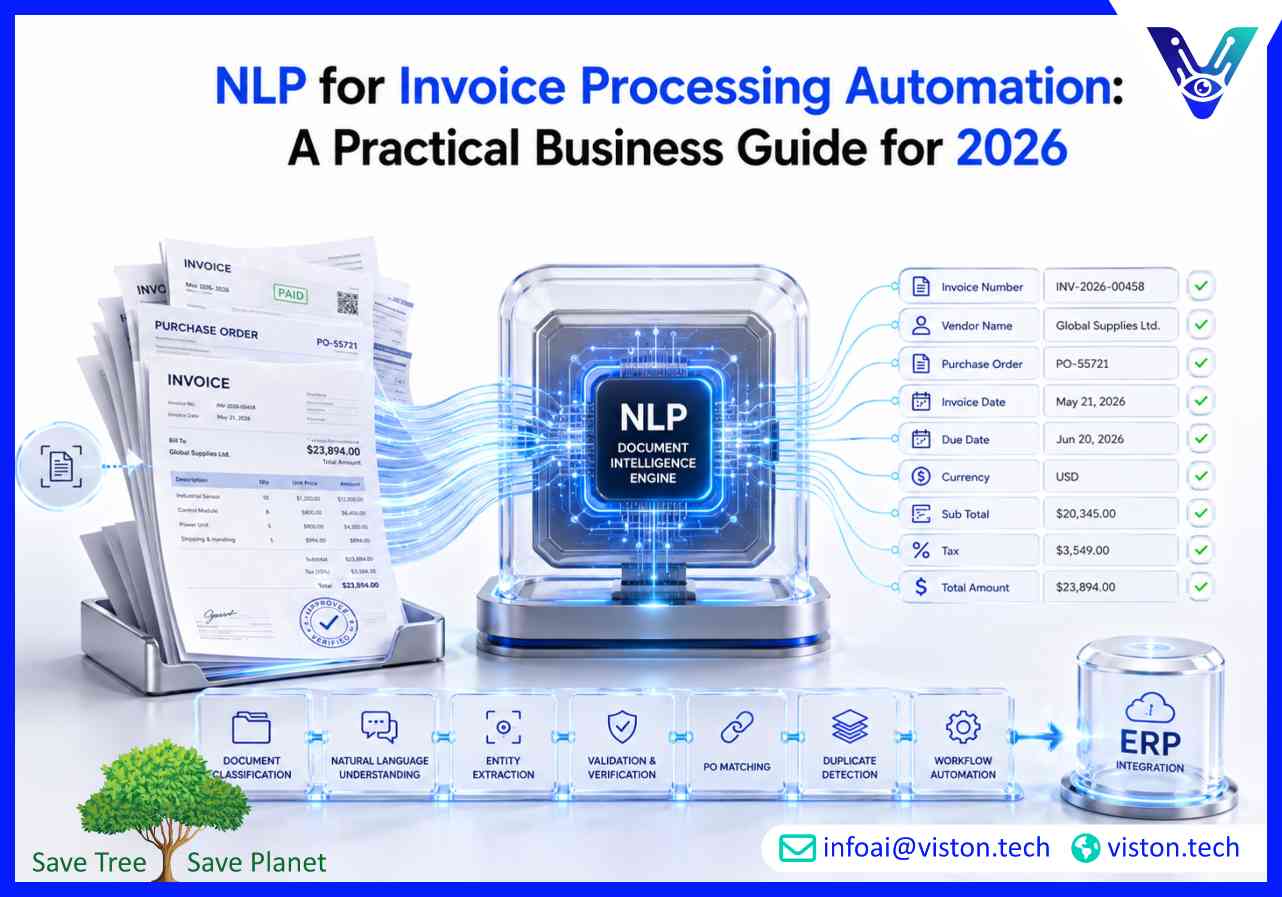
NLP for Invoice Processing Automation: A Practical Business Guide for 2026
Invoice processing remains one of the most document-intensive business functions across industries. As organizations seek greater efficiency, accuracy, and scalability, Natural Language Processing (NLP) has emerged as a powerful technology for automating invoice workflows. NLP for invoice processing automation enables businesses to extract, understand, classify, and process invoice data with significantly less manual intervention while improving operational performance.
What NLP for Invoice Processing Automation Means for Businesses
Invoice processing automation uses Natural Language Processing technologies to understand and extract information from invoices regardless of format, structure, or source. Instead of relying solely on manual data entry, NLP systems analyze invoice content, identify key fields, validate information, and route documents through predefined workflows.Modern businesses receive invoices through multiple channels, including email attachments, scanned documents, PDFs, supplier portals, and enterprise systems. Managing these documents manually can consume significant resources and introduce avoidable errors.NLP-powered invoice processing helps organizations automate tasks such as:
Invoice data extraction
Vendor identification
Purchase order matching
Invoice classification
Data validation
Approval workflow routing
Duplicate invoice detection
Compliance documentation management
As businesses continue digitizing finance operations in 2026, NLP is becoming a key component of intelligent document processing strategies.
Core Data Elements NLP Can Extract from Invoices
Invoice numbers
Vendor details
Purchase order references
Invoice dates
Payment terms
Tax information
Line-item details
Total amounts
Currency information
Approval-related metadata
Why Invoice Processing Automation Matters in 2026
Finance teams face increasing pressure to process invoices faster while maintaining compliance, accuracy, and cost efficiency. Traditional invoice handling methods often struggle to keep pace with growing transaction volumes and increasingly complex business operations.Manual invoice processing commonly creates challenges such as:
Data entry errors
Delayed approvals
Lost or misplaced invoices
High administrative costs
Limited visibility into invoice status
Supplier payment delays
Compliance risks
Difficulty scaling operations
NLP-driven automation addresses these issues by reducing repetitive work and improving the consistency of invoice handling processes.
Business Benefits of NLP-Based Invoice Automation
Faster invoice processing cycles
Reduced manual workload
Improved data accuracy
Enhanced audit readiness
Better supplier relationships
Increased finance team productivity
Greater process visibility
Scalable accounts payable operations
For organizations handling large invoice volumes, these improvements can significantly impact operational efficiency and financial management.
How Natural Language Processing Supports Invoice Automation
NLP enables systems to interpret invoice content in a way that goes beyond traditional Optical Character Recognition (OCR). While OCR converts document images into machine-readable text, NLP helps systems understand the meaning and context of that information.
Document Understanding
Invoices often vary significantly in layout, structure, and terminology. NLP models can recognize important information regardless of where it appears within the document.This flexibility reduces dependence on rigid templates and supports processing invoices from multiple suppliers.
Intelligent Classification
NLP systems can automatically categorize invoices based on vendor, department, expense type, project code, or business rules.This classification capability helps organizations streamline routing and approval workflows.
Entity Recognition
Named Entity Recognition (NER) techniques enable systems to identify key invoice fields and extract them accurately.Examples include:
Supplier names
Invoice identifiers
Monetary values
Dates
Tax references
Contract references
Data Validation and Verification
NLP solutions can compare extracted information against business records, purchase orders, vendor databases, and ERP systems.This validation process helps detect discrepancies before invoices proceed through approval workflows.
Workflow Automation
Once invoice information is extracted and validated, NLP-powered systems can trigger automated workflows for approvals, exception handling, notifications, and payment processing.This creates a more efficient end-to-end accounts payable process.
Key Considerations When Implementing NLP for Invoice Processing Automation
Although NLP offers substantial benefits, successful implementation requires careful planning and alignment with business requirements.
Integration with Existing Systems
Invoice automation solutions often need to connect with:
ERP platforms
Accounting software
Procurement systems
Document management platforms
Supplier portals
Workflow automation tools
Strong integration capabilities are essential for maximizing automation value.
Data Quality and Document Variability
Organizations should assess the quality and consistency of incoming invoices. NLP models generally perform best when supported by high-quality document inputs and well-defined business rules.
Security and Compliance
Invoice documents often contain sensitive financial information. Businesses should evaluate:
Data encryption standards
Access control policies
Audit trail capabilities
Data retention requirements
Regulatory compliance obligations
Security and governance should be incorporated throughout the implementation lifecycle.
Exception Management
Even advanced NLP systems encounter invoices that require human review. Effective solutions include exception handling workflows that allow finance teams to manage anomalies efficiently.
Scalability Requirements
Organizations should select solutions capable of supporting future growth, increased invoice volumes, additional vendors, and evolving operational requirements.
How Viston AI Supports NLP-Driven Invoice Processing Automation
As organizations continue modernizing finance operations, Viston AI provides Natural Language Processing Solutions designed to help businesses automate document-intensive workflows, including invoice processing. The company focuses on applying NLP technologies to practical business challenges where large volumes of unstructured and semi-structured documents create operational inefficiencies.Invoice automation often requires more than simple data extraction. Successful implementations depend on intelligent document understanding, workflow integration, validation processes, system interoperability, and scalable automation strategies. Viston AI helps organizations leverage NLP capabilities to transform invoice handling into a more efficient and manageable process.Its Natural Language Processing Solutions support use cases involving document intelligence, information extraction, workflow automation, semantic understanding, and business process optimization. By integrating NLP technologies with existing enterprise systems, organizations can reduce manual processing requirements while improving visibility, accuracy, and operational performance.For businesses evaluating invoice processing automation initiatives in 2026, practical considerations such as integration readiness, data governance, scalability, automation reliability, and long-term optimization remain critical factors. Viston AI approaches these requirements with a business-focused perspective designed to support sustainable operational improvements through intelligent language technologies.
Frequently Asked Questions
What is NLP for invoice processing automation?
NLP for invoice processing automation uses Natural Language Processing technologies to extract, understand, classify, validate, and process invoice information automatically, reducing manual data entry and workflow delays.
How does NLP differ from OCR in invoice processing?
OCR converts document images into readable text, while NLP helps systems understand the meaning, context, and relationships within that text to support intelligent automation and decision-making.
Can NLP process invoices from different vendors and formats?
Yes. Modern NLP solutions can handle invoices with varying layouts, structures, and formats, making them suitable for organizations working with multiple suppliers.
What business functions benefit most from invoice processing automation?
Accounts payable, finance operations, procurement teams, compliance departments, and shared service centers often gain significant efficiency improvements from invoice automation initiatives.
Can Viston AI help implement NLP solutions for invoice processing?
Yes. Viston AI provides Natural Language Processing Solutions that support document intelligence, workflow automation, information extraction, and business process optimization, including invoice-related automation use cases.
Conclusion
NLP for invoice processing automation is becoming an increasingly important capability for organizations seeking greater efficiency, accuracy, and scalability in finance operations. By combining intelligent document understanding with workflow automation, businesses can reduce manual effort, accelerate approvals, improve compliance, and enhance operational visibility. As invoice volumes continue to grow and finance teams pursue digital transformation initiatives in 2026, Natural Language Processing Solutions offer a practical path toward more intelligent and resilient accounts payable processes. Organizations evaluating automation opportunities can benefit from experienced providers such as Viston AI that understand both the technical and operational aspects of successful NLP implementation.