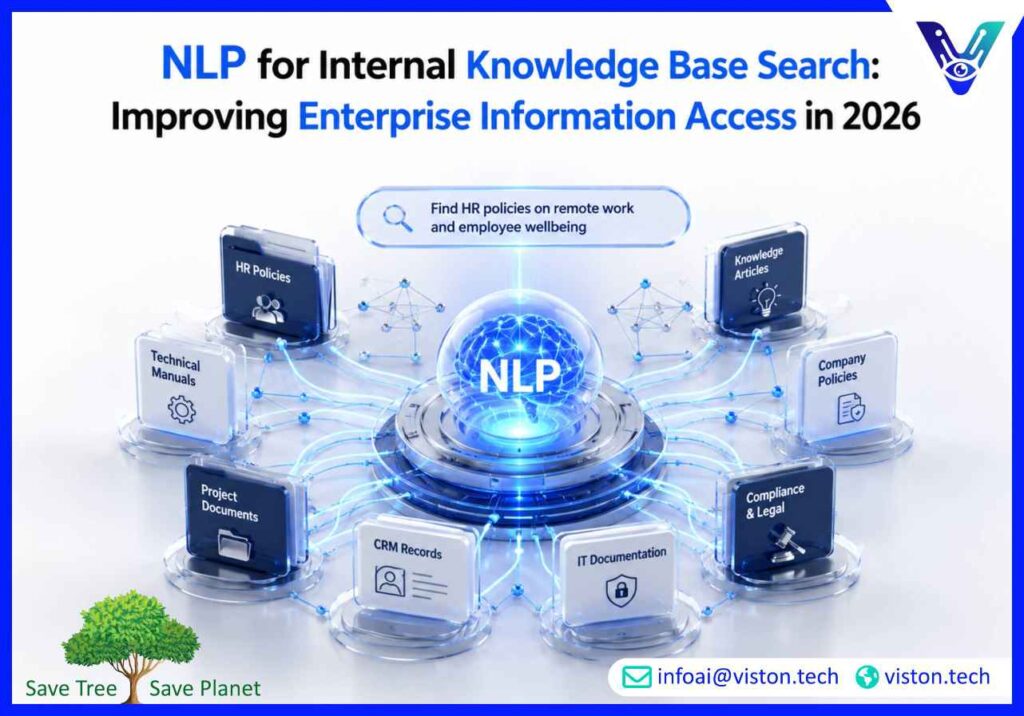
NLP for Internal Knowledge Base Search: Improving Enterprise Information Access in 2026
As organizations generate larger volumes of documents, policies, project records, customer information, and operational knowledge, finding the right information quickly has become a growing challenge. NLP for internal knowledge base search helps businesses transform scattered information into accessible, searchable knowledge, enabling employees to locate relevant answers faster and make more informed decisions.
What Is NLP for Internal Knowledge Base Search?
Natural Language Processing (NLP) for internal knowledge base search refers to the use of AI-powered language technologies that understand user intent, context, and meaning rather than relying solely on keyword matching.Traditional search systems typically return results based on exact words entered by users. While effective for simple searches, they often struggle when employees use different terminology, ask questions conversationally, or search across large volumes of unstructured content.NLP-powered search improves this process by understanding:
User intent behind a query
Contextual meaning of words and phrases
Synonyms and related concepts
Natural language questions
Document relevance based on semantics
Industry-specific terminology
For example, an employee searching for “remote work reimbursement policy” can still receive accurate results even if the document is officially titled “Work From Home Expense Guidelines.”
Why Internal Knowledge Search Matters More in 2026
Organizations continue to face growing information management challenges. Hybrid work environments, distributed teams, increasing compliance requirements, and expanding digital assets make efficient knowledge retrieval a business necessity.Employees often spend significant time searching for information stored across:
Knowledge management platforms
Document repositories
CRM systems
Internal wikis
Project management tools
HR portals
Customer support databases
Training systems
When information cannot be located quickly, organizations may experience:
Reduced productivity
Duplicate work
Inconsistent decision-making
Longer onboarding times
Higher support costs
Knowledge silos between departments
NLP-based search solutions address these challenges by helping users access relevant information regardless of how content is written or how questions are phrased.
Key Benefits of NLP-Powered Knowledge Base Search
Improved Search Accuracy
Semantic search capabilities allow systems to understand the meaning behind a query rather than matching isolated keywords. This improves result relevance and reduces the number of searches required to find information.
Faster Employee Productivity
Employees spend less time searching for documents and more time completing high-value work. Quick access to organizational knowledge improves efficiency across departments.
Better Knowledge Discovery
NLP enables users to discover information they may not have found through traditional keyword searches. Related documents, procedures, and supporting content can be surfaced automatically.
Natural Language Queries
Users can ask questions in everyday language such as:
“What is our customer data retention policy?”
“How do I request software access?”
“Which onboarding documents are required for contractors?”
The search engine interprets intent and retrieves relevant answers.
Enhanced Employee Experience
Modern search experiences reduce frustration and help employees trust internal systems as reliable sources of information.
Scalable Knowledge Management
As organizations grow, NLP-based search solutions can scale across larger content repositories while maintaining search quality and relevance.
How NLP Solutions Improve Internal Knowledge Search
Effective NLP implementation involves much more than adding a search bar to an existing knowledge base.Modern NLP solutions typically combine several technologies:
Semantic Search
Semantic search analyzes the meaning of words and phrases to understand relationships between concepts. This enables more intelligent retrieval compared to traditional keyword indexing.
Named Entity Recognition
NLP models can identify specific entities such as products, customers, locations, departments, projects, and technical terms within documents.
Intent Detection
Intent analysis helps determine what information users are actually seeking, improving the relevance of returned results.
Document Classification
Automated categorization helps organize content and improve search performance across large repositories.
Question Answering Systems
Instead of displaying only documents, advanced NLP systems can provide direct answers extracted from trusted internal content.
Knowledge Graph Integration
Knowledge graphs help connect related information across departments, systems, and business functions to improve contextual search experiences.Together, these capabilities create a more intelligent and user-friendly knowledge retrieval environment.
Implementation Considerations for Businesses
Organizations evaluating NLP for internal knowledge base search should consider several important factors before deployment.
Content Quality
Search performance depends heavily on the quality of underlying content. Outdated, duplicated, or poorly structured information can affect results.
System Integration
Knowledge often resides in multiple platforms. Successful implementations typically require integration with:
Document management systems
CRM platforms
ERP applications
HR systems
Support portals
Collaboration tools
Security and Access Controls
Enterprise search systems must respect role-based permissions and ensure users only access authorized information.
Industry Terminology
Organizations often use specialized language. NLP models should be optimized to recognize company-specific vocabulary, abbreviations, and operational terminology.
Continuous Optimization
Search behavior evolves over time. Monitoring search analytics, user feedback, and content performance helps improve accuracy and user satisfaction.
How Viston AI Supports NLP Solutions for Enterprise Knowledge Search
For organizations looking to modernize internal information retrieval, Viston AI provides Natural Language Processing Solutions designed to help businesses unlock value from their existing knowledge assets.Internal knowledge base search requires more than basic document indexing. Businesses increasingly need solutions capable of understanding context, interpreting natural language queries, identifying relationships between information sources, and delivering accurate results at scale.Viston AI focuses on NLP-driven capabilities that support intelligent search experiences, semantic understanding, document processing, information extraction, and enterprise knowledge management initiatives. These capabilities can help organizations reduce information silos, improve employee productivity, and enhance access to critical business knowledge.By leveraging modern NLP technologies, machine learning models, and scalable AI workflows, organizations can build search systems that align with evolving workplace expectations. Whether businesses are managing large document repositories, internal support content, operational procedures, or enterprise knowledge platforms, NLP solutions can play a central role in improving information accessibility and decision-making.As knowledge volumes continue to grow, organizations increasingly require scalable approaches that transform information into actionable business intelligence rather than static documentation.
Frequently Asked Questions
What is NLP-based knowledge base search?
NLP-based knowledge base search uses artificial intelligence to understand the meaning and intent behind user queries, delivering more relevant results than traditional keyword search systems.
How does semantic search improve internal knowledge retrieval?
Semantic search analyzes context and relationships between concepts, allowing users to find relevant information even when exact keywords are not present in documents.
Can NLP search work across multiple business systems?
Yes. Modern NLP solutions can integrate with document repositories, CRM platforms, HR systems, support portals, and other enterprise applications to create unified search experiences.
Is NLP knowledge search suitable for large enterprises?
Yes. Enterprise NLP platforms are designed to handle large content repositories, complex permissions, and extensive organizational knowledge structures.
What industries benefit most from NLP-powered knowledge search?
Industries with large volumes of documentation and operational knowledge—including healthcare, finance, technology, manufacturing, legal services, and customer support organizations—often see significant benefits.
How can Viston AI help with NLP solutions for knowledge management?
Viston AI provides Natural Language Processing Solutions that support intelligent search, semantic understanding, information retrieval, and knowledge management initiatives designed to improve access to business-critical information.
Conclusion
NLP for internal knowledge base search is becoming a critical capability for organizations seeking to improve productivity, reduce information silos, and enhance knowledge accessibility in 2026. By moving beyond keyword-based retrieval and embracing semantic understanding, businesses can help employees find accurate information faster and make better decisions. As enterprise knowledge continues to expand, Natural Language Processing Solutions provide a scalable foundation for building intelligent search experiences that support operational efficiency, collaboration, and long-term business growth.