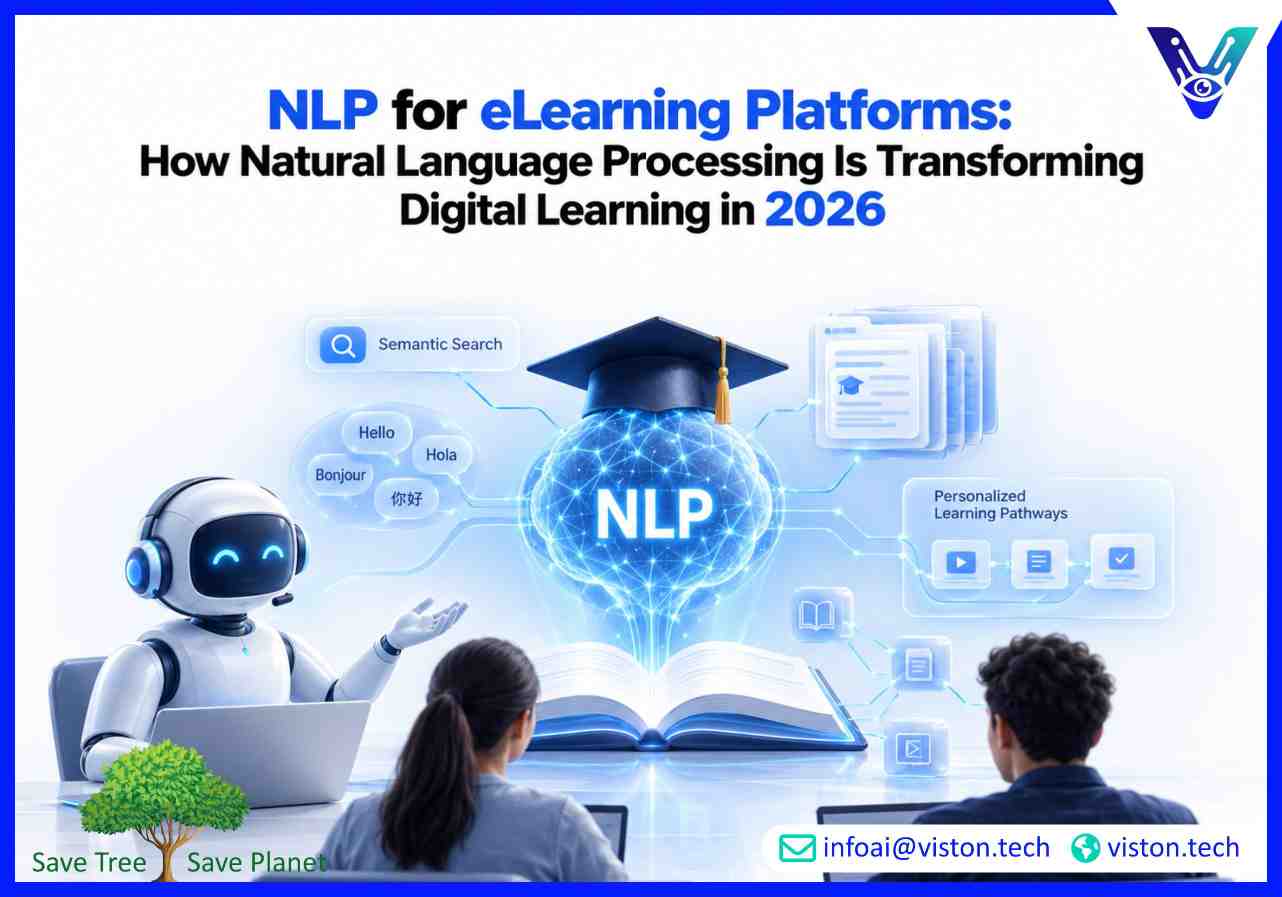
NLP for eLearning Platforms: How Natural Language Processing Is Transforming Digital Learning in 2026
As digital education continues to evolve, eLearning providers are under increasing pressure to deliver personalized, scalable, and engaging learning experiences. Natural Language Processing (NLP) has emerged as a powerful technology that helps eLearning platforms better understand learner interactions, automate educational workflows, and improve learning outcomes. In 2026, NLP is becoming a strategic capability for organizations looking to enhance both learner satisfaction and operational efficiency.
Why NLP Matters for eLearning Platforms in 2026
Natural Language Processing enables software systems to understand, analyze, interpret, and generate human language. For eLearning platforms, this capability creates opportunities to deliver more intelligent learning experiences while reducing administrative workloads.Traditional learning management systems often struggle to provide personalized support at scale. NLP helps bridge this gap by enabling platforms to process learner questions, analyze learning behavior, automate content interactions, and provide contextual assistance in real time.As educational institutions, corporate training providers, certification organizations, and online learning businesses expand their digital offerings, NLP has become increasingly important for supporting diverse learner needs across multiple learning environments.
Key Drivers Behind NLP Adoption in eLearning
Growing demand for personalized learning experiences
Increasing volumes of educational content
Need for scalable learner support
Expansion of remote and hybrid learning models
Demand for multilingual learning environments
Focus on learner engagement and retention
Need for data-driven educational insights
How NLP Improves Learning Experiences
One of the most significant benefits of NLP in eLearning platforms is its ability to make learning more interactive and personalized.
Intelligent Learning Assistants
NLP-powered virtual learning assistants can answer student questions, explain concepts, recommend resources, and guide learners through course materials. Unlike traditional FAQ systems, these assistants can understand natural language queries and provide contextually relevant responses.This allows learners to receive immediate support without waiting for instructors or support teams.
Personalized Content Recommendations
By analyzing learner interactions, assessments, and content consumption patterns, NLP systems can recommend relevant courses, modules, articles, videos, and exercises.Personalized recommendations help learners progress more efficiently while increasing engagement with educational content.
Natural Language Search
Many eLearning platforms contain thousands of learning resources. NLP-powered semantic search allows users to find information using conversational language rather than exact keyword matches.For example, a learner searching for “how to improve project management communication” can receive relevant content even if those exact words do not appear in course titles.
Automated Learner Support
NLP chatbots can assist learners with:
Course navigation
Enrollment questions
Assignment deadlines
Technical support requests
Certification information
Learning pathway recommendations
This improves learner satisfaction while reducing support team workloads.
Practical NLP Use Cases for eLearning Platforms
NLP technologies can be applied across various educational and training workflows.
Automated Content Classification
Educational organizations often manage large content libraries. NLP systems can automatically categorize courses, lessons, documents, assessments, and learning materials based on subject matter and learning objectives.This improves content organization and discoverability.
Assessment and Feedback Analysis
NLP can analyze written responses, discussion posts, surveys, and learner feedback to identify trends, measure sentiment, and uncover learning challenges.Instructors and administrators gain deeper insights into learner experiences without manually reviewing large volumes of text.
Multilingual Learning Support
Global eLearning providers increasingly serve learners across different languages and regions. NLP enables translation, language detection, multilingual search, and localized learner support.This helps organizations expand educational access while maintaining consistent learning experiences.
Content Summarization
Learners often need quick access to key concepts. NLP-powered summarization tools can generate concise summaries of lengthy lessons, research materials, and training documents.This improves knowledge retention and reduces information overload.
Discussion Forum Intelligence
Many online learning environments rely heavily on community discussions. NLP systems can monitor conversations, identify recurring questions, surface important topics, and help instructors engage more effectively with learners.
Challenges eLearning Organizations Must Consider
While NLP offers substantial benefits, successful implementation requires careful planning and execution.
Content Quality and Data Preparation
NLP systems perform best when trained on high-quality educational content and well-structured learning data. Organizations must ensure content consistency and proper metadata management.
Context Understanding
Educational content often contains specialized terminology and subject-specific language. NLP solutions should be customized to understand domain-specific concepts and learning contexts.
Privacy and Data Security
eLearning platforms frequently process learner data, assessment results, and personal information. Security, privacy controls, and responsible AI governance remain essential considerations in 2026.
Integration with Existing Systems
NLP capabilities must often integrate with:
Learning Management Systems (LMS)
Student Information Systems (SIS)
Content Management Systems
Assessment Platforms
CRM Solutions
Analytics Platforms
Successful implementation depends on seamless interoperability between these systems.
How Businesses Can Successfully Implement NLP for eLearning
Organizations considering NLP adoption should focus on business objectives rather than technology alone.
Identify High-Value Use Cases
Start by identifying areas where NLP can deliver measurable value, such as learner support automation, content discovery, assessment analysis, or personalized learning.
Build Scalable Architecture
As learner volumes grow, NLP systems should be capable of supporting increasing interactions without compromising performance.
Measure Educational Outcomes
Success should be evaluated through metrics such as:
Learner engagement
Course completion rates
Support ticket reduction
Knowledge retention
Learner satisfaction
Operational efficiency improvements
Continuously Optimize Models
NLP systems improve when organizations regularly refine training data, monitor performance, and adapt workflows based on learner behavior and educational objectives.
How Viston AI Supports NLP Solutions for eLearning Platforms
As educational technology continues to advance, Viston AI provides Natural Language Processing Solutions designed to help organizations create more intelligent, scalable, and learner-focused digital education environments.Its NLP capabilities support a wide range of eLearning applications, including conversational AI, semantic search, intelligent content discovery, automated learner support, document processing, multilingual communication, and learning analytics. By integrating NLP technologies with existing educational systems and workflows, organizations can improve learner engagement while streamlining operational processes.For eLearning providers, training companies, certification organizations, and educational institutions, successful NLP implementation requires more than deploying AI tools. It involves aligning language technologies with learning objectives, content strategies, user experiences, and business goals. Viston AI focuses on practical Natural Language Processing Solutions that help organizations build sustainable and scalable learning ecosystems capable of supporting evolving learner expectations in 2026 and beyond.
Frequently Asked Questions
What is NLP in eLearning platforms?
NLP in eLearning refers to the use of Natural Language Processing technologies to understand, analyze, and generate human language within educational systems. It supports personalized learning, learner assistance, content discovery, and automation.
How does NLP improve online learning experiences?
NLP improves learning experiences by enabling intelligent search, personalized recommendations, automated support, multilingual capabilities, and conversational learning assistance.
Can NLP help reduce learner support workloads?
Yes. NLP-powered chatbots and virtual assistants can handle common learner questions, course navigation support, enrollment inquiries, and administrative requests, reducing manual support demands.
Is NLP suitable for corporate training platforms?
Absolutely. Corporate training providers use NLP for knowledge management, employee learning support, content recommendations, training analytics, and automated learner engagement.
Can Viston AI help implement NLP solutions for eLearning platforms?
Yes. Viston AI provides Natural Language Processing Solutions that support conversational AI, semantic search, learner support automation, multilingual learning environments, content intelligence, and educational workflow optimization.
Conclusion
NLP for eLearning platforms is rapidly becoming a core capability for organizations seeking to deliver more personalized, efficient, and scalable digital learning experiences. From intelligent learner support and semantic search to multilingual education and content automation, Natural Language Processing enables educational providers to better serve learners while improving operational performance. As digital learning continues to expand in 2026, organizations that invest in effective Natural Language Processing Solutions will be better positioned to enhance learner engagement, improve educational outcomes, and support long-term growth. For businesses looking to implement these capabilities, Viston AI offers practical expertise in developing NLP-driven learning solutions aligned with modern educational needs.