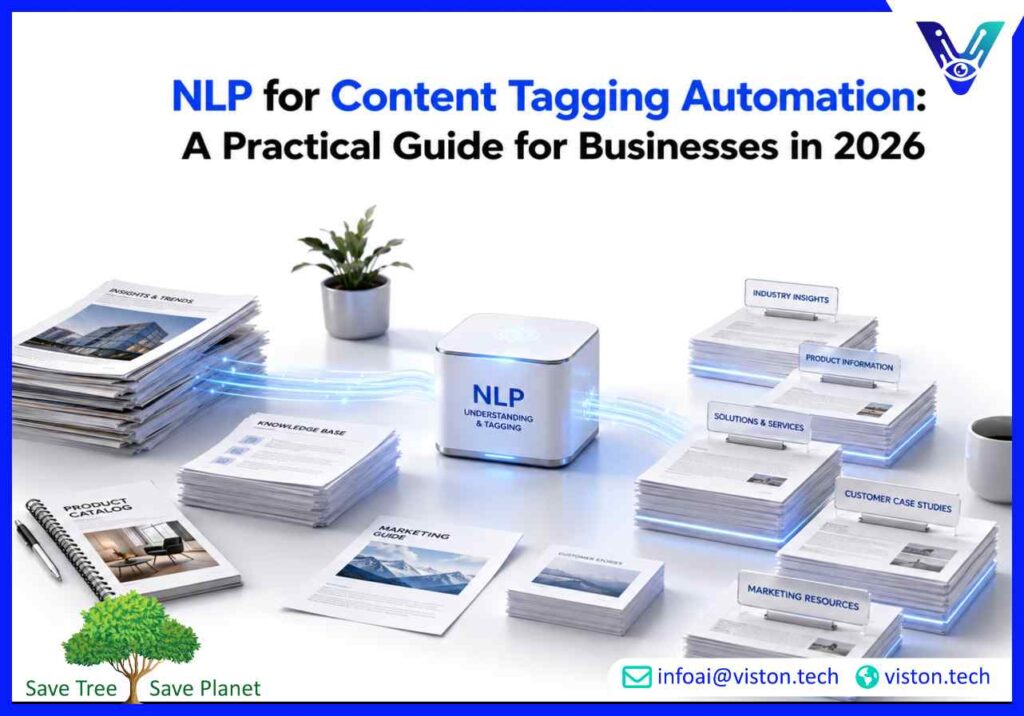
NLP for Content Tagging Automation: A Practical Guide for Businesses in 2026
As digital content volumes continue to grow across websites, knowledge bases, ecommerce platforms, media portals, and enterprise systems, organizing information efficiently has become a major business challenge. NLP for content tagging automation helps organizations classify, categorize, and enrich content automatically, improving discoverability, operational efficiency, and data management at scale.
What Is NLP for Content Tagging Automation?
Content tagging automation uses Natural Language Processing (NLP) technologies to analyze text and automatically assign relevant tags, categories, topics, keywords, entities, and metadata to digital content.Instead of relying on manual tagging processes, NLP systems understand the context and meaning of content to generate accurate classifications. This enables businesses to organize large volumes of information more efficiently while maintaining consistency across content repositories.Common content types processed through NLP tagging automation include:
Blog articles
Knowledge base documents
Product descriptions
Customer support content
Research reports
Legal documents
Training materials
News articles
Internal documentation
As organizations increasingly depend on content-driven operations, automated tagging has become a critical component of content management strategies in 2026.
Why Content Tagging Automation Matters in 2026
Businesses generate and manage significantly more content today than they did just a few years ago. Manual categorization methods often struggle to keep pace with growing content volumes, leading to inconsistent metadata, poor search experiences, and reduced operational efficiency.NLP-powered content tagging addresses these challenges by providing scalable and intelligent classification capabilities.
Improved Content Discoverability
Accurate tags help users locate relevant information quickly through search systems, recommendation engines, and content libraries. This improves user experience while reducing time spent searching for information.
Enhanced Knowledge Management
Organizations with large internal knowledge repositories can use automated tagging to structure information effectively and improve employee access to critical resources.
Consistency Across Large Content Libraries
Human tagging practices often vary between teams and departments. NLP automation applies standardized tagging rules, ensuring consistency across thousands or even millions of content assets.
Operational Efficiency
Automating content classification reduces manual workload and enables content teams to focus on higher-value activities such as content creation, optimization, and strategy.
Better Analytics and Insights
Structured metadata allows organizations to analyze content performance more effectively and identify trends across categories, topics, and user interests.
How NLP Content Tagging Automation Works
Modern NLP systems use multiple language understanding techniques to determine the most relevant tags for a piece of content.
Text Analysis and Processing
The system first processes the content by analyzing words, phrases, sentence structures, and contextual relationships.This stage often includes:
Tokenization
Language detection
Text normalization
Part-of-speech tagging
Semantic analysis
Entity Recognition
NLP models identify key entities such as:
Organizations
Products
People
Locations
Technologies
Industry-specific terminology
These entities often become valuable metadata tags that improve content organization.
Topic Classification
Machine learning models evaluate the overall meaning of content and assign topic categories based on predefined taxonomies or custom business classifications.
Keyword Extraction
Relevant keywords and phrases are automatically identified and applied as metadata, improving content retrieval and search relevance.
Metadata Enrichment
Advanced systems generate additional attributes such as content themes, sentiment indicators, audience classifications, and subject matter relevance.
Business Use Cases for NLP Content Tagging Automation
Content tagging automation supports a wide range of operational and customer-facing applications across industries.
Knowledge Base Management
Organizations with extensive documentation repositories use NLP tagging to improve navigation, search performance, and self-service support experiences.Automatically tagged knowledge assets enable users to find answers faster while reducing support requests.
Content Marketing Operations
Marketing teams can automatically categorize blogs, articles, whitepapers, and resources based on topics, audience segments, industries, and buyer journeys.This improves content organization and enables more targeted content recommendations.
Ecommerce Catalog Management
Retail businesses use NLP to automatically classify products, assign attributes, and generate searchable metadata that improves product discovery and filtering.
Media and Publishing Platforms
Publishers often process thousands of content pieces daily. Automated tagging enables efficient categorization, recommendation systems, and content distribution workflows.
Enterprise Document Management
Businesses managing contracts, reports, policies, and operational documents can improve document retrieval through intelligent classification and metadata generation.
Customer Support Content Optimization
NLP tagging helps support teams organize FAQs, troubleshooting guides, and help center resources to improve customer self-service capabilities.
Key Considerations When Implementing NLP Content Tagging Solutions
Successful implementation requires more than deploying an NLP model. Businesses should evaluate several important factors before adopting content tagging automation.
Content Taxonomy Design
A well-structured taxonomy is essential for meaningful content classification. Organizations should define categories, tags, and metadata standards that align with business objectives and user needs.
Integration with Existing Systems
Content tagging solutions should integrate seamlessly with:
Content Management Systems (CMS)
Digital Asset Management platforms
Knowledge management systems
Enterprise search platforms
Customer support software
Document management systems
Industry-Specific Language Requirements
Generic NLP models may struggle with specialized terminology. Businesses often benefit from custom NLP configurations tailored to industry-specific content and vocabulary.
Scalability
Content volumes continue to grow rapidly. Organizations should select solutions capable of processing increasing amounts of content without compromising performance or accuracy.
Governance and Quality Control
Regular monitoring, model refinement, and taxonomy updates help maintain classification quality as content and business requirements evolve.
How Viston AI Supports NLP Content Tagging Automation
As organizations seek more efficient ways to manage growing content ecosystems, Viston AI delivers Natural Language Processing Solutions that help automate content classification, metadata generation, and information organization.Content tagging automation often requires more than basic keyword extraction. Effective implementation depends on semantic understanding, taxonomy alignment, workflow integration, search optimization, and scalable processing capabilities. Viston AI focuses on building NLP-driven solutions that connect language intelligence with practical business requirements.Its capabilities support organizations looking to automate content categorization across knowledge bases, digital content platforms, customer support systems, document repositories, and enterprise information environments. By integrating NLP technologies with existing workflows and business systems, organizations can improve content discoverability, reduce manual effort, and enhance operational efficiency.As content volumes continue to increase in 2026, businesses benefit from NLP solutions that provide consistent tagging, intelligent classification, and scalable content management capabilities that support both users and operational teams.
Frequently Asked Questions
What is content tagging automation?
Content tagging automation uses technologies such as Natural Language Processing to automatically assign categories, keywords, topics, and metadata to digital content without manual intervention.
How does NLP improve content tagging?
NLP enables systems to understand context, meaning, and relationships within content, resulting in more accurate and relevant tags than simple keyword-matching approaches.
Which industries benefit most from content tagging automation?
Industries including publishing, ecommerce, education, healthcare, legal services, technology, customer support, and enterprise knowledge management commonly benefit from automated content classification.
Can NLP tagging solutions integrate with existing content management systems?
Yes. Most modern NLP solutions can integrate with CMS platforms, document management systems, knowledge bases, search engines, and other business applications through APIs and workflow integrations.
Can Viston AI help implement NLP content tagging automation?
Yes. Viston AI provides Natural Language Processing Solutions that support automated content classification, metadata enrichment, semantic analysis, and content management optimization for organizations seeking scalable automation capabilities.
Conclusion
NLP for content tagging automation has become an essential capability for organizations managing large volumes of digital content in 2026. By automating classification, metadata generation, and content organization, businesses can improve discoverability, strengthen knowledge management, enhance user experiences, and reduce manual workloads. Successful implementation requires a combination of language intelligence, structured taxonomies, workflow integration, and scalable architecture. For organizations exploring Natural Language Processing Solutions, NLP-powered content tagging offers a practical path toward more efficient and intelligent content management. Viston AI helps businesses leverage these capabilities through NLP solutions designed to support long-term operational and content management objectives.