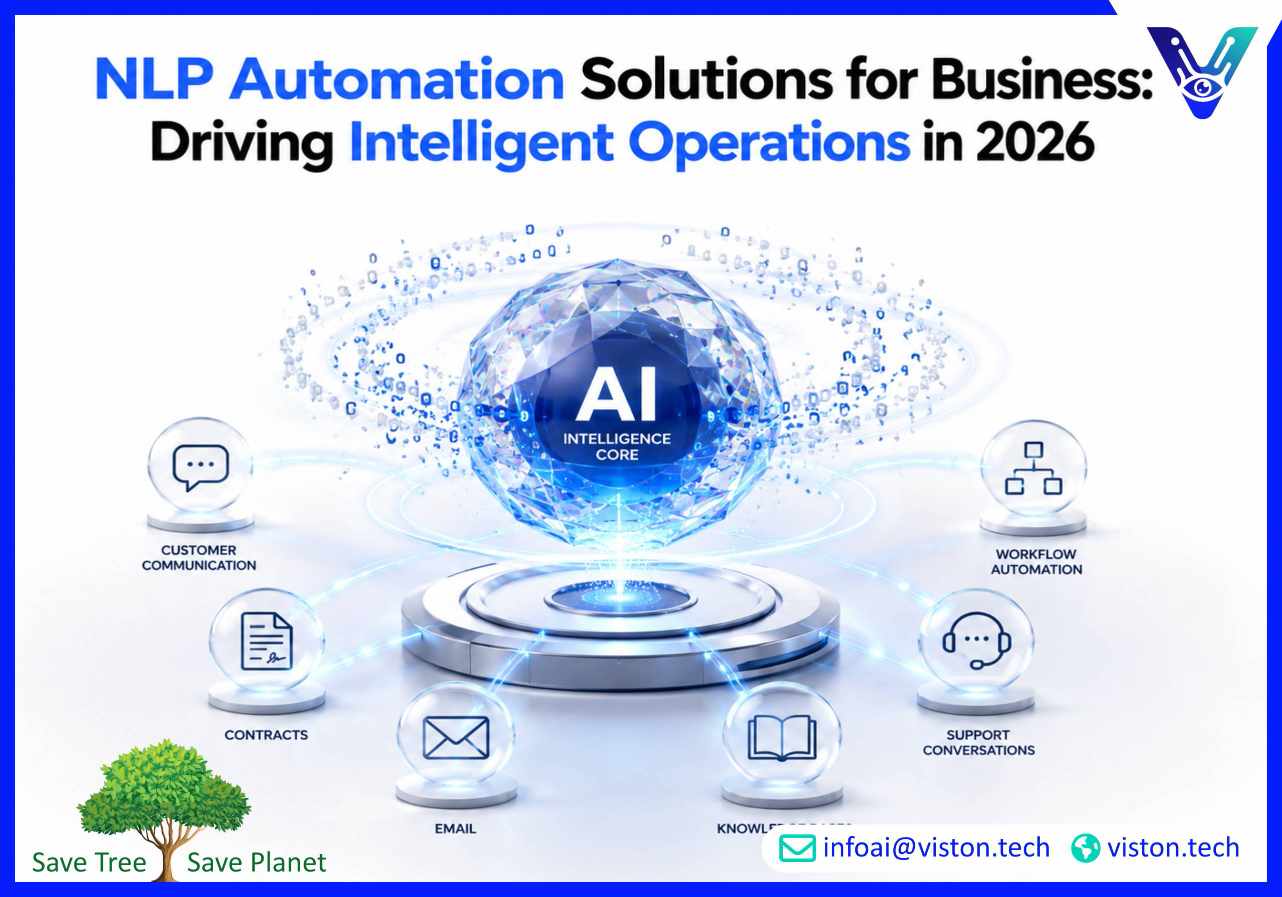
NLP Automation Solutions for Business: Driving Intelligent Operations in 2026
Businesses are under increasing pressure to improve efficiency, reduce manual workloads, and deliver faster customer and employee experiences. NLP automation solutions have emerged as a practical way to automate language-driven processes, enabling organizations to transform unstructured data into actionable insights while improving productivity across multiple business functions.
What Are NLP Automation Solutions for Business?
Natural Language Processing (NLP) automation solutions use artificial intelligence to understand, interpret, analyze, and generate human language. These solutions allow businesses to automate tasks that traditionally required manual review, communication, or data processing.Unlike conventional automation systems that depend on structured inputs, NLP-powered automation can process emails, support tickets, documents, customer inquiries, chat conversations, reports, contracts, and other text-based information.Common NLP automation applications include:
Customer support automation
Intelligent document processing
Email classification and routing
Sentiment analysis
Knowledge management
Chatbot and virtual assistant automation
Contract analysis
Workflow automation
Voice-to-text processing
Content categorization
As organizations continue investing in digital transformation initiatives, NLP automation has become an important component of scalable business operations.
Why NLP Automation Matters for Businesses in 2026
Modern organizations generate massive volumes of unstructured data every day. Customer communications, support requests, internal documents, reports, and operational records often contain valuable information that remains difficult to process manually.NLP automation solutions help businesses unlock this information while reducing operational complexity.
Managing Increasing Data Volumes
Businesses are collecting more text-based data than ever before. NLP systems can analyze large datasets in real time, helping organizations extract insights that would otherwise require significant manual effort.
Improving Operational Efficiency
Automating repetitive language-based tasks allows teams to focus on higher-value work. Instead of manually sorting emails or reviewing documents, employees can spend more time on strategic activities.
Enhancing Customer Experience
NLP-powered systems help businesses respond faster and more accurately to customer inquiries. Automated interactions can improve service availability while maintaining consistency across communication channels.
Supporting Better Decision-Making
Organizations can use NLP automation to identify trends, customer sentiment, emerging issues, and business opportunities hidden within large volumes of text data.
Key Business Use Cases for NLP Automation Solutions
NLP automation delivers value across multiple departments and industries. The most successful implementations focus on solving specific operational challenges.
Customer Support Automation
Support teams often manage thousands of customer inquiries across various channels. NLP solutions can automatically:
Classify support requests
Route tickets to appropriate teams
Suggest responses
Power AI chatbots
Identify urgent issues
Analyze customer satisfaction trends
This reduces response times while improving service consistency.
Document Processing and Information Extraction
Many businesses rely on documents containing valuable information that is difficult to process manually.NLP automation can extract:
Customer information
Contract terms
Invoice details
Compliance-related data
Financial information
Operational metrics
Automated extraction significantly improves processing speed and accuracy.
Email and Communication Management
Organizations often struggle with growing email volumes. NLP solutions can:
Categorize messages
Prioritize communications
Automate routing
Generate suggested replies
Detect sentiment and urgency
This helps teams manage communications more efficiently.
Knowledge Management Automation
Businesses frequently store valuable information across multiple systems. NLP technologies can organize and retrieve knowledge more effectively by understanding user intent rather than relying solely on keyword searches.
Compliance and Risk Monitoring
Organizations operating in regulated environments can use NLP to monitor communications, identify compliance concerns, detect policy violations, and support audit processes.
What Businesses Should Consider When Implementing NLP Automation Solutions
Successful NLP automation initiatives require more than deploying AI technology. Organizations must consider operational, technical, and governance factors to achieve meaningful business outcomes.
Data Quality and Accessibility
NLP systems perform best when trained on high-quality, relevant data. Businesses should evaluate data sources, consistency, accessibility, and governance practices before implementation.
Integration Requirements
NLP automation often needs to connect with existing business systems, including:
CRM platforms
ERP systems
Customer support software
Document management systems
Communication platforms
Business intelligence tools
Integration planning plays a significant role in long-term success.
Security and Privacy Considerations
Since NLP solutions frequently process sensitive business information, organizations should implement strong security controls, access management policies, and compliance frameworks.
Scalability and Performance
Businesses should evaluate whether an NLP solution can handle growing data volumes, increasing user demand, and future expansion requirements.
Continuous Optimization
Language evolves continuously. NLP models require ongoing monitoring, refinement, and retraining to maintain performance and relevance.
How NLP Automation Creates Competitive Advantages
Organizations that successfully implement NLP automation often gain operational advantages beyond cost savings.These advantages may include:
Faster decision-making
Improved customer engagement
Reduced manual processing
Enhanced workforce productivity
Greater operational visibility
Better scalability
More consistent business processes
As AI adoption accelerates in 2026, businesses increasingly view NLP automation as a strategic capability rather than a standalone technology project.The ability to understand and act upon language data at scale allows organizations to become more responsive, efficient, and data-driven.
How Viston AI Supports NLP Automation Initiatives
For businesses seeking practical Natural Language Processing solutions, Viston AI focuses on helping organizations automate language-driven workflows, improve operational efficiency, and unlock value from unstructured data.NLP automation projects often involve multiple components, including language understanding, workflow automation, data processing, system integrations, AI model implementation, and ongoing optimization. Effective solutions require a balance between technical capability and real-world business requirements.Viston AI develops NLP solutions designed to support business automation across customer service, document processing, knowledge management, communication workflows, and intelligent decision-support systems. By aligning NLP technologies with operational objectives, organizations can create scalable automation strategies that improve productivity while maintaining flexibility and control.As businesses continue expanding their AI capabilities, specialized NLP expertise can help ensure successful implementation, integration, governance, and long-term performance across evolving business environments.
Frequently Asked Questions
What are NLP automation solutions?
NLP automation solutions use artificial intelligence to understand and process human language, enabling businesses to automate communication, document processing, customer support, and various text-based workflows.
Which industries benefit most from NLP automation?
Industries including healthcare, finance, legal services, retail, manufacturing, technology, insurance, and customer service operations frequently benefit from NLP automation due to their large volumes of language-based data.
Can NLP automation integrate with existing business systems?
Yes. Modern NLP solutions can integrate with CRM platforms, ERP systems, support software, communication tools, document repositories, and analytics platforms through APIs and integration frameworks.
Is NLP automation suitable for small and medium-sized businesses?
Yes. Many NLP automation solutions can be scaled to match the needs of small, mid-sized, and enterprise organizations depending on operational requirements and implementation goals.
How can Viston AI help with NLP automation projects?
Viston AI provides Natural Language Processing solutions that help businesses automate language-based workflows, improve operational efficiency, integrate AI capabilities, and support long-term business automation strategies.
Conclusion
NLP automation solutions for business are becoming increasingly important as organizations seek smarter ways to manage information, improve customer experiences, and scale operations efficiently. By automating language-driven processes, businesses can reduce manual workloads, gain deeper insights from unstructured data, and improve overall operational performance. As AI adoption continues to expand in 2026, investing in effective Natural Language Processing solutions can provide significant long-term value. Organizations looking to implement scalable NLP automation strategies can benefit from working with experienced specialists such as Viston AI to align technology capabilities with practical business objectives.