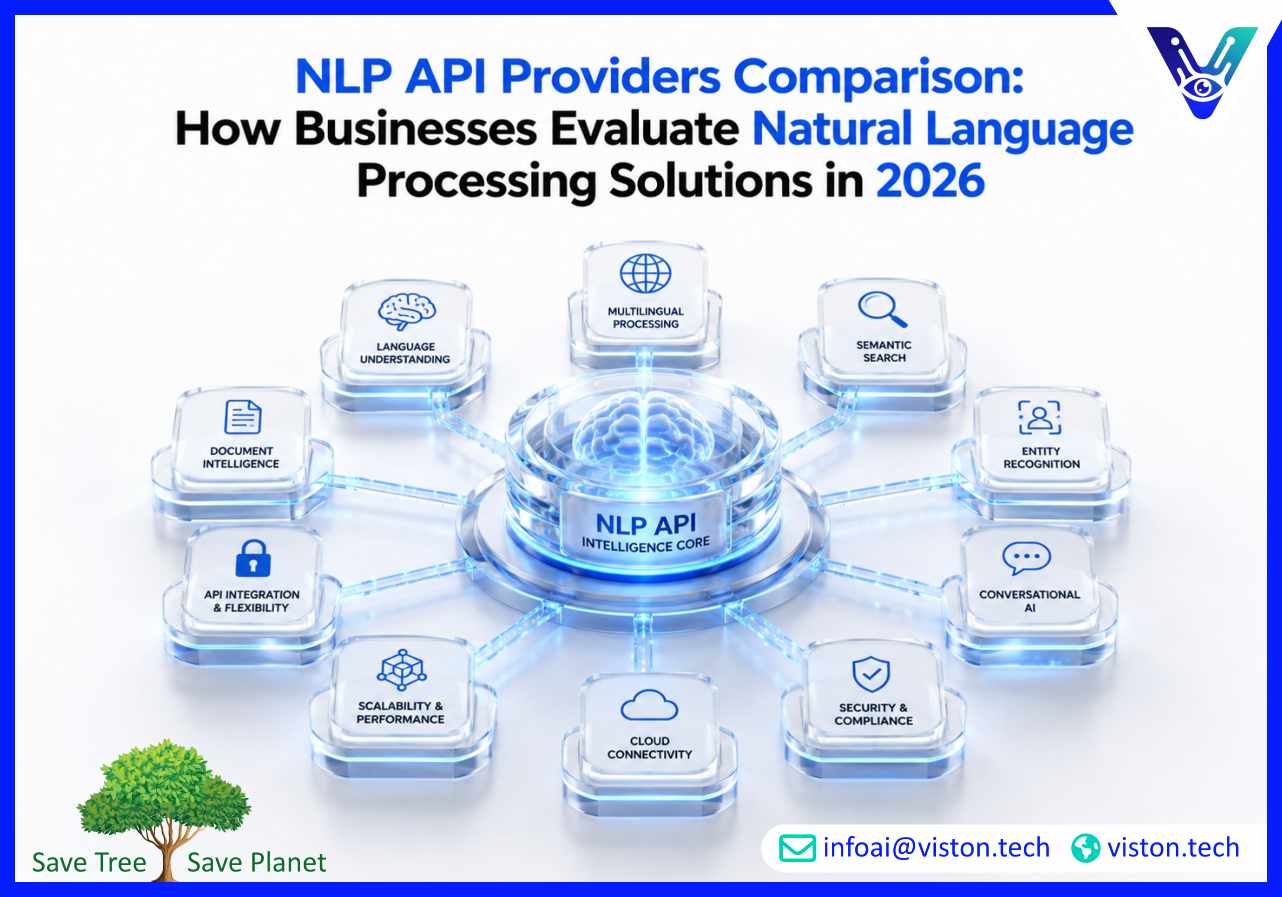
NLP API Providers Comparison: How Businesses Evaluate Natural Language Processing Solutions in 2026
Natural language processing has become a core component of modern business automation, customer engagement, analytics, and AI-driven decision-making. As organizations increasingly rely on language-based technologies, selecting the right NLP API provider has become a strategic technology decision. Understanding how NLP API providers compare can help businesses choose solutions that align with their operational goals, scalability requirements, and long-term AI initiatives.
Why NLP API Provider Selection Matters in 2026
Natural language processing APIs allow businesses to integrate advanced language understanding capabilities into applications, platforms, products, and workflows without building complex machine learning systems from scratch.Organizations use NLP APIs for a variety of business functions, including:
AI chatbots and virtual assistants
Customer support automation
Sentiment analysis
Document classification
Text summarization
Entity recognition
Language translation
Knowledge management
Voice and conversational AI applications
Business intelligence and analytics
Choosing an NLP provider impacts accuracy, performance, security, compliance, scalability, integration flexibility, and overall return on investment. As AI adoption continues to accelerate in 2026, businesses are placing greater emphasis on selecting solutions that can support both current requirements and future growth.
Key Factors Businesses Should Compare When Evaluating NLP API Providers
Language Understanding Capabilities
The first consideration is the depth of language understanding offered by the provider. Some APIs focus primarily on basic text analysis, while others support advanced capabilities such as contextual understanding, intent recognition, semantic search, multilingual processing, and large language model integration.Businesses should evaluate whether the provider can support:
Named entity recognition
Intent detection
Sentiment analysis
Topic modeling
Text summarization
Question answering
Document extraction
Conversational AI workflows
Accuracy and Domain Adaptability
Generic NLP models may perform well for common use cases but often require customization for industry-specific applications. Organizations should assess how easily models can be adapted to specialized terminology, internal knowledge bases, and unique business processes.Industries such as healthcare, finance, legal services, manufacturing, and technology frequently require domain-specific language understanding capabilities.
Multilingual Support
Global businesses increasingly require NLP systems capable of handling multiple languages and regional variations. Providers differ significantly in their multilingual capabilities, language coverage, and localization support.Organizations operating across international markets should evaluate:
Supported languages
Translation quality
Regional dialect handling
Cross-language search capabilities
Multilingual chatbot support
Integration Flexibility
An NLP API should integrate seamlessly with existing business systems and technology environments.Important integration considerations include:
REST API availability
SDK support
Webhook compatibility
Cloud deployment options
Hybrid infrastructure support
CRM integration capabilities
ERP connectivity
Knowledge base integration
The ability to connect NLP capabilities with operational systems often determines how effectively businesses can scale AI initiatives.
What Separates Enterprise NLP Providers from Basic API Services?
Not all NLP API providers are designed for enterprise environments. While some platforms offer simple text-processing functions, enterprise-grade solutions typically provide broader capabilities and stronger operational controls.
Security and Compliance
Organizations handling customer information, regulated data, or proprietary business content require robust security controls.Evaluation criteria often include:
Data encryption
Access controls
Audit logging
Identity management integration
Data residency options
Compliance support
Privacy management capabilities
Scalability and Performance
Enterprise applications frequently process large volumes of content in real time. NLP providers should be evaluated based on:
Response latency
Request throughput
Infrastructure reliability
Global availability
Service-level commitments
Load balancing capabilities
Scalability becomes especially important for customer-facing applications where response speed directly impacts user experience.
Customization and Model Control
Businesses increasingly seek greater control over AI outputs. Enterprise NLP providers often support:
Custom model training
Private knowledge base integration
Retrieval-augmented generation architectures
Prompt management
Workflow orchestration
Model monitoring
Performance optimization tools
These capabilities help organizations improve relevance, accuracy, and consistency.
Common Challenges Businesses Face When Comparing NLP API Providers
Overemphasis on Feature Lists
Many organizations compare providers solely based on available features. However, practical implementation success often depends more on integration quality, data readiness, governance, and operational support than on the number of API endpoints available.
Ignoring Long-Term Scalability
An API that works well for a pilot project may not support enterprise-scale requirements. Businesses should assess future expansion plans before committing to a provider.
Underestimating Data Quality Requirements
NLP performance depends heavily on the quality of underlying business data. Organizations should evaluate how providers support data preparation, knowledge management, and continuous improvement.
Limited Governance Planning
As AI regulations and organizational governance standards continue evolving, businesses need NLP solutions that support responsible AI practices, transparency, monitoring, and compliance requirements.
Best Practices for Evaluating NLP API Providers
Rather than focusing exclusively on technical specifications, organizations should evaluate providers through a business outcomes perspective.A structured evaluation process typically includes:
Defining business objectives
Identifying required NLP capabilities
Assessing integration requirements
Evaluating security and compliance needs
Conducting proof-of-concept testing
Measuring performance against real use cases
Reviewing scalability requirements
Analyzing long-term operational costs
Organizations that align provider selection with measurable business goals are generally more successful in achieving meaningful AI outcomes.
How Viston AI Helps Businesses Navigate NLP Solution Selection
As businesses evaluate NLP API providers, many discover that selecting an API is only one part of a broader natural language processing strategy. Successful NLP implementation requires solution architecture, workflow design, data integration, model optimization, governance planning, and ongoing performance management.Viston AI specializes in Natural Language Processing Solutions that help organizations transform language-based data into practical business outcomes. Rather than focusing solely on API deployment, Viston AI works with businesses to design scalable NLP ecosystems that align with operational objectives, customer experience goals, and automation initiatives.Its capabilities support conversational AI, intelligent document processing, semantic search, enterprise knowledge management, multilingual applications, workflow automation, and advanced language analytics. By combining technical expertise with business-focused implementation strategies, organizations can make more informed decisions about NLP technologies while reducing deployment risks and accelerating value realization.For businesses exploring NLP API providers in 2026, a structured evaluation process supported by experienced NLP specialists can help ensure technology investments align with long-term business priorities.
Frequently Asked Questions
What is an NLP API provider?
An NLP API provider offers cloud-based language processing services that allow businesses to integrate text analysis, language understanding, conversational AI, and related capabilities into applications and workflows.
What should businesses prioritize when comparing NLP API providers?
Organizations should evaluate language understanding accuracy, integration flexibility, scalability, security, compliance support, multilingual capabilities, and alignment with business objectives.
Are NLP APIs suitable for enterprise applications?
Yes. Many enterprise-grade NLP platforms support large-scale deployments, custom workflows, advanced security controls, governance requirements, and integration with business systems.
How important is multilingual support when selecting an NLP provider?
For organizations operating across multiple markets, multilingual support can be critical for customer engagement, content analysis, translation, and conversational AI initiatives.
Can Viston AI help businesses evaluate NLP API providers?
Yes. Viston AI provides Natural Language Processing Solutions that help organizations assess requirements, design NLP architectures, integrate language technologies, and optimize business outcomes from NLP investments.
Conclusion
An effective NLP API providers comparison goes beyond feature lists and pricing models. Businesses must evaluate language capabilities, scalability, integration flexibility, governance requirements, security controls, and long-term operational goals. As natural language processing becomes increasingly central to customer engagement, automation, analytics, and AI transformation initiatives, selecting the right Natural Language Processing Solutions can significantly influence business outcomes. Organizations seeking a strategic approach to NLP adoption can benefit from experienced partners such as Viston AI, which helps businesses implement practical, scalable, and business-focused NLP solutions designed for modern enterprise environments.