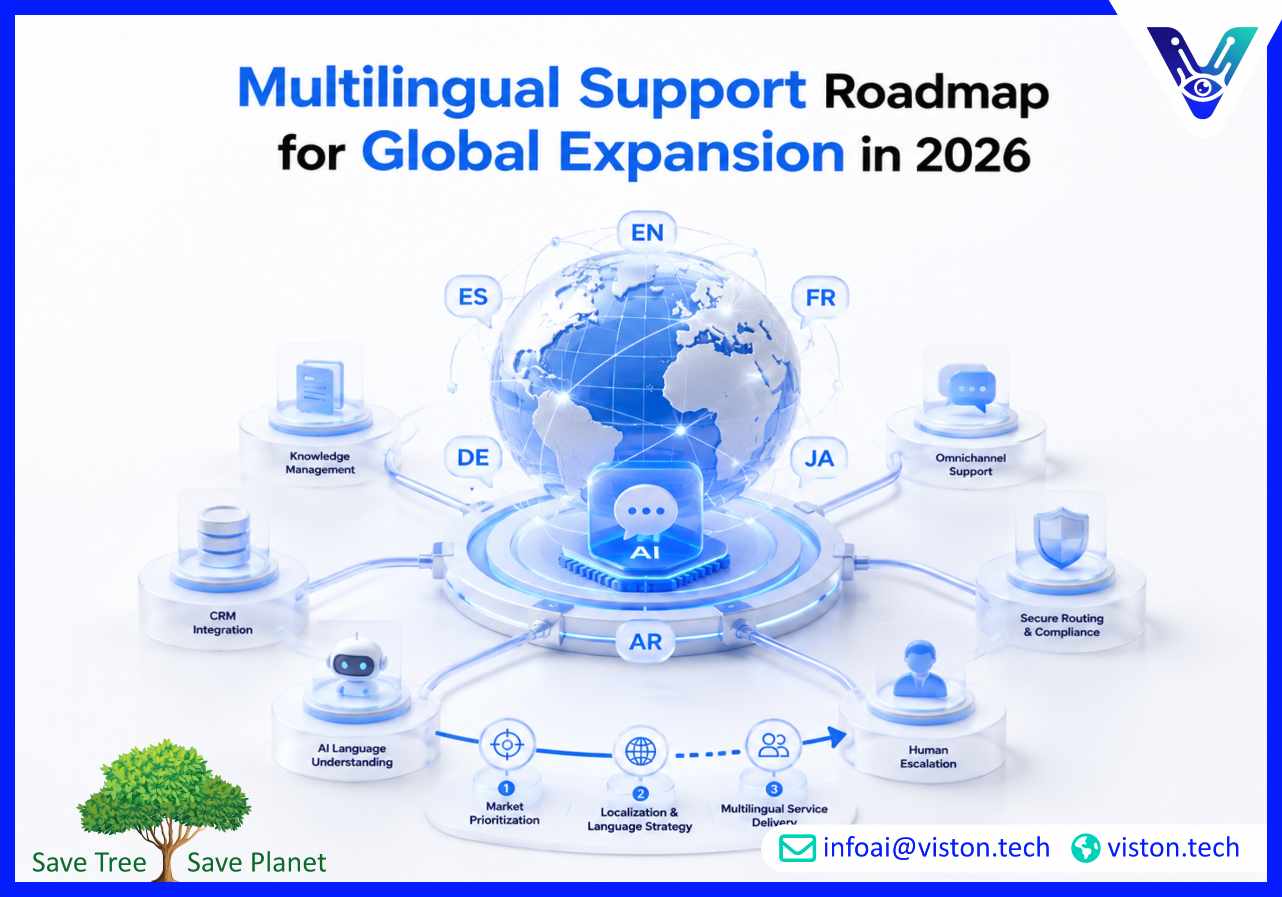
Multilingual Support Roadmap for Global Expansion in 2026
A multilingual support roadmap gives businesses a controlled way to enter new markets without creating inconsistent service, excessive staffing costs, or avoidable compliance risks. The right plan connects language priorities, localized knowledge, AI automation, human escalation, system integration, and performance measurement to each stage of global expansion.
What a Multilingual Support Roadmap Must Achieve
International growth often creates customer service demand before a company has built the operating model to manage it. Customers may discover the business through global search, app stores, marketplaces, distributors, or regional campaigns. They can purchase successfully but still face English-only onboarding, billing support, technical guidance, or complaint handling.A multilingual support roadmap closes that gap. It defines which languages the business will support, what service level each market will receive, which interactions can be automated, and when a human specialist must take control.An effective roadmap should support five business outcomes:
Faster entry into new markets without immediately building separate support teams
Consistent answers across languages, channels, products, and customer segments
Lower operational pressure through appropriate automation
Better customer trust through localized terminology, tone, and escalation
Clear performance visibility by language, market, channel, and use case
Multilingual support is broader than translation. Translation converts words between languages. Multilingual service delivery preserves meaning, policy accuracy, brand voice, customer context, workflow logic, and regional requirements.A grammatically fluent answer is not useful when it applies the wrong refund policy, misunderstands a technical term, or routes an urgent complaint to the wrong team. The goal is therefore dependable service in the customer’s preferred language, not translation volume alone.
Align support planning with the expansion strategy
Technology selection should follow the business plan. A company entering one neighboring market needs a different setup from a platform launching across Europe, North America, and Asia-Pacific.Before evaluating translation tools or multilingual chatbots, define the target markets, expected customer volume, support channels, operating hours, product complexity, risk level, and available human expertise. This prevents the business from promising language coverage that its operations cannot reliably deliver.
Phase One: Prioritize Markets, Languages, and Customer Journeys
The first phase of a multilingual support roadmap should focus on discovery and prioritization. Its purpose is to identify where language support can create the greatest commercial and customer value.
Select languages using business evidence
Population size alone is not a sufficient reason to support a language. Review available customer and market data, including:
Website traffic and browser language
International search demand
Sales enquiries and pipeline by country
Trial registrations and account sign-ups
Existing support conversations in other languages
Revenue potential and product-market fit
Planned marketing, distributor, or partner activity
Regulatory and operational complexity
Score each language against commercial opportunity, expected support volume, strategic importance, delivery difficulty, and risk. This creates a defensible rollout order rather than a list based on assumptions.
Create language support tiers
Not every language needs the same service model. A practical tier structure can include:
Tier 1: Fully localized chatbot, email, help centre, workflows, and human escalation
Tier 2: Localized self-service and AI-assisted support with translated human handover
Tier 3: Language detection, translated intake, and escalation to a central support team
These tiers should be documented internally so that marketing, sales, product, and customer success teams understand what customers in each market will receive.
Map the most important customer journeys
Identify the interactions that affect purchase confidence, product adoption, retention, or customer risk. Typical journeys include product discovery, onboarding, account access, billing, order tracking, returns, technical support, complaints, cancellations, and renewals.For each journey, document the customer’s likely request, required information, approved source of truth, resolution steps, permitted automated actions, and escalation conditions.Begin with high-volume, well-documented, lower-risk enquiries. Order tracking, appointment scheduling, password assistance, product guidance, and standard account questions are usually easier to automate than disputes, regulated advice, fraud concerns, or complex technical failures.
Phase Two: Build the Multilingual Support Operating Model
Once priorities are clear, the business can build the knowledge, workflows, technology, and governance needed for reliable multilingual service.
Create an approved knowledge foundation
Review the existing knowledge base before translating it. Remove outdated articles, resolve conflicting policies, identify missing information, assign content owners, and establish review dates.Localized support content should come from approved sources covering products, pricing, eligibility, delivery, refunds, billing, troubleshooting, privacy, and escalation. Translating inconsistent source content simply creates inconsistency in more languages.Create a terminology glossary containing product names, industry terms, abbreviations, brand language, and words that should remain untranslated. Translation memories and reusable content components can improve consistency, while important customer-facing material should receive fluent human review.
Design an AI-plus-human support model
AI can detect a customer’s language, retrieve approved knowledge, translate conversations, answer common questions, collect structured details, summarize cases, and route enquiries. Human teams remain essential for sensitive complaints, exceptions, negotiations, regulated decisions, vulnerable customers, and situations requiring empathy or judgment.Define confidence thresholds and escalation rules for every supported language. When the system cannot confirm an answer, it should ask a clarifying question or transfer the case rather than produce a confident guess.The receiving agent should receive the original message, translated version, customer details, detected intent, conversation history, attempted resolutions, and relevant account records. This prevents customers from repeating the entire issue after escalation.
Connect support with business systems
A multilingual chatbot or translated inbox operating in isolation has limited value. Integrate the support layer with CRM, helpdesk, ecommerce, billing, identity, scheduling, order management, and knowledge platforms.These connections allow the system to recognize the customer, retrieve current information, complete approved actions, and update business records after the conversation. Integration design should also cover authentication, permissions, error handling, audit logs, data retention, and duplicate prevention.International expansion introduces additional data responsibilities. Companies should evaluate regional privacy requirements, cross-border data transfers, consent, retention, access controls, and vendor responsibilities. Organizations serving EU markets should also prepare for applicable AI transparency requirements taking effect on 2 August 2026.
Test with real native-language enquiries
Do not rely only on polished or machine-translated test scripts. Customers use spelling errors, slang, dialects, mixed languages, abbreviations, and product-specific expressions.Build test sets from real customer enquiries and involve native or fluent reviewers who understand the product and industry. Test intent recognition, answer accuracy, tone, workflow completion, fallback behavior, security boundaries, and escalation quality separately for each language.
Phase Three: Launch, Measure, and Scale by Market
A global rollout should be phased. Launching every language at once makes it difficult to isolate quality problems or determine whether a failure comes from translation, content, workflow design, training data, or system integration.
Use a controlled rollout schedule
First 30 days: Confirm priority markets, language tiers, customer journeys, content gaps, compliance requirements, and baseline performance.
Days 31–90: Localize core knowledge, configure automation, connect priority systems, train agents, and complete native-language testing.
Months 4–6: Launch one or two priority languages, review failed conversations, and improve content, routing, and escalation.
Months 6–12: Expand to additional channels, languages, and workflows based on demonstrated demand and performance.
Measure every language separately
Aggregate reporting can hide serious performance gaps. A strong overall resolution rate may be driven by English while another language produces repeated fallbacks and escalations.Track the following metrics by language, market, and channel:
First-response and resolution time
Self-service resolution rate
Workflow completion rate
Fallback and abandonment rate
Repeat contact and escalation rate
Customer satisfaction
Translation and terminology corrections
Human handover quality
Cost per resolved conversation
Set minimum performance thresholds before adding more complex use cases. A language should move from basic self-service to transactional automation only after the existing experience has proved accurate and reliable.
Establish continuous governance
Assign owners for language strategy, localized knowledge, translation quality, AI behavior, system integrations, privacy, agent training, and reporting.During an initial launch, review performance weekly. After stabilization, use monthly optimization and scheduled content audits to identify new customer intents, outdated answers, product changes, regional differences, and recurring escalation problems.The roadmap should remain flexible. A language may move into a higher service tier when revenue or ticket volume increases. Another may remain self-service-led when demand is limited. This keeps operational cost aligned with real market growth.
How Viston AI Supports a Multilingual Expansion Roadmap
Viston AI’s Multilingual AI Chatbot Support service is directly relevant to businesses building structured language coverage for global growth. Its published capabilities include multilingual intent recognition, real-time translation and localization, omnichannel deployment, intelligent routing, performance analytics, and integration with CRM platforms, knowledge bases, transaction systems, and other business applications.This combination matters because a multilingual support roadmap requires more than a translation layer. Businesses need approved knowledge, contextual responses, workflow automation, human escalation, and visibility into service quality across markets.Viston AI’s delivery approach includes discovery and strategy alignment, data preparation, model selection, testing, system integration, deployment, monitoring, and continuous optimization. This can support a phased rollout beginning with selected languages and high-volume customer journeys.Multilingual interactions can be delivered across channels such as web chat, mobile applications, WhatsApp, SMS, voice assistants, and social platforms. Routine enquiries can be automated while complex cases are routed to appropriate teams with customer and conversation context preserved.For organizations planning international expansion, these capabilities can help connect language coverage with customer experience, operational control, existing business systems, and measurable market performance.
Frequently Asked Questions
How many languages should a company support when expanding globally?
Begin with the languages connected to the strongest revenue opportunity and existing support demand. Many businesses should launch one to three priority languages, validate service quality, and expand when market data justifies additional coverage.
Should multilingual support be ready before entering a new market?
Core support should be available before significant customer acquisition begins. At minimum, localize onboarding, billing information, essential help content, complaint intake, and escalation instructions.
Can AI replace multilingual customer support agents?
AI can automate repetitive enquiries, translate conversations, retrieve approved information, and assist agents. Human judgment is still needed for sensitive complaints, exceptions, regulated decisions, negotiations, and complex technical cases.
What content should be localized first?
Prioritize product information, onboarding, account access, billing, order or booking management, returns, troubleshooting, cancellation, and escalation guidance. These journeys directly affect conversion, activation, and retention.
How should multilingual support quality be measured?
Measure response time, resolution, fallback, repeat contact, escalation, customer satisfaction, workflow completion, and translation corrections separately for every language. Native-language review should remain part of quality assurance.
Can Viston AI support a phased multilingual rollout?
Viston AI’s multilingual chatbot, integration, routing, analytics, and optimization capabilities support deployment by language, market, channel, and use case. Coverage can then expand according to customer demand and measured performance.
Conclusion
A multilingual support roadmap for global expansion should connect market priorities with dependable service operations. Businesses need to select languages using real demand, localize approved knowledge, combine AI automation with human judgment, integrate customer systems, and measure quality separately for each language. A phased approach reduces risk and keeps cost aligned with growth. Viston AI offers relevant multilingual support, chatbot integration, routing, analytics, and optimization capabilities for organizations seeking to build language coverage as a scalable business function rather than a collection of isolated translation tasks.