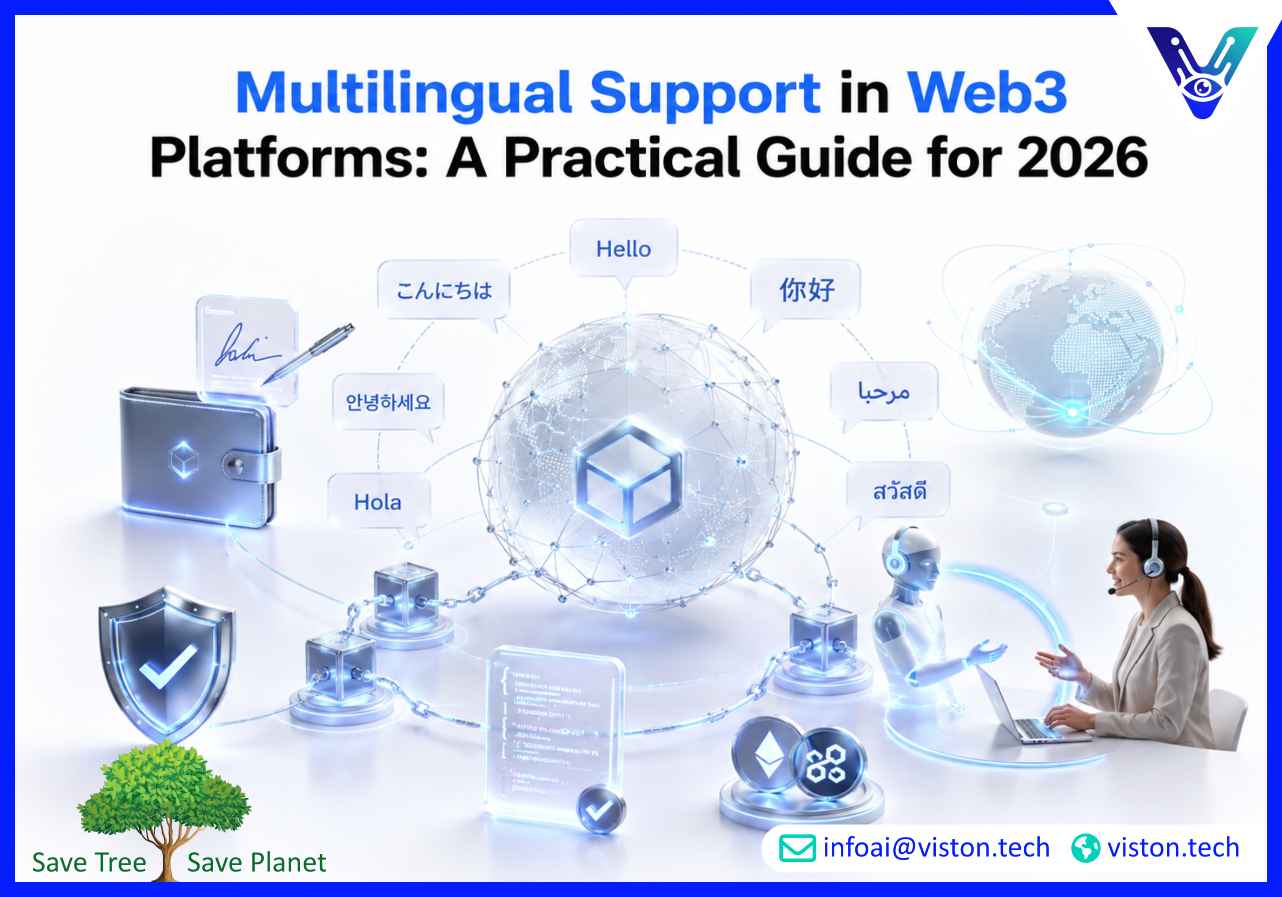
Multilingual Support in Web3 Platforms: A Practical Guide for 2026
Multilingual support in Web3 platforms is no longer just a translation task. It directly affects onboarding, wallet safety, transaction confidence, community trust, and user retention. As Web3 products attract global audiences, support teams need language coverage that explains technical actions clearly without weakening security or creating inconsistent guidance.
What Multilingual Support in Web3 Platforms Actually Involves
Web3 platforms include decentralized applications, wallets, exchanges, DeFi products, NFT marketplaces, blockchain games, DAOs, token platforms, and developer tools. A decentralized application combines a user-facing interface with smart contracts, so support teams must explain both software issues and blockchain-specific actions.For users, the difficult part is rarely language alone. They may be trying to connect a wallet, switch networks, approve a token, estimate gas fees, understand slippage, claim rewards, bridge assets, read a transaction status, or determine why a smart contract interaction failed. Effective multilingual support must translate the meaning of these actions, not merely the words displayed on screen.
It covers the full user journey
Strong language support begins before a user submits a ticket. It should cover product pages, onboarding flows, wallet connection prompts, error messages, help-center articles, transaction explanations, security warnings, chatbot responses, community moderation, and human escalation. The same terminology should appear consistently across the interface, documentation, chatbot, email, Discord, Telegram, and ticketing system.Consistency is especially important in Web3 because several terms may look similar while describing different actions. “Approve,” “sign,” “send,” “stake,” “delegate,” and “bridge” are not interchangeable. A loose translation can cause a user to misunderstand what permission is being granted or what on-chain action will occur.
Localization matters as much as translation
Localization adapts content to the user’s language, region, conventions, and level of technical familiarity. It includes locale-aware formatting, right-to-left interfaces, plural rules, token symbols, regional examples, and culturally appropriate support language. W3C language tags and Unicode locale data provide established foundations for identifying languages and formatting software naturally across locales.A Web3 platform should also preserve terms that must remain exact. Wallet addresses, transaction hashes, chain IDs, token contract addresses, smart contract function names, API errors, and code snippets should never be casually translated. The support system needs rules that distinguish translatable language from immutable technical data.
Why Multilingual Support Matters for Web3 Growth in 2026
Web3 products are inherently accessible across borders, but global availability does not create global usability. Users may discover a platform globally, connect a wallet, and attempt an on-chain action within minutes. When guidance is unclear, they often leave before completing the first meaningful transaction.
Better onboarding reduces avoidable confusion
New users frequently need help understanding wallet setup, network selection, token availability, transaction confirmation, and the difference between custodial and self-custody experiences. Native-language explanations can reduce uncertainty at each step. They also help experienced users resolve technical issues faster.Good support should be contextual. A generic translation such as “transaction failed” is not enough. The response should distinguish between insufficient gas, wrong network, expired quote, rejected signature, contract revert, RPC issue, unsupported token, liquidity limitation, or a pending transaction. The more precise the explanation, the less likely the user is to repeat an unsafe or costly action.
Security communication must be unmistakable
Web3 support operates in an environment where impersonation, malicious links, fake support accounts, and recovery-phrase theft are persistent risks. Security messages therefore need to be direct, repeated, and accurately localized. Users should always understand that legitimate support will not request a secret recovery phrase or private key. Official MetaMask guidance emphasizes that anyone with this information can control the wallet and move its assets.This creates a higher standard for multilingual support. Automated responses must never suggest unsafe troubleshooting. Human agents need clear scripts for suspected compromise, malicious approvals, phishing reports, and impersonation. Community moderators should consistently direct users toward verified support routes.
Language quality influences trust and retention
Users are more likely to trust a platform when explanations are clear, respectful, and technically accurate in their preferred language. Poor machine translation can make a legitimate platform appear careless or unsafe. It can also increase repeated contacts, escalations, abandoned transactions, and negative community sentiment.In 2026, multilingual support should be viewed as product infrastructure. It supports expansion, reduces user friction, and gives product teams insight into regional problems. Language-specific support data can reveal that one market struggles with wallet onboarding while another encounters local payment, compliance, or network-availability issues.
How to Build Safe and Scalable Multilingual Support for Web3
A scalable model combines AI assistance, approved knowledge, human review, secure escalation, and language-level performance monitoring. A generic translation chatbot may respond quickly without delivering reliable support.
Prioritize high-value languages and use cases
Start with evidence from product analytics, wallet connections, community membership, ticket volume, website traffic, and expansion plans. Select languages based on user demand and commercial relevance, then map the highest-volume intents.
Wallet connection and network switching
Deposits, withdrawals, swaps, staking, and bridging
Transactions that are pending, failed, or reverted
Token visibility and contract verification
Account access and identity verification
Security alerts, suspicious links, and compromised wallets
Governance, rewards, quests, and eligibility questions
Each intent should have an approved answer, supported variants, prohibited advice, escalation rules, and links to the correct product documentation. High-risk topics should be reviewed by security, legal, compliance, or protocol specialists before publication.
Create a controlled terminology system
Build a multilingual glossary covering protocol names, network names, token terminology, wallet actions, governance language, error categories, and security warnings. Define which terms should be translated, transliterated, explained, or preserved in English. Translation memory improves consistency, while human reviewers validate ambiguous, high-impact content.Quality management should also distinguish low-risk conversational content from high-risk operational guidance. AI translation may be suitable for simple status questions, but transaction instructions, legal disclosures, recovery guidance, and security incidents need stronger controls. Translation service standards such as ISO 17100 and post-editing guidance such as ISO 18587 offer useful process principles for qualified review and machine-translation oversight.
Connect support to real platform context
A multilingual assistant becomes more useful when it can retrieve approved information from product documentation, a status page, supported-network lists, token metadata, transaction explorers, CRM records, and ticket history. It should identify the user’s language and issue while protecting wallet and personal data.The system should use role-based permissions, data minimization, audit logs, and clear retention rules. Support tools should mask sensitive data and avoid storing private keys, recovery phrases, or unnecessary wallet information. When a user reports a transaction, the workflow can request a public transaction hash or wallet address while clearly explaining what should never be shared.
Design human escalation for irreversible or uncertain cases
Automation should stop when confidence is low, the user reports asset loss, the conversation involves suspected fraud, or the requested action could create financial harm. The handoff should include the detected language, issue category, chain, wallet type, transaction hash if voluntarily provided, troubleshooting already attempted, and the security warnings shown.This reduces repetition and lets a specialist continue without requesting sensitive information. It also helps teams separate product defects from network congestion, third-party wallet issues, smart contract behavior, or user education gaps.
How to Evaluate Multilingual Support Quality and Business Impact
Web3 teams should evaluate multilingual support by language, channel, intent, and risk level. A global satisfaction score can hide weaknesses in smaller markets or complex journeys.
Track operational and user-experience metrics
First-contact resolution by language and issue type
Fallback and misunderstanding rates
Average response and resolution time
Human escalation rate and handoff quality
Customer satisfaction by language
Onboarding completion after support interactions
Repeat contact and conversation abandonment
Security-incident detection and routing accuracy
For AI-supported service, review answer accuracy, source grounding, glossary compliance, prohibited-response incidents, and performance drift. A language with low ticket volume may still require urgent improvement if its security-warning accuracy is weak.
Test real conversations, not isolated translations
Evaluation should include complete journeys: connecting a wallet, explaining a signature request, troubleshooting a failed swap, identifying the correct network, reporting a phishing link, and escalating a potentially compromised wallet. Test informal phrasing, spelling errors, mixed-language messages, regional dialects, abbreviations, and code-switching.Web3 teams should also run adversarial tests. Confirm that the assistant refuses requests for secret phrases, does not invent transaction outcomes, does not guarantee recoverability, and does not direct users to unverified links. Every supported language should receive the same safety standard, even when training data is limited.
Choose providers based on delivery capability
Buyers should assess whether a provider can manage domain terminology, approved knowledge sources, omnichannel deployment, workflow integration, human escalation, language-specific analytics, and continuous optimization. Ask how the provider handles low-resource languages, mixed-language queries, hallucination risk, security content, data protection, and changes to protocol documentation.The best solution delivers accurate, safe, measurable support in the languages that matter to users.
How Viston AI Can Support Multilingual Web3 Customer Experiences
Viston AI’s Multilingual Support service is relevant to Web3 platforms that need consistent conversational assistance across markets and channels. Its verified offering combines multilingual AI chatbots, natural language processing, real-time translation and localization, centralized knowledge management, intelligent routing, performance analytics, and continuous optimization. The company also supports deployment across web chat, mobile applications, messaging, voice, and social channels.For a Web3 product, these capabilities can be applied to wallet onboarding, transaction-status guidance, technical documentation, community questions, account workflows, and escalation to protocol or security specialists. An integration-led approach is particularly useful because accurate support often depends on current network, product, and ticketing information rather than generic blockchain answers.Viston AI’s language-specific analytics and routing capabilities can help teams compare resolution quality across markets, identify terminology gaps, and direct sensitive cases to the right human expert. Its offering is best suited to organizations prepared to build an approved Web3 knowledge base, define security boundaries, and continuously review responses. Used within those controls, multilingual automation can extend support coverage while preserving the technical precision and caution Web3 users require.
Frequently Asked Questions
What is multilingual support in Web3 platforms?
It is the delivery of localized product guidance, technical help, security communication, chatbot assistance, and human support across multiple languages. It covers wallet connections, transactions, smart contract interactions, account issues, documentation, and community channels.
Which Web3 support content should receive human translation review?
Human review is most important for security warnings, recovery guidance, transaction instructions, legal or compliance notices, token-sale information, financial explanations, and any content where ambiguity could cause asset loss or incorrect user action.
Can an AI chatbot safely handle multilingual Web3 support?
Yes, when it uses approved sources, controlled terminology, confidence thresholds, secure integrations, and clear escalation rules. It should never request private keys or recovery phrases, speculate about transaction outcomes, or provide unverified links.
How should a Web3 platform choose which languages to support first?
Use evidence from active users, wallet connections, community channels, support volume, traffic, revenue potential, and expansion priorities. Prioritize languages linked to meaningful product use rather than choosing solely by global population size.
What metrics show whether multilingual Web3 support is working?
Track first-contact resolution, satisfaction, fallback rate, response time, escalation quality, repeat contacts, onboarding completion, and safety-policy compliance by language. Review high-risk intents separately from routine questions.
How can Viston AI help a Web3 platform?
Viston AI can support multilingual chatbot deployment, localization, NLP-based intent handling, omnichannel assistance, knowledge integration, intelligent escalation, and language-specific performance monitoring. The Web3 platform should provide approved technical content and security policies for implementation.
Conclusion
Multilingual support in Web3 platforms must make complex actions understandable without simplifying away security, risk, or technical accuracy. The strongest programs combine localized product content, controlled terminology, approved knowledge, safe AI automation, specialist escalation, and language-level measurement. For global Web3 teams, multilingual support is a practical part of onboarding, trust, retention, and incident prevention. Viston AI offers relevant multilingual support capabilities for platforms that want to extend coverage across channels while maintaining structured knowledge, measurable performance, and reliable human handoffs.