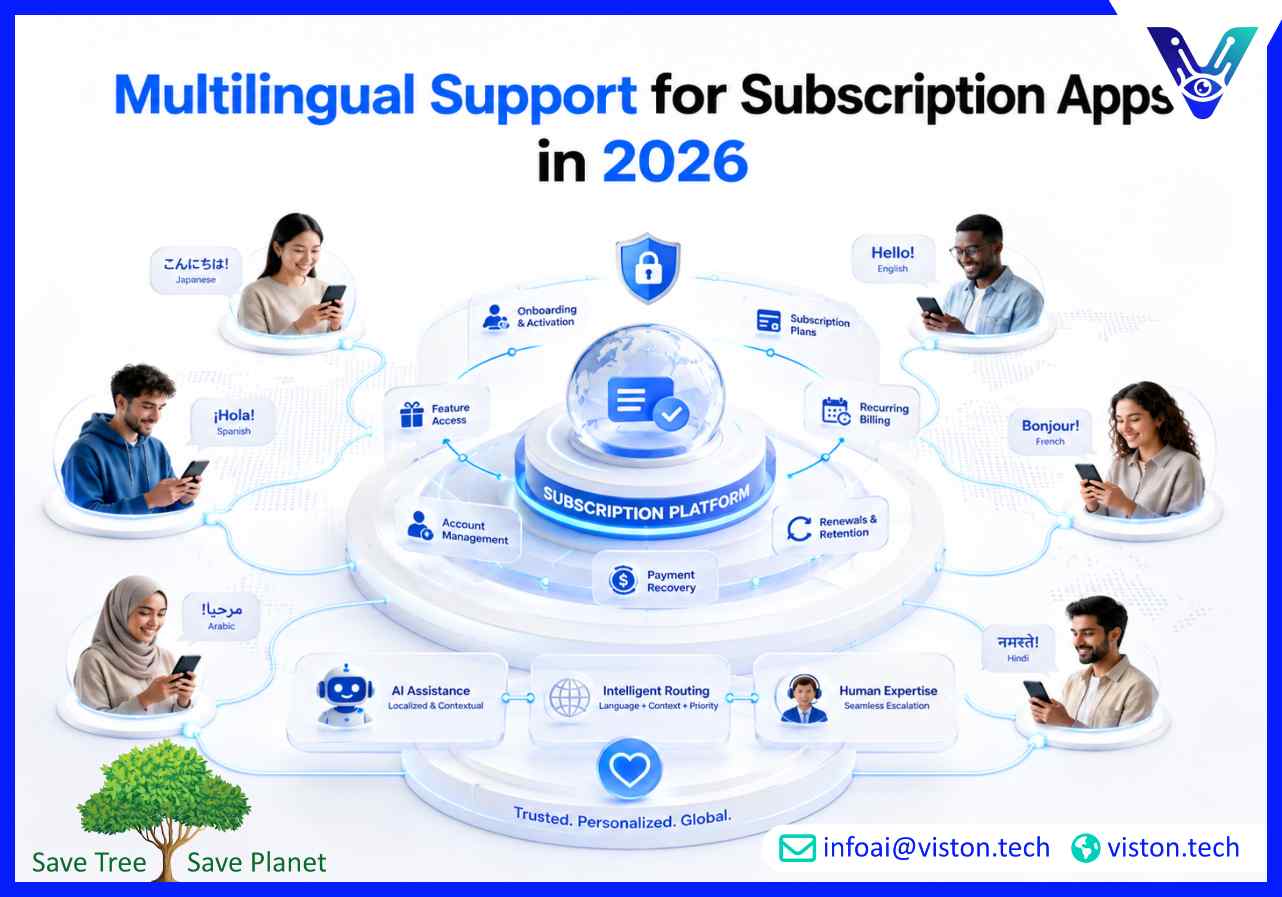
Multilingual Support for Subscription Apps in 2026
Multilingual support for subscription apps is no longer limited to translating a help centre. It must help users understand plans, manage renewals, resolve payment problems, use product features, and receive accurate assistance throughout the subscription lifecycle. For app businesses expanding internationally, support quality can directly affect trust, retention, and recurring revenue.
What Multilingual Support for Subscription Apps Involves
Subscription apps create an ongoing relationship rather than a one-time transaction. Customers may need help before subscribing, during onboarding, when changing plans, after a failed payment, or when deciding whether to renew. Multilingual support makes these interactions accessible in the languages customers are most comfortable using.Effective support goes beyond translating English responses word for word. It combines language detection, localized knowledge, culturally appropriate wording, subscription account context, workflow automation, and access to human agents when a case requires judgment. The objective is to give users a consistent level of service regardless of language, channel, device, or time zone.
Support must cover the full subscriber journey
A practical multilingual support operation should address the moments that influence acquisition, activation, retention, and recovery. Common support needs include:
Explaining plan differences, trial terms, usage limits, and premium features
Guiding users through account creation, setup, and product onboarding
Answering billing, renewal, tax, invoice, and payment-method questions
Helping customers upgrade, downgrade, pause, restore, or cancel access
Troubleshooting login, entitlement, synchronization, and feature issues
Recovering failed payments and resolving discrepancies between app-store and account records
Escalating refund requests, complaints, security concerns, and complex technical cases
These conversations often involve sensitive details and precise commercial language. A mistranslated renewal date, refund condition, or cancellation instruction can create avoidable disputes. Subscription businesses therefore need approved terminology and clear source-of-truth content for each supported language.
Subscription state must inform the answer
Generic replies are rarely enough. Support systems should understand whether a user is in a free trial, an active paid term, a grace period, a paused state, a payment hold, an expired plan, or a cancelled-but-still-entitled period. Answers should also reflect where the subscription was purchased, because management steps can differ between web billing, Apple platforms, Google Play, and partner marketplaces.
Why Subscription Apps Need Multilingual Support in 2026
Subscription products can acquire users globally through app stores, online advertising, referrals, creator partnerships, and localized landing pages. Growth may happen faster than a support team can hire native-speaking agents. Without a scalable multilingual model, new markets can generate slower responses, inconsistent explanations, and higher escalation volumes.
Language friction can become retention friction
Subscribers are more likely to lose confidence when they cannot understand how a recurring charge works, why access changed, or what action is required after a payment failure. Even when the underlying product is functioning correctly, unclear support can make the experience feel unreliable.This is especially important during high-risk moments such as trial conversion, renewal, cancellation, account recovery, and billing disputes. Fast, accurate assistance can prevent an easily resolved issue from becoming a chargeback, negative review, or cancellation. Multilingual support also allows product teams to distinguish language problems from genuine defects in the app.
App-store processes require precise guidance
Subscription support must account for platform-specific purchase and management flows. Auto-renewable subscriptions continue until cancellation, while entitlement changes can be triggered by renewals, expirations, refunds, pauses, grace periods, or payment failures. Google Play also expects subscription apps to provide clear management and cancellation access, while both major app ecosystems provide their own subscriber-management processes. Support content must therefore be accurate, current, and linked to the customer’s actual purchase route.
Always-on assistance supports global usage patterns
Subscription apps are often used outside the support team’s working hours. A customer may encounter a login problem before a class, a renewal issue during travel, or a failed payment immediately after a product launch. Multilingual self-service and conversational support can provide immediate first-line help while preserving human escalation for cases involving refunds, account security, technical investigation, or policy exceptions.The business value is not simply fewer tickets. A well-designed system can improve onboarding completion, reduce repeated contacts, shorten resolution time, support payment recovery, and reveal which markets or languages are experiencing recurring problems.
How to Build Multilingual Support for Subscription Apps
A reliable implementation starts with the subscriber journey and the underlying business systems. Adding translation to an existing chatbot will not solve gaps in knowledge, billing visibility, or escalation design. The support operation must be built around real customer intents and verified account data.
Prioritize languages using customer evidence
Language selection should be based on active subscribers, trial users, revenue, ticket volume, expansion plans, app-store geography, and conversion opportunity. Teams should also review which languages generate the highest abandonment, repeated contact, or unresolved-ticket rates. Launching a smaller set of well-supported languages is usually more valuable than advertising broad coverage with uneven quality.
Create a multilingual knowledge architecture
Start with approved source content for plans, features, billing rules, troubleshooting, privacy, cancellations, refunds, and account management. Assign owners to each content area and define how updates are propagated across languages. Product names, interface labels, plan tiers, and technical terms should follow a controlled glossary so the same concept is not translated differently across the app, help centre, chatbot, and agent replies.High-impact content should be localized rather than directly translated. Examples, date formats, currencies, formality, sentence structure, and explanations may need adjustment for the target market. Legal or policy-sensitive content should receive appropriate human review.
Connect support to subscription and product systems
Useful multilingual support depends on context. Integrations may include customer relationship management, helpdesk, identity management, product analytics, subscription management, payment processing, Apple and Google purchase data, knowledge bases, and incident-status systems. With the right permissions, the support layer can identify the user, confirm plan status, retrieve relevant events, and provide the correct next step.Automation should be limited to well-defined actions. A system may safely explain plan features, surface invoices, guide a password reset, or route a failed-payment case. Refund approval, fraud concerns, data deletion, and complex entitlement disputes may require human authorization and an auditable workflow.
Design human handover by language and issue type
Escalation should not send every unresolved conversation into a general queue. Routing rules should consider language, urgency, subscription value, sentiment, technical category, and risk. The receiving agent should receive the transcript, detected language, translated summary where appropriate, account context, actions already attempted, and the reason for escalation.This avoids making customers repeat information and helps monolingual agents work with qualified language assistance. Native or professionally reviewed support remains important for sensitive complaints, nuanced retention conversations, accessibility needs, and markets where automated quality is not yet reliable enough.
How to Measure Quality and Choose the Right Support Approach
Multilingual support should be evaluated by outcomes in each language, not by total conversation volume. A system can appear successful globally while underperforming in a smaller market. Reporting must therefore segment performance by language, region, channel, intent, subscription stage, and automation path.
Track operational and subscriber-focused KPIs
First-contact and self-service resolution rates by language
Fallback, abandonment, and repeat-contact rates
Average response and resolution time
Escalation rate and handover quality
Customer satisfaction by language and issue type
Trial onboarding completion and feature-adoption outcomes
Payment-recovery and involuntary-churn resolution outcomes
Cancellation-related contacts and save-offer acceptance where appropriate
Knowledge accuracy, terminology consistency, and policy compliance
Quality reviews should inspect real conversations, not only dashboard averages. Teams need to identify incorrect translations, unsupported answers, missed escalation signals, outdated billing guidance, and differences between language groups. Low-volume languages still require testing because a small number of serious errors can create disproportionate risk.
Evaluate providers on delivery capability
A capable multilingual support provider should demonstrate how it handles language detection, contextual understanding, terminology control, knowledge retrieval, account integrations, human escalation, analytics, security, and continuous improvement. Buyers should ask how responses are tested before launch, how sensitive data is protected, how access is restricted, and how changes to plans or policies are synchronized.It is also important to clarify the operating model. Some subscription apps need automated first-line support with specialist human backup. Others require agent-assist translation, multilingual ticket triage, or a hybrid model that varies by language. The right design depends on ticket complexity, customer value, regulatory exposure, product maturity, and internal support capacity.
How Viston AI Supports Multilingual Subscription-App Experiences
Viston AI provides multilingual AI chatbot support designed for customer conversations across languages, channels, and time zones. Its published capabilities include contextual intent recognition, localized responses, centralized knowledge management, intelligent routing, performance analytics, and integration with CRM platforms, knowledge bases, transaction systems, and other business applications.These capabilities are relevant to subscription apps because useful support must connect language understanding with account and billing context. A subscriber asking why premium access disappeared needs more than a translated FAQ; the support workflow may need to distinguish a failed renewal from a cancelled plan, identify the purchase channel, retrieve the correct policy, and escalate the case with complete context.Viston AI also identifies SaaS product support as a multilingual use case covering onboarding, feature guidance, billing assistance, technical troubleshooting, and escalation workflows. For subscription businesses, this creates a practical foundation for supporting web, mobile, and messaging interactions through a consistent knowledge and routing model. Its delivery approach can be applied to language prioritization, workflow design, system integration, testing, deployment, monitoring, and ongoing optimization, helping teams scale support without treating every market as a separate operation.
Frequently Asked Questions
What is multilingual support for subscription apps?
It is customer assistance delivered across multiple languages for the entire subscription lifecycle. It covers plan selection, onboarding, billing, renewals, payment failures, account access, upgrades, downgrades, cancellations, technical issues, and human escalation.
Can AI handle subscription support in multiple languages?
AI can handle many repeatable interactions, including FAQs, onboarding guidance, plan explanations, basic troubleshooting, and account-status questions when connected to trusted systems. Human review or escalation is still needed for sensitive, ambiguous, high-value, or policy-exception cases.
Which languages should a subscription app support first?
Prioritize languages using subscriber numbers, revenue, trial growth, ticket demand, target markets, app-store distribution, and service-quality gaps. Begin with languages where better support can create a measurable improvement rather than selecting languages only by population size.
How does multilingual support help reduce churn?
It helps customers resolve onboarding, billing, access, and product-use problems before frustration leads to cancellation. It can also support failed-payment recovery and provide clear cancellation or plan-change guidance, improving trust even when a customer chooses to leave.
What integrations are important for multilingual subscription support?
Common integrations include helpdesk, CRM, identity, subscription management, payment systems, app-store purchase data, product analytics, knowledge bases, and incident-status tools. The necessary stack depends on where subscriptions are sold and how entitlements are managed.
Can Viston AI support multilingual SaaS and subscription-app workflows?
Viston AI’s multilingual chatbot service is aligned with SaaS support use cases such as onboarding, feature guidance, billing help, troubleshooting, system integration, intelligent routing, and performance monitoring. The final design should be tailored to the app’s languages, billing channels, policies, and support model.
Conclusion
Multilingual support for subscription apps should make recurring relationships easier to understand and manage. The strongest approach combines localized knowledge, subscription context, secure integrations, clear escalation, and language-level performance measurement. In 2026, app businesses should treat multilingual support as part of product delivery rather than an isolated translation task. When implemented carefully, it can improve onboarding, resolve billing friction, protect customer trust, and support international growth. Viston AI offers relevant multilingual support and integration capabilities for subscription businesses seeking a scalable, practical service model.