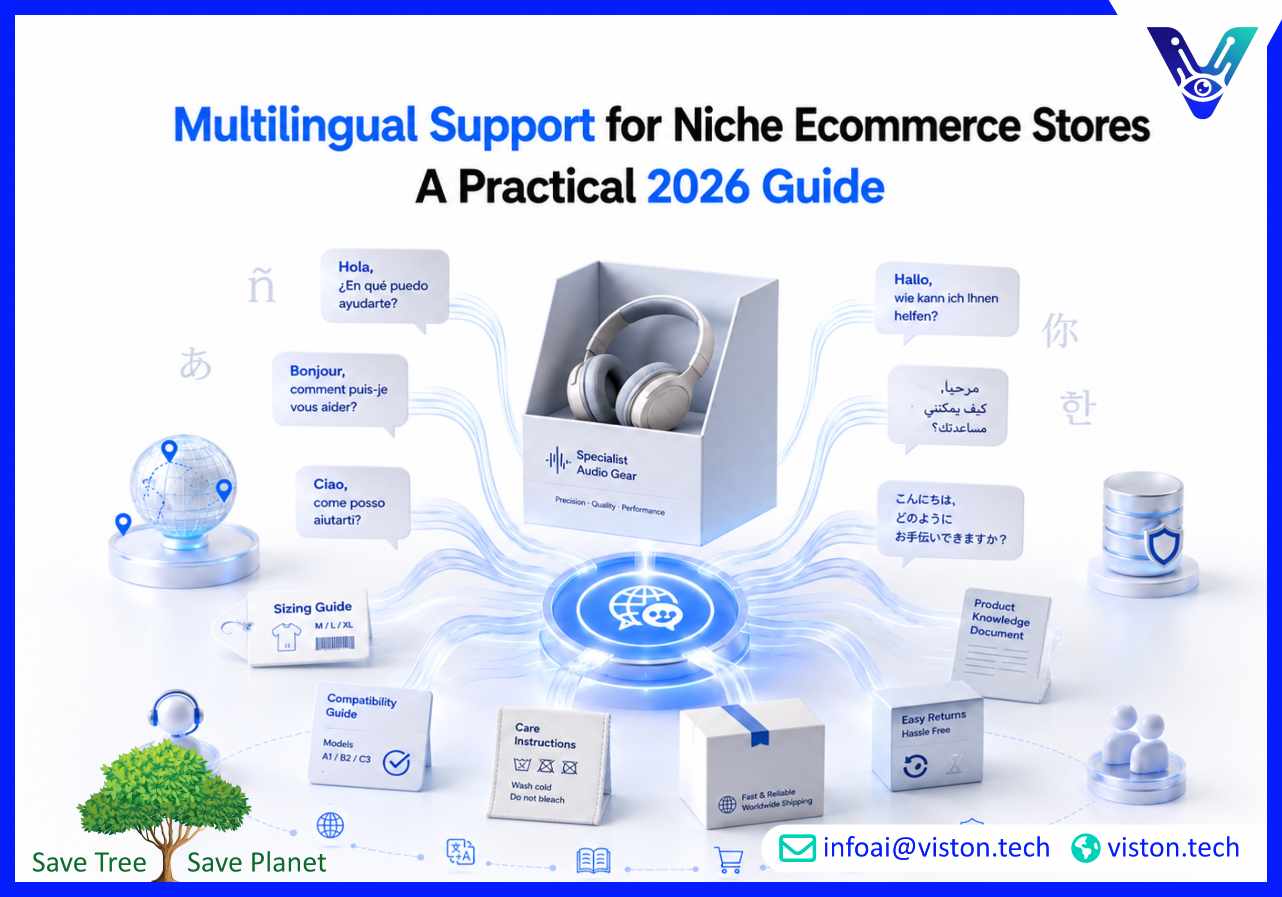
Multilingual Support for Niche Ecommerce Stores: A Practical 2026 Guide
Multilingual support for niche ecommerce stores helps specialist retailers serve international buyers without losing the product knowledge, personal service, and brand credibility that make them distinctive. The challenge is not simply translating messages. Stores need accurate, context-aware support across product discovery, ordering, delivery, returns, and post-purchase care.
Why Multilingual Support Matters for Niche Ecommerce Stores
Niche ecommerce businesses often sell products that require more explanation than typical mass-market goods. Customers may need help understanding materials, ingredients, compatibility, sizing, care instructions, customization options, usage requirements, shipping restrictions, or product differences before they are ready to purchase.This creates a particular challenge when the customer and support team do not share the same language. A basic translation may communicate individual words correctly while missing the product context, technical meaning, cultural expectations, or intended tone.Effective multilingual customer support allows a store to answer questions in the language customers are most comfortable using. It can cover website chat, email, social messaging, help centers, marketplace inquiries, order notifications, and human support conversations.For niche retailers, this capability is valuable throughout the customer journey:
Before purchase, customers can clarify product details and suitability.
During checkout, they can ask about payment, shipping, taxes, or delivery.
After purchase, they can track orders, report problems, or request returns.
During repeat purchases, they can receive relevant product guidance.
Ecommerce now operates through online stores, mobile applications, social platforms, and marketplaces, making customer communication increasingly distributed across channels. A multilingual support model should therefore provide consistent answers wherever the customer chooses to interact.
Translation and multilingual support are not the same
Translation converts content from one language into another. Multilingual support is a broader operational capability. It includes language detection, localized knowledge, product terminology, support workflows, escalation rules, customer history, quality control, and reporting.For example, translating “Will this fit?” is easy. Answering it correctly may require access to product dimensions, the customer’s model or variant, regional specifications, previous orders, and a compatibility guide. The value comes from combining language capability with reliable ecommerce information.Localization also matters. A response may need to account for regional measurements, currencies, address formats, dates, delivery expectations, cultural tone, or market-specific policies. A literal translation can still feel confusing or inappropriate if these details are ignored.
Common Multilingual Support Challenges for Specialist Retailers
Niche stores rarely have the staffing or ticket volume to justify a full in-house support team for every language. At the same time, relying entirely on unreviewed machine translation can create serious customer experience problems. The most practical approach usually combines automation, approved knowledge, and human oversight.
Specialist product terminology
Product terminology is one of the biggest risks. A store selling cycling components, collectible items, specialty skincare, musical equipment, craft materials, replacement parts, or premium pet products may use vocabulary that general translation systems interpret incorrectly.Product names, model numbers, ingredients, measurements, technical terms, and brand-specific phrases should be protected through approved glossaries. These glossaries help automated systems and human agents use consistent terminology across product pages, support replies, and help-center content.
Inconsistent information across languages
A store may update its English shipping or return policy but forget to update translated versions. Customers then receive different answers depending on the language they use.This inconsistency can affect trust and increase complaints. Multilingual knowledge content should have clear ownership, version control, review dates, and a defined source of truth. When a policy changes, every supported language should be included in the update workflow.
Small teams and unpredictable demand
Niche stores often experience uneven support demand. A campaign, influencer mention, seasonal event, or marketplace promotion can produce a sudden increase in international inquiries. Hiring permanent native-speaking agents for temporary demand may not be commercially realistic.AI-assisted support can help manage common questions, translate conversations, classify tickets, retrieve approved answers, and route complex cases. However, automation should be designed around real support workflows rather than added as a disconnected chat feature.Current multilingual service tools increasingly combine language support with contextual knowledge, workflow actions, and integrations instead of providing translation alone. This allows customer questions to be connected with order, account, and service data.
High-risk conversations
Some conversations should not be handled through unrestricted automation. Refund disputes, payment problems, suspected fraud, safety concerns, allergic reactions, damaged high-value goods, regulated products, or highly technical troubleshooting may require human judgment.A responsible multilingual support workflow should recognize these cases, transfer them promptly, and give the human agent the translated conversation, customer details, detected issue, and relevant order information.
How to Build Effective Multilingual Support for a Niche Store
A niche retailer does not need to support every language immediately. A focused rollout based on customer demand is usually more manageable and produces better-quality service.
Prioritize languages using real customer data
Start by reviewing store analytics, shipping destinations, abandoned checkouts, support tickets, social media messages, marketplace activity, and search demand. Identify where customers already show interest but experience language friction.Consider both volume and commercial value. A language with fewer inquiries may still deserve priority when it represents high-value orders, repeat customers, strategic expansion, or a category with complex pre-purchase questions.
Map the most important customer intents
Customer intent describes what the shopper is trying to accomplish. Common ecommerce intents include:
Checking product availability or suitability
Comparing two products
Confirming size, fit, ingredients, or compatibility
Understanding shipping times or costs
Tracking an order
Changing or cancelling an order
Requesting a return, refund, or replacement
Reporting a damaged or missing item
Begin with frequent, predictable, and low-risk intents. Create approved answers and workflows for each language before expanding into more complex interactions.
Build a multilingual knowledge base
A reliable knowledge base gives both customers and support systems access to consistent information. It should include product guidance, sizing information, compatibility instructions, shipping policies, returns, warranties, care guidance, troubleshooting, and contact options.Content should be written clearly in the source language before translation. Ambiguous or overly promotional source material becomes even harder to understand after localization.Each article should have an owner and review schedule. Stores should also document which information comes from the ecommerce platform, inventory system, shipping provider, or internal policy so that answers are not based on outdated static content.
Connect support with ecommerce systems
Customers expect more than general answers. They may want to know whether an item is in stock, when an order will arrive, whether a discount was applied, or whether a return has been approved.Multilingual support becomes significantly more useful when it connects with the ecommerce platform, helpdesk, CRM, order management system, shipping tools, inventory records, and product database. Proper integration allows the support system to retrieve customer-specific information instead of giving generic responses.
Use human review strategically
Human review should focus on conversations where accuracy, empathy, or commercial judgment matters most. This includes complaints, unusual product questions, high-value orders, sensitive situations, and messages with unclear intent.Native or highly proficient reviewers can also audit automated conversations, refine terminology, identify culturally awkward phrasing, and improve approved response templates. This creates a continuous quality cycle rather than treating translation as a one-time setup task.
How to Implement and Measure Multilingual Ecommerce Support
A successful implementation should balance customer coverage, support quality, operational cost, and technical complexity. Stores should define what each supported language includes instead of using a vague promise of global support.
Define the support level for each language
One language may receive full live-agent support, while another receives automated chat, translated email, and human escalation during specific hours. These service levels should be based on demand, risk, and available resources.Customers should be told clearly when live support is available, how long a response may take, and which channels are supported. Clear expectations are better than presenting limited coverage as complete language support.
Test real ecommerce conversations
Testing should use realistic questions from actual customers rather than simple translated scripts. Include spelling errors, informal language, mixed-language messages, abbreviations, product codes, regional vocabulary, and follow-up questions.Teams should verify whether the system can maintain context across several messages. A customer may first ask about a product and then say, “Does it work with the one I bought last month?” The support workflow needs access to both conversational context and purchase data.
Monitor quality and business outcomes
Useful multilingual support metrics include first-response time, resolution rate, fallback rate, escalation rate, repeat contact, customer satisfaction, translation corrections, order-related errors, and conversion from supported conversations.Results should be reviewed by language and intent. A strong overall satisfaction score may conceal poor performance in one market or product category. Stores should also examine failed conversations to identify missing content, misunderstood terminology, integration problems, or inappropriate automation.
Protect customer information
Support conversations may contain names, addresses, contact details, payment references, order histories, and personal preferences. Stores should understand how translation and AI systems process, store, and transfer this data.Access controls, data minimization, retention rules, secure integrations, and audit records should be considered when selecting a multilingual support provider. Sensitive information should not be included in training or testing datasets without an appropriate business need and suitable protection.
How Viston AI Supports Multilingual Ecommerce Customer Service
Viston AI is relevant to niche ecommerce businesses because its service portfolio includes Multilingual AI Chatbot Support, language translation services, NLP and text analysis, voice-enabled AI assistants, and wider AI integration capabilities. These services can support retailers that need language coverage combined with product knowledge, customer data, and operational workflows.For a specialist store, the practical requirement is not merely to translate a chatbot interface. The support system must understand category-specific terminology, retrieve approved product information, recognize customer intent, connect with relevant business systems, and escalate uncertain or sensitive cases.Viston AI’s capabilities can be applied to multilingual chat experiences, translated customer interactions, automated responses, knowledge retrieval, workflow routing, and integration with ecommerce or support platforms. This can help stores manage common inquiries while preserving human involvement for complex product advice, complaints, and high-value customer situations.Its integration-focused approach is particularly relevant for growing ecommerce businesses that want support conversations connected with order records, customer histories, inventory information, and internal service processes. A structured implementation can help niche retailers extend language coverage without building a separate support operation for every market.
Frequently Asked Questions
What is multilingual support for niche ecommerce stores?
It is the ability to assist ecommerce customers in multiple languages across product questions, ordering, delivery, returns, and post-purchase support. It includes translation, localization, approved knowledge, ecommerce integrations, and human escalation.
Which languages should a niche store support first?
Prioritize languages using website traffic, shipping destinations, customer inquiries, abandoned checkouts, marketplace demand, and expansion plans. Begin with markets where language barriers are already affecting customer service or sales opportunities.
Can AI handle multilingual ecommerce support without human agents?
AI can manage common and predictable questions, but human support remains important for unusual product advice, disputes, safety concerns, sensitive complaints, high-value orders, and situations where the available information is uncertain.
How is localization different from translation?
Translation changes text from one language to another. Localization adapts the experience to regional language, tone, measurements, currency, dates, delivery expectations, and cultural context.
What should a multilingual ecommerce support system integrate with?
Useful integrations include the ecommerce platform, helpdesk, CRM, inventory system, order management tools, shipping providers, product database, knowledge base, and analytics platform.
Can Viston AI support multilingual customer service for specialist stores?
Viston AI offers multilingual chatbot support, language translation, NLP, AI assistants, and integration capabilities that align with the needs of niche ecommerce stores seeking scalable, connected customer support.
Conclusion
Multilingual support for niche ecommerce stores should preserve the specialist knowledge and personal service that customers expect from a focused retailer. The strongest approach combines accurate language handling, localized content, approved product knowledge, ecommerce integrations, quality monitoring, and timely human escalation. Stores should begin with priority languages and high-value customer intents, then expand using real performance data. For businesses seeking a structured multilingual support capability, Viston AI offers relevant language, conversational AI, NLP, and integration services that can connect customer communication with practical ecommerce workflows.