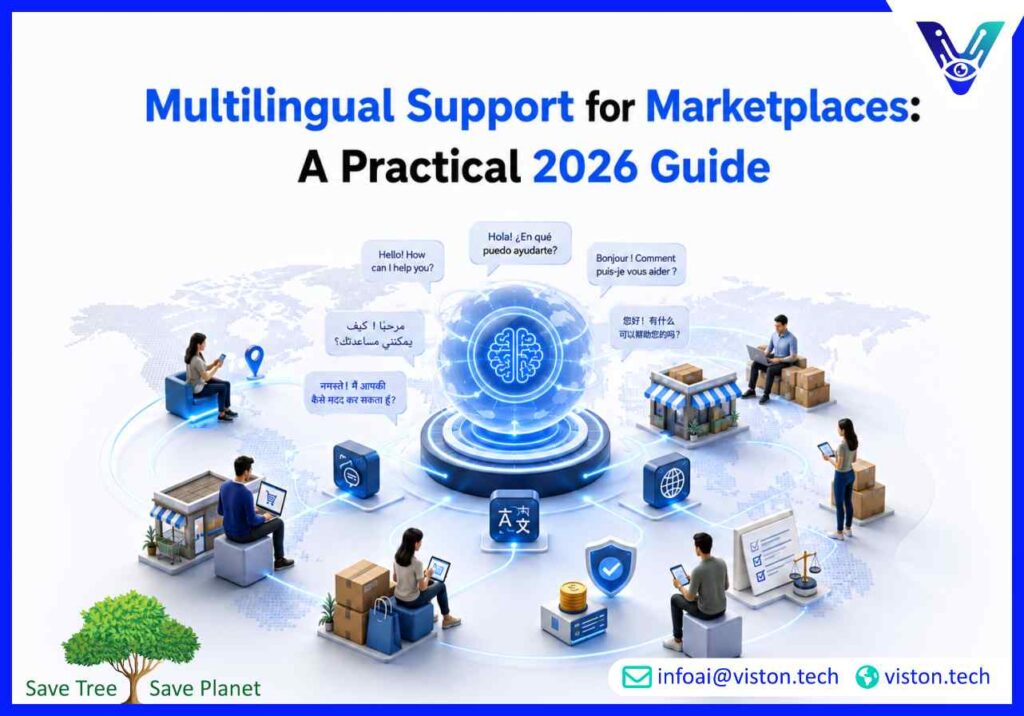
Multilingual Support for Marketplaces: A Practical 2026 Guide
Multilingual support for marketplaces is no longer a simple translation task. It is an operating capability that helps buyers, sellers, service providers, and platform teams resolve issues accurately across languages, regions, and channels. In 2026, marketplaces need support models that protect trust while scaling complex, two-sided customer journeys.
Why Multilingual Support for Marketplaces Is Different
A marketplace supports buyers, sellers, vendors, hosts, drivers, freelancers, and partners, often within the same transaction. Each group has different questions, permissions, and risks. A buyer may need help with delivery, refunds, or product quality, while a seller may need assistance with listings, payouts, identity verification, account restrictions, or dispute evidence.That complexity makes multilingual marketplace support more demanding than translating a standard help centre. The support system must understand who the user is, what stage of the transaction they are in, which policies apply, and what action is allowed. It must also preserve meaning when handling legal, financial, safety, or fraud-related language.
Marketplace conversations are highly contextual
A message such as “I have not been paid” could relate to a payout delay, failed verification, chargeback, banking issue, reserve policy, or suspected fraud. Direct word-for-word translation may preserve the sentence but lose the operational context. Effective multilingual support combines language detection, intent recognition, account data, transaction history, and policy knowledge before recommending a next step.
Trust depends on consistency across both sides
Marketplaces can damage trust when buyers and sellers receive conflicting explanations in different languages. Refund eligibility, cancellation windows, prohibited products, service standards, and appeal processes should be communicated consistently. Localisation should improve clarity without changing the underlying policy.This is especially important for marketplaces operating in regulated regions. The European Union’s Digital Services Act applies to online marketplaces and includes obligations related to trader traceability, illegal goods, transparency, and user protection. Support and reporting workflows therefore need to communicate platform processes clearly to affected users.
Where Multilingual Marketplace Support Creates Business Value
The strongest business case comes from reducing friction that affects transactions, retention, safety, and operational cost. A well-designed multilingual support model helps users solve problems without waiting for a specific language team to become available.
Buyer support across the transaction lifecycle
Buyers need assistance before, during, and after a purchase or booking. Common use cases include product discovery, availability, payment problems, delivery tracking, cancellations, returns, refunds, warranty questions, damaged items, and disputes. Multilingual self-service can answer routine questions immediately, while higher-risk cases can be routed to trained agents with the full conversation context.
Seller and provider enablement
Marketplace growth depends on the ability to onboard and retain supply. Sellers often need guidance on account setup, identity checks, catalogue requirements, listing quality, pricing rules, inventory updates, commission structures, payouts, tax documentation, policy violations, and performance standards.When this guidance is available only in one language, sellers may make avoidable errors or require repeated manual assistance. Localised onboarding, contextual chatbot support, translated knowledge articles, and language-aware ticket routing can shorten the path from registration to productive participation.
Disputes, safety, and fraud-sensitive conversations
Disputes are difficult because they often involve emotional language, incomplete evidence, and competing versions of an event. Machine translation alone may miss urgency, sarcasm, threats, or culturally specific wording. Marketplace support should therefore use confidence thresholds, safety classification, sentiment signals, and human review for sensitive cases.Fraud, harassment, illegal listings, chargebacks, account takeovers, and identity concerns should follow clearly defined escalation paths. The goal is not to automate every decision. It is to identify risk quickly, collect the right information, and route the case to the correct specialist without losing meaning between languages.
Global service without duplicating every team
Multilingual automation can handle high-volume questions, assist agents with translated summaries, suggest approved responses, and provide 24/7 first-line coverage. Human specialists remain essential for complex judgement, negotiation, regulatory issues, and exceptions. This blended model expands language coverage without duplicating an entire support operation in every market.
How to Build a Reliable Multilingual Support Operating Model
Successful multilingual support for marketplaces requires more than selecting a translation tool. It needs a coordinated design across knowledge, automation, integrations, agent workflows, quality assurance, and governance.
Prioritise languages using real demand
Start with transaction volume, user growth, unresolved ticket volume, seller concentration, strategic expansion plans, and risk exposure. Website traffic alone can be misleading. A language may represent modest traffic but a high share of seller onboarding failures or payment disputes.Marketplaces should also account for regional variants. Localisation decisions should reflect how users describe products, payments, deliveries, and complaints in each market.
Create one governed source of truth
Multilingual support quality depends on the quality of the underlying knowledge. Policies, help articles, macros, chatbot answers, and agent scripts should be connected to an approved source of truth. Content owners must be responsible for updates when fees, eligibility rules, service areas, payment methods, or moderation policies change.Translations should be version-controlled so that outdated language content does not remain live after the original policy changes. High-risk material should receive human linguistic and subject-matter review before publication.
Integrate support with marketplace systems
Support tools need access to relevant operational data, including user profiles, orders, bookings, listings, shipment events, payouts, verification status, disputes, and CRM history. Integration allows the system to answer account-specific questions rather than giving generic instructions.Permissions are critical. A multilingual assistant should reveal only the information appropriate to the authenticated user. Sensitive actions such as refunds, payout changes, identity updates, or account reinstatement should require secure verification and clearly defined approval rules.
Design human handover by language and case type
Escalation should consider more than language. A French-speaking payout case may require a payments specialist, while a French-speaking safety complaint may need a trust and safety team. The handover package should include detected language, translated summary, original message, user role, transaction details, sentiment, previous steps, and supporting evidence.Agents should be able to see both the source-language text and the translation. This helps them identify ambiguous phrases and prevents translated summaries from becoming the only record of a sensitive conversation.
Quality, Security, and Performance in 2026
Marketplace leaders should measure multilingual support by outcome, not by the number of languages listed on a service page. A language is not truly supported unless users can complete important journeys with acceptable accuracy, response time, and escalation quality.
Use language-level performance metrics
Aggregate customer satisfaction can hide weak performance in smaller markets. Track first response time, resolution rate, self-service completion, escalation rate, repeat contact, abandonment, translation correction rate, and customer satisfaction by language, region, user type, and issue category.For automated support, review intent recognition, retrieval accuracy, fallback rate, unsafe-answer rate, and workflow completion. Marketplace-specific metrics may include seller activation, dispute resolution time, listing correction completion, payout case resolution, and refund handling accuracy.
Test with real marketplace language
Quality testing should include misspellings, mixed-language messages, slang, abbreviations, product names, local payment terms, and code-switching. Teams should test simple requests and multi-turn conversations with topic changes or incomplete information.Low-confidence answers should trigger clarification or escalation. A system that confidently gives the wrong refund or safety guidance creates more risk than one that acknowledges uncertainty.
Protect personal and transaction data
Multilingual workflows may process names, addresses, payment information, identity documents, support transcripts, and dispute evidence. Data minimisation, access control, encryption, retention rules, audit logs, and regional data requirements should be included in the support architecture from the beginning.External language models and translation services should be evaluated for how they handle prompts, logs, training data, and cross-border processing. Procurement teams should confirm contractual controls, incident processes, model governance, and the ability to remove or restrict sensitive information.
Maintain a continuous improvement cycle
New products, sellers, markets, and abuse patterns constantly change marketplace language. Teams should review failed conversations, emerging intents, agent corrections, and unresolved cases on a regular schedule. Improvements may involve updating knowledge, adding examples, changing routing rules, refining prompts, or increasing human review for a specific language or workflow.
How Viston AI Supports Multilingual Marketplace Operations
Viston AI’s multilingual support offering is relevant to marketplace businesses because it combines conversational AI, language handling, workflow orchestration, and business-system integration. Its official service materials describe multilingual chatbot support built around advanced intent recognition, real-time translation and localisation, omnichannel delivery, intelligent routing, and performance analytics. The service is designed to operate across web chat, mobile applications, WhatsApp, SMS, voice, and social channels.For a marketplace, these capabilities can support buyer questions, seller onboarding, order or booking updates, listing guidance, returns, payment enquiries, and first-line dispute intake. Integration with marketplace data and support systems is particularly important because a useful response often depends on the user’s role, transaction status, location, and account history.Viston AI also positions its multilingual capability alongside NLP, chatbot integration, workflow automation, and e-commerce intelligence. That combination is relevant for platforms that need language support to trigger practical actions rather than simply translate static text. A suitable implementation would still require marketplace-specific discovery, approved policy content, secure permissions, language-level testing, and human escalation rules. With those foundations, Viston AI can help organisations build a more consistent and scalable multilingual support layer for global marketplace operations.
Frequently Asked Questions
What is multilingual support for marketplaces?
Multilingual support for marketplaces is the ability to assist buyers, sellers, and service providers in their preferred languages across chat, email, voice, messaging, and help content. It includes translation, localisation, intent recognition, account-aware workflows, routing, and human escalation.
Which marketplace support journeys should be multilingual first?
Prioritise high-volume and high-impact journeys such as account access, seller onboarding, order or booking status, payments, cancellations, returns, refunds, listing problems, and dispute intake. Language priorities should be based on actual user and ticket data.
Can AI replace multilingual marketplace support agents?
AI can automate routine questions, translate conversations, summarise cases, and guide users through structured workflows. Human agents remain important for complex disputes, fraud, safety, policy exceptions, emotional cases, and decisions requiring judgement or approval.
How should a marketplace measure multilingual support quality?
Track resolution rate, first response time, customer satisfaction, repeat contact, escalation quality, fallback rate, workflow completion, and translation corrections by language. Review business outcomes such as seller activation, refund accuracy, and dispute resolution time.
What are the biggest risks in multilingual marketplace support?
The main risks are inconsistent policy explanations, inaccurate translation of sensitive terms, exposure of personal data, weak escalation, outdated knowledge, and automation that acts without sufficient confidence or permission.
Can Viston AI support multilingual marketplace workflows?
Viston AI offers multilingual chatbot support, intent recognition, localisation, omnichannel orchestration, routing, analytics, and integration-related capabilities. These services can be adapted to marketplace use cases when supported by approved knowledge, secure data access, and tested operational workflows.
Conclusion
Multilingual support for marketplaces is a core trust and operations capability in 2026. The most effective approach connects language technology with marketplace data, governed knowledge, specialist routing, human review, and measurable service outcomes. Buyers and sellers should receive consistent guidance regardless of language, while sensitive cases move quickly to the right team. Marketplaces evaluating multilingual support should focus on accuracy, workflow completion, security, scalability, and language-level performance. Viston AI offers relevant multilingual support and integration capabilities for organisations that want to build a practical, globally scalable service model.