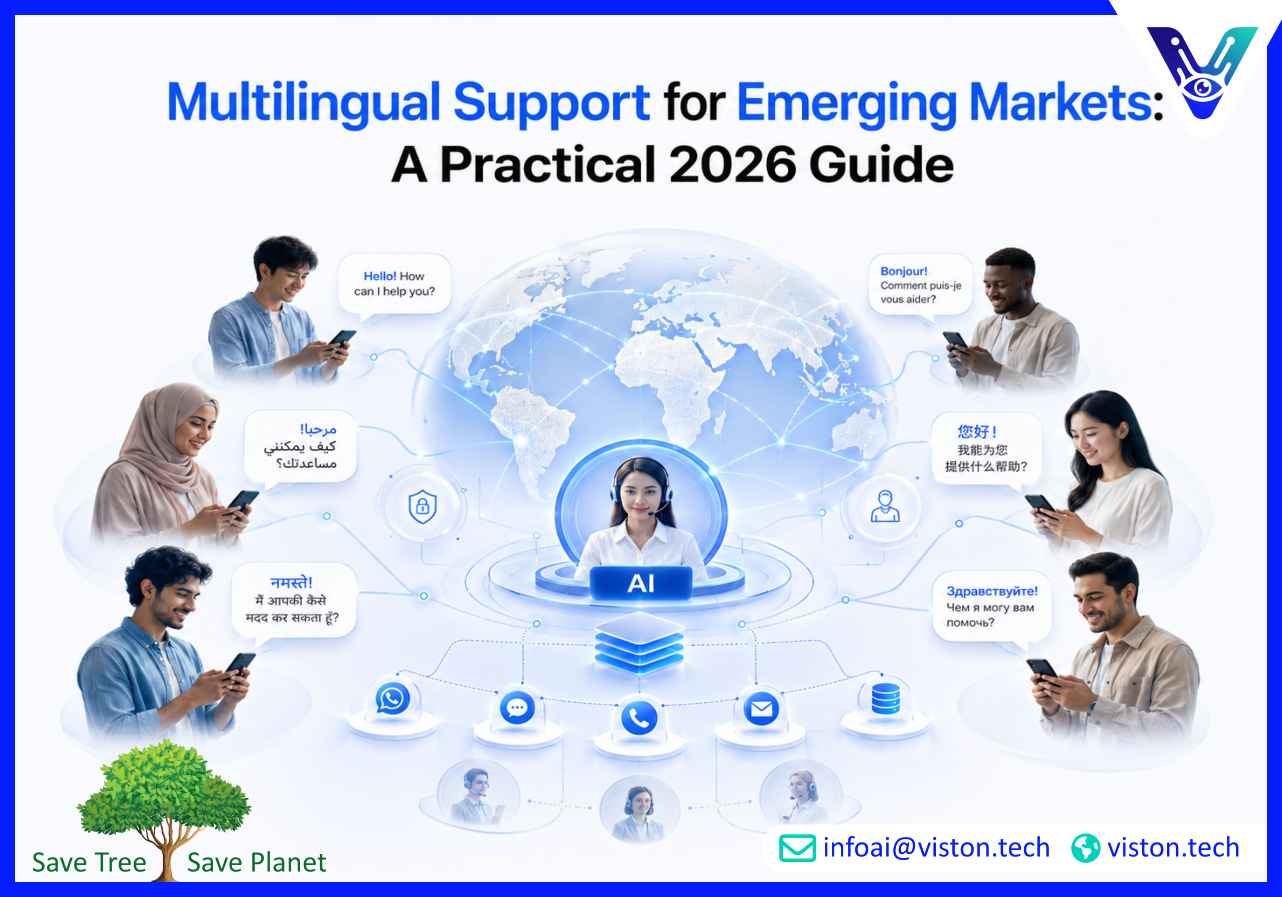
Multilingual Support for Emerging Markets: A Practical 2026 Guide
Multilingual support for emerging markets helps businesses serve customers who use different languages, dialects, digital channels, and communication styles. In 2026, effective support requires more than translation. It depends on localized knowledge, mobile-friendly experiences, reliable automation, secure integrations, and clear access to human assistance.
What Multilingual Support for Emerging Markets Really Involves
Emerging markets are not a single customer segment. They include countries and regions with different languages, income levels, technology infrastructure, regulations, payment systems, literacy levels, and customer-service expectations. Even within one country, customers may move between a national language, a regional language, English, and informal code-mixed language during the same conversation.For that reason, multilingual customer support cannot be reduced to translating an English help centre or adding a language selector to a chatbot. It is an operating capability that enables customers to understand a product, complete a transaction, resolve a problem, and receive appropriate assistance in a language and channel they can use confidently.
Translation and multilingual support are not the same
Translation converts content from one language into another. Multilingual support combines translation with customer context, product knowledge, workflow design, escalation rules, channel management, localization, and quality control.A translated response may be grammatically correct but still fail because it uses unfamiliar terminology, ignores local payment methods, gives the wrong regional process, or fails to recognize a culturally specific way of describing a problem.Reliable multilingual support should therefore account for:
Regional languages, dialects, scripts, and code-switching
Local product names, financial terms, measurements, currencies, and date formats
Customer preferences for chat, messaging apps, email, voice, or self-service
Differences in digital literacy and reading ability
Country-specific policies, delivery processes, identity requirements, and consumer rules
Clear escalation when automation cannot provide a safe or accurate answer
Digital services can expand market access in developing economies, but inclusive design remains important. The World Bank has noted that technology and AI can reduce barriers and help services reach underserved users, while warning that benefits may remain concentrated unless systems are designed for inclusion. GSMA research also continues to highlight affordability, digital skills, literacy, and practical usability as barriers to digital participation in lower- and middle-income markets.
Key Challenges When Supporting Customers in Emerging Markets
The main difficulty is not the number of languages. It is the operational complexity behind each language. Businesses must maintain answer quality, brand consistency, data protection, workflow reliability, and customer trust while adapting support to local conditions.
Language variation and code-mixed conversations
Customers do not always communicate in standardized written language. They may use phonetic spelling, regional vocabulary, abbreviations, transliterated text, informal grammar, or a mixture of two languages. A customer may begin a conversation in English, explain the problem in a local language, and use English product terms throughout.Support systems must be tested with real customer language rather than idealized translations. Intent recognition, search, and response generation should be evaluated using common misspellings, local expressions, mixed scripts, short messages, and incomplete questions.
Mobile-first and messaging-led behaviour
In many emerging markets, a smartphone is the customer’s primary connection to digital services. Support experiences therefore need to work on small screens, slower connections, and channels customers already use.Long chatbot responses, large attachments, complex forms, or repeated page loads can create unnecessary friction. Businesses may need concise messages, guided choices, low-data interfaces, asynchronous conversations, and support through messaging channels such as WhatsApp or other regionally important platforms.A mobile-first design should also preserve conversation progress. Customers should not have to restart a complaint or application because their connection was interrupted.
Limited high-quality data for some languages
Widely used languages often have stronger translation tools, training data, terminology resources, and quality-assurance options. Lower-resource languages and regional dialects may have less digital content available, making automated responses more difficult to validate.Businesses should not assume that equal technical availability means equal service quality. Every supported language needs its own testing, fallback thresholds, approved terminology, and review process.
Trust, security, and sensitive transactions
Customers may hesitate to share identity details, financial information, health data, or account credentials through an unfamiliar automated channel. This is especially important for fintech, healthcare, ecommerce, telecom, education, insurance, and public-service use cases.The support experience should clearly explain what information is required, why it is needed, how it will be used, and when the conversation is being transferred to a person. Authentication, access controls, retention policies, encryption, consent, and audit records should be designed around the applicable market and use case.
Human support capacity
Hiring fluent agents for every language and time zone may not be financially practical. However, removing people completely creates its own risks. Complaints, fraud concerns, vulnerable customers, legal requests, account restrictions, medical questions, and unusual payment problems often require judgment.The practical solution is a blended model. Automation handles repetitive and well-documented questions, while trained employees review complex, sensitive, or low-confidence conversations.
How to Build a Scalable Multilingual Support Model
A successful rollout begins with a narrow, evidence-based scope. Businesses should prioritize the languages, use cases, and channels that represent genuine customer demand rather than attempting to support every market immediately.
Prioritize languages using business and support data
Review website traffic, account registrations, customer locations, sales enquiries, abandoned transactions, support tickets, app-store feedback, and messaging conversations. This reveals which languages are already creating demand and where language barriers may be affecting conversion or retention.Language prioritization should consider:
Existing and expected customer volume
Revenue or strategic importance of the market
Frequency and complexity of support requests
Availability of reliable language resources
Regulatory and reputational risk
Access to fluent reviewers or escalation staff
Build an approved source of truth
Automation is only as dependable as the information behind it. Before translating content, businesses should clean and organize the original knowledge base. Outdated articles, conflicting policies, duplicate documents, and unclear ownership will create inconsistent answers in every language.Core content may include product information, account instructions, delivery policies, billing guidance, return processes, troubleshooting steps, eligibility rules, and escalation procedures. Each item should have an owner, approval status, review date, and market applicability.
Localize complete customer journeys
Businesses often translate marketing pages but leave onboarding, billing, error messages, help content, and cancellation processes in English. This creates a fragmented experience in which customers can purchase a service but cannot manage it successfully.Localization should cover the full journey, including:
Product discovery and pre-sales questions
Registration, verification, and onboarding
Payment and transaction guidance
Product use and technical assistance
Returns, refunds, cancellations, and complaints
Account recovery and human escalation
Combine AI automation with controlled human escalation
AI-supported chatbots can detect languages, answer common questions, retrieve approved information, summarize conversations, collect diagnostic details, and route customers to the correct team. However, they need defined boundaries.Escalation should be triggered by low confidence, repeated misunderstanding, negative sentiment, regulated advice, payment disputes, security concerns, vulnerable-customer indicators, or direct requests for an agent.The receiving employee should see the customer’s preferred language, conversation history, translated summary, detected intent, relevant account details, and actions already attempted. This avoids forcing the customer to repeat the entire problem.
Integrate support with operational systems
A multilingual assistant becomes more useful when it can access accurate business context. Depending on the use case, this may require integration with CRM, helpdesk, ecommerce, payment, logistics, booking, identity, subscription, or knowledge-management systems.Integration allows the support channel to check an order, update a ticket, schedule an appointment, verify an account status, record consent, or route a qualified sales enquiry. Permissions should be limited so the system can access only the information required for each task.
How to Measure Quality and Choose the Right Support Approach
Conversation volume alone does not prove that multilingual support is working. Businesses need language-level reporting that shows whether customers are receiving correct answers and completing their intended tasks.
Measure performance separately by language
Overall averages can hide serious weaknesses. A chatbot may perform well in English while producing high fallback rates or poor satisfaction in another language.Useful multilingual support metrics include:
First-response time by language and channel
Intent recognition and fallback rate
Self-service and first-contact resolution
Customer satisfaction by language
Repeat-contact and abandonment rates
Human escalation rate and handover quality
Translation corrections and terminology errors
Workflow completion and integration failure rates
Use native-language quality review
Automated scores cannot fully assess tone, cultural appropriateness, ambiguity, or regional terminology. Fluent reviewers should regularly examine successful conversations, failed conversations, complaints, escalations, and high-risk interactions.Reviews should identify inaccurate translation, unnatural phrasing, unsupported claims, incorrect policy retrieval, inappropriate formality, missing local context, and cases where the system should have escalated sooner.
Start with a controlled pilot
A practical pilot may cover one or two priority languages, one channel, and several high-volume intents. This makes it easier to validate terminology, workflow integration, customer acceptance, escalation, and reporting before expanding.The pilot should include realistic test conversations, security testing, failure scenarios, human handover, and clear success criteria. Expansion should be based on measured performance rather than assumed readiness.
Evaluate providers on operational capability
A multilingual support provider should be assessed on more than its language count. Buyers should examine how the provider manages localization, knowledge sources, low-resource languages, integrations, data security, escalation, monitoring, and ongoing optimization.Important evaluation questions include whether the solution can support code-mixed language, maintain different policies by market, report results by language, operate on mobile messaging channels, connect with existing systems, and provide a clear process for correcting inaccurate answers.
How Viston AI Supports Multilingual Service Delivery in Emerging Markets
Viston AI provides Multilingual AI Chatbot Support for businesses that need to manage customer conversations across languages, channels, and operational workflows. Its published capabilities include language-aware intent recognition, real-time translation and localization, omnichannel deployment, intelligent routing, performance analytics, and integrations with CRM platforms, knowledge bases, transaction systems, and other business applications.These capabilities are relevant to emerging-market deployments because language is only one part of the service challenge. A business may also need to support mobile users, regional terminology, mixed-language conversations, local processes, variable demand, and limited access to fluent agents.Viston AI’s delivery methodology covers discovery, data preparation, model selection, testing, integration, deployment, monitoring, and continuous optimization. This provides a structured path for organizations that want to begin with selected languages and high-value support use cases before expanding coverage.The approach can support ecommerce, SaaS, financial services, travel, telecom, education, logistics, healthcare, marketplaces, and other service-led organizations. By connecting multilingual conversations with approved knowledge, business systems, escalation rules, and language-specific reporting, companies can build support operations that are more consistent, measurable, and scalable without treating automated translation as a complete solution.
Frequently Asked Questions
What is multilingual support for emerging markets?
Multilingual support for emerging markets is the delivery of customer assistance across relevant local languages, dialects, and channels. It combines localization, automation, business knowledge, system integration, quality assurance, and human escalation.
Which languages should a business support first?
Start with languages linked to existing customer demand, commercial opportunity, repeated support problems, and high-value markets. Customer location, ticket data, website traffic, sales enquiries, and abandoned transactions can guide prioritization.
Can AI handle lower-resource languages reliably?
AI can support many lower-resource languages, but performance may vary. Businesses need language-specific testing, approved terminology, confidence thresholds, fluent review, fallback responses, and access to human assistance.
Is machine translation enough for customer support?
No. Machine translation may help with routine communication, but complete support also requires localized policies, customer context, workflow integration, cultural appropriateness, security controls, and escalation for complex cases.
Which channels matter most in emerging markets?
The right channels depend on customer behaviour. Mobile web, in-app chat, WhatsApp, other messaging platforms, email, voice, and lightweight self-service may all be relevant. Businesses should prioritize channels customers already use.
How can Viston AI help with an emerging-market rollout?
Viston AI can support multilingual chatbot development, localization, channel deployment, intelligent routing, system integration, analytics, testing, and ongoing optimization. A rollout can begin with priority languages and selected use cases before expanding.
Conclusion
Multilingual support for emerging markets should make digital products and services easier to understand, access, and trust. The strongest model combines localized knowledge, mobile-friendly communication, carefully governed automation, secure integrations, and timely human assistance. Businesses should begin with real language demand, test each language independently, and measure customer outcomes rather than translation volume. Viston AI offers relevant Multilingual Support capabilities for organizations seeking a structured way to connect language-aware customer conversations with business workflows, escalation processes, and continuous performance improvement.