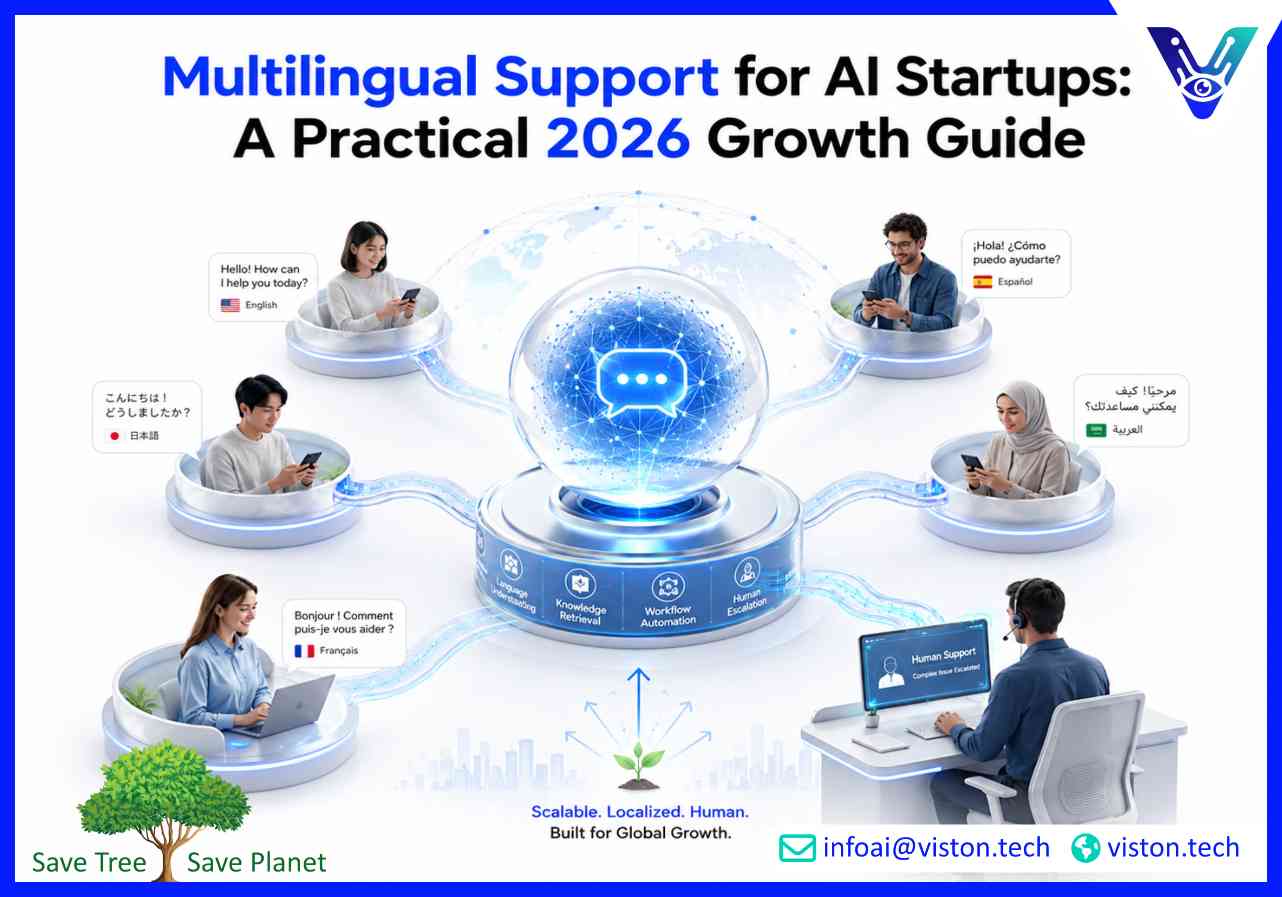
Multilingual Support for AI Startups: A Practical 2026 Growth Guide
Multilingual support for AI startups is no longer only a localization task. It is an operating capability that affects product adoption, onboarding, technical support, trust, retention, and international growth. Startups that design it early can serve global users consistently without building a large language-specific support team for every new market.
What Multilingual Support for AI Startups Really Involves
Multilingual support means enabling customers to understand, use, troubleshoot, and evaluate an AI product in their preferred language. It includes more than translating chatbot replies. A complete support experience may involve localized onboarding, help-center content, product documentation, in-app guidance, automated conversations, ticket routing, escalation, release communications, and human-agent support.For an AI startup, the challenge is especially complex because the product itself may generate, summarize, classify, recommend, or automate content. Users therefore need support that can explain not only account and billing issues but also model behavior, output limitations, data handling, integrations, prompt design, and workflow failures.
Translation and localization are not the same
Translation changes words from one language to another. Localization adapts the complete experience to a market or user group. That includes terminology, tone, date and number formats, currencies, legal wording, examples, interface space, reading direction, and culturally appropriate phrasing.An AI support assistant may produce grammatically correct translations while still confusing users because it applies the wrong technical term, uses a phrase that sounds unnatural, or gives instructions that do not match the localized interface. Startups need approved glossaries, language-specific content rules, and regional review rather than relying on raw machine translation alone.
The support layer must understand product context
General language fluency is not enough. The support system must understand the startup’s product architecture, plans, permissions, integrations, error states, and common user goals. It should distinguish between a general question and an action that requires account data, a backend lookup, or human approval.For example, “the model is not working” may refer to API latency, a failed authentication token, an unsupported file type, a usage limit, or dissatisfaction with an output. Accurate multilingual support requires intent recognition, technical context, and a structured troubleshooting path in each supported language.
Why Multilingual Support Matters for AI Startups in 2026
AI products can attract international demand early because they are distributed digitally and often solve problems that exist across markets. That creates an opportunity, but it also exposes a startup to customer expectations it may not be operationally prepared to meet. English-only support can become a barrier even when the product interface is simple.
It reduces friction during onboarding and evaluation
Prospective users often test an AI product before speaking with sales. They read documentation, connect data sources, try prompts, and assess output quality independently. Localized guidance removes uncertainty and helps buyers reach value faster. Poorly translated technical documentation, by contrast, can cause implementation errors and weaken confidence.
It helps lean teams manage global support volume
Early-stage companies rarely have the budget to hire a dedicated support team for every language. A multilingual AI support layer can handle repetitive questions, guide users through standard workflows, summarize conversations, and route complex cases to the right person. The goal is not to prevent human contact. It is to reserve human time for issues that require judgment, investigation, or relationship management.Automation also gives founders and product teams better visibility into recurring market-specific problems. If users in one language repeatedly ask about a feature, payment method, integration, or policy, the startup can identify a product or content gap rather than treating each ticket as an isolated event.
It supports trust, transparency, and responsible deployment
Users need to know when they are interacting with an automated system, what it can do, and when a human is available. This expectation is becoming more important as AI rules mature. For companies serving the European Union, the EU AI Act’s chatbot transparency provisions become applicable on 2 August 2026, including the requirement to inform people when they are interacting with a machine.Startups should therefore build disclosure, consent, escalation, logging, and content-governance processes into multilingual support from the beginning. A disclosure written clearly in English but poorly translated elsewhere does not create a consistent user experience.
How to Build Scalable Multilingual Support for an AI Product
The most effective approach is to expand deliberately rather than launch every language at once. Start with markets where customer demand, revenue opportunity, product readiness, and support data justify investment.
Prioritize languages using evidence
Review sign-ups, website traffic, trial activity, support tickets, sales enquiries, churn reasons, and product usage by country or browser language. Combine this with commercial priorities. A language may have high traffic but low product fit, while a smaller market may contain valuable enterprise buyers with urgent support needs.
Create a controlled multilingual knowledge base
The support system should retrieve answers from approved product information rather than improvise. Build a source-of-truth knowledge base containing current documentation, troubleshooting steps, feature definitions, plan rules, security answers, integration guidance, and escalation policies.Each article should have an owner, version, review date, and translation status. Product changes must update all language versions together. A terminology glossary should define product names, technical terms, preferred translations, untranslated phrases, prohibited wording, and tone guidance.
Design for language, locale, and interface behavior
Internationalization should be built into the product and support architecture. Use Unicode-compatible systems, language tags, flexible interface layouts, locale-aware dates and numbers, and right-to-left support where required. W3C guidance recommends declaring content language, supporting localized formats, using UTF-8, and providing clear access to localized versions.Support flows should handle code-switching and preserve product names, error codes, URLs, and technical identifiers rather than translating them incorrectly.
Test quality separately for every language
A chatbot that performs well in English may fail in another language because training data, terminology, sentiment cues, or intent examples are weaker. Evaluate each language using realistic customer questions, ambiguous phrasing, misspellings, regional vocabulary, and multi-turn troubleshooting scenarios.Track language-level metrics such as intent accuracy, successful resolution, fallback rate, escalation rate, response correctness, customer satisfaction, and human correction rate. Aggregate reporting can hide poor performance in lower-volume languages.
Build safe human handover and feedback loops
Escalation should transfer the full context: language, detected intent, account information, conversation history, steps already attempted, and the reason for handover. If a bilingual agent is unavailable, the system can provide a translated summary while preserving the original conversation for review.Review failed and corrected conversations to identify missing knowledge, weak translations, unsafe responses, integration failures, and new intents. Do not automatically train on every conversation without privacy controls and quality review.
How to Choose a Multilingual Support Solution or Partner
AI startups should evaluate providers based on operational fit, not the number of languages shown on a feature list. A useful solution must support the languages, channels, integrations, and risk profile that the business actually needs.
Assess language quality and domain expertise
Ask how the provider handles technical vocabulary, regional variations, culturally sensitive wording, and lower-resource languages. Test it with real product questions, and require a clear explanation of how models, retrieval, glossaries, translation, and human review work together.
Check integration and workflow depth
Confirm that the solution can connect securely with the helpdesk, CRM, knowledge base, authentication, billing, status, and analytics systems. It should retrieve permitted information, create tickets, route conversations, trigger workflows, and log outcomes.
Review security, privacy, and model controls
Understand where conversation data is processed, how long it is retained, which model providers receive it, and how access is controlled. The system should protect sensitive data, validate outputs before triggering business actions, and address threats such as prompt injection and unsafe downstream output handling, which remain central risks for LLM applications.
Demand measurable performance
Define success before implementation. Measure first-contact resolution, time to resolution, ticket deflection, language-specific satisfaction, escalation quality, correction rate, onboarding completion, and cost per resolved conversation. Evaluation should continue after launch.
How Viston AI Supports Multilingual Growth for AI Startups
Viston AI offers multilingual AI chatbot support as part of its conversational AI and language technology services. Its published service capabilities include multilingual intent recognition, real-time translation and localization, centralized knowledge management, intelligent routing, escalation, and performance analytics. The company also describes deployments across web chat, mobile applications, WhatsApp, SMS, voice assistants, and social channels.These capabilities are relevant to AI startups that need to serve international users without creating disconnected support processes for each market. A startup can use a multilingual support layer to answer common product questions, guide onboarding, qualify enquiries, surface documentation, and pass complex issues to human teams with context.Viston AI’s wider offering includes AI chatbot development, NLP and text analysis, language translation, business-system integration, workflow automation, and model monitoring. That combination can be useful when multilingual support must connect to a helpdesk, CRM, knowledge base, product workflow, or analytics environment rather than operate as a standalone chat interface.For growing AI companies, the practical value lies in designing support around approved knowledge, measurable language-level performance, secure integrations, and continuous optimization. This gives the startup a more scalable way to expand language coverage while protecting consistency, product accuracy, and customer trust.
Frequently Asked Questions
When should an AI startup introduce multilingual support?
Introduce it when user data shows meaningful demand from non-English-speaking markets, or when expansion into a target region is commercially planned. Start with the highest-value languages and priority support journeys rather than translating everything immediately.
Can AI fully replace multilingual support agents?
No. AI can resolve repetitive questions, translate content, collect context, and route tickets, but human support remains important for complex technical cases, sensitive complaints, contractual issues, and situations where the system is uncertain.
Which content should be localized first?
Prioritize onboarding instructions, key help articles, common troubleshooting flows, pricing and billing explanations, security information, error messages, and escalation paths. These materials have the greatest effect on adoption and support demand.
How can startups measure multilingual support quality?
Track resolution rate, fallback rate, escalation rate, customer satisfaction, response accuracy, correction rate, and time to resolution by language. Review failed conversations regularly and compare automated answers with approved product information.
What is the difference between a multilingual chatbot and translated help content?
Translated help content is static information. A multilingual chatbot can understand questions, retrieve relevant content, maintain conversation context, collect account details, perform supported actions, and escalate users to human teams.
Can Viston AI integrate multilingual support with existing startup tools?
Viston AI positions its multilingual support alongside chatbot integration, NLP, workflow automation, and business-system connectivity. The exact integration scope should be defined around the startup’s helpdesk, CRM, knowledge base, product APIs, security requirements, and target channels.
Conclusion
Multilingual support for AI startups is a practical foundation for international product adoption, not simply a translation feature. In 2026, startups need language-aware knowledge, localized workflows, transparent automation, secure integrations, measurable quality, and reliable human escalation. A phased approach allows teams to focus investment on the markets and customer journeys that matter most. By treating multilingual support as part of product operations, AI companies can reduce onboarding friction, improve technical support, and scale customer experience more responsibly. Viston AI offers relevant multilingual chatbot, NLP, integration, and automation capabilities for startups building this operational foundation.