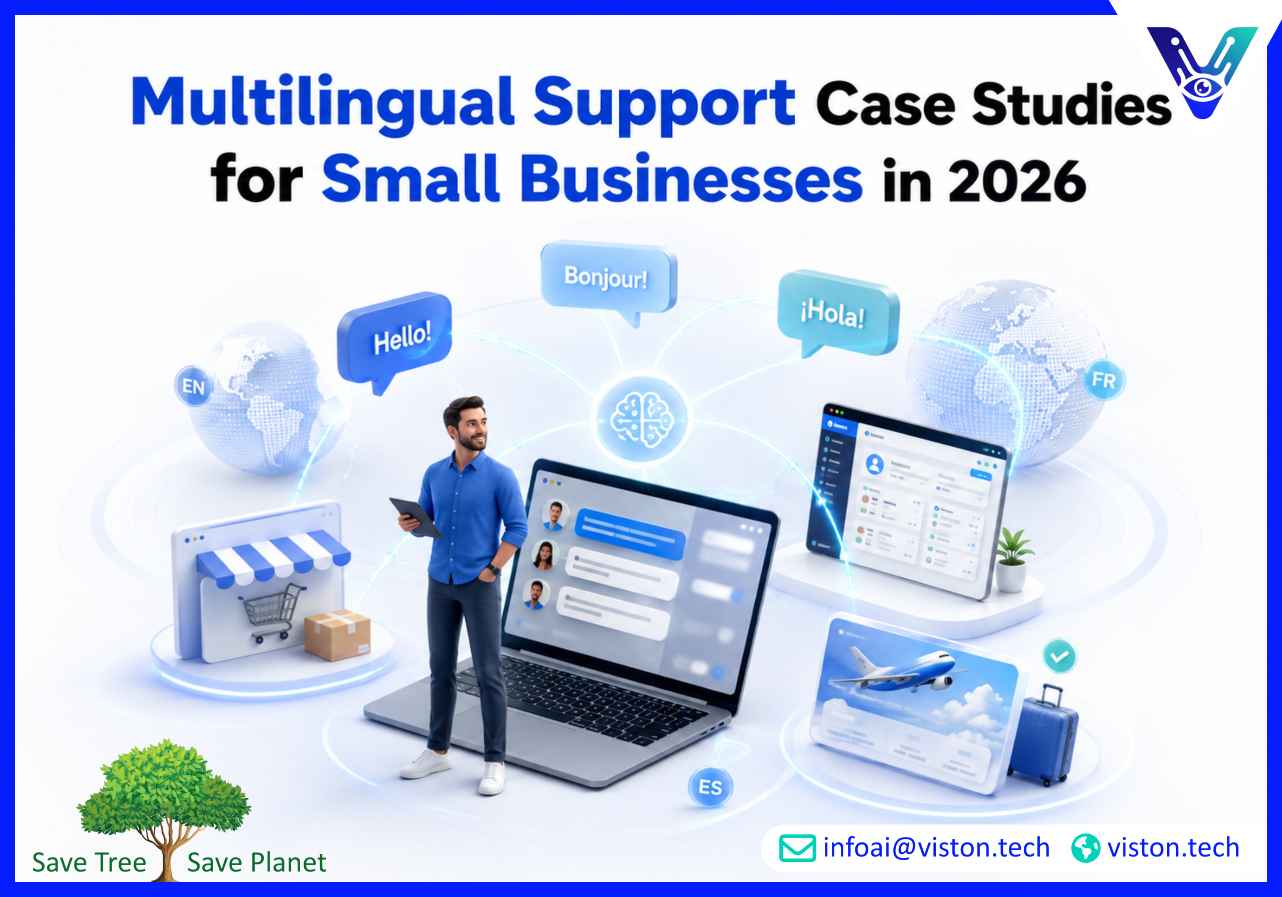
Multilingual Support Case Studies for Small Businesses in 2026
Multilingual support case studies for small businesses show that international customer service does not require a large contact centre. With focused language coverage, reliable automation, localized knowledge, and clear human escalation, smaller companies can serve new markets while controlling workload, service quality, and operating costs.
What Multilingual Support Case Studies Reveal About Small-Business Growth
Small businesses often begin serving multilingual customers before they have deliberately planned for international support. An ecommerce store may receive questions from overseas buyers, a SaaS company may attract users through global search, or a local hospitality provider may start receiving bookings from several countries.The first response is often informal. A founder uses an online translator, a bilingual employee handles every foreign-language message, or customers are asked to communicate in English. These methods can work temporarily, but they become fragile as conversation volume increases.Effective multilingual customer support means delivering a dependable level of service across selected languages, not simply translating individual sentences. Customers still need accurate answers, appropriate tone, secure handling of personal information, clear escalation, and consistent policies. In 2026, AI chatbots and translation tools can identify languages and automate common enquiries, but businesses must still define which languages, channels, use cases, and service levels they can support.
Why small businesses need a focused model
A small company rarely needs to support every language from the first day. It needs to identify the languages that create the most support demand or commercial opportunity and build a reliable operating model around them.A practical rollout normally starts with:
The two or three highest-demand customer languages
Frequently repeated enquiries that are safe to automate
Translated and approved knowledge-base content
Language-specific routing and escalation rules
Human review for complaints, refunds, legal issues, and complex cases
Performance reporting by language, channel, and enquiry type
The following case-based scenarios reflect common small-business environments. They focus on realistic workflows and decisions rather than presenting unverified customer names, testimonials, or performance claims.
Multilingual Support Case Studies for Ecommerce and Local Service Businesses
Case study 1: A niche ecommerce store serving international buyers
Consider a small online retailer that originally sells in English but begins receiving orders from customers in France, Germany, and Spain. Sales increase, but so do questions about delivery dates, sizing, payment methods, customs charges, returns, and damaged products.The owner initially translates each message manually. This creates slow responses, inconsistent wording, and a growing risk that return policies will be explained differently across languages. A bilingual employee becomes the default person for every non-English enquiry, creating a single point of failure.A more sustainable multilingual support model begins by reviewing ticket history. The business identifies the most common intents: order tracking, product information, cancellations, returns, and delivery problems. Approved answers are then localized into the priority languages and added to the help centre.An AI-supported chat or email workflow can detect the customer’s language, retrieve the appropriate policy, and answer routine questions. Order-status requests can be connected to the ecommerce platform, while complaints, payment disputes, and unusual return cases are escalated to a person with the full translated conversation attached.The business value comes from consistency rather than translation volume alone. Customers receive faster answers, employees spend less time rewriting the same information, and policies remain aligned across markets. The retailer can measure progress through first-response time, self-service resolution, repeat-contact rate, return-related escalations, and customer satisfaction by language.
Case study 2: A local tour operator supporting overseas guests
A small tour operator may serve customers who book through its website, travel marketplaces, social media, email, and WhatsApp. Enquiries arrive in multiple languages and often concern time-sensitive issues such as meeting points, transport delays, cancellations, weather changes, accessibility, and booking amendments.Generic machine translation is risky when instructions affect where and when a customer must arrive. The business needs approved multilingual message templates for operational information and a clear process for urgent cases.The operator can create localized pre-arrival messages, frequently asked questions, booking confirmations, refund explanations, and emergency instructions. A multilingual assistant can answer routine questions around the clock while routing booking changes or safety-related enquiries to an employee.The important design choice is context. The system should know the customer’s booking, selected tour, date, location, and preferred language. Without this information, even a grammatically correct answer may be operationally wrong.Useful KPIs include missed-tour enquiries, response time by channel, percentage of conversations resolved before arrival, booking-change completion rate, and the number of customers who need to repeat information after escalation.
Multilingual Support Case Studies for SaaS and Marketplace Companies
Case study 3: A micro SaaS company expanding beyond its home market
A small SaaS company may attract international customers through product-led growth long before it hires regional support teams. Users can sign up independently, but they still need help with onboarding, integrations, billing, account access, subscriptions, and technical errors.The company’s first challenge is usually knowledge consistency. Product pages may be translated, while setup guides, error messages, and support replies remain English-only. Customers can buy the software but struggle to reach value after registration.A focused multilingual support plan starts with onboarding and high-volume product questions. The team localizes core help articles, interface terminology, billing explanations, and troubleshooting steps. It also creates a terminology glossary so that feature names and technical terms are translated consistently.A multilingual chatbot can guide users through setup, retrieve relevant documentation, and collect diagnostic details before opening a ticket. Complex technical problems should be transferred to a specialist with the original message, translated summary, account information, and attempted troubleshooting steps.Testing must include natural customer language rather than polished translations. Research published in 2026 found that machine-translated test data can overstate multilingual intent-classification performance compared with noisy, native customer queries, particularly for less common intents.The SaaS company should monitor activation rate by language, onboarding completion, ticket deflection, billing-related contacts, fallback rate, escalation quality, and customer retention. These metrics show whether multilingual support is improving product adoption rather than simply increasing automated conversation volume.
Case study 4: A small marketplace coordinating buyers and sellers
A specialist marketplace faces a more complex multilingual environment because support may involve two customer groups. Buyers ask about products, payments, delivery, and refunds, while sellers need help with listings, verification, fees, fulfilment, and account restrictions.Direct translation is not enough when a support case depends on marketplace rules. The system must distinguish between buyer and seller intents, retrieve the correct policy, and preserve the meaning of evidence such as delivery notes, product descriptions, and dispute messages.The marketplace can begin by separating knowledge and workflows by user type. Routine questions can be automated, while disputes, fraud concerns, policy appeals, and payment issues should be reviewed by trained staff. Language-aware routing can assign cases to available specialists or provide translated summaries when a fluent agent is unavailable.The strongest outcome is operational visibility. Management can identify which languages generate the most unresolved cases, which policies cause confusion, and where translated content needs improvement. Relevant measures include dispute-resolution time, incorrect routing, repeat contact, seller onboarding completion, escalation rate, and satisfaction for buyers and sellers in each supported language.
How Small Businesses Can Apply These Multilingual Support Lessons
These multilingual support case studies show that successful delivery depends on scope, knowledge quality, workflow integration, and continuous review. Buying a translation tool without redesigning the support process usually moves the language problem rather than solving it.
Prioritize languages using real demand
Review customer locations, browser languages, support tickets, sales enquiries, refunds, and abandoned conversations. Select languages according to commercial opportunity and service demand, not assumptions about which markets may become important.
Automate suitable enquiries first
Order tracking, account access, opening hours, subscription guidance, booking confirmations, and standard product questions are often practical starting points. Sensitive complaints, negotiations, legal requests, complex technical issues, and high-value disputes require stronger human oversight.
Localize knowledge rather than translating isolated replies
Create approved source content before expanding language coverage. Policies, product terminology, troubleshooting instructions, and escalation messages should have clear owners and review dates. Localization should account for tone, cultural expectations, currencies, dates, measurements, and regional processes.
Connect support with business systems
Customers expect the support channel to recognize their order, booking, subscription, or account. Integrating multilingual support with CRM, helpdesk, ecommerce, scheduling, and knowledge platforms reduces repetitive questions and gives automated responses the context needed to be useful.
Measure quality separately for each language
A strong result in English does not prove that another language performs equally well. Track resolution, fallback, escalation, satisfaction, response time, and translation corrections for each language. Review native-language conversations regularly to identify mistranslated terminology, unnatural tone, and missing intents.
How Viston AI Supports Multilingual Service Delivery for Growing Businesses
Viston AI provides Multilingual AI Chatbot Support designed to manage customer conversations across languages, channels, and business workflows. Its published service capabilities include language-aware intent recognition, real-time translation and localization, omnichannel deployment, intelligent routing, performance analytics, and integration with CRM platforms, knowledge bases, transaction systems, and other business applications.These capabilities are relevant to small businesses that need more structured multilingual support without immediately building separate teams for every market. A deployment can begin with selected languages and high-volume use cases, then expand as demand becomes clearer.Viston AI’s delivery approach includes discovery, data preparation, model selection, testing, system integration, deployment, monitoring, and continuous optimization. For a retailer, SaaS provider, marketplace, travel business, or other growing company, this can support consistent answers, language-specific routing, contextual automation, and measurable service improvement.The practical advantage is not simply the number of languages available. It is the ability to connect translated conversations with approved business knowledge, operational systems, escalation rules, and performance reporting. That structure helps a small business provide responsive multilingual support while maintaining control over quality, security, and customer experience.
Frequently Asked Questions
What do multilingual support case studies for small businesses demonstrate?
They demonstrate that small companies can support international customers by prioritizing high-demand languages, localizing core knowledge, automating routine enquiries, integrating support systems, and escalating complex cases to people.
Does a small business need native-speaking agents for every language?
Not necessarily. AI translation, localized self-service content, and translated agent workspaces can cover many routine interactions. Native or fluent review remains valuable for complex complaints, sensitive conversations, cultural nuance, and quality assurance.
Which customer enquiries should be automated first?
Start with repetitive, well-documented, low-risk enquiries such as order tracking, booking confirmations, account access, product information, subscription guidance, opening hours, and standard return procedures.
How should multilingual support quality be measured?
Track first-response time, resolution rate, fallback rate, escalation rate, customer satisfaction, repeat contact, translation corrections, and workflow completion separately for each language and channel.
What is the biggest multilingual support risk for a small business?
The biggest risk is providing a fluent but inaccurate answer. Businesses need approved source content, confidence thresholds, human escalation, access controls, and regular review of native-language conversations.
Can Viston AI support a phased multilingual rollout?
Viston AI’s multilingual support, integration, analytics, and optimization capabilities are suited to phased deployment. A business can begin with priority languages and specific use cases before extending coverage based on demand and performance.
Conclusion
Multilingual support case studies for small businesses show that effective global service is built through disciplined choices, not unlimited language coverage. Companies should prioritize real customer demand, localize trusted knowledge, automate appropriate enquiries, preserve human escalation, and measure performance by language. Multilingual Support can help ecommerce stores, SaaS providers, marketplaces, hospitality companies, and other growing businesses serve wider audiences without losing operational control. Viston AI offers relevant multilingual chatbot, integration, routing, and analytics capabilities for organizations seeking a scalable and business-focused approach.