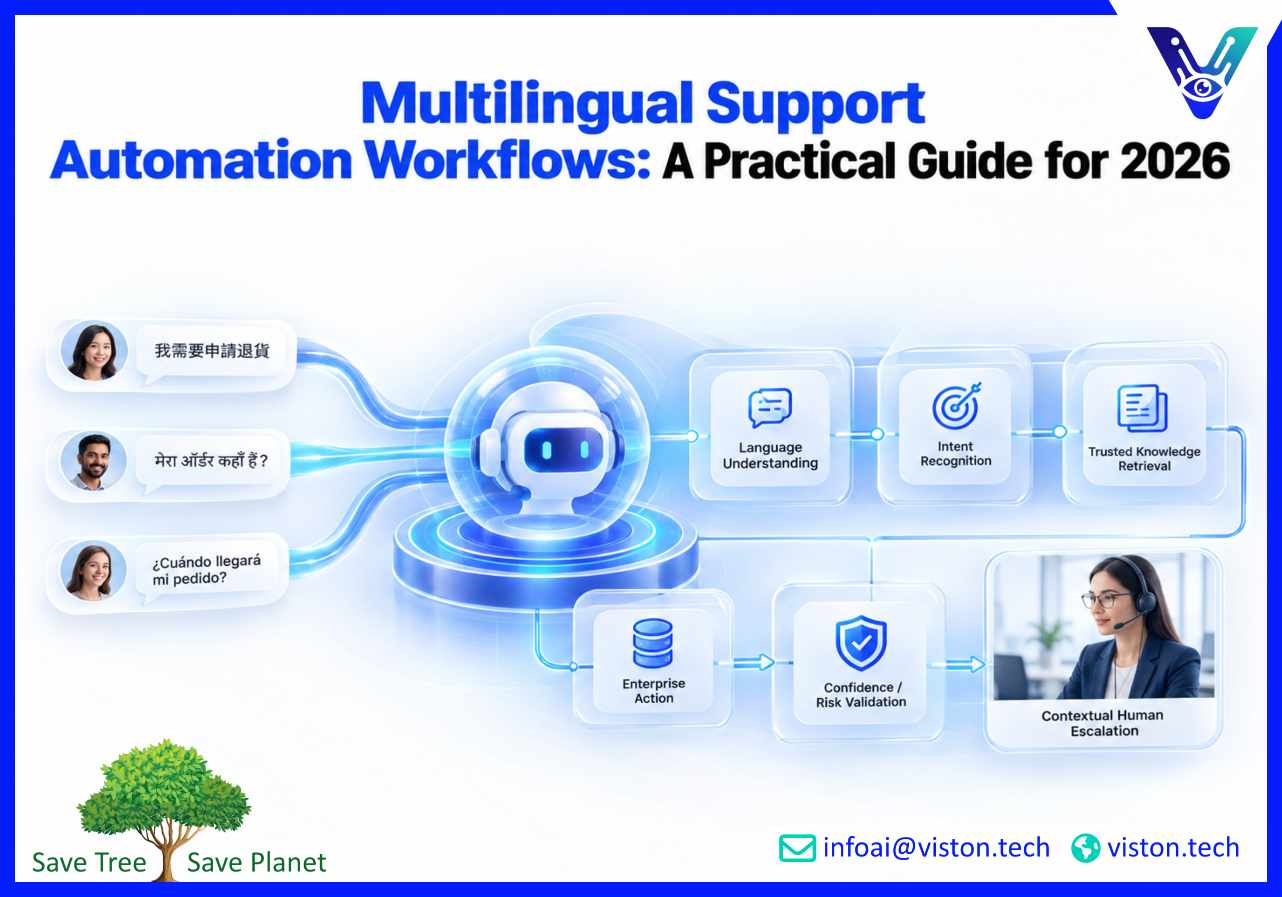
Multilingual Support Automation Workflows: A Practical Guide for 2026
Multilingual support automation workflows help businesses serve customers across languages without creating disconnected processes for every market. In 2026, effective automation must do more than translate messages: it must detect intent, retrieve approved knowledge, trigger business actions, preserve context, and escalate sensitive or complex cases to the right human team.
What Multilingual Support Automation Workflows Actually Involve
A multilingual support workflow is a coordinated sequence that receives a customer request, identifies the language and intent, gathers the right business context, produces or retrieves an approved response, completes any permitted action, and records the outcome. The same workflow may operate across web chat, mobile apps, messaging platforms, email, voice, and internal service portals.The key word is workflow. Translation is only one component. A useful system must also understand what the customer is trying to achieve, which account or order is involved, what information the user is allowed to access, whether an automated action is safe, and when a specialist should take over.
The Core Stages of a Multilingual Automated Interaction
Channel and identity capture: The system identifies where the request came from and, when appropriate, verifies the user.
Language detection: It determines the customer’s preferred language, including mixed-language messages where possible.
Intent and entity recognition: It identifies the goal and extracts details such as product, order number, location, subscription, date, or issue type.
Knowledge retrieval: It searches an approved multilingual knowledge base or retrieves localized content from a trusted source.
Action or response: It answers the question or initiates a permitted workflow, such as creating a ticket, checking delivery status, scheduling an appointment, or updating a CRM record.
Confidence and risk check: It evaluates whether the response is reliable enough to deliver automatically.
Escalation and handover: It routes complex, sensitive, or low-confidence cases to an appropriate agent with full context.
Logging and analysis: It records language, intent, outcome, errors, escalation reason, and customer feedback for improvement.
How to Design Multilingual Support Automation Workflows
Strong workflow design begins with customer needs, not software features. Businesses should identify high-volume, repeatable requests that have clear answers or reliable system actions. Common starting points include order tracking, account access, appointment scheduling, product information, subscription questions, returns, ticket creation, and basic troubleshooting.
Start With an Intent Map, Then Add Language Coverage
Define the customer intents the workflow will support before translating content. For each intent, document the required data, approved answer source, business rules, integrations, escalation conditions, and success criteria. Then review how customers express that intent in each priority language.Customers may use local product names, abbreviations, informal phrases, regional spellings, mixed-language sentences, or culturally specific descriptions. Recent research found that machine-translated test data can overstate real-world multilingual intent performance compared with native customer queries, especially for long-tail intents. Native-language testing is therefore essential.
Use One Governed Knowledge Source
Automated support should retrieve answers from approved, current content rather than from scattered documents. A central knowledge layer can contain product information, policy explanations, troubleshooting steps, localized templates, terminology rules, and escalation instructions.Each content item should have an owner, review date, target audience, applicable regions, and language status. Source changes should update every connected channel rather than separate scripts, macros, and articles.
Connect the Workflow to Business Systems
Customers often need an action, not an explanation. Integrations with CRM, helpdesk, ecommerce, identity, booking, billing, order-management, and knowledge systems allow automation to complete tasks while maintaining a traceable record.For example, an order-status workflow may detect Spanish, verify the customer, retrieve the latest shipment event, explain the status in Spanish, create a delivery investigation when a threshold is met, and log the complete interaction in the helpdesk. The language layer should not break the underlying operational rules.
Set Confidence Thresholds and Approval Points
Not every request should be handled automatically. Low-confidence intent detection, conflicting source information, emotionally charged complaints, payment disputes, legal requests, safety concerns, and high-value account changes may require a human decision.Separate low-risk informational responses from actions that change data, money, access, or contractual status. Require human approval before sensitive actions.
Which Workflows Deliver the Most Business Value
The best multilingual support automation workflows reduce repetitive work while improving the customer’s ability to complete a task. The right use cases depend on transaction volume, language demand, system readiness, operational risk, and the quality of available knowledge.
Customer Service Triage and Routing
The system detects language, intent, sentiment, urgency, customer tier, and product area, then sends the request to the correct queue. When human support is required, the agent should receive the original message, translated summary, detected intent, customer history, and actions already attempted.This workflow reduces manual sorting and prevents multilingual requests from being placed in a general queue simply because the first-line team cannot read them.
Knowledge-Based Self-Service
Customers can ask questions naturally and receive responses grounded in approved support content. Suitable topics include setup guidance, feature explanations, eligibility rules, operating hours, document requirements, warranty information, and standard troubleshooting.The system should preserve important details such as product names, technical terms, policy wording, measurements, and dates. It should also show uncertainty when the knowledge source is missing or contradictory rather than generating a confident but unreliable answer.
Transactional Workflows
Automation can guide customers through structured tasks such as booking, rescheduling, order lookup, refund initiation, password recovery, subscription changes, lead qualification, or service requests. These workflows create the most value when they combine multilingual conversation with secure system integration.Every transactional flow needs consistent validation for required fields, identity, consent, errors, duplicates, and confirmations.
Agent-Assist Workflows
Not all automation needs to face the customer directly. Agent-assist tools can translate incoming messages, summarize conversation history, retrieve relevant articles, recommend responses, and produce localized follow-up notes. The agent remains responsible for reviewing the output before sending it.This model is useful for complex conversations, lower-volume languages, and regulated environments where fluent language output alone does not prove that a response is safe or appropriate. Research on multilingual AI in healthcare, for example, emphasizes accountable workflow design, traceability, and calibrated human oversight for high-stakes communication.
How to Govern, Measure, and Improve Multilingual Automation
Launching language coverage is not the end of the project. Customer terminology changes, products evolve, policies are updated, and new failure patterns appear. A reliable operating model combines language quality assurance, workflow monitoring, security controls, and regular review by support specialists.
Measure Performance by Language and Intent
Overall averages can hide gaps. Track performance by language, intent, channel, region, and customer segment.
Intent recognition accuracy
Successful task completion rate
Fallback and clarification rate
Self-service resolution rate
Escalation rate and escalation reason
Human handover quality
Customer satisfaction by language
Workflow and integration failure rate
Knowledge retrieval accuracy
Average time to resolution
Review failed and abandoned conversations, not only successful ones. A high automation rate is not valuable when customers receive inaccurate answers, repeat information after handover, or reopen the same issue.
Build a Language Quality Process
Priority languages should be reviewed by qualified native or near-native speakers who understand the product and customer context. Testing should include spelling variants, informal phrasing, code-switching, slang, typos, long messages, ambiguous requests, and unsupported topics.Create approved glossaries for brand terms, technical vocabulary, product names, legal wording, and phrases that must not be translated. Maintain localized response patterns rather than forcing identical sentence structures across every market.
Protect Customer Data Throughout the Workflow
Multilingual automation may pass customer data through models, translation services, integration platforms, logs, and analytics systems. Businesses should minimize unnecessary data exposure, control access by role, encrypt data in transit and at rest, define retention periods, maintain audit trails, and review where data is processed.Security reviews should cover both the conversational layer and every connected action. A well-translated response does not compensate for weak authentication, excessive permissions, or an integration that updates the wrong record.
Create a Continuous Improvement Cycle
Support teams, language reviewers, product owners, and technical teams should share ownership. Use a scheduled cycle to update intents, knowledge, prompts, routing rules, integrations, and test sets.Version changes and compare results before expanding automation so performance declines can be traced to content, models, workflows, or integrations.
How Viston AI Supports Multilingual Support Automation Workflows
Viston AI is directly relevant to multilingual support automation workflows because its service portfolio combines multilingual AI chatbot support, workflow automation, and business-system integration. The company describes its multilingual offering as using natural language processing, generative AI, centralized knowledge management, omnichannel orchestration, intelligent routing, and performance analytics across customer-facing channels.That combination matters when a business needs more than translated answers. A complete workflow may need to recognize intent in the customer’s language, retrieve approved information, check CRM or order data, trigger a ticket or operational process, and transfer the case with context. Viston AI’s chatbot integration service specifically addresses bidirectional data exchange, CRM and ERP connectivity, multichannel orchestration, business-rule validation, and multi-step workflow automation.Its broader automation capabilities also include process orchestration, document handling, decision automation, governance, and cloud deployment options. These capabilities can support organizations that want multilingual service to operate as part of a scalable customer-experience and operations architecture rather than as an isolated translation tool.For global and cross-industry teams, the practical value is a structured delivery approach: prioritize use cases, connect trusted knowledge and systems, define escalation rules, test with native-language inputs, and measure performance separately by language. That creates a stronger foundation for reliable automation, controlled expansion, and consistent customer support across markets.
Frequently Asked Questions
What Is a Multilingual Support Automation Workflow?
It is an automated process that detects a customer’s language and intent, retrieves approved information, completes permitted support actions, records the outcome, and escalates the case when human judgment is required.
Is Real-Time Translation Enough for Multilingual Customer Support?
No. Translation does not provide identity verification, business context, knowledge governance, workflow actions, risk controls, or effective escalation. Reliable multilingual support combines language technology with process design and system integration.
Which Multilingual Workflows Should a Business Automate First?
Start with high-volume, low-risk tasks that have clear rules and trusted data, such as FAQs, order tracking, appointment scheduling, ticket creation, account guidance, and basic troubleshooting.
How Should Multilingual Automation Hand a Case to a Human Agent?
The handover should include the original customer message, a translated summary, detected intent, account context, sentiment or urgency, steps already completed, relevant records, and the reason for escalation.
How Do Businesses Test Multilingual Support Automation?
Test with native speakers and real-world phrasing, including typos, slang, regional variants, mixed languages, ambiguous requests, and edge cases. Measure task completion, accuracy, escalation quality, and customer satisfaction separately for each language.
Can Viston AI Connect Multilingual Support With Existing Business Systems?
Viston AI positions its services around multilingual chatbot support, workflow automation, and integrations with CRM, ERP, helpdesk, and other enterprise systems, making it relevant for connected multilingual service workflows.
Conclusion
Multilingual support automation workflows give businesses a practical way to scale service across languages while maintaining consistent processes, knowledge, and controls. Success depends on more than translation: teams need accurate intent detection, trusted content, secure integrations, sensible approval points, contextual human handovers, and language-specific measurement. By starting with clear, low-risk use cases and improving them with real customer data, organizations can expand multilingual support without sacrificing quality. Viston AI offers relevant multilingual, integration, and automation capabilities for businesses building connected support operations across channels and markets.