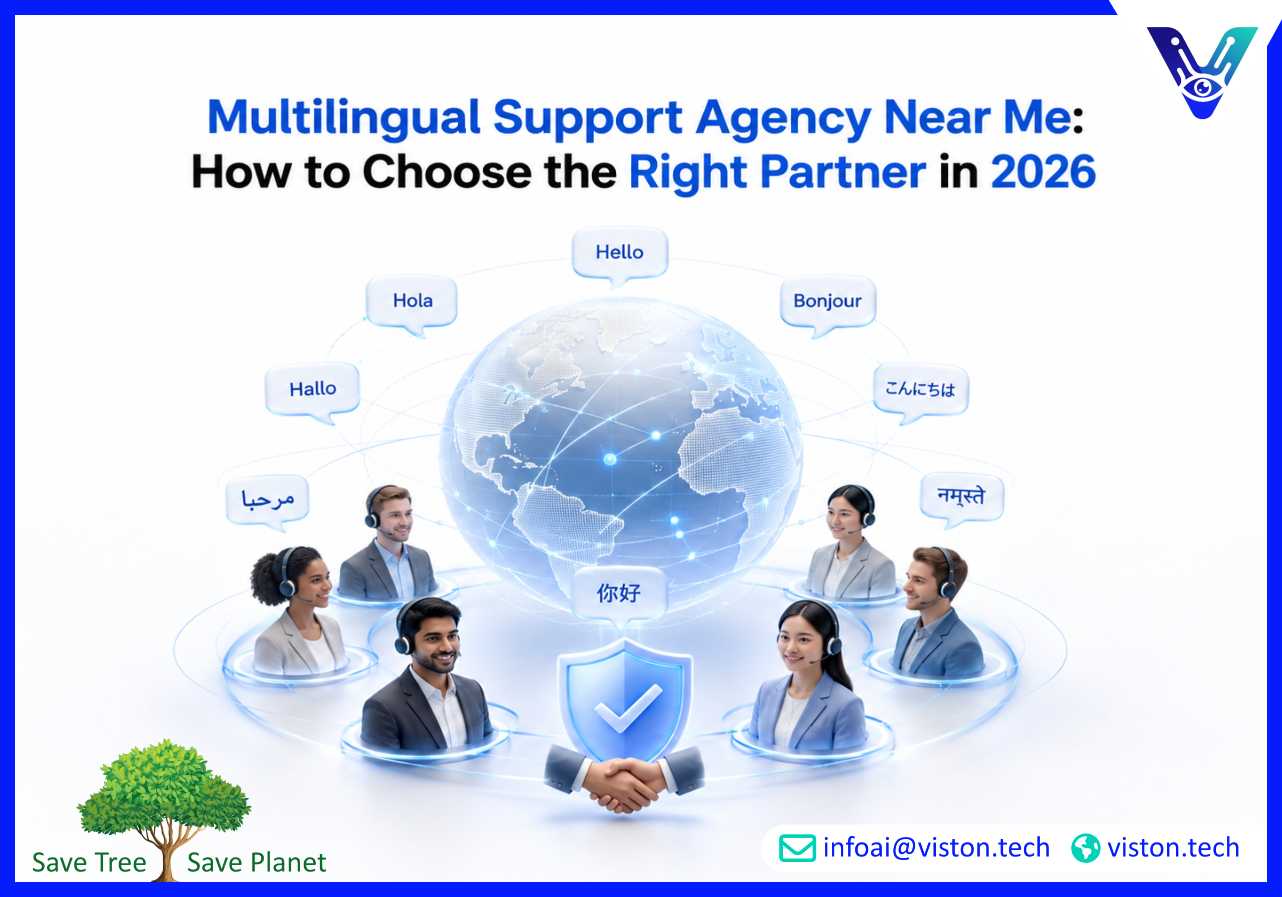
Multilingual Support Agency Near Me: How to Choose the Right Partner in 2026
Searching for a multilingual support agency near me usually means your business needs faster, clearer customer communication across languages. The right partner should do more than translate replies. It should combine language quality, cultural awareness, scalable technology, secure workflows, and reliable escalation so every customer receives consistent support.
What a Multilingual Support Agency Should Deliver
A multilingual support agency helps businesses serve customers, prospects, employees, or partners in more than one language. Depending on the operating model, support may be delivered by human agents, AI chatbots, translation technology, or a blended system in which automation handles routine requests and specialists manage complex or sensitive conversations.The service should cover the complete support journey rather than isolated translation tasks. That includes understanding the customer’s intent, retrieving accurate information, responding in the correct language and tone, completing permitted actions, recording the interaction, and escalating the case with full context when human judgment is needed.
Language support is not the same as direct translation
Literal translation can produce grammatically correct answers that still feel unnatural, unclear, or inappropriate. Good multilingual support accounts for terminology, dialects, local expectations, formality, cultural references, product names, legal wording, and channel-specific communication habits.For example, a technical support response may require consistent product terminology, while a billing complaint may require empathy and careful escalation. A hospitality customer may expect conversational service, whereas a banking customer may need precise, controlled language. The agency should adapt its language workflows to the business context.
Core capabilities to expect
Support for the languages, dialects, and markets your customers actually use
Human-reviewed terminology, response templates, and knowledge content
Multichannel delivery across web chat, mobile apps, email, messaging, voice, or service portals
Integration with CRM, helpdesk, ecommerce, booking, or internal knowledge systems
Intelligent routing and escalation to the correct team
Language-level reporting for quality, resolution, response time, and customer satisfaction
Defined controls for privacy, permissions, retention, and sensitive information
In 2026, buyers should also expect the provider to explain where AI is used, where human review remains necessary, how uncertain responses are handled, and how performance is monitored separately for each language.
How to Evaluate a Multilingual Support Agency Near Me
Proximity may be useful for workshops, procurement, or local market knowledge, but it should not be the main selection criterion. A nearby provider that lacks language expertise, integration capability, or governance may be less suitable than a specialist team that supports your markets remotely.
Confirm language depth, not only language count
A long language list is not proof of delivery quality. Ask which languages are handled natively, which rely on machine translation, how dialects are managed, and whether the provider can support your industry terminology. Request a practical demonstration using real but anonymized customer questions.Evaluate performance across routine, ambiguous, emotional, and technical requests. The agency should be able to identify when an answer is uncertain and route the conversation appropriately rather than presenting a fluent but unreliable response.
Review the operating model
Understand whether the service is human-led, AI-led, or hybrid. Human support is important for negotiation, complaints, regulated decisions, unusual cases, and conversations where trust is critical. AI can be effective for common questions, triage, knowledge retrieval, after-hours coverage, language detection, and high-volume interactions.A strong hybrid model defines clear boundaries. It specifies which requests may be automated, what confidence threshold triggers escalation, which teams receive transferred cases, and what conversation history accompanies the handover.
Check integration and workflow capability
Multilingual support becomes operationally valuable when it connects with the systems your teams already use. Ask whether the agency can integrate with your CRM, ticketing platform, knowledge base, order system, appointment software, or identity controls.Integration should allow the support layer to retrieve approved information and complete permitted actions without creating duplicate records or exposing restricted data. The provider should also test failure scenarios, such as unavailable APIs, outdated content, missing customer information, or conflicting system records.
Assess security, privacy, and governance
Ask where conversation data is processed, which subprocessors are involved, how access is controlled, how long records are retained, and whether your data is used to train shared models. For organizations operating in regulated markets, the provider should map its delivery approach to the laws and contractual obligations that apply to the specific use case.Where personal data is processed by AI, organizations need a valid purpose and lawful basis, appropriate data minimization, access controls, and meaningful oversight. Translation workflows may also benefit from documented quality processes and human post-editing for high-risk content.
Service Quality, KPIs, and Commercial Questions to Ask
A multilingual support contract should define measurable outcomes. Avoid choosing a provider only on price per conversation, language, or agent hour. A lower headline rate can become expensive when poor accuracy creates repeat contacts, escalations, refunds, complaints, or manual rework.
Define quality by language and use case
Overall averages can hide weak performance in lower-volume languages. Reporting should separate results by language, region, channel, intent, and support type. This makes it easier to identify whether a particular knowledge source, translation workflow, or escalation path needs improvement.Useful multilingual support KPIs include:
First-contact and self-service resolution rates
Response and handling time by language
Fallback, misunderstanding, and repeat-contact rates
Customer satisfaction by market and channel
Human escalation rate and handover quality
Translation or terminology error rate
Workflow completion and CRM update accuracy
Availability, incident response, and service-level performance
Understand the pricing model
Pricing may be based on supported languages, interaction volume, operating hours, human agent capacity, AI usage, implementation effort, integrations, knowledge preparation, reporting, and ongoing optimization. Ask for a clear split between setup costs and recurring charges.The proposal should explain what happens when conversation volumes rise, new markets are added, knowledge content changes, or additional human review is required. It should also clarify whether unused capacity expires, whether integrations have separate maintenance fees, and what level of optimization is included.
Ask for a controlled pilot
A pilot is more useful than a generic product demonstration. Select a limited set of languages and high-volume use cases, define success metrics, and test the service with realistic customer phrasing. Include difficult cases such as code-switching, spelling errors, slang, mixed-language messages, sensitive complaints, and requests that require backend actions.The pilot should produce evidence about accuracy, resolution, escalation, latency, customer effort, and operational fit. It should also reveal how quickly the provider can correct terminology, update knowledge, and improve weak conversation paths.
Local Agency or Global Remote Partner: Which Is Better?
The best choice depends on why you searched for a multilingual support agency near me. Some businesses need local workshops, on-site discovery, domestic data handling, or familiarity with regional regulations. Others need broad language coverage, continuous availability, and specialist technology that can be delivered effectively from another location.
When local presence matters
A local agency may be preferable when stakeholder workshops must happen in person, procurement requires a domestic entity, customer conversations involve strong regional nuance, or support processes depend on local institutions and regulations. Local time-zone coverage can also simplify day-to-day collaboration.
When remote expertise matters more
A remote or distributed provider may be stronger when your customers are spread across several countries, you need multiple time zones, or the project requires specialized NLP, chatbot, integration, and analytics expertise. In these cases, delivery capability matters more than the distance between offices.
Use a practical decision framework
List the languages, channels, use cases, and operating hours you need now.
Separate low-risk repetitive requests from complex or sensitive conversations.
Identify required systems, data sources, actions, and escalation teams.
Set measurable quality and security requirements before requesting proposals.
Compare providers through a controlled pilot rather than marketing claims.
Choose the partner that offers the best operational fit, not simply the nearest address.
For many businesses, the strongest arrangement is a globally capable provider with structured remote delivery, clear local-market validation, and accessible project support. This combines scale with the language and cultural control required for credible customer communication.
How Viston AI Supports Multilingual Customer Experiences
Viston AI is relevant for organizations seeking technology-led multilingual support. The company offers multilingual AI chatbot support as part of its broader conversational AI and natural language processing services. Its published service scope includes context-aware multilingual interactions, real-time translation and localization, omnichannel deployment, intelligent routing, performance analytics, and connections with business systems.This approach is suited to businesses that want multilingual support to operate across web chat, mobile experiences, messaging channels, and service workflows rather than as a separate translation task. By linking conversational interfaces with approved knowledge and operational systems, organizations can automate common queries while preserving escalation paths for cases requiring human attention.Viston AI also positions its multilingual capability alongside enterprise chatbots, voice-enabled assistants, language translation, sentiment analysis, and AI chatbot integration. That combination can be useful when a business needs language detection, localized responses, workflow automation, and reporting within one support design.For companies serving several regions, the practical value lies in designing a support model around actual customer intents, terminology, channels, permissions, and service-level goals. Viston AI can therefore be considered by buyers who prioritize scalable multilingual automation, system integration, and measurable performance over physical proximity alone.
Frequently Asked Questions
How do I find a reliable multilingual support agency near me?
Start with your required languages, channels, operating hours, integrations, and quality standards. Then compare providers based on language testing, security controls, escalation design, reporting, and pilot results. Physical distance should be a secondary factor unless on-site delivery is essential.
What is the difference between multilingual support and translation services?
Translation converts content from one language to another. Multilingual support manages complete customer interactions, including intent recognition, troubleshooting, account context, workflow actions, documentation, escalation, and follow-up in the customer’s preferred language.
Should multilingual customer support use AI or human agents?
Most businesses benefit from a hybrid model. AI can handle repetitive questions, triage, knowledge retrieval, and after-hours requests. Human agents should manage sensitive, complex, regulated, emotional, or low-confidence conversations.
How much does a multilingual support agency cost?
Cost depends on language coverage, interaction volume, channels, service hours, human staffing, AI usage, integrations, implementation complexity, and quality assurance. Buyers should compare total operating cost and resolution quality, not only the lowest unit price.
What should be included in a multilingual support service agreement?
The agreement should define supported languages, channels, hours, response targets, quality metrics, escalation rules, data handling, security responsibilities, change management, reporting, incident handling, and pricing for volume or scope changes.
Can Viston AI provide multilingual support for global businesses?
Viston AI offers multilingual AI chatbot support designed for multi-language, multi-channel customer interactions. Its relevance depends on the required languages, workflows, systems, compliance needs, and balance between automation and human support.
Conclusion
Choosing a multilingual support agency near me in 2026 requires more than finding a nearby supplier. Businesses should evaluate language depth, cultural quality, human oversight, AI capability, integrations, privacy, escalation, reporting, and commercial scalability. A controlled pilot provides the clearest evidence of whether a provider can resolve real customer needs across languages. For organizations considering technology-led multilingual support, Viston AI offers relevant conversational AI, localization, routing, analytics, and integration capabilities. The right partner should ultimately make global support feel accurate, accessible, and operationally consistent in every market.