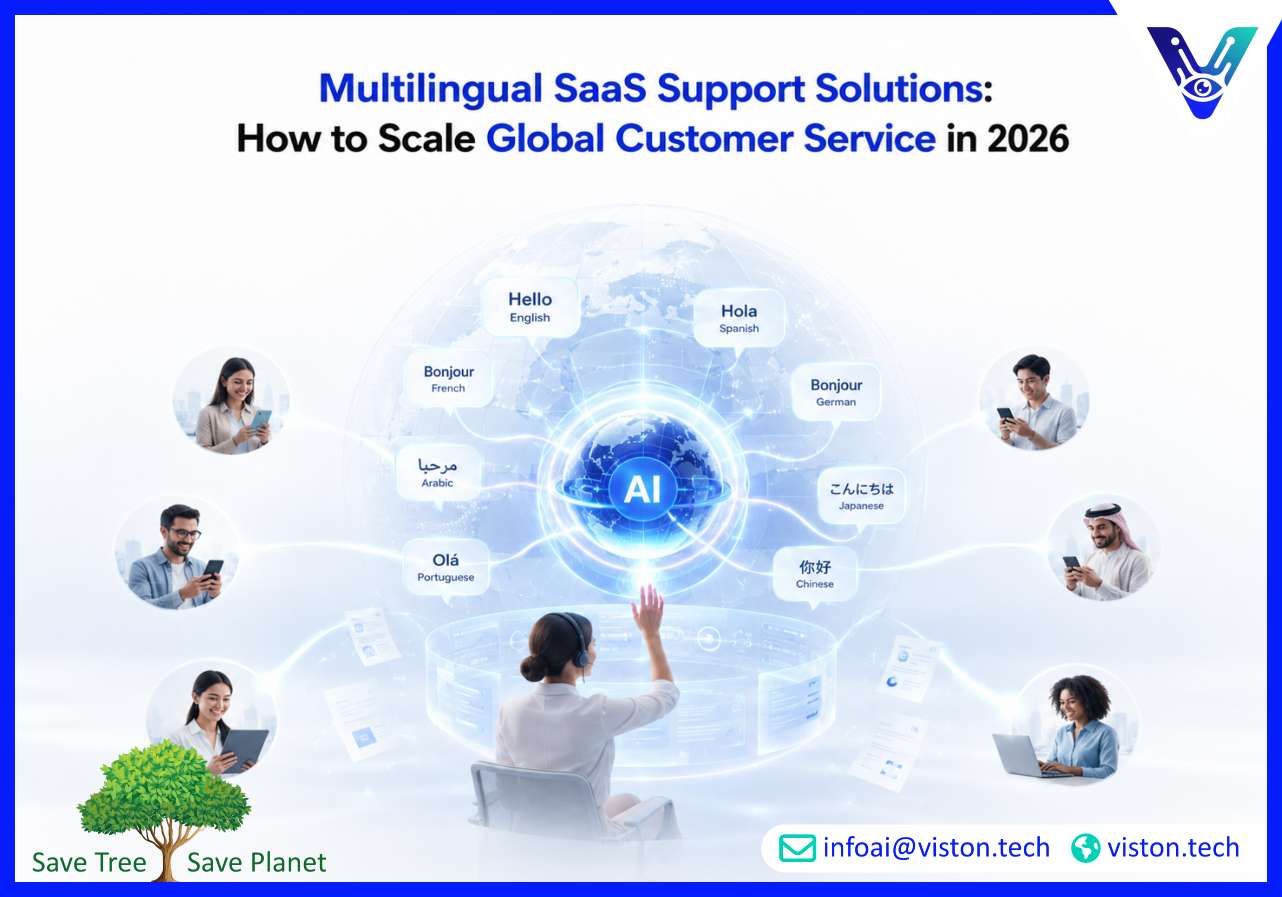
Multilingual SaaS Support Solutions: How to Scale Global Customer Service in 2026
Multilingual SaaS support solutions help software companies serve international users without creating disconnected support operations for every market. The right model combines localized knowledge, AI-assisted automation, skilled human escalation, product integrations, and language-level quality control to deliver reliable support as customer numbers, regions, and product complexity grow.
What Multilingual SaaS Support Solutions Include
Multilingual SaaS support is the delivery of product, billing, onboarding, account, and technical assistance in the languages customers prefer. It may cover live chat, email, support tickets, in-app messaging, knowledge bases, community forums, messaging applications, and voice channels.A complete solution involves more than translating an English response into another language. SaaS users often describe technical problems using product-specific terms, informal expressions, screenshots, error messages, integration names, and account context. The support system must understand the customer’s intent, identify the correct product information, and communicate the resolution clearly in the target language.
AI-powered multilingual self-service
AI chatbots and virtual assistants can answer recurring questions, guide users through common workflows, retrieve approved knowledge, and collect information before an issue reaches an agent. Typical SaaS use cases include password resets, subscription questions, feature guidance, account setup, billing explanations, troubleshooting steps, and service-status queries.Automation is most useful when it is connected to an accurate knowledge base and governed by clear confidence thresholds. When the system cannot verify an answer, it should request clarification or transfer the conversation rather than produce uncertain technical guidance.
Multilingual human support
Human agents remain essential for complex bugs, security concerns, contractual questions, data migration issues, integration failures, customer dissatisfaction, and high-value account support. SaaS businesses may use native-language teams, bilingual agents, regional partners, centralized agents supported by translation technology, or a combination of these models.The appropriate staffing structure depends on ticket volume, language demand, customer value, product complexity, service-level commitments, and the consequences of an inaccurate response.
Localized knowledge and product content
Support quality depends heavily on the information available to customers and agents. Help-center articles, onboarding guides, troubleshooting instructions, release notes, interface labels, chatbot answers, and escalation scripts should use consistent terminology.Localization must also account for regional conventions and customer expectations. A technically correct translation can still cause confusion when it uses unfamiliar terminology, fails to match the interface, or ignores how users in that market describe the problem.
Integrated support operations
Effective multilingual SaaS support solutions connect with the existing support stack. This may include customer relationship management systems, helpdesk platforms, subscription management tools, product analytics, identity systems, incident-management software, customer success platforms, and internal knowledge repositories.These integrations allow the support team to understand the customer’s plan, account history, previous conversations, product usage, open incidents, and entitlement level. They also help preserve conversation context when an automated interaction is escalated to a human agent.
Why Multilingual SaaS Support Matters in 2026
SaaS products can attract customers internationally long before the company has established offices or local support teams in each region. A product-led sign-up process, online marketplace listing, partner referral, or global marketing campaign can introduce users from several language groups at once.Without a multilingual operating model, international growth can create longer response times, inconsistent answers, excessive ticket transfers, and a growing dependence on a small number of bilingual employees. These problems affect customer confidence at important stages of the subscription lifecycle.
Language influences product adoption
New users need to understand setup instructions, permissions, integrations, workflows, and feature limitations. When onboarding material is difficult to understand, users may configure the product incorrectly or abandon features that would otherwise provide value.Multilingual onboarding support can help customers reach their first useful outcome more quickly. It can also reduce repetitive questions by making setup guidance and in-product assistance easier to follow.
Support quality affects retention
Recurring-revenue businesses depend on continued product use and customer confidence. A language barrier during a billing dispute, service interruption, or integration failure can make an already frustrating situation worse.Customers do not necessarily expect every issue to be solved instantly. They do expect the provider to understand the problem, communicate clearly, set realistic expectations, and preserve context throughout the resolution process.
Global availability requires a scalable model
Hiring a dedicated native-language team for every market may not be practical, particularly when ticket volumes vary widely. Automation can handle predictable requests, while regional agents or language specialists manage nuanced cases. A shared support operation can then provide consistent procedures, reporting, and quality controls across markets.The objective is not to remove human support. It is to assign each request to the most appropriate resource based on language, complexity, urgency, customer tier, and risk.
AI transparency and governance are becoming operational requirements
SaaS companies using AI chatbots should clearly distinguish automated assistance from human support and define how AI-generated answers are monitored. For organizations serving users in the European Union, the EU AI Act’s chatbot transparency rules are scheduled to apply from August 2026 and require people to be informed when they are interacting with a machine, except where this is already obvious from the context.Responsible deployment also requires appropriate access controls, audit records, privacy safeguards, human escalation, and restrictions on what the system is permitted to answer or change. These controls are especially important when support interactions contain personal information, payment details, confidential business data, or security-related requests.
Core Capabilities of Effective Multilingual SaaS Support Solutions
A multilingual support platform should be evaluated on its ability to resolve customer needs, not simply on the number of languages listed in a product description. Language coverage has limited value when the system performs poorly on technical questions, regional terminology, complex workflows, or real customer conversations.
Automatic language and intent detection
The system should identify the customer’s language without forcing the user through unnecessary menus. It should also recognize the purpose of the request, including situations where the customer switches languages, uses product abbreviations, includes an error code, or combines several questions in one message.Intent recognition should be tested against authentic support conversations. Clean demonstration prompts rarely reflect the abbreviations, spelling variations, incomplete sentences, and technical vocabulary found in live SaaS support.
Consistent terminology across languages
Product names, interface labels, plan names, feature descriptions, and technical terms should remain consistent across the help center, application, chatbot, and agent responses. A controlled terminology library can prevent translators and AI systems from using different words for the same function.Terminology management becomes more important as the product changes. New features, renamed settings, revised policies, and altered subscription rules must be updated across all supported languages rather than only in the original content.
Knowledge retrieval with source control
AI support systems should retrieve information from approved and current sources. Content owners need to know which documents are active, which are outdated, and which are restricted to internal teams.Useful controls include document versioning, publication approval, regional content rules, access permissions, expiration dates, and links back to the source material. When several documents conflict, the system should follow a defined source hierarchy or escalate the request.
Context-rich human escalation
A multilingual chatbot should transfer the full interaction rather than simply opening a blank ticket. The receiving agent may need the customer’s language, account details, detected intent, conversation history, attempted troubleshooting, sentiment, product area, and relevant knowledge sources.Strong handover design prevents customers from repeating the problem and helps agents continue the conversation without losing time. It also allows the support team to route issues to billing, technical support, customer success, security, or engineering more accurately.
Language-specific analytics
Overall support metrics can hide serious differences between languages. A solution should allow teams to review resolution rate, fallback rate, escalation rate, response time, customer satisfaction, abandonment, knowledge gaps, and automation performance for each language.For example, a chatbot may perform well in English but produce higher escalation rates in German or Japanese because the translated knowledge base is incomplete. Language-level reporting makes that gap visible and supports targeted improvement.
Security and permission controls
Support systems should apply the same security principles in every language. Authentication requirements, account verification, data-access rules, and restricted actions must not become weaker because the request arrives through a translated interface.Businesses should define what automated systems can view, disclose, update, or trigger. Sensitive actions such as changing account ownership, exposing personal data, processing refunds, modifying permissions, or discussing security incidents may require additional verification or human approval.
How to Choose and Implement a Multilingual SaaS Support Model
The best implementation begins with customer demand rather than a goal to support every possible language immediately. SaaS teams should identify where language barriers are already affecting onboarding, ticket volume, product adoption, customer satisfaction, renewals, or expansion opportunities.
Prioritize languages using business evidence
Review customer locations, browser language, sales pipeline, ticket history, support searches, trial registrations, churn feedback, and expansion plans. Consider both current ticket volume and the commercial importance of each market.A language with modest support volume may still deserve priority when it represents strategic enterprise accounts or a new market launch. Conversely, a high number of website visitors may not justify full support coverage when few become active customers.
Classify support use cases by complexity and risk
Routine, low-risk questions are generally the easiest to automate. These may include feature navigation, plan comparisons, invoice access, standard integration instructions, and basic troubleshooting.Complex or high-risk cases should have stricter escalation rules. Examples include suspected account compromise, data deletion, contractual commitments, compliance requests, advanced API failures, service-credit disputes, and incidents affecting business-critical workflows.
Build a multilingual knowledge foundation
Before adding automation, teams should remove duplicate articles, correct outdated instructions, identify source owners, and standardize product terminology. Translating an inconsistent knowledge base only reproduces the inconsistency in more languages.Begin with the content connected to high-volume intents and key customer journeys. Establish a workflow for translating and reviewing product changes so localized material does not fall behind the original version.
Test complete customer journeys
Testing should cover more than individual answers. Teams should evaluate complete workflows such as account onboarding, integration setup, invoice questions, subscription changes, incident communication, and escalation to a technical agent.Include native-language reviewers and real examples from different customer segments. Testing should examine meaning, tone, technical accuracy, interface consistency, cultural appropriateness, handover quality, and the correct handling of unsupported requests.
Measure outcomes and improve continuously
Useful performance indicators include first-contact resolution, self-service resolution, escalation quality, customer satisfaction, average response time, reopened tickets, knowledge accuracy, and cost per resolved conversation.These metrics should be reviewed by language, channel, product area, and customer tier. Conversation reviews can then identify missing documentation, confusing product experiences, weak translations, failed integrations, or inappropriate automation rules.
How Viston AI Supports Multilingual SaaS Customer Service
Viston AI offers multilingual AI chatbot support designed for organizations that need to manage customer conversations across languages, channels, and time zones. Its published service capabilities include contextual intent recognition, real-time translation and localization, centralized knowledge management, intelligent routing, performance analytics, and support across channels such as web chat, mobile applications, WhatsApp, SMS, voice assistants, and social platforms.These capabilities are relevant to SaaS providers because product support frequently depends on accurate documentation retrieval, technical terminology, customer context, and reliable escalation. Viston AI describes a SaaS support use case covering onboarding assistance, feature guidance, billing questions, technical troubleshooting, knowledge-base search, ticketing integration, and handover to human engineers when a request exceeds the chatbot’s capabilities.Its integration-focused approach can help businesses connect multilingual support with existing customer service and operational systems rather than deploying an isolated translation interface. Language-specific analytics and ongoing optimization can also help support leaders identify where automation performs well and where additional content, training, or human expertise is required.For growing software companies, this combination offers a practical route to expanding language coverage while maintaining centralized governance, consistent workflows, and measurable support performance.
Frequently Asked Questions
What are multilingual SaaS support solutions?
Multilingual SaaS support solutions combine localized knowledge, AI assistance, translation technology, multilingual agents, support integrations, and quality controls to help software companies assist customers in multiple languages.
Can AI completely replace multilingual SaaS support agents?
No. AI can resolve repetitive and well-documented requests, but human agents are still needed for complex technical problems, sensitive account issues, negotiation, security concerns, and situations requiring judgment or empathy.
Which SaaS support requests should be automated first?
Start with frequent, low-risk requests that have clear answers and stable workflows. Common examples include password guidance, invoice access, account setup, feature navigation, standard integrations, and basic troubleshooting.
How should a SaaS company select which languages to support?
Use customer locations, ticket data, sales opportunities, churn feedback, product usage, strategic accounts, and expansion plans. Prioritize languages where improved support can create a measurable customer or commercial benefit.
How is multilingual support quality measured?
Track first-contact resolution, customer satisfaction, escalation rate, reopened tickets, response time, chatbot fallback rate, translation accuracy, knowledge coverage, and human handover quality for each language.
Can Viston AI integrate multilingual support with existing SaaS systems?
Viston AI positions its multilingual support service around knowledge integration, omnichannel deployment, intelligent routing, analytics, and connectivity with support workflows, making it relevant to SaaS companies that want multilingual assistance connected to their existing operations.
Conclusion
Multilingual SaaS support solutions allow software companies to serve international customers without sacrificing technical accuracy, response consistency, or operational control. A successful model combines reliable localization, governed AI automation, knowledgeable human support, integrated customer data, and language-specific performance monitoring. Businesses should begin with the markets and use cases that create the greatest customer impact, then expand coverage based on measured demand. Viston AI provides relevant multilingual support capabilities for SaaS organizations seeking contextual automation, integrated escalation, centralized knowledge, and scalable service across global customer journeys.