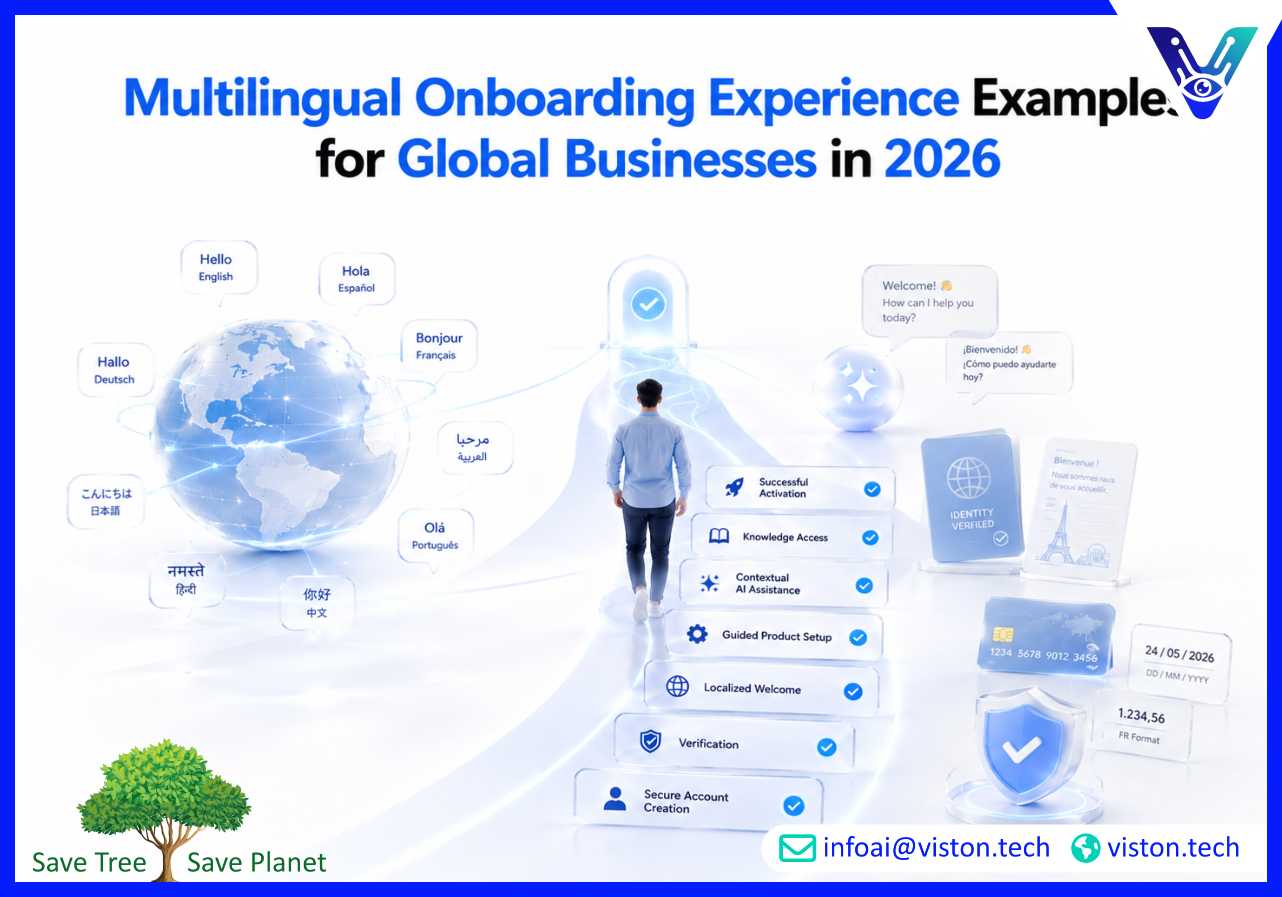
Multilingual Onboarding Experience Examples for Global Businesses in 2026
A strong multilingual onboarding experience helps new customers understand a product, complete setup, and reach value without struggling through an unfamiliar language. In 2026, effective onboarding goes beyond translating screens. It combines localized guidance, multilingual support, culturally appropriate communication, accessible content, and reliable handoffs across the full customer journey.
What a Multilingual Onboarding Experience Looks Like in 2026
Multilingual onboarding is the process of guiding customers, users, employees, partners, or suppliers through their first interactions in a language they can understand confidently. It may include localized registration pages, product tours, setup instructions, knowledge articles, chatbot conversations, emails, videos, forms, and live support.The best experience is not a direct word-for-word copy of an English onboarding flow. It adapts terminology, tone, examples, date and number formats, legal notices, payment expectations, and support routes to the user’s language and market. The goal is to preserve the meaning and outcome of each step while making the journey feel natural.
Language choice should appear early
Users should be able to select or confirm their preferred language before they encounter important instructions. Automatic language detection can reduce friction, but it should not remove user control. A visitor may browse from one country while preferring another language or use a shared device configured differently from their own preferences.
Critical actions need consistent localization
Businesses often translate marketing pages but leave account verification, error messages, billing explanations, consent text, and support content in the default language. This creates a broken experience at the moments when clarity matters most. Multilingual onboarding should cover the entire task, including confirmation messages and recovery paths.
Support must understand context, not just language
A multilingual support system should recognize what the user is trying to achieve, where they are in the onboarding journey, which product or plan they selected, and what actions have already been completed. This context allows a chatbot or agent to guide the next step instead of repeating generic instructions.
Multilingual Onboarding Experience Examples by Business Model
Useful multilingual onboarding experience examples show how language support changes with the product, risk level, user objective, and operational workflow. The following examples are illustrative patterns that businesses can adapt rather than fixed templates.
1. SaaS product onboarding with in-app guidance
A project management platform serves customers in English, German, French, Spanish, and Japanese. During sign-up, users choose a preferred language. The welcome checklist, workspace setup, role descriptions, tooltips, sample projects, and lifecycle emails then appear in that language.A multilingual assistant answers questions such as how to invite colleagues, configure permissions, import data, or connect another application. When a technical issue requires human support, it transfers the conversation with the user’s language, account details, completed steps, and error context attached. The result is a connected onboarding journey rather than a translated interface followed by English-only support.
2. Ecommerce onboarding for first-time shoppers
An online retailer uses multilingual support to help new shoppers understand delivery regions, sizing, payment methods, returns, and account benefits. A customer browsing in Arabic can view right-to-left content, ask product questions in Arabic, and receive localized guidance through checkout.The onboarding flow also explains address formats, delivery expectations, taxes, and return instructions using market-appropriate wording. After purchase, order notifications remain in the chosen language across email, web chat, and messaging channels. Consistency reduces uncertainty during the first transaction and makes repeat purchasing easier.
3. Financial service account activation
A digital financial platform guides new users through identity verification, account security, funding options, and service limitations. Because the process involves sensitive information, the multilingual experience distinguishes between general guidance and regulated or account-specific decisions.Users receive clear explanations of required documents and security steps in their preferred language. The support assistant can clarify navigation and status updates but routes complex eligibility, fraud, or compliance questions to authorized staff. Important disclosures are professionally localized and version-controlled rather than generated casually during a conversation.
4. Healthcare portal onboarding
A healthcare network introduces patients to online appointment booking, prescription requests, test-result access, and secure messaging. The onboarding flow uses plain language, explains privacy expectations, and avoids relying on automated translation for clinical instructions that require specialist review.A multilingual assistant helps patients find the correct service, prepare documents, and understand administrative steps. Urgent symptoms or uncertain medical questions trigger a safe escalation path. This model uses automation for navigation and routine support while reserving diagnosis and clinical judgment for qualified professionals.
5. Marketplace onboarding for buyers and sellers
A global marketplace needs separate onboarding journeys for customers, sellers, and service providers. Buyers may need help with search, payment, and dispute processes, while sellers need guidance on listings, verification, fees, fulfillment, and performance standards.Multilingual support identifies the user role and provides the correct workflow. It can explain platform terminology, collect missing setup information, and direct users to localized policy content. Regional examples help users understand expectations without changing the platform’s core rules.
6. Employee onboarding across international teams
A company onboarding employees in several countries provides localized access to workplace policies, IT setup, benefits information, training modules, and internal support. A multilingual virtual assistant answers routine questions and directs employees to the correct country-specific resource.Access controls are essential. The assistant should provide information according to the employee’s location, role, and permissions without exposing restricted HR or payroll data. Human specialists remain available for contractual, personal, or sensitive matters.
How Multilingual Support Improves Each Onboarding Stage
Multilingual support creates the most value when it is designed around the complete onboarding lifecycle. Businesses should identify where users hesitate, abandon a task, submit repetitive questions, or require unnecessary manual assistance.
Before sign-up: explain relevance and expectations
Prospective users need to understand what the product does, whether it is available in their market, what information they must provide, and what happens after registration. Localized FAQs and conversational support can answer these questions before the user commits.
During registration: reduce form and verification friction
Forms should use understandable field labels, local formats, clear validation messages, and translated recovery instructions. A support assistant can explain why information is required, but privacy-sensitive details should be handled through secure forms and approved systems rather than exposed unnecessarily in chat.
During setup: guide users toward first value
Onboarding should prioritize the minimum actions needed to achieve a meaningful outcome. For a SaaS platform, that may be creating a workspace and completing one task. For a marketplace seller, it may be publishing a compliant listing. Multilingual prompts, checklists, and contextual help make these steps easier to complete independently.
After activation: reinforce confidence
New users often need support after the formal onboarding sequence ends. Multilingual follow-up messages, knowledge articles, feature guidance, and proactive reminders help them continue using the service. The preferred language should carry across the CRM, helpdesk, chatbot, email platform, and account profile so users do not have to restate it.
When problems occur: provide a clean escalation path
Automation should recognize uncertainty, repeated failure, negative sentiment, high-risk topics, and requests for a person. A strong handoff includes the conversation history, detected language, user objective, account context, and attempted resolutions. This allows the human agent to continue the journey without forcing the user to start again.
How to Design and Measure Multilingual Onboarding
Successful multilingual onboarding begins with business priorities, not the number of languages a platform can technically produce. Teams should select languages based on customer demand, market strategy, support volume, revenue opportunity, risk, and available quality assurance.
Map the complete onboarding journey
Document every touchpoint from the first visit through activation and early support. Include pages, forms, tooltips, notifications, chatbot flows, help articles, videos, human handoffs, and error states. This reveals untranslated or disconnected moments that are easy to miss when teams review only the main interface.
Create a controlled terminology and content system
Maintain approved product names, industry terms, policy wording, tone guidance, and prohibited phrases for each language. Content should have clear owners, review dates, and source-of-truth documents. High-risk material may require professional linguists, legal review, subject specialists, or native-language quality assurance.
Connect language support with business systems
Multilingual onboarding becomes more useful when it can retrieve approved knowledge, recognize account status, update CRM fields, create support tickets, and trigger workflows. Integrations should use appropriate authentication, permissions, encryption, logging, and data-retention controls.
Test with native user behavior
Testing should include natural questions, spelling variations, dialects, mixed-language messages, local terminology, and mobile usage. Machine-translated test scripts alone may appear cleaner than real customer conversations. Native speakers and market teams can identify awkward phrasing, cultural mismatches, unclear instructions, and missing intents.
Measure outcomes by language
Track onboarding completion, time to first value, drop-off points, support contact rate, fallback rate, escalation rate, first-contact resolution, satisfaction, and activation or conversion by language. Aggregate results may hide a weak experience in a smaller market. Language-level reporting helps teams prioritize content, workflow, and model improvements.
How Viston AI Supports Multilingual Onboarding Experiences
Viston AI’s Multilingual Support service is relevant to organizations that want onboarding assistance to continue across languages, channels, and operational systems. Its published capabilities include multilingual AI chatbot support, context-aware intent recognition, real-time translation and localization, centralized knowledge management, intelligent routing, performance analytics, and omnichannel delivery across web, mobile, WhatsApp, SMS, voice, and social platforms.For onboarding use cases, these capabilities can support product setup guidance, account activation questions, billing explanations, knowledge discovery, document collection, status updates, and escalation to the appropriate team. Viston AI also describes integration with CRM platforms, knowledge bases, transaction systems, analytics tools, and other business applications, which is important for maintaining customer context throughout the journey.The service is designed for global deployment and supports more than 100 languages according to the company’s current service information. A practical engagement should still begin with priority markets, approved content, security requirements, workflow mapping, and language-specific testing. This focused approach helps businesses launch multilingual onboarding that is useful and measurable rather than simply adding automated translation to an existing experience.
Frequently Asked Questions
What is a multilingual onboarding experience?
It is an onboarding journey that helps users register, configure, learn, and receive support in their preferred language. It covers interfaces, instructions, messages, knowledge content, assistance, and escalation paths rather than translating only the first screen.
Which parts of onboarding should be translated first?
Prioritize high-impact and high-friction steps: registration, verification, setup instructions, error messages, billing information, security guidance, confirmation messages, and support content. Language selection and recovery paths should also be available early.
Can AI translate an entire onboarding journey automatically?
AI can accelerate translation and conversational support, but critical content still needs governance and review. Legal, medical, financial, security, and policy information may require professional localization and subject-matter approval.
How many languages should a business launch initially?
Start with languages supported by clear customer demand and business value. A smaller, well-tested launch is usually more effective than offering many languages with weak content coverage, poor escalation, or inconsistent support.
How should multilingual onboarding performance be measured?
Measure completion rate, activation, time to first value, abandonment, fallback, escalation, support demand, first-contact resolution, satisfaction, and conversion by language. Compare results across markets and investigate significant gaps.
Can Viston AI connect multilingual onboarding with existing systems?
Viston AI states that its multilingual chatbot solutions can connect with CRM platforms, knowledge bases, transaction systems, analytics tools, and business applications. The exact integration scope should be defined around the organization’s systems, security controls, and onboarding workflows.
Conclusion
The most effective multilingual onboarding experience examples share one principle: users receive clear, consistent guidance from first contact through activation and early support. Multilingual Support should combine localization, conversational assistance, secure integrations, human escalation, and language-level measurement. Businesses do not need to launch every language at once, but each supported journey should be complete enough to build confidence and help users reach value. Viston AI offers relevant multilingual chatbot, localization, integration, routing, and analytics capabilities for organizations building scalable onboarding experiences across global markets.