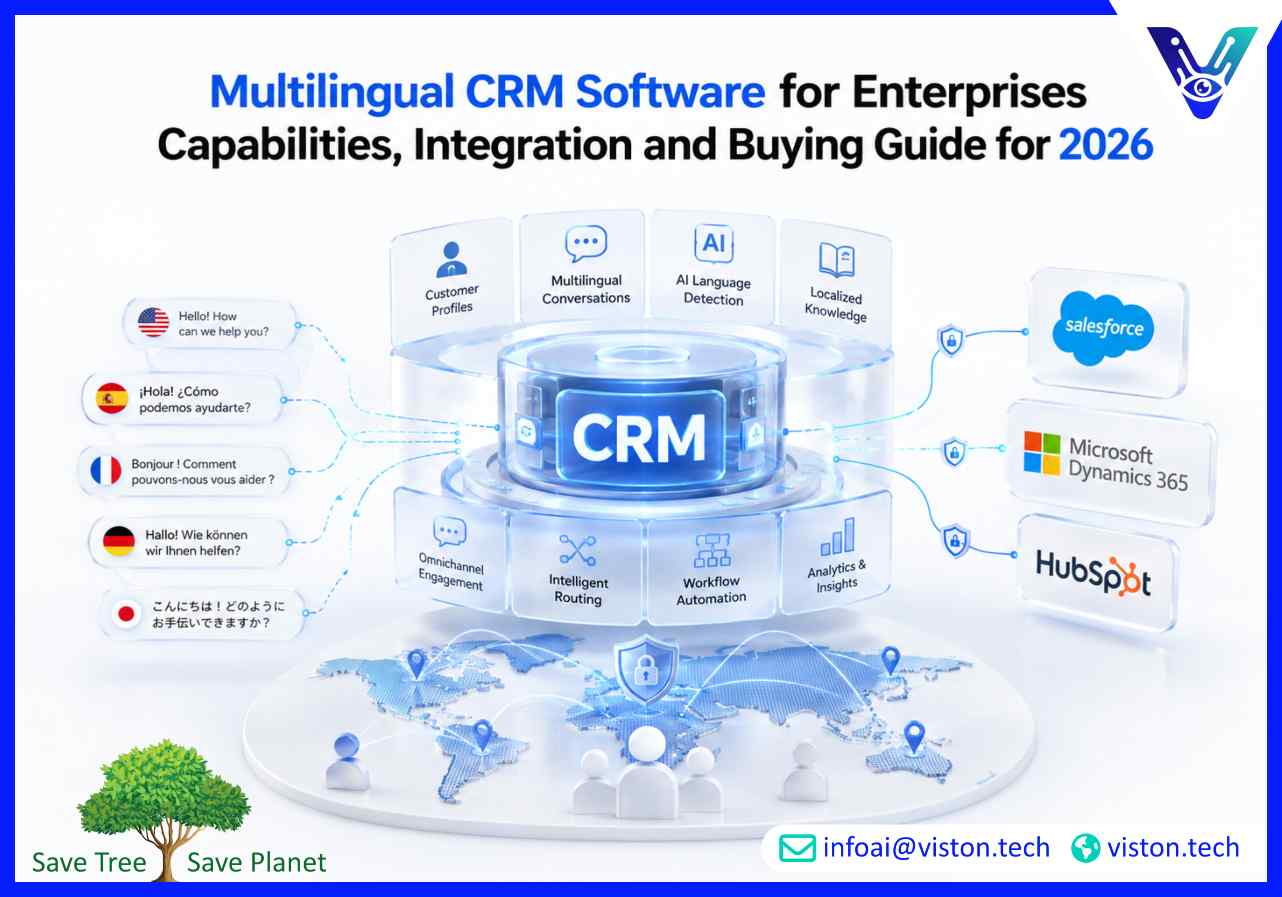
Multilingual CRM Software for Enterprises: Capabilities, Integration and Buying Guide for 2026
Multilingual CRM software for enterprises helps global teams manage customer relationships without losing context across languages, regions, and channels. The real value is not a translated interface alone. It comes from connecting language-aware customer support, automation, knowledge, routing, and reporting to the CRM records that sales and service teams already depend on.
What Multilingual CRM Software Means for Enterprises
Multilingual CRM software is a customer relationship management environment that can support users, customer data, content, workflows, and communications in more than one language. At enterprise scale, this usually combines a core CRM platform with multilingual knowledge, translation, conversational AI, language-based routing, localized templates, and regional governance.The distinction matters. A CRM may allow employees to change the interface language, yet still provide a poor multilingual customer experience. Customer-facing emails may use inconsistent terminology, knowledge articles may be unavailable in the customer’s preferred language, and service cases may lose meaning when they move between regional teams. A mature solution handles the whole interaction lifecycle rather than translating isolated screens.
The CRM remains the system of record
For most organizations, the CRM should remain the authoritative record for accounts, contacts, opportunities, cases, consent preferences, service history, and communication activity. The multilingual layer should enrich those records by detecting or storing language preference, translating approved content, supporting multilingual conversations, and routing work to the right human or automated resource.Major enterprise platforms now support multilingual knowledge and conversational agents, reinforcing the need to evaluate language support as part of the CRM operating model rather than as a separate translation task.
Typical enterprise use cases
Customer service teams handling cases across regional markets
Sales teams qualifying and nurturing leads in preferred languages
Global contact centres routing enquiries by language and expertise
Self-service portals offering localized knowledge and case updates
AI assistants answering questions and writing interaction data back to the CRM
The strongest business case usually appears when language complexity is already creating delays, duplicate work, poor handovers, inconsistent answers, or limited coverage outside core business hours.
Core Capabilities Enterprise Buyers Should Prioritize
Buyers should assess how language capabilities work across data, channels, workflows, and human teams rather than relying on a simple list of supported languages.
Language preference and customer profile management
The CRM should store a customer’s preferred language in structured, reportable fields and make it available to sales, service, marketing, and automation workflows. Teams also need rules for cases where browser language, message language, country, and recorded preference do not match. This data supports routing, templates, portal personalization, staffing, and demand analysis.
Multilingual knowledge management
Translated knowledge must be governed like any other business content. Each article needs an owner, source language, translation status, version, approval date, review schedule, and retirement process. Critical policy, pricing, legal, safety, and technical content should not depend entirely on unreviewed machine translation.Enterprises should also decide whether search works across languages. A user may ask a question in Spanish while the most complete source document exists in English. The system needs a controlled way to retrieve the right source, generate or display an appropriate answer, and preserve traceability.
Conversational AI and automated language handling
In 2026, multilingual CRM projects increasingly include AI agents that detect language, interpret intent, retrieve approved information, collect structured data, and trigger CRM actions. Current Microsoft guidance covers primary and secondary languages, dynamic language switching, custom translations for nuanced content, and language-specific testing.That combination of automation and control is important. An enterprise assistant should know when to translate, when to retrieve a reviewed localized answer, when to ask for clarification, and when to escalate to a person.
Omnichannel continuity
Customers may begin on web chat, continue through WhatsApp or email, and finish with a live agent. The CRM should preserve language preference, history, intent, case status, and prior actions across channels so customers do not have to repeat themselves.
Language-based routing and human handover
Routing should consider language alongside product, region, urgency, customer tier, and agent skill. A multilingual system also needs a fallback plan for languages with limited staffing. Options may include AI-assisted translation for the agent, specialist queues, scheduled callbacks, or escalation to an external support team.Human handover quality is a critical evaluation point. The receiving agent should see the original message, translated content where appropriate, the customer’s language, the steps already taken, and the relevant CRM record.
Language-level analytics
Enterprise reporting should reveal performance differences by language and market. Useful measures include first-contact resolution, average handling time, fallback rate, escalation rate, customer satisfaction, translation review failure, response accuracy, conversion rate, and backlog by language. Overall averages can hide weak performance in smaller but strategically important markets.
How to Implement Multilingual CRM Software Successfully
A multilingual CRM initiative is a service design and integration programme spanning customer experience, data governance, localization, AI, security, operations, and change management.
Start with language demand and business priority
Begin with actual interaction data. Review case volumes, sales enquiries, website traffic, customer locations, lost opportunities, escalation patterns, and current translation spend. Rank languages by customer demand, revenue relevance, operational risk, and readiness.A phased rollout is usually more reliable than launching every language at once. Enterprises can begin with high-volume use cases such as order status, account access, onboarding, billing questions, product guidance, and appointment scheduling, then expand after quality and workflow performance are proven.
Define the source of truth
Before building automation, decide which system owns each data type. The CRM may own contacts and cases, while ERP, product, and knowledge platforms own operational information. The multilingual layer should retrieve and update data through governed integrations instead of creating uncontrolled copies.
Design translation and localization workflows
Translation converts language; localization adapts content to the market, audience, terminology, and context. Enterprises need clear rules for which content can be translated automatically, which requires human review, and which must be authored locally.Maintain approved glossaries for product names, technical terms, regulated phrases, tone, and words that must not be translated. Include regional variants where they materially affect understanding. Spanish for Spain and Spanish for Latin American markets, for example, may require different wording, workflows, and compliance notices.
Integrate securely with CRM and business systems
Multilingual assistants may read records, update cases, log conversations, qualify leads, and trigger workflows. Integrations should use authenticated APIs, least-privilege access, validation, encryption, audit logging, and error handling. Important values should be confirmed and checked against business rules before CRM write-back.
Test every language as its own customer journey
Test each language for intent recognition, knowledge retrieval, templates, field validation, escalation, tone, character display, right-to-left layouts where relevant, and channel behavior. Native-speaking reviewers should test code-switching, regional terminology, abbreviations, unclear requests, and multiple intents. Continue quality assurance after launch through conversation sampling and language-level analytics.
How to Evaluate Multilingual CRM Software for Enterprises
Procurement teams should evaluate CRM capabilities, multilingual technology, integrations, security, governance, and support. Strong translation alone is insufficient if the solution cannot preserve context or operate reliably within enterprise workflows.
Questions to ask potential providers
Does the solution work with our existing CRM, contact centre, knowledge base, and messaging channels?
How are language preference, translated content, and original customer messages stored?
Can we control terminology, brand voice, prohibited wording, and regional variants?
How are low-confidence answers and unsupported languages handled?
Can cases be routed by language, skill, geography, product, and priority?
What data is sent to language models or translation services, and where is it processed?
Can administrators audit answers, record updates, handovers, and quality by language?
Look beyond the number of supported languages
A large language count is not enough. Buyers should test performance in the exact language pairs, dialects, channels, and business scenarios they need. Ask providers to demonstrate difficult terminology, mixed-language conversations, incomplete customer messages, escalation, and CRM write-back.Also examine coverage depth. A solution may support chat in a language but not voice, knowledge search, sentiment analysis, document extraction, or agent assistance in the same language.
Build the business case around measurable outcomes
The financial case should connect language capabilities to operational and commercial outcomes. Relevant measures may include reduced translation handling, faster first response, lower case transfer rates, improved self-service resolution, broader support-hour coverage, better lead conversion, fewer repeat contacts, and faster expansion into new markets.Set a baseline before implementation and review results by language. This helps decision-makers separate real improvement from changes caused by seasonality, staffing, campaigns, or market growth.
How Viston AI Supports Multilingual CRM Workflows
Viston AI is relevant to multilingual CRM software for enterprises as an AI and integration specialist rather than as a replacement for the organization’s core CRM. Its published service offering combines multilingual AI chatbot support with business-system integration, omnichannel conversational experiences, intelligent routing, analytics, and ongoing optimization.This approach can help enterprises add language-aware customer engagement to existing sales and service operations. Viston AI describes CRM integration capabilities for platforms including Salesforce, HubSpot, Microsoft Dynamics, and custom systems, with bidirectional data flows that can log interactions, update customer records, create leads, and trigger workflows. Its materials also describe support across web, mobile, WhatsApp, SMS, voice, and social channels.For a multilingual CRM programme, the practical value lies in connecting conversational language handling to approved knowledge, customer context, escalation rules, and enterprise workflows. That can address common problems such as fragmented conversation histories, inconsistent answers across regions, manual case creation, weak language routing, and limited reporting by market.Organizations evaluating Viston AI should still validate the required languages, integrations, security architecture, regional data needs, and production support against their own environment. Used with a well-governed CRM and knowledge strategy, its multilingual support and integration capabilities may provide a practical route to scalable global customer service without forcing teams to replace the systems they already use.
Frequently Asked Questions
What is multilingual CRM software?
Multilingual CRM software supports customer records, knowledge, messages, automation, and service workflows across multiple languages. Enterprise implementations often combine a core CRM with localization, translation, AI assistants, language routing, and multilingual analytics.
Does a multilingual CRM automatically translate every customer interaction?
Not always. Some platforms use real-time translation, while others rely on reviewed templates, multilingual knowledge, bilingual agents, or a blended model. Critical or regulated content may require human review.
Can multilingual support be added to an existing CRM?
Yes. Enterprises can keep their current CRM and add multilingual chatbots, translation, localized knowledge, messaging channels, and language-aware routing through APIs and connectors.
How should enterprises choose which languages to launch first?
Prioritize languages using customer volume, revenue opportunity, service risk, staffing gaps, and content readiness. Start with repeatable, high-value journeys and expand after quality controls perform reliably.
How can Viston AI fit into a multilingual CRM strategy?
Viston AI can support the multilingual conversational and integration layer around an existing CRM through chatbots, CRM synchronization, workflow automation, routing, and performance monitoring.
Conclusion
Multilingual CRM software for enterprises should create one connected customer journey across languages, not a collection of translated screens. The strongest solutions combine governed language data, localized knowledge, secure CRM integration, intelligent automation, skilled human handover, and language-level reporting. In 2026, enterprises should evaluate real workflows, quality assurance, and production controls rather than language counts alone. Viston AI’s multilingual support and integration services are relevant for organizations that want to extend existing CRM operations with scalable, language-aware customer engagement.