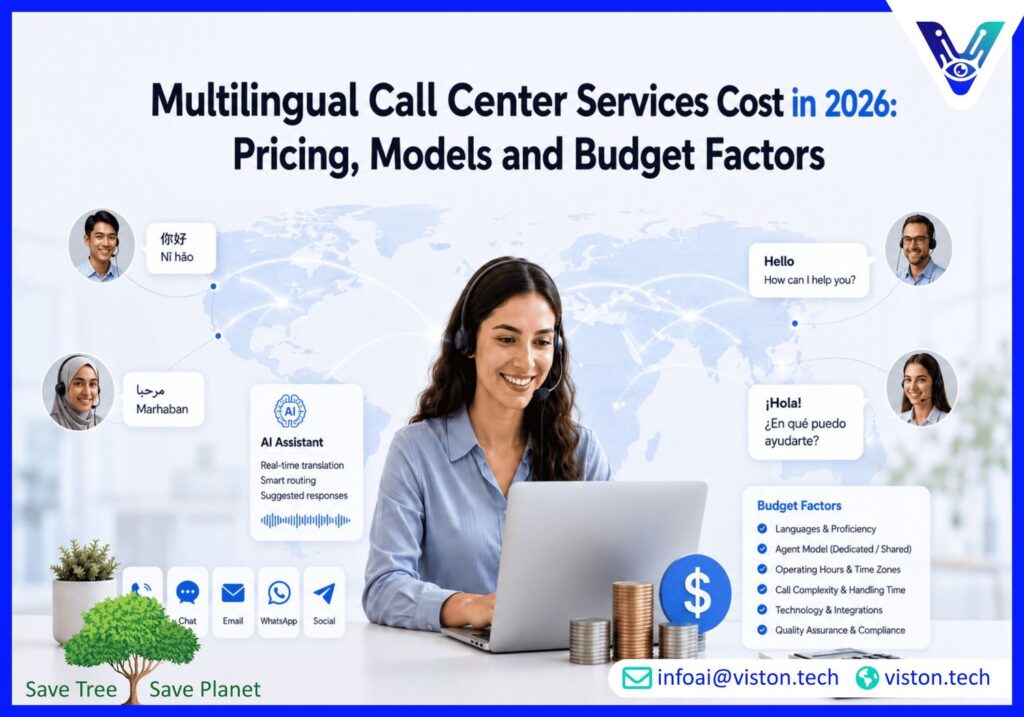
Multilingual Call Center Services Cost in 2026: Pricing, Models and Budget Factors
Multilingual call center services cost more than standard single-language support because businesses must account for language availability, agent proficiency, regional coverage, training, technology and quality control. Understanding how providers build their prices helps decision-makers compare proposals fairly, avoid hidden expenses and create a realistic global customer support budget.
How Much Do Multilingual Call Center Services Cost in 2026?
There is no universal price for multilingual call center services. Most providers calculate fees according to the delivery region, languages required, number of agents, operating hours, call complexity and level of account dedication.Published 2026 pricing guides indicate that general outsourced call center rates can begin at approximately $8 to $14 per agent hour for offshore delivery. Nearshore services may fall around $13 to $23 per hour, while providers in the United States and Canada may charge approximately $28 to $65 per hour. Western European and Australian operations can reach roughly $40 to $50 per hour. These are broad market ranges in US dollars rather than guaranteed multilingual rates.Another 2026 market guide reports that call center projects reviewed on its platform often cost less than $25 per hour, while total engagements can range from a few thousand dollars to tens of thousands. It also identifies language coverage, staffing levels, service type, setup requirements and location as important pricing variables.Multilingual requirements can move a project above ordinary customer service rates. Common languages with a large talent pool may be relatively economical. Less widely available languages, regional dialects, native-level communication or specialist terminology can require higher agent rates and longer recruitment periods.
Typical services included in the price
A basic multilingual call center quotation may include inbound call handling, standard agent training, workforce scheduling, call recording, supervisor oversight and basic performance reports. More comprehensive agreements may also cover:
Customer service and complaint handling
Technical support and troubleshooting
Order, booking or account assistance
Outbound sales and appointment setting
Email, chat, social messaging and WhatsApp support
Quality assurance in every supported language
CRM, helpdesk and knowledge base integration
Translation, localization and terminology management
AI-assisted responses, routing and self-service automation
Businesses should confirm exactly what is included. A low hourly rate may exclude onboarding, recruitment, management, reporting, software licences, telephone charges, quality monitoring or after-hours coverage.
What Determines Multilingual Call Center Services Cost?
The number of languages is important, but it is not the only cost driver. A provider must build an operating model that can consistently place an appropriately trained agent in front of each customer at the required time.
Language availability and proficiency level
Pricing depends on whether the business needs conversational fluency, professional proficiency or native-level communication. A simple order-status line requires a different language standard from financial support, healthcare communication, legal intake or technical troubleshooting.Providers may also need separate quality analysts, trainers or supervisors for each language group. Buyers should ask how proficiency is assessed and whether evaluations cover spoken fluency, writing, comprehension, pronunciation, cultural context and industry terminology.
Dedicated versus shared agents
Dedicated agents work primarily or exclusively for one client. They can develop stronger product knowledge, follow detailed processes and support complex customer journeys. However, the buyer usually pays for scheduled capacity even when call volume is low.Shared agents support several accounts. This model can be more economical for low-volume languages, overflow calls or simple enquiries because the provider distributes staffing costs across multiple clients. The trade-off may be less account-specific knowledge and reduced scheduling control.
Operating hours and time-zone coverage
Business-hours support costs less than continuous operation. A 24/7 multilingual service may require several shifts, weekend staffing, public-holiday coverage and backup capacity for absence or unexpected demand.Coverage becomes more expensive when every language must be available at all times. A more efficient model may provide live agents for high-volume languages, scheduled coverage for lower-volume languages and reliable callback or AI-assisted options outside staffed periods.
Call complexity and handling time
Longer and more complicated interactions require more agent capacity. Password resets and appointment confirmations may take only a few minutes. Technical investigations, insurance queries, travel disruption, financial complaints or sensitive customer cases may require verification, system access, detailed documentation and escalation.Providers may charge more when agents need advanced product knowledge, specialist qualifications or experience with regulated processes. Longer average handling time also reduces the number of interactions each agent can complete.
Technology and integrations
Call routing, interactive voice response, recording, speech analytics, workforce management, CRM connectivity and helpdesk integration may be included, charged separately or supplied by the client.Integration costs usually increase when agents must work across several systems or when the provider must build custom workflows. Businesses should also budget for testing, user permissions, data mapping, reporting configuration and ongoing maintenance.
Security, privacy and compliance
Support involving personal, financial, health or payment data may require additional controls. These can include restricted access, secure workspaces, authentication procedures, encryption, audit logs, data retention policies and jurisdiction-specific processing arrangements.Compliance should not be treated as an optional add-on. Buyers need to understand where data is processed, which subcontractors are involved and how multilingual calls and transcripts are protected.
Common Pricing Models and Realistic Budget Examples
The right commercial model depends on call volume, predictability and service complexity. Businesses should compare total monthly expenditure rather than judging providers by the lowest headline rate.
Per-agent hourly pricing
The provider charges for each scheduled agent hour. This model is easy to understand and suits predictable workloads, dedicated teams and services requiring consistent product knowledge.For example, six agents working 160 hours per month at $18 per hour would create a base monthly cost of $17,280. That figure may not include team leadership, quality assurance, recruitment, software, telecommunications, training or setup charges.
Dedicated full-time equivalent pricing
A fixed monthly rate is charged for each full-time equivalent agent. The package may include salary, employment costs, workspace, equipment and management. This structure offers budget predictability but usually involves minimum staffing levels or contract terms.Buyers should ask how many productive hours are included. Paid hours are not always the same as customer-facing hours because breaks, meetings, coaching, training, leave and system downtime reduce available capacity.
Per-minute pricing
Per-minute pricing can work for low or fluctuating inbound demand. Published ranges for general outsourced services can run from approximately $0.35 to $0.55 per minute for lower-cost international providers and from $0.75 to $1.35 for providers in higher-cost regions.This model appears efficient because the buyer pays for usage, but the contract may include monthly minimums, rounding rules or separate charges for after-call work. It is important to confirm whether billing covers talk time only or the complete handling period.
Per-interaction or transaction pricing
A fixed fee is charged for every completed call, booking, order, ticket or qualified lead. This can work well when interactions are consistent and the required outcome is clearly defined.The risk is that a provider may prioritize speed over quality. Contracts should define what counts as a completed interaction, how repeat contacts are treated and whether unsuccessful or transferred calls are billable.
Hybrid and outcome-based pricing
Hybrid agreements combine a base staffing fee with usage or performance charges. This can balance guaranteed capacity with variable demand. Some providers may also link a proportion of fees to agreed results such as appointments, qualified leads, service levels or customer satisfaction.Outcome-based elements require careful definitions. The provider should not be rewarded for reducing handling time if rushed calls increase repeat contact, complaints or customer churn.
Costs that are often missed
A realistic budget should account for more than agent time. Potential additional costs include:
Recruitment and language testing
Initial product and process training
Knowledge base translation and localization
Implementation and project management
CRM, ticketing or telephony licences
Telephone numbers and international call charges
Quality monitoring and translated call reviews
Weekend, overnight and holiday premiums
Volume minimums and reserved capacity
Contract exit, transition or data-export fees
How to Compare Providers Without Sacrificing Service Quality
The least expensive proposal is not always the lowest-cost operating model. Poor language quality, weak training or inaccurate information can increase repeat contact, escalations, refunds and customer dissatisfaction.
Give every provider the same operational brief
A meaningful quotation should be based on the same languages, forecast volume, operating hours, channels, average handling time, service levels and process complexity. Without a consistent brief, price comparisons can be misleading.Include historical contact data where possible. Providers need to understand hourly and seasonal demand, not only monthly totals. A service receiving 10,000 evenly distributed calls requires a different staffing model from one receiving most of its calls during a weekly or seasonal peak.
Evaluate quality by language
Overall performance reports can hide weak results in smaller language queues. Require language-level reporting for customer satisfaction, first-contact resolution, transfer rate, abandonment, response time, quality scores and repeat contact.Ask who reviews calls in each language, how frequently interactions are audited and how feedback is delivered to agents. Automated translation alone is not enough for evaluating cultural appropriateness, technical accuracy or sensitive conversations.
Assess the escalation and continuity model
Agents should know when to resolve, clarify, escalate or transfer an interaction. The provider must be able to preserve customer context when moving between languages, channels or support tiers.Buyers should also examine business continuity. A credible operating plan includes backup connectivity, workforce contingency, surge capacity, data recovery and clear communication during service disruption.
Calculate cost per successful resolution
Hourly price provides only a partial view. A more useful measure is the cost of delivering an accurate resolution without avoidable repeat contact. A higher-rate provider may produce a lower total cost when agents resolve issues faster, make fewer errors and require less internal supervision.Commercial reviews should therefore connect expenditure to service outcomes. Useful measures include cost per resolved interaction, first-contact resolution, customer satisfaction, quality assurance scores, complaint rate, sales conversion and retention-related outcomes.
How Viston AI Supports a More Scalable Multilingual Service Model
Viston AI is relevant to multilingual call center cost planning as a provider of multilingual AI chatbot support rather than as a traditional staffed call center or BPO operator. Its official service information describes multilingual conversational support across web chat, mobile applications, WhatsApp, SMS, voice assistants and social channels, together with intent recognition, routing, escalation and performance analytics.This distinction matters for businesses comparing support models. Human agents remain essential for complex, sensitive and judgement-based conversations. However, multilingual AI can handle suitable repetitive enquiries, gather customer information, provide approved answers and route cases before an agent becomes involved.That approach can change the cost structure. Instead of staffing every language for every routine enquiry, an organization can reserve trained agents for cases requiring empathy, investigation or authority. Automation may also provide initial coverage for lower-volume languages where maintaining a dedicated human queue would be difficult to justify.Viston AI’s relevance lies in designing the multilingual automation layer, connecting it with business systems and supporting consistent interactions across channels. Organizations should still validate language quality, knowledge governance, escalation logic, privacy controls and human oversight before deployment. For companies seeking to combine multilingual support with AI-assisted self-service, this model can provide a practical alternative to expanding human headcount for every market and time zone.
Frequently Asked Questions
What is the average multilingual call center services cost?
General outsourced call center rates can range from roughly $8 per agent hour in lower-cost offshore locations to $65 or more in higher-cost onshore markets. Multilingual pricing depends on language availability, proficiency, complexity, service hours and whether agents are shared or dedicated.
Do call centers charge extra for additional languages?
They may. Widely available languages can sometimes be added with limited additional cost, while less common languages may require recruitment, minimum staffing commitments or specialist language premiums. Translation, localized training and language-specific quality assurance may also be charged separately.
Is per-minute or per-agent pricing better?
Per-minute pricing may suit low or unpredictable call volumes. Per-agent pricing is often more practical for stable workloads, complex support and dedicated teams. The best choice depends on volume consistency, average handling time and the level of account knowledge required.
How much does 24/7 multilingual support cost?
The cost depends on how many languages must be continuously available and the expected overnight or weekend volume. Full live coverage requires multiple shifts and backup capacity. A blended model using agents, callbacks and automated self-service may be more economical.
Can AI reduce multilingual call center costs?
AI can reduce the volume of routine interactions reaching human agents, support initial triage and provide service outside staffed hours. Savings depend on automation accuracy, integration quality and customer adoption. Human escalation must remain available for complex or sensitive cases.
Does Viston AI provide traditional multilingual call center agents?
Viston AI’s verified offering focuses on multilingual AI chatbot support and conversational automation. Businesses seeking human call center outsourcing should separately confirm staffing services with a BPO provider or combine human operations with Viston AI’s multilingual automation capabilities.
Conclusion
Multilingual call center services cost depends on much more than an agent’s hourly rate. Language availability, operating hours, interaction complexity, technology, quality assurance and compliance all influence the final budget. Buyers should compare providers using total cost per successful resolution and require transparent language-level performance reporting. Human support remains critical, but multilingual support can also incorporate carefully governed automation for repetitive enquiries and after-hours coverage. Viston AI offers a relevant multilingual AI layer for organizations seeking to complement human service, extend channel coverage and build a more scalable global support model.