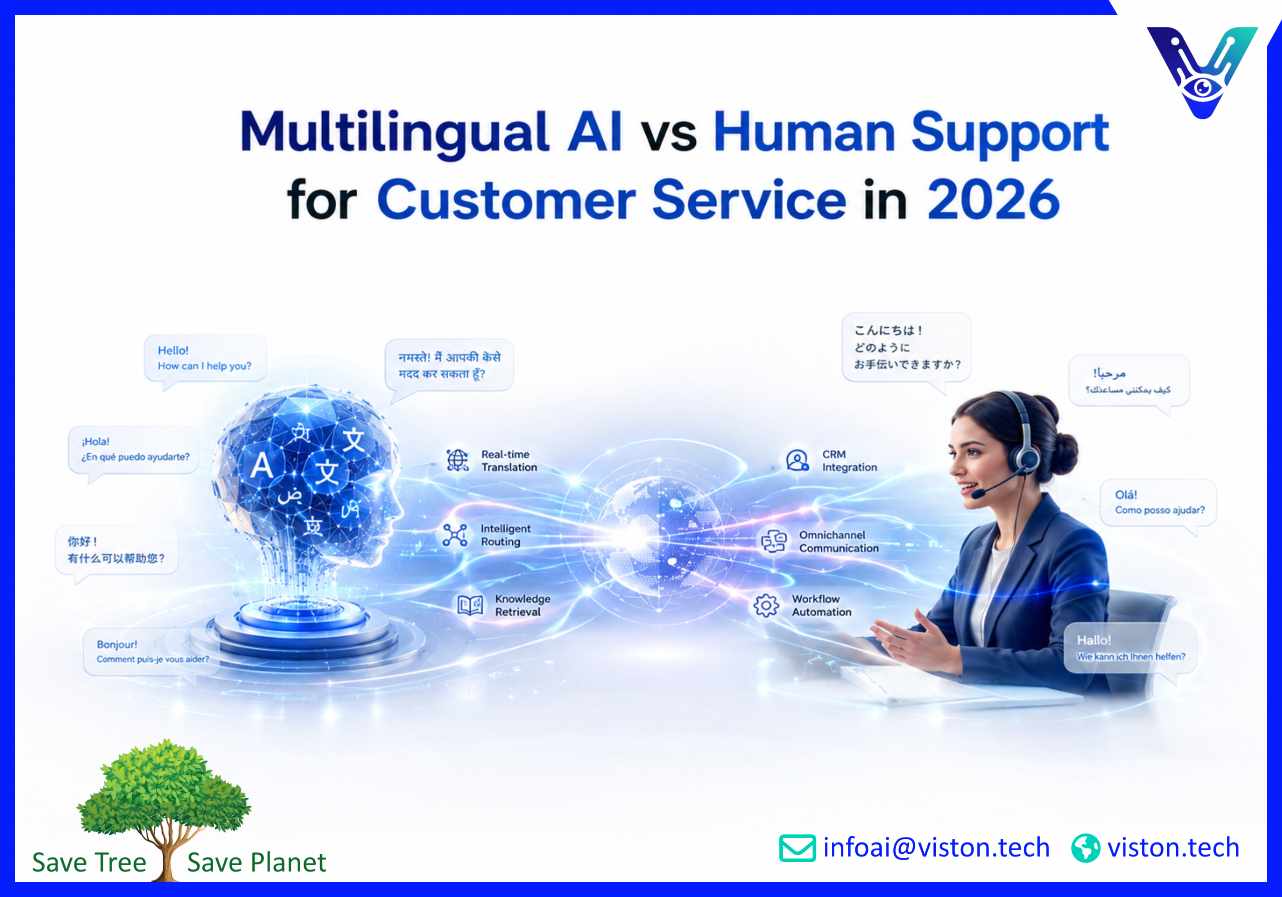
Multilingual AI vs Human Support for Customer Service in 2026
Comparing multilingual AI vs human support is no longer about choosing automation or people. Businesses need to decide which customer conversations can be handled reliably by AI, which require human judgment, and how both can work together to deliver fast, accurate, culturally appropriate service across languages.
What Multilingual AI vs Human Support Really Means
Multilingual AI support uses technologies such as natural language processing, large language models, language detection, machine translation, knowledge retrieval, and workflow automation to answer customer questions in multiple languages. It can operate through web chat, messaging apps, mobile applications, email, voice channels, and self-service portals.Human multilingual support relies on fluent or native-speaking agents who understand the customer’s language and can interpret context, emotion, cultural expectations, and unusual circumstances. Human teams may be employed internally, outsourced to regional service providers, or supported by real-time translation tools when direct language coverage is unavailable.The comparison is therefore not simply machine versus person. It is a decision about service design. Businesses must match the type of enquiry, customer risk, language complexity, operational volume, response-time expectation, and required level of judgment to the right support resource.
The core difference is repeatability versus adaptability
AI performs best when the business can define a trusted answer, decision path, or connected workflow. Examples include order tracking, booking confirmation, account access, delivery information, product availability, subscription guidance, opening hours, standard returns, and common troubleshooting.Human agents perform best when the conversation is ambiguous, emotionally sensitive, commercially important, or dependent on facts that are not available in the support system. Complaints, exceptions, negotiations, vulnerable customers, legal concerns, complex technical issues, and high-value account problems often require human involvement.Language quality also varies by use case. A system may translate a simple shipping update accurately but struggle with regional idioms, mixed-language messages, indirect requests, humour, specialist terminology, or culturally specific expectations. Recent multilingual customer-service research has shown that evaluation based only on machine-translated test data can overestimate performance compared with native, real-world customer queries.
Where Multilingual AI Support Performs Better
Multilingual AI is strongest when customer demand is high, repetitive, distributed across time zones, and supported by accurate business data. It gives organizations a practical way to extend language coverage without building a fully staffed team for every market from the first day.
Speed and continuous availability
AI can respond immediately at any hour and handle many simultaneous conversations. This is useful for global ecommerce, SaaS, travel, marketplaces, logistics, and subscription services where customers expect help outside the operating hours of a central support team.Fast responses are particularly valuable for simple, time-sensitive requests. A customer checking a booking, delivery status, password reset process, or store location usually benefits more from an immediate correct answer than from waiting for a specialist.
Consistent answers across languages and channels
When an AI system retrieves from approved policies and knowledge sources, it can provide a more consistent explanation than an informal process in which employees translate replies independently. Centralized knowledge also makes it easier to update return rules, product instructions, billing guidance, and service information across channels.Consistency depends on governance. Product names, legal terms, measurements, dates, currencies, and brand terminology should be managed through glossaries and localized content. Automatic translation should not be assumed to be equally reliable for every language or topic.
Scalable coverage for routine enquiries
AI allows a business to test demand in new language markets before hiring a complete regional support operation. A phased deployment can begin with two or three priority languages, a limited set of high-volume intents, and clear escalation to people.This is more sustainable than claiming broad language support without testing. Real coverage means the system can understand natural customer phrasing, retrieve the correct answer, complete the required workflow, and transfer the conversation when confidence is low.
Workflow automation and operational data
An integrated multilingual assistant can do more than translate text. It can check an order, create a support ticket, collect account details, schedule an appointment, update a CRM record, route a lead, or retrieve an approved document. These actions reduce manual handling and give customers a more useful service experience.
Where Human Multilingual Support Performs Better
Human agents remain essential because customer service is not always a predictable information exchange. Some conversations require interpretation, accountability, discretion, relationship management, or a decision that falls outside standard policy.
Empathy and emotional judgment
A fluent human agent can recognize frustration, hesitation, embarrassment, urgency, or fear even when the customer does not state it directly. This matters in complaints, service failures, financial difficulties, healthcare-related interactions, bereavement, safety concerns, and other sensitive situations.AI can detect language patterns associated with sentiment, but it does not experience the situation or carry human responsibility for the outcome. A poorly timed automated reply may sound dismissive even when it is linguistically correct.
Cultural nuance and relationship building
Customer expectations vary by market. Levels of formality, directness, acceptable humour, apology style, negotiation behaviour, and preferred communication pace may differ significantly. Skilled agents can adjust during the conversation rather than relying only on predetermined localization rules.This is especially important in B2B customer success, high-value sales, hospitality, financial services, healthcare, and account management. A human can understand the commercial history behind a request, identify unstated concerns, and preserve a long-term relationship.
Complex problems and policy exceptions
Many difficult cases involve incomplete information or conflicting facts. A shipment may show as delivered but be missing. A customer may request an exception because of a medical or personal circumstance. A technical failure may involve several systems. These cases require investigation rather than a standard answer.Human agents can compare evidence, speak with internal teams, negotiate an acceptable solution, and explain why a decision was made. They can also take ownership when a process has failed, which is often central to restoring trust.
Quality assurance for lower-resource languages
AI performance can be uneven across languages, dialects, writing systems, and domain-specific vocabulary. Human reviewers are particularly valuable when launching support in a new language, validating terminology, testing native phrasing, reviewing escalated conversations, and monitoring for culturally inappropriate responses.
How to Build the Right Hybrid Multilingual Support Model
For most businesses, the strongest answer to multilingual AI vs human support is a hybrid operating model. AI handles suitable volume and preparation work, while people manage exceptions, sensitive cases, and decisions requiring accountability.
Assign conversations by risk and complexity
Start by grouping enquiries into practical categories rather than automating an entire support queue at once.
Use AI for repetitive, well-documented, low-risk questions.
Use AI-assisted human support for cases that benefit from translation, summaries, suggested replies, or knowledge retrieval.
Route high-risk, emotional, regulated, ambiguous, or high-value conversations directly to trained people.
Escalation should be triggered by more than failure to understand. Rules can consider repeated questions, negative sentiment, refund value, customer segment, urgency, confidence score, policy exceptions, and the type of action requested.
Design a complete human handover
A customer should not have to restart after escalation. The agent should receive the original message, translated text, conversation history, detected language, customer details, attempted steps, relevant records, and a clear reason for transfer.
Test every priority language separately
Do not assume strong English performance proves multilingual quality. Test native-language questions, spelling mistakes, regional phrasing, mixed-language messages, specialist terminology, and multi-turn conversations. Review both answer accuracy and whether the tone feels natural.Performance should be tracked by language. Useful measures include first-contact resolution, fallback rate, human escalation, repeat contact, customer satisfaction, translation correction rate, workflow completion, and average time to resolution.
Build governance into the service
Businesses need named owners for knowledge, language quality, data access, integrations, escalation policy, monitoring, and incident response. AI governance frameworks increasingly emphasize transparency, accountability, risk management, and continuous improvement rather than treating deployment as a one-off software installation.Organizations serving EU customers should also prepare for the AI Act transparency rules that become applicable on 2 August 2026, including the requirement to inform people when they are interacting with an AI system.
How Viston AI Supports Hybrid Multilingual Customer Service
Viston AI provides Multilingual AI Chatbot Support for businesses that need to manage customer conversations across languages, channels, and connected workflows. Its published capabilities include language-aware intent recognition, real-time translation and localization, omnichannel deployment, intelligent routing, performance analytics, and integration with CRM platforms, knowledge bases, transaction systems, and other business applications.These capabilities are relevant to a hybrid support model because multilingual automation must know when to answer, when to complete an action, and when to involve a person. Viston AI describes routing based on factors such as complexity, urgency, and sentiment, allowing routine requests to be automated while more demanding cases move to specialist teams with useful context.The service can support phased deployment across selected languages and channels rather than requiring an organization to automate everything at once. Businesses can begin with approved knowledge and repeatable use cases, integrate the chatbot with operational systems, monitor language-specific outcomes, and expand coverage as quality is proven.For organizations comparing multilingual AI vs human support, Viston AI’s practical relevance lies in connecting both sides of the operating model. Automation can provide availability and scale, while routing, analytics, integrations, and human-in-the-loop controls help preserve service quality for conversations that require judgment or cultural expertise.
Frequently Asked Questions
Is multilingual AI better than human customer support?
Multilingual AI is better for fast, repetitive, high-volume, and well-documented enquiries. Human support is better for complex, emotional, sensitive, or unusual cases. Most businesses achieve stronger results by combining both.
Can AI replace multilingual customer service agents?
AI can reduce repetitive workload and extend language coverage, but full replacement is rarely appropriate. People are still needed for exceptions, complaints, negotiations, quality review, cultural nuance, and accountable decision-making.
Which multilingual enquiries should be automated first?
Start with low-risk requests such as order tracking, account access, appointment confirmation, product information, subscription guidance, opening hours, and standard policy questions. The source information should be current and approved.
How can businesses measure multilingual AI quality?
Measure performance separately for each language using resolution rate, fallback rate, escalation rate, customer satisfaction, repeat contact, workflow completion, response accuracy, and human translation corrections.
When should a multilingual chatbot transfer to a human?
Transfer when confidence is low, the customer repeats the question, sentiment deteriorates, the request involves a policy exception, the issue is sensitive or regulated, or the business value requires specialist attention.
How does Viston AI support human agents?
Viston AI’s multilingual service includes intelligent routing, system integration, conversation analytics, and language-aware automation. These capabilities can help agents receive better context and focus on conversations that need human judgment.
Conclusion
The multilingual AI vs human support decision should be based on conversation type, risk, complexity, language quality, and customer value. AI offers speed, availability, consistency, and scalable coverage for routine service. Human agents provide empathy, cultural understanding, investigation, and accountable judgment. A well-designed Multilingual Support model uses each where it performs best, with clear escalation, integrated customer context, language-specific testing, and continuous governance. Viston AI offers relevant multilingual chatbot, routing, integration, and analytics capabilities for businesses building this balanced approach.