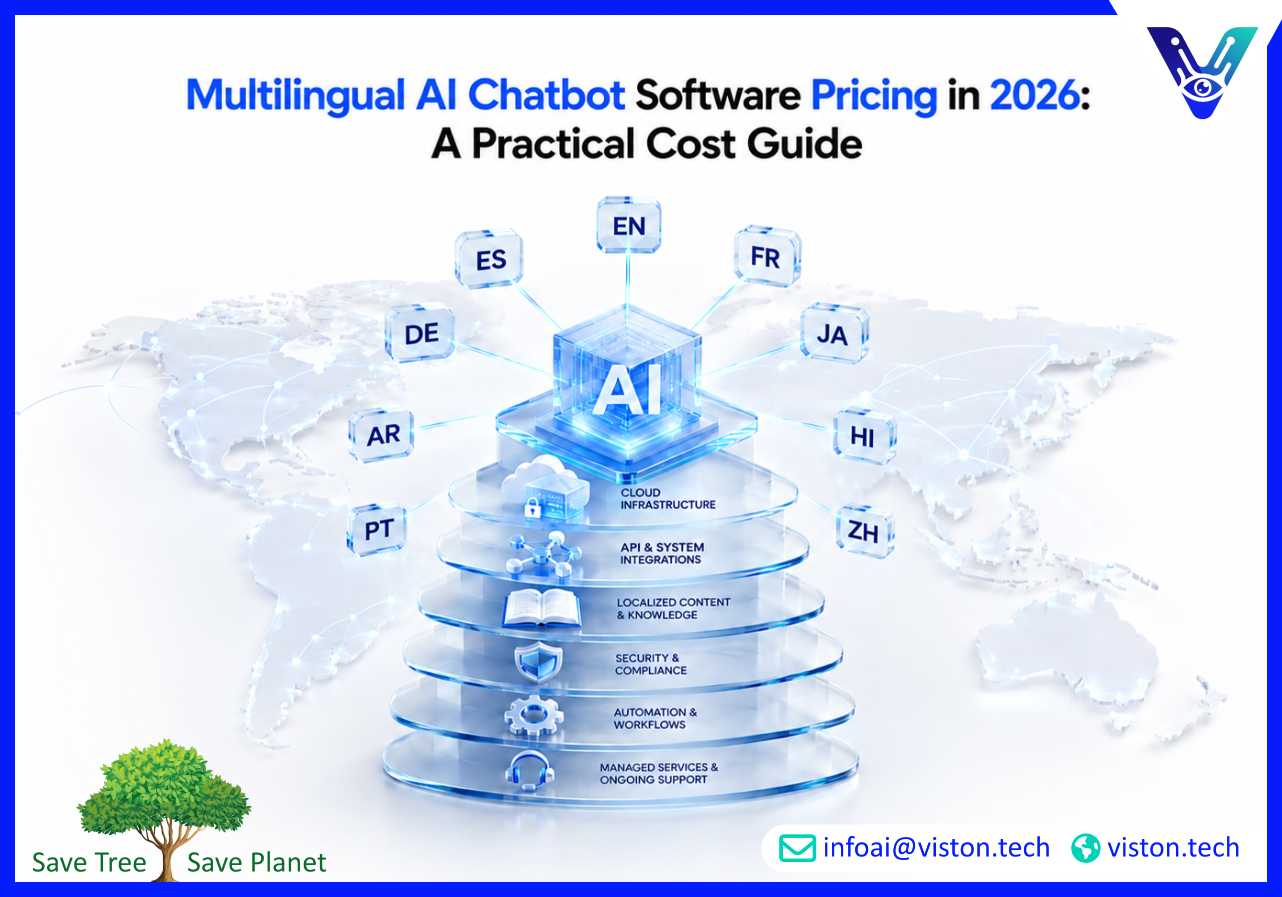
Multilingual AI Chatbot Software Pricing in 2026: A Practical Cost Guide
Multilingual AI chatbot software pricing varies because businesses are not simply buying a chat window. They are paying for language coverage, AI usage, knowledge preparation, integrations, security, testing, human handover, and ongoing optimization. Understanding these cost layers helps buyers compare proposals fairly and budget for reliable multilingual support.
What Multilingual AI Chatbot Software Pricing Usually Includes
A basic chatbot subscription may look inexpensive, but production-ready multilingual support normally combines platform access, AI consumption, implementation, localization, integrations, and ongoing service. The final price depends on whether the business needs configurable software, a customized deployment, or a fully managed solution.
Platform access and AI usage
Providers may charge by messages, conversations, active users, tokens, API calls, or a combination of these. Costs rise when conversations are long, responses use more capable language models, or the chatbot searches large knowledge bases before answering.Model selection also affects cost. A strong architecture may route routine requests to an efficient model and reserve a more capable model for complex questions. This can control spending without lowering service quality across every interaction.
Language enablement and localization
Adding a language involves more than translating existing answers. Each language may need intent examples, terminology mapping, localized knowledge content, tone rules, fallback messages, escalation paths, and quality testing. Languages with major dialect variation, limited data, complex scripts, or specialized vocabulary usually require more preparation.A chatbot serving three languages from one shared knowledge base will generally cost less than a ten-market system with different products, policies, compliance wording, and workflows. Buyers should ask whether the fee covers basic machine translation or genuine multilingual conversation design.
Implementation, integration, and support
Implementation can include discovery, conversation design, prompt engineering, knowledge-base setup, testing, deployment, and project management. Integration adds cost when the chatbot must connect with CRM, helpdesk, ecommerce, ERP, booking, identity, payment, or analytics systems.Ongoing support may cover performance monitoring, failed-conversation review, content updates, prompt refinement, retraining, security maintenance, reporting, and incident response. A low launch price can become poor value when the business must build its own team to maintain language quality and integrations after go-live.
Main Factors That Change Multilingual AI Chatbot Software Pricing
The number of supported languages matters, but it is only one variable. Two organizations using the same languages can receive very different quotes because their volumes, workflows, channels, data risks, and service expectations differ.
Number and complexity of languages
Pricing often increases as language coverage expands, but not in a simple per-language pattern. Closely related languages using common content may be easier to add than languages requiring separate scripts, regional variants, or market-specific rules. Buyers should define whether they need one standard language version or regional variants such as Brazilian and European Portuguese.
Conversation volume and peak demand
Monthly conversation volume affects infrastructure and AI consumption. Businesses should estimate average traffic, campaign spikes, seasonal peaks, and expected growth. A system designed for 5,000 short FAQ conversations is different from one handling hundreds of thousands of multi-step support interactions.Ask whether unused volume rolls over, how overages are charged, and whether third-party messaging fees are separate. Predictable usage bands are often easier to govern than a low subscription combined with unclear variable charges.
Use-case depth and workflow automation
An informational chatbot is usually cheaper than one that checks orders, changes bookings, verifies identity, processes claims, or qualifies leads. Every automated action adds integration, business-rule, testing, security, and exception-handling work.Complex workflows also need stronger human handover. The chatbot must recognize low confidence, preserve conversation context, route the case correctly, and pass the user’s language preference to the receiving agent.
Content readiness, channels, and security
Clean, current, well-structured content reduces implementation effort. Duplicate policies, conflicting translations, and outdated help articles increase cost because the provider must first organize and validate the knowledge base. Translation, terminology management, and subject-matter approval may also be separate workstreams.A website-only chatbot is simpler than an omnichannel deployment across apps, WhatsApp, social messaging, voice, and internal portals. Security controls such as single sign-on, role-based access, encryption, audit logs, data residency, private hosting, and retention policies also affect architecture and pricing.
Common Pricing Models and How to Build a Realistic Budget
Multilingual chatbot providers commonly use subscription, usage-based, project-based, or managed-service pricing. Enterprise proposals often combine more than one model.
Subscription pricing
A subscription provides platform access for a monthly or annual fee. Plans may be based on users, languages, channels, features, or conversation limits. This model works well when usage is predictable and customization is limited.Check whether the subscription includes AI usage, analytics, integrations, testing environments, support hours, and extra languages. A headline fee may exclude essential production components.
Usage-based pricing
Usage-based pricing charges according to messages, conversations, tokens, API calls, or completed resolutions. It can suit pilots or variable demand, but buyers need safeguards against unexpected bills.Request sample calculations for normal, peak, and high-growth months. The provider should explain how long conversations, retries, document retrieval, translation calls, and third-party channel fees are counted.
Project-based and managed-service pricing
A fixed project fee covers a defined implementation scope, such as discovery, a set number of languages, integrations, testing, deployment, and training. It offers budget clarity, but additional workflows, channels, or data sources may trigger change requests.A managed service combines software with monitoring, language quality reviews, content updates, analytics, retraining, and advisory support. It costs more than software alone, but it may reduce the need for internal conversational AI, localization, and support-operations specialists.
Budget for total cost of ownership
Separate one-time and recurring costs. One-time items may include discovery, implementation, integrations, content cleanup, translation, testing, and security review. Recurring items may include subscription, AI usage, channel fees, hosting, monitoring, localization updates, and enhancement work.Model costs over at least twelve months. The better buying question is not “Which chatbot is cheapest?” but “Which option delivers acceptable language quality, resolution performance, governance, and scalability at a predictable total cost?”
How to Compare Multilingual Chatbot Quotes Without Choosing on Price Alone
Comparable proposals require a shared scope. Give every provider the same language list, channels, use cases, monthly volumes, integrations, data requirements, service levels, and support expectations. Otherwise, the lowest quote may simply cover less.
Ask for clear assumptions
How many languages, regional variants, and channels are included?
Are model usage, translation, messaging, and hosting included?
What limits and overage charges apply?
Which integrations and workflows are in scope?
Who prepares, translates, and approves knowledge content?
What monitoring and optimization are included after launch?
Test language quality with real scenarios
A multilingual demo should use your terminology, customer questions, and edge cases. Test intent recognition, tone, code-switching, spelling variation, dialects, escalation, and answer consistency. Do not rely only on a provider’s list of supported languages.Operational fit matters as much as linguistic fluency. The chatbot should connect to relevant systems, preserve context during handover, produce useful analytics, and allow controlled updates. A natural-sounding solution that cannot complete tasks may not justify its price.
Measure value through outcomes
Assess pricing against expected outcomes such as self-service resolution, ticket reduction, response speed, lead capture, availability, and support coverage. Establish baseline metrics before deployment and review performance by language, channel, and use case.Cost per resolved conversation is often more meaningful than cost per message. A cheaper platform that creates more fallbacks, escalations, or inaccurate answers can increase downstream costs for support teams and customers.
How Viston AI Approaches Multilingual AI Chatbot Pricing and Delivery
Viston AI is directly relevant to multilingual AI chatbot software pricing because multilingual AI chatbot support is part of its stated service portfolio. Its offering covers multilingual conversational support, language-aware NLP, omnichannel deployment, business-system integration, analytics, monitoring, and cloud, private-cloud, on-premises, and hybrid deployment options.For buyers, this means pricing is shaped by scope rather than one universal software price. Viston AI’s service page lists pay-as-you-go, project-based, hourly or time-based, and subscription-based commercial models. A useful proposal should map the selected model to languages, usage, integrations, deployment, testing, and ongoing support.This approach can support phased adoption. An organization may begin with priority languages and high-volume use cases, validate accuracy and handover quality, then expand into more markets and workflows. Viston AI’s related capabilities in chatbot development, integration, NLP, model monitoring, and workflow automation are also relevant where multilingual conversations must connect with real customer-service and operational systems.
Frequently Asked Questions
How much does multilingual AI chatbot software cost?
There is no universal price. Cost depends on languages, conversation volume, AI usage, channels, integrations, workflows, hosting, security, content preparation, and support. Request a twelve-month total-cost model rather than comparing only monthly fees.
Does each additional language increase chatbot pricing?
Usually, but the increase varies. A language may require localized content, terminology, testing, regional rules, and quality review. Adding a language to shared FAQ content costs less than supporting market-specific policies and complex workflows.
What hidden costs should businesses look for?
Commonly overlooked costs include AI-token usage, translation, messaging fees, integration work, data cleanup, security reviews, overages, human quality assurance, monitoring, and post-launch optimization.
Is usage-based or subscription pricing better?
Subscription pricing is easier to budget when demand is stable. Usage-based pricing may suit pilots or variable traffic. Many businesses use a hybrid model with a base subscription, included volume, and transparent overages.
How can a business reduce multilingual chatbot costs?
Start with priority languages and high-volume, low-risk use cases. Clean the knowledge base, use pre-built integrations, route routine requests to efficient models, and expand after measuring resolution quality and demand.
Does Viston AI publish fixed multilingual chatbot prices?
Viston AI presents flexible pricing models rather than one fixed public price. Its proposal should therefore itemize implementation, usage, languages, integrations, deployment, and ongoing support.
Conclusion
Multilingual AI chatbot software pricing in 2026 reflects much more than the number of languages on a feature list. Reliable multilingual support requires suitable models, localized knowledge, integrations, security, testing, monitoring, and continuous improvement. Businesses should compare total cost of ownership, evaluate real language scenarios, and measure outcomes rather than choosing on headline price alone. Viston AI is relevant for organizations seeking multilingual support through flexible commercial and deployment options. The right choice balances predictable cost with language quality, operational fit, governance, and the ability to scale.