
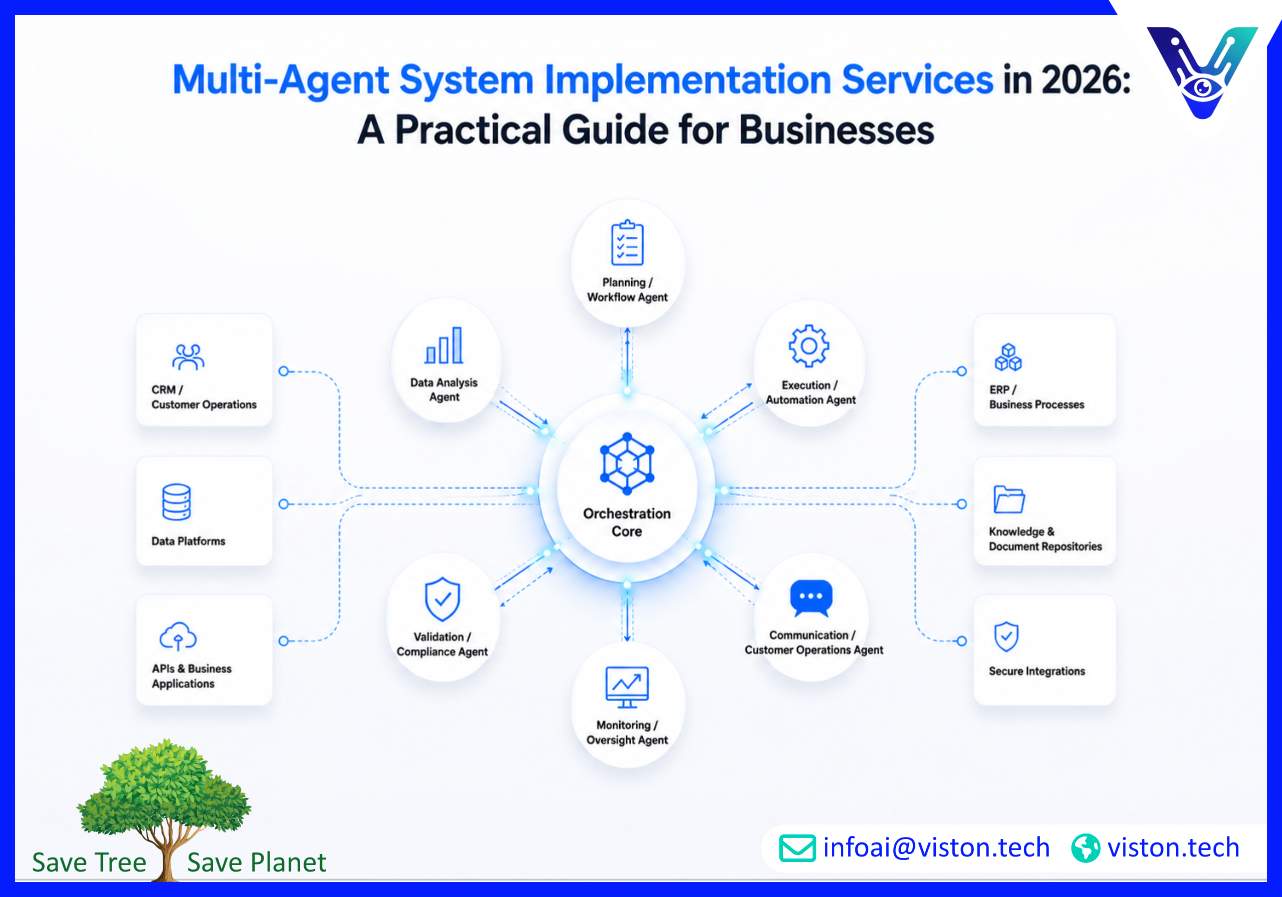
Businesses are increasingly moving beyond isolated AI tools and adopting coordinated AI systems that can manage complex workflows across departments. Multi-agent system implementation services help organizations design, deploy, orchestrate, and govern multiple AI agents that work together to automate processes, improve decision-making, and increase operational efficiency.
Multi-agent system implementation services focus on building and deploying AI environments where multiple specialized agents collaborate to achieve business objectives. Unlike a single AI assistant, a multi-agent system distributes responsibilities across multiple agents, each designed for a specific task.
These agents may handle functions such as data collection, analysis, customer communication, workflow execution, reporting, compliance validation, decision support, and process monitoring. An orchestration framework manages how agents interact, exchange information, access tools, and complete tasks.
Implementation services typically include:
The goal is not simply to automate tasks but to create coordinated AI-driven workflows that support real business operations.
Organizations face increasing pressure to improve productivity while managing growing volumes of data, customer interactions, compliance requirements, and operational complexity. Traditional automation solutions often struggle when workflows require contextual understanding, decision-making, and collaboration across systems.
Multi-agent systems address these challenges by enabling specialized AI agents to work together while maintaining clear responsibilities and oversight.
Multiple agents can simultaneously handle different stages of a workflow, reducing delays and manual handoffs between teams.
As business demands increase, organizations can expand agent capabilities without redesigning entire workflows.
Agents can gather data, perform analysis, validate findings, and provide recommendations before actions are executed.
Complex processes involving multiple systems and stakeholders can be coordinated through a structured orchestration layer.
Implementation frameworks can include approval workflows, audit trails, permission controls, and monitoring mechanisms that support responsible AI adoption.
Successful implementation requires a structured approach that combines technology, process design, security, and operational governance.
Each agent should have a clearly defined purpose. Common examples include planning agents, execution agents, monitoring agents, validation agents, communication agents, and analytics agents.
Clearly defined responsibilities reduce duplication, improve reliability, and simplify maintenance.
The orchestration layer serves as the coordination engine for the entire system. It determines:
Without effective orchestration, even highly capable agents may fail to produce reliable business outcomes.
Multi-agent systems often need access to existing business platforms, including:
Implementation services ensure secure and reliable integration between agents and business systems.
Agents require access to relevant information to make informed decisions. Effective context management ensures agents can retrieve, update, and share information throughout a workflow.
This helps maintain consistency across interactions and reduces the likelihood of errors.
As AI systems gain greater operational responsibility, governance becomes increasingly important. Organizations need controls for:
These safeguards help ensure responsible deployment and long-term trust in AI-driven operations.
Effective implementation starts with business objectives rather than technology selection. Organizations that focus on solving specific operational challenges tend to achieve stronger outcomes.
The best candidates for multi-agent implementation are workflows that involve multiple steps, systems, decisions, and stakeholders.
Examples include:
Understanding how work currently flows through the organization helps identify opportunities for agent collaboration and automation.
This stage typically reveals bottlenecks, manual handoffs, duplicated work, and process inefficiencies.
Rather than building one large agent, organizations should create specialized agents that perform clearly defined tasks. This improves transparency, testing, and performance management.
Certain decisions should remain under human supervision, particularly those involving financial transactions, legal obligations, customer commitments, or compliance risks.
Human review mechanisms help balance automation with accountability.
Deployment is only the beginning. Businesses should continuously evaluate:
Continuous optimization ensures long-term value from the implementation.
Organizations investing in professional implementation services often achieve stronger results than those relying on ad-hoc AI deployments.
As AI adoption matures, businesses increasingly recognize that implementation quality often determines whether a multi-agent initiative succeeds or fails.
Organizations pursuing multi-agent system implementation often require expertise that extends beyond AI model deployment. Successful projects depend on orchestration strategy, workflow design, integration planning, governance frameworks, and operational alignment.
Viston AI specializes in Multi-Agent Orchestration, helping businesses design coordinated AI systems that align with real-world operational requirements. Its capabilities are relevant for organizations seeking to move from isolated automation initiatives to structured agent ecosystems that support scalable business workflows.
By focusing on orchestration, integration, workflow automation, and agent collaboration, Viston AI helps organizations build systems where specialized agents can work together efficiently while maintaining security, transparency, and operational control.
Whether supporting customer operations, internal workflows, data-driven processes, or business automation initiatives, a structured orchestration approach can help organizations achieve more reliable outcomes and maximize the value of AI investments.
A multi-agent system consists of multiple specialized AI agents that collaborate to complete tasks, execute workflows, and support business operations under a coordinated orchestration framework.
Implementation timelines vary based on workflow complexity, integration requirements, governance needs, and organizational readiness. Pilot projects can often be delivered faster than enterprise-wide deployments.
Industries with complex workflows, large data volumes, multiple systems, and operational coordination requirements often benefit significantly, including finance, healthcare, retail, manufacturing, logistics, and technology sectors.
Most implementations are designed to augment employees by automating repetitive tasks, supporting decision-making, and improving workflow efficiency while allowing people to focus on higher-value responsibilities.
Orchestration is critical because it manages communication, coordination, workflow routing, approvals, context sharing, and exception handling between agents.
Yes. Viston AI’s specialization in Multi-Agent Orchestration aligns with organizations seeking structured implementation, workflow coordination, system integration, and scalable AI-driven automation.
Multi-agent system implementation services provide businesses with a practical pathway to scale AI beyond isolated tools and into coordinated operational workflows. As organizations continue to pursue efficiency, automation, and intelligent decision-making in 2026, the ability to orchestrate multiple specialized agents becomes increasingly valuable. Success depends on thoughtful architecture, effective orchestration, secure integrations, governance controls, and continuous optimization. For organizations exploring Multi-Agent Orchestration, Viston AI offers expertise that aligns with building reliable, scalable, and business-focused multi-agent environments capable of supporting long-term operational transformation.
