
Multi-Agent Orchestration for Startups: A 2026 Guide to Building Scalable AI Workflows
Introduction
Startups in 2026 face a critical choice: build AI features that wow demos, or build AI systems that drive real business outcomes. Multi-agent orchestration is the infrastructure that turns isolated AI experiments into reliable, scalable workflows—enabling startups to automate complex processes, reduce operational costs, and compete with enterprise-grade capabilities from day one.
What Multi-Agent Orchestration Means for Startups
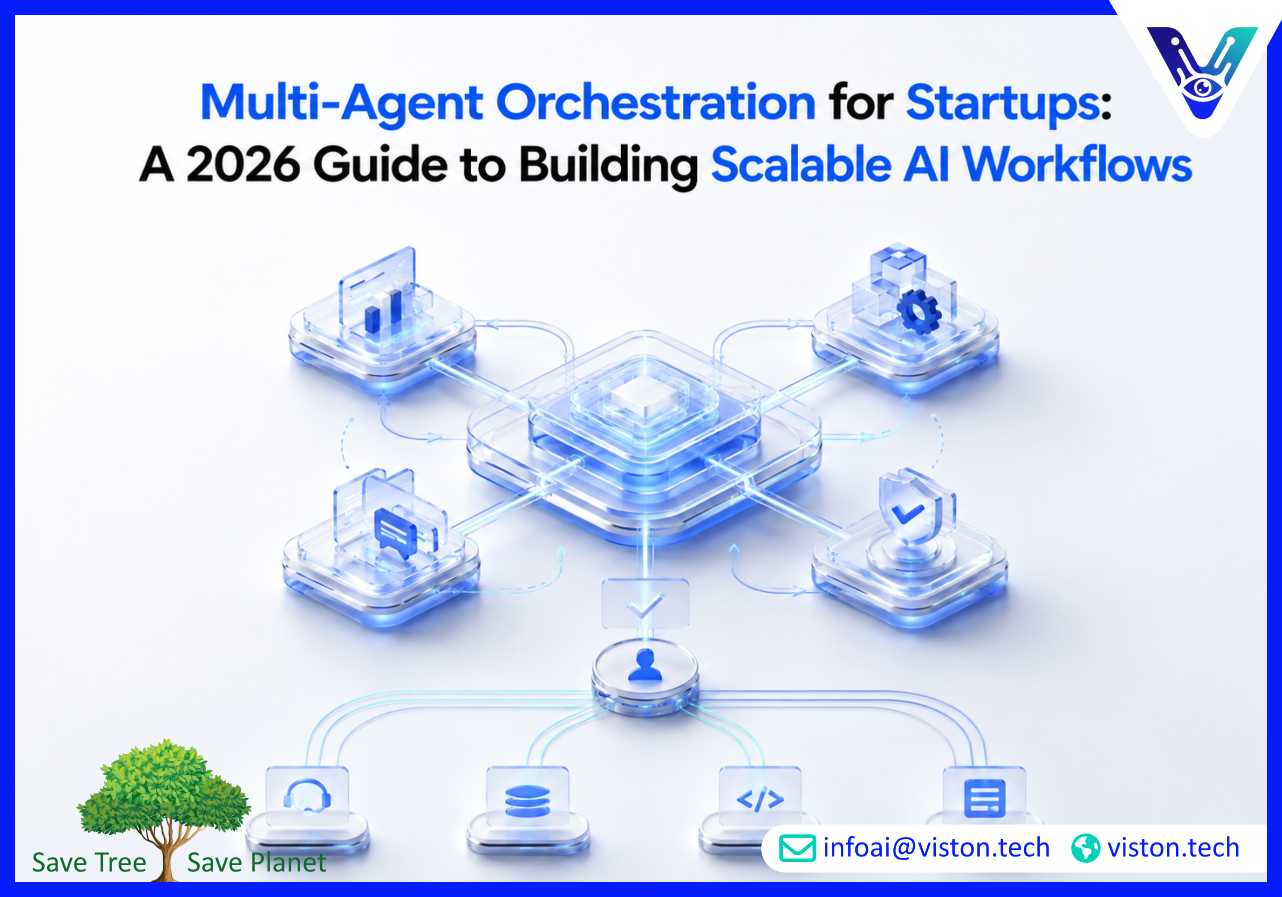
Multi-agent orchestration is the coordination layer that manages multiple specialized AI agents working together to complete complex tasks. Instead of relying on a single general-purpose AI model, orchestrated systems deploy teams of agents—each with a specific role like planning, execution, review, or data retrieval—coordinated through defined workflows:
- The Planner breaks down high-level goals into actionable sub-tasks
- The Specialist executes specific functions like code generation, data analysis, or content creation
- The Reviewer validates outputs, checks for errors, and requests revisions
- The Coordinator manages handoffs, maintains context, and ensures task completion
This architecture transforms AI from a chatbot into an operational workforce. A recent LangGraph implementation showed multi-agent approaches improving task accuracy by 70% compared to single-agent systems. For startups operating with limited teams, this means automating workflows that previously required multiple specialists.
Why Multi-Agent Orchestration Matters for Startups in 2026
The startup landscape has shifted fundamentally. By 2026, 40% of enterprise applications integrate autonomous agents, and nearly half of European AI pilots have moved into production. The question is no longer whether AI will power your product, but whether your AI infrastructure can scale without collapsing under complexity.
Single-agent systems hit a performance wall when faced with multi-step business problems. They lack the specialized skills, error-checking, and iterative refinement needed for robust solutions . Startups that bet everything on one generalist agent often discover too late that their AI works great in demos but fails in production when edge cases emerge.
Multi-agent orchestration addresses this by distributing intelligence across specialized agents. This methodology enables organizations to enhance accuracy through role-specific agents, alleviate bottlenecks by parallelizing workflows, strengthen security through compartmentalization, and foster innovation by adding new agents without overhauling the entire system.
Business Problems Startups Solve with Multi-Agent Orchestration
Startups adopting multi-agent orchestration typically face these critical challenges:
Scaling Operations Without Proportional Head Growth
Early-stage startups cannot hire specialists for every function. A multi-agent crew can handle market research, content creation, customer support escalation, and code review simultaneously—acting as a force multiplier for small teams.
Moving from Pilot to Production Without ROI Diminishment
A staggering 46% of AI pilots fail to scale because they lack the infrastructure for production-grade reliability. The biggest hurdle isn’t the technology—it’s transitioning from a successful proof-of-concept to enterprise-grade deployment . Multi-agent orchestration provides the stateful execution, cyclical reasoning, and human-in-the-loop checkpoints necessary for production resilience.
Avoiding Vendor Lock-In and Cost Volatility
Startups betting on single-model APIs face existential risk when providers release competing features or change pricing. Successful startups build atop Agentic Operating Systems using the Model Context Protocol (MCP), which allows model-swapping without workflow disruption.
Ensuring Compliance and Auditability
In regulated industries, AI decisions must be explainable. Multi-agent systems with graph-based workflows provide transparency—making it easier to trace, debug, and audit every decision path. This is non-negotiable for fintech, healthtech, and companies serving enterprise customers.
How Multi-Agent Orchestration Addresses These Challenges
Orchestrated multi-agent systems solve startup challenges through specific architectural capabilities:
Stateful Execution Across Multiple Steps
Agents remember context across tool uses and workflow stages, leading to more intelligent and coherent outcomes. This is essential for multi-step processes like lead qualification, data pipelines, or customer onboarding.
Cyclical Reasoning and Self-Correction
Agents can loop, retry tasks, and self-correct when encountering errors—mimicking human problem-solving and ensuring process completion rather than abandoning tasks at the first obstacle.
Human-in-the-Loop Integration
Explicit checkpoints for human oversight and approval ensure critical enterprise operations maintain control. This balances automation speed with risk management.
Framework Selection for Startup Needs
Startups should choose orchestration frameworks based on their workflow characteristics:
| Framework | Best For | Use Case Example |
|---|---|---|
| LangGraph | Complex decision trees requiring explicit control | Research assistants that iteratively refine outputs, compliance workflows with approval gates |
| CrewAI | Team collaboration workflows | Content creation pipelines, market analysis crews, customer support escalation |
| AutoGen | Multi-agent conversation scenarios | Collaborative coding, debate-style problem solving |
Practical Use Cases for Startups
Startups are deploying multi-agent orchestration across these high-impact areas:
- Go-to-Market Automation: One agent tracks competitors, another drafts content, a third schedules posts—all coordinated as a crew
- Customer Support Escalation: Agents handle Tier 1 queries autonomously and escalate complex cases to humans with full context preserved
- Data Pipeline Automation: Extract, transform, validate, and load data across systems with branching error-recovery logic
- Code Review Workflows: Security, performance, and style experts each contribute to comprehensive code quality assessment
- Grant Writing and Fundraising: Research agents identify opportunities, writing agents draft applications, review agents optimize for success patterns.
Implementation Considerations for Startups
Building multi-agent systems requires careful planning to avoid amplifying chaos rather than scale:
Define Decision Rights Early
One team built a multi-agent system across LangGraph and CrewAI where output increased but reversals doubled. Once decision rights and a kill-switch were defined, performance stabilized and the stack simplified. Startups must establish clear autonomy boundaries—insufficient autonomy renders agents ineffective, while excessive authority introduces risk.
Start with Agent-Native Workflows
Startups launching in 2026 should design agent-native workflows where AI agents are the primary actors and human oversight is the exception, rather than retrofitting AI onto human-centered processes.
Implement Cost Controls from Day One
Configure budget capping for agent compute costs, implement hybrid architectures using local models for routine tasks and frontier APIs for complex reasoning, and establish circuit breakers at 80% budget thresholds.
Build Governance Hardening
Conduct security audits of agent permissions, document constitutional constraints, and establish immutable audit trails. Prepare for scale before scale becomes a problem.
Viston AI’s Multi-Agent Orchestration Expertise
Viston AI specializes in building production-ready multi-agent orchestration systems for startups and enterprises transitioning from AI pilots to scalable operations. Based in Ahmedabad with global clients, Viston AI delivers custom, enterprise-focused artificial intelligence solutions that turn complex data into practical business outcomes.
The company leverages LangGraph to build AI agents that are deterministic and debuggable for production environments. Their approach includes stateful execution that remembers context across multiple steps, cyclical reasoning that enables agents to self-correct, and human-in-the-loop integration with explicit approval checkpoints—critical for enterprise operations. Viston AI’s proprietary 3-phase scaling framework cuts time-to-ROI by 40%, bridging the gap between promising proofs-of-concept and profitable, enterprise-grade solutions.
Through their Delos platform, Viston AI enables businesses to deploy task-specific AI agents that work in concert—such as data analysis, email drafting, and CRM updates—coordinated through LLM orchestration and prompt chaining. This creates intelligent, end-to-end process ownership that reduces errors and unlocks new productivity levels. For startups considering multi-agent orchestration, Viston AI provides the technical expertise and scaling framework to move beyond single-agent limitations toward sophisticated, real-world AI solutions.
Frequently Asked Questions
What is multi-agent orchestration for startups?
Multi-agent orchestration coordinates multiple specialized AI agents to complete complex tasks that single agents cannot handle. For startups, it means deploying teams of AI agents—each with roles like planning, execution, and review—working together through defined workflows to automate business processes at scale.
Why do startups need multi-agent orchestration instead of single agents?
Single AI agents hit performance walls on multi-step problems, lacking specialized skills and error-checking. Multi-agent orchestration improves task accuracy by up to 70% compared to single-agent systems and enables startups to automate entire workflows rather than isolated tasks.
What frameworks should startups use for multi-agent orchestration in 2026?
LangGraph excels for complex decision trees requiring explicit control and stateful execution. CrewAI shines for team collaboration workflows like content creation or market analysis. AutoGen works well for multi-agent conversation scenarios. The choice depends on whether your workflow needs explicit control paths or natural team collaboration.
How much does multi-agent orchestration cost for startups?
Costs vary based on agent compute usage, API calls, and workflow complexity. Startups should implement budget capping, hybrid architectures using local models for routine tasks, and circuit breakers at 80% budget thresholds. Many startups begin with open-source frameworks like LangGraph or CrewAI before scaling to enterprise platforms.
What are the biggest risks of implementing multi-agent orchestration?
Key risks include integration complexity with legacy systems, undefined autonomy boundaries leading to either ineffectiveness or excessive risk, talent gaps requiring vendor reliance, and orchestrating without defined decision rights which can amplify chaos rather than scale. Startups must establish governance, kill-switches, and clear decision authority early.
Can Viston AI help startups implement multi-agent orchestration?
Yes. Viston AI specializes in multi-agent orchestration for startups moving from pilots to production. They leverage LangGraph for stateful, debuggable agents and offer a proprietary 3-phase scaling framework that cuts time-to-ROI by 40%. Their Delos platform enables deployment of coordinated AI agent teams with human-in-the-loop oversight.
Conclusion
Multi-agent orchestration is no longer optional for startups serious about AI-driven growth in 2026. It transforms isolated AI experiments into reliable, scalable workflows that automate complex business processes, reduce operational costs, and deliver enterprise-grade capabilities without enterprise budgets. The startups winning today are those treating AI agents as coordinated team members with workflow infrastructure, shared context, and governance—not just better code generation or chatbots.
Success requires choosing the right framework for your workflow, defining decision rights early, implementing cost controls from day one, and building governance before scale becomes a problem. For startups ready to move beyond single-agent limitations, multi-agent orchestration with partners like Viston AI provides the technical expertise and scaling framework to transform AI from a cost center into a strategic, revenue-driving asset.
