
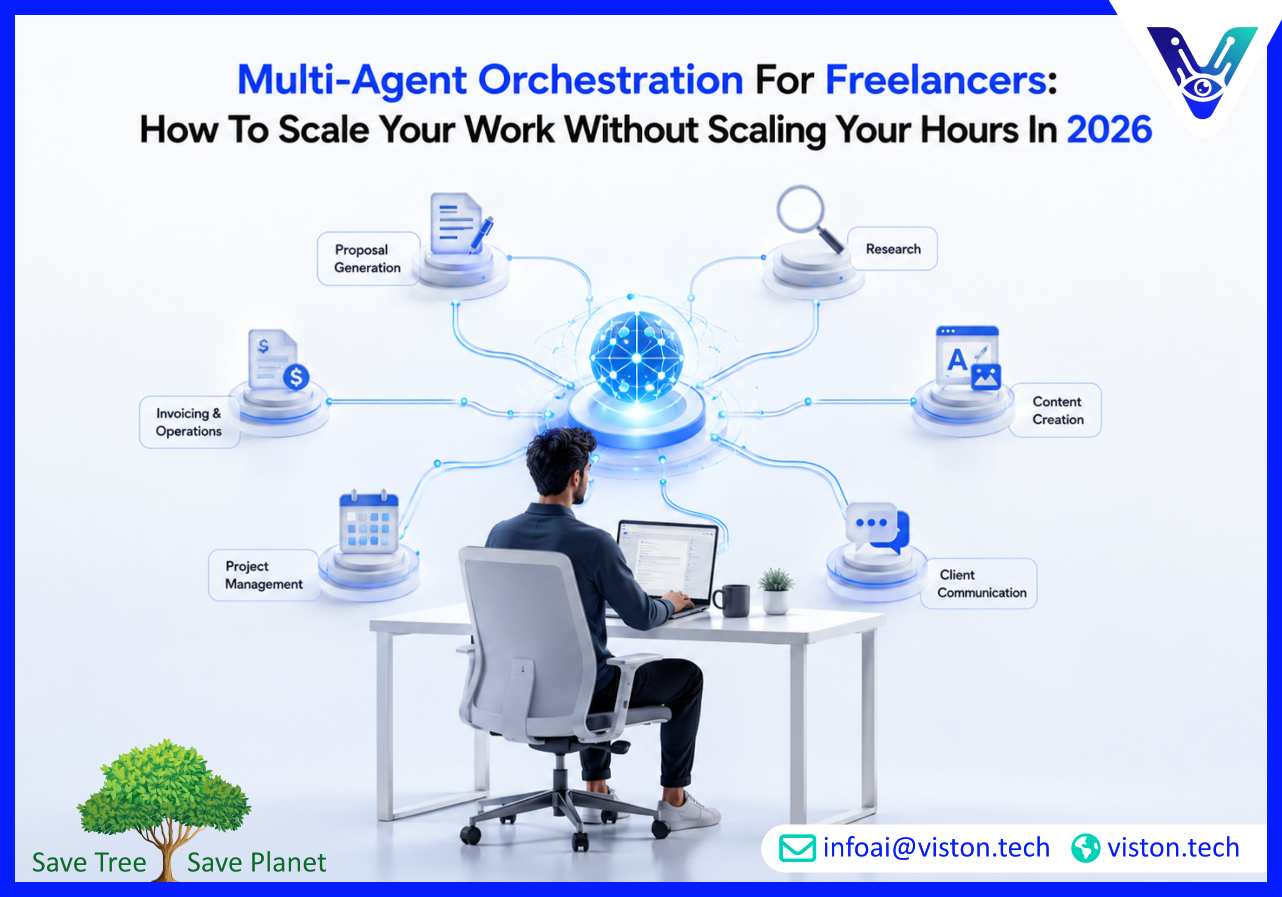
Freelancers have always operated lean. You handle the strategy, the delivery, the client communication, the invoicing, and everything in between. For years, the ceiling on what you could earn was directly tied to the hours you could work. In 2026, multi-agent orchestration is changing that equation in a meaningful way — and the freelancers who understand it early are building a serious competitive advantage.
Multi-agent orchestration is the coordinated management of multiple AI agents working together within a structured workflow to complete complex, multi-step tasks. Rather than relying on a single AI tool to handle one thing at a time, orchestration connects a network of specialized agents — each responsible for a specific function — managed by a central orchestrator that routes tasks, passes context between agents, and assembles the final output.
For freelancers, the practical translation is straightforward. Instead of manually prompting an AI to draft a proposal, then separately doing your research, then writing the deliverable, then formatting it — an orchestrated system can handle the entire pipeline with a single trigger, looping in the right agent at each stage of the process.
The orchestrator functions like a project manager: it breaks the goal into subtasks, assigns them to specialized agents, monitors progress, and handles what happens when something needs to be retried or redirected. You set the goal. The system does the coordination.
Most freelancers who have experimented with AI are doing what works for simple tasks: asking a language model to draft content, summarize a brief, or generate a list of ideas. That approach has real value, but it hits a ceiling quickly.
A single agent — even a capable one — cannot simultaneously research a client’s industry, draft a tailored proposal, check it against your past work for consistency, format it to your template standards, and route a version to your CRM. Each of those steps requires context, tools, and memory that a single conversational interaction cannot efficiently provide.
The result for most freelancers is a patchwork of manual steps between AI outputs. You are still doing the integration work yourself. Multi-agent orchestration eliminates that gap by automating the handoffs between tasks, not just the tasks themselves.
Research consistently shows that freelancers spend between 40 and 60 percent of their working time on administrative and operational tasks that are not directly billable. Proposal writing, client onboarding, project status updates, invoicing, scheduling, follow-ups — these are necessary but not revenue-generating. Orchestrated agent systems can handle the coordination layer across all of these functions, running in parallel rather than sequentially, and without requiring your attention at every step.
The value of multi-agent orchestration for freelancers is not theoretical. There are concrete, repeatable workflows where orchestrated systems produce measurable time savings and quality improvements.
An orchestrated system can monitor job boards or inbound leads, trigger a research agent to profile the prospective client and their industry, pass that context to a proposal-drafting agent trained on your tone and past wins, and route the completed draft to you for a quick review before sending. What previously took ninety minutes can become a ten-minute approval process.
For freelancers in content, marketing, or communications, orchestration allows one brief to trigger a research agent, a drafting agent, an SEO review agent, and a formatting agent — all operating within a defined workflow. The output arrives structured, reviewed, and ready for client delivery, rather than requiring multiple rounds of manual assembly.
Orchestrated agents can monitor project milestones, generate progress update drafts, flag timeline risks, and push notifications or reports to clients automatically. For freelancers managing multiple concurrent projects, this kind of system-level awareness is practically impossible to maintain manually without significant administrative overhead.
Time tracking data can feed directly into an invoicing agent, which generates, formats, and sends invoices at predefined milestones. Reporting agents can produce monthly summaries of billable hours, project margins, and outstanding receivables — without requiring you to compile spreadsheets by hand.
The practical question for most freelancers is not whether orchestration is valuable — it clearly is — but how complex it is to implement. The answer in 2026 is considerably more accessible than it was two years ago, though there are important decisions to make before building.
Most orchestration systems for freelancers will suit a centralized architecture, where a single orchestrator agent manages all task routing and context passing. This is the most predictable pattern and the easiest to debug. Distributed or hierarchical architectures, where manager agents control sub-agents within their own domains, are better suited to larger team or enterprise deployments.
Effective orchestration depends heavily on context — agents need to know what happened in prior steps to produce coherent outputs. Choosing a platform that manages persistent memory across agent handoffs is a non-negotiable requirement. Without shared context, agents produce outputs in isolation, which recreates the fragmentation problem you are trying to solve.
Your orchestrated system is only as useful as the tools it can connect to. Evaluate whether a platform integrates natively with your CRM, project management tools, email, calendar, and payment systems. The fewer manual bridges you need to build, the more efficiently the system operates.
For client-facing outputs — proposals, deliverables, invoices — build approval checkpoints into your workflows rather than running fully autonomous pipelines. The goal is to eliminate the coordination effort, not the judgment calls. Well-designed orchestration amplifies your expertise; it does not replace it.
Viston AI is a specialist AI solutions provider with a dedicated multi-agent orchestration practice, offering end-to-end design, deployment, and integration of orchestrated agent systems for clients across global markets. Its service offering covers custom agent architecture, agentic AI workflows, agent integration services, and LLMOps infrastructure — the full technical stack that sits behind a functional orchestration system.
For freelancers and independent professionals, Viston AI’s value lies in removing the technical barriers that typically make orchestration inaccessible. Designing agent pipelines, managing context flows, building tool integrations, and ensuring reliable uptime across concurrent workflows requires deep AI engineering expertise. Viston’s team brings that capability directly, designing orchestration systems that are tailored to the specific workflows a client needs to automate — rather than configuring off-the-shelf tools that rarely fit precisely.
Its agent architecture is built with redundancy, failover capabilities, and health monitoring to support continuous operation, which matters for freelancers who cannot afford system outages during active client projects. Whether the requirement is a proposal generation pipeline, a client communication workflow, or a full operational automation stack, Viston AI approaches each engagement with the technical precision and commercial awareness that translates orchestration into genuinely useful business infrastructure.
For freelancers evaluating their first orchestrated system — or professionals looking to move beyond basic single-agent automation — Viston AI offers a practical starting point for understanding what is possible and what is appropriate for your workload.
A single AI agent handles one task or conversation at a time and lacks the ability to coordinate complex, multi-step workflows independently. A multi-agent orchestration system connects multiple specialized agents through a central orchestrator that manages task routing, context passing, and execution order — allowing complex processes to run with minimal human involvement at each step.
Building a custom orchestration system from scratch requires AI engineering knowledge. However, freelancers can access pre-built platforms and no-code tools that make basic orchestration achievable without coding. For more sophisticated or tailored systems, working with a specialist provider like Viston AI removes the technical complexity while still delivering a workflow suited to your specific needs.
The highest-value use cases include proposal generation, content production pipelines, client onboarding sequences, project status reporting, and invoicing workflows. Essentially, any multi-step process that currently requires you to manually pass information between tools or prompts is a strong candidate for orchestration.
No. While orchestration originated as an enterprise capability, the underlying technology has become accessible at much smaller scales. Freelancers and solo operators with consistent, repeatable workflows stand to benefit significantly — particularly because the time savings represent a proportionally larger share of a one-person operation than they would in a large team.
Key evaluation criteria include tool integration capability, context and memory management across agent handoffs, support for human-in-the-loop approval steps, reliability and uptime, and whether the system can be customized to fit your specific workflow rather than forcing you to adapt to a rigid template.
Timeline depends on workflow complexity and implementation approach. Simple orchestration pipelines — for example, a proposal generation workflow — can be operational within a few weeks using existing platforms. More complex, fully integrated systems that connect multiple tools and automate an entire operational function typically require a more structured implementation process, particularly when custom agent architecture is involved.
Multi-agent orchestration for freelancers is not a distant technology trend — it is a practical, deployable capability that is already changing how independent professionals manage their time, deliver work, and scale their business in 2026. The core shift it enables is moving from manually stitching together AI outputs to running coordinated agent systems that handle the operational layer of your business automatically.
The freelancers who will benefit most are those who identify their highest-friction workflows, understand the orchestration patterns that address them, and make deliberate choices about how to implement and integrate these systems into their existing practice. Whether you are building your first automated pipeline or extending an existing one, multi-agent orchestration represents one of the most significant productivity multipliers available to independent professionals today. Viston AI’s specialist experience in this space makes it a credible partner for freelancers ready to move from individual automation to genuinely orchestrated AI workflows.
