
Multi-Agent Orchestration Challenges Enterprises Must Solve in 2026
Moving from a single AI model to a coordinated system of specialized agents is one of the most consequential architectural decisions an enterprise can make in 2026. But the business value of multi-agent orchestration is only realizable when the operational challenges are properly understood and addressed from the outset.
Why Multi-Agent Orchestration Is No Longer Experimental
The proof-of-concept phase for agentic AI is behind us. Organizations across finance, healthcare, manufacturing, logistics, and retail are now deploying multi-agent systems in production environments — not as experiments, but as core operational infrastructure.
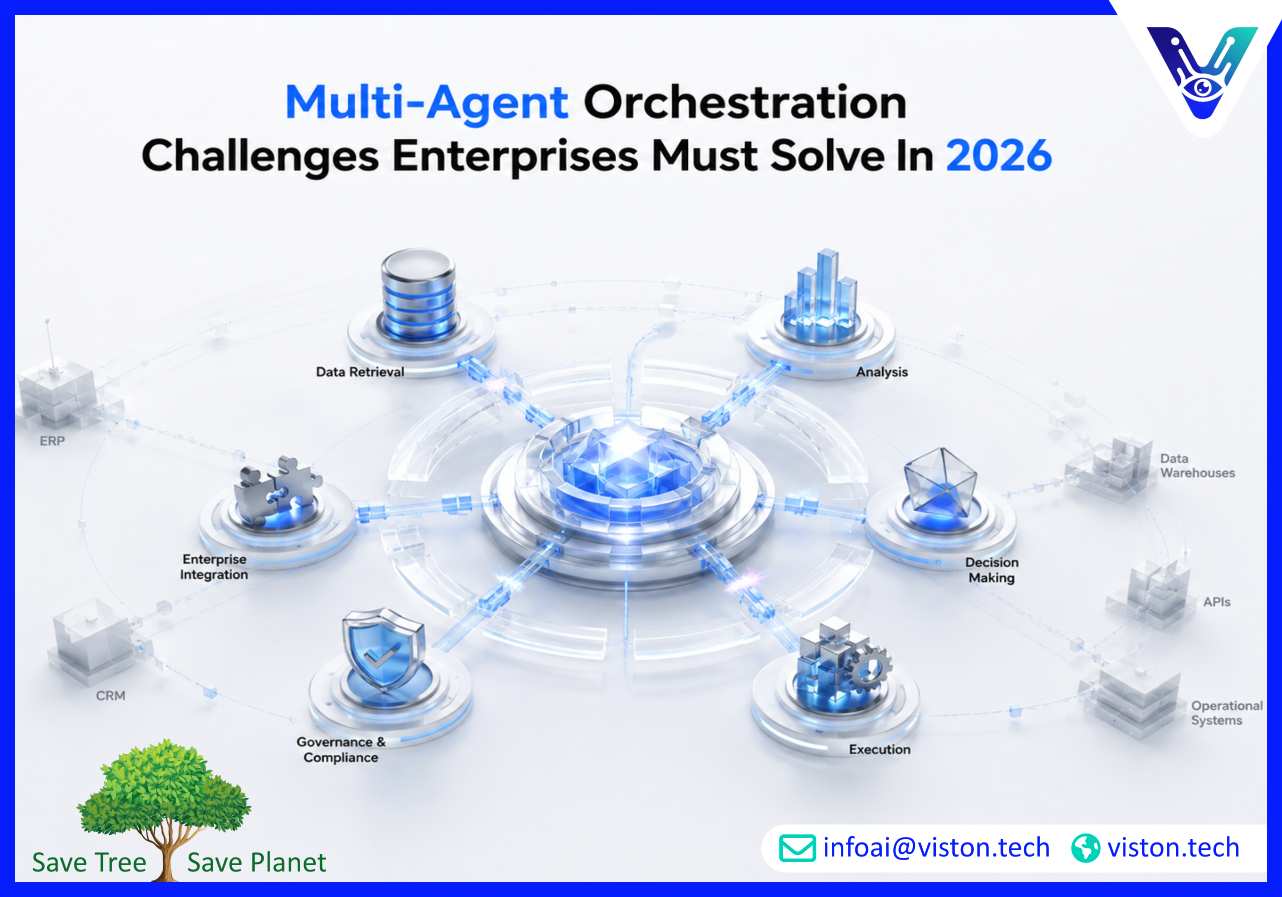
The appeal is clear. Rather than relying on a single generalist model, multi-agent orchestration deploys specialized AI agents that each handle a defined function, whether that is data retrieval, analysis, decision-making, or execution. An orchestrator coordinates their activity, delegates tasks, manages dependencies, and synthesizes outputs into coherent, actionable results.
The shift mirrors what enterprises went through with microservices architecture a decade ago. The analogy holds in more than one way: the gains are substantial, but so are the coordination requirements. Enterprises that rush into multi-agent deployments without understanding the underlying challenges often find themselves managing agent sprawl, debugging difficult-to-trace failures, and dealing with governance gaps that create serious compliance exposure.
The Core Challenges That Slow Enterprise Deployment
Context Management Across Agent Handoffs
One of the most persistent technical challenges in multi-agent orchestration is maintaining coherent context as tasks move between agents. When an agent completes its portion of a workflow and passes control to the next, information can be lost, misinterpreted, or insufficiently summarized. Most production failures in multi-agent systems are not caused by model capability limitations — they occur at handoff points where context transfer breaks down.
This is particularly damaging in workflows where downstream agents depend entirely on upstream outputs. A misclassified intent, an incomplete data extract, or a missed constraint can cascade through an entire pipeline before the error becomes visible. The longer the agent chain, the greater the compounding risk.
Addressing this requires shared state management frameworks, standardized communication protocols, and clear role boundaries for each agent — technical requirements that demand deliberate architecture decisions rather than ad hoc configurations.
Agent Coordination and Sprawl
As organizations scale their multi-agent implementations, the number of active agents multiplies quickly. Without disciplined governance, this creates what practitioners describe as agent sprawl: a proliferation of agents with overlapping responsibilities, unclear ownership, and inconsistent behavior across workflows.
Coordinating dozens of agents that interact dynamically — adjusting behavior based on real-time data and each other’s outputs — requires a robust orchestration layer that can handle task decomposition, dependency management, and conflict resolution simultaneously. As agent counts grow, the number of possible interactions increases rapidly, making unmanaged coordination a direct threat to system stability and predictability.
Observability and Debuggability Gaps
Traditional software debugging relies on deterministic logic and predictable outputs. Multi-agent systems introduce probabilistic behavior, dynamic routing, and emergent interactions that make conventional monitoring insufficient. When something goes wrong in a complex agent workflow, identifying the specific point of failure — and understanding why an agent made a particular decision — requires specialized observability tooling.
This is a recognized gap across the enterprise AI landscape. Research from early 2026 indicates that only a small fraction of organizations report mature agent governance, with most still operating without the auditability infrastructure needed to satisfy compliance teams or risk committees. In regulated industries, this is not a minor operational gap — it is a deployment blocker.
Governance, Compliance, and Accountability
Multi-agent systems introduce accountability questions that single-model deployments do not. When an agent makes a consequential decision — approving a financial transaction, flagging a patient record, triggering a procurement action — organizations need to know who or what is responsible, why the decision was made, and whether it fell within defined operational boundaries.
Embedding governance into the orchestration layer itself, rather than treating it as a separate audit function, is essential for enterprise-scale deployments. This means defining compliance rules as code, enforcing them automatically across every agent, and maintaining a verifiable audit trail for every decision. Organizations operating in environments subject to GDPR, HIPAA, MiFID II, or sector-specific regulatory frameworks cannot treat governance as an afterthought.
Integration With Existing Enterprise Systems
Most enterprises do not start with a clean slate. Multi-agent orchestration must integrate with legacy ERP systems, proprietary data warehouses, real-time operational feeds, and existing API ecosystems. Agents need reliable, low-latency access to relevant data — and that data frequently sits in systems that were not designed with agentic AI in mind.
Poor integration architecture creates performance bottlenecks, inconsistent data quality, and agents that make decisions based on incomplete or stale information. A robust API gateway strategy, pre-built connectors for major enterprise platforms, and clear data access controls are foundational requirements for any production-grade multi-agent implementation.
Scalability Without Performance Degradation
Scaling multi-agent systems from a single workflow to enterprise-wide deployment is not simply a matter of adding more agents. As workloads grow, orchestration latency, memory overhead, and compute costs require active management. Dynamic agent scaling — automatically adjusting resources based on real-time demand — is a critical capability that prevents both performance degradation during peak periods and unnecessary cost accumulation during quieter cycles.
How Architecture Decisions Determine Outcomes
The architecture pattern chosen for a multi-agent system shapes every downstream operational characteristic. Supervisor/worker patterns centralize coordination under a single orchestrator and work well for structured workflows like customer service triage or document processing. Peer-to-peer patterns distribute decision authority across agents and suit research or distributed analysis tasks. Hierarchical patterns add additional management layers for complex enterprise operations that span multiple business functions.
Choosing the right pattern is not a technical preference — it is a business decision. Factors including workflow complexity, data sovereignty requirements, fault tolerance expectations, and regulatory context all influence which architecture delivers reliable performance at scale.
How Viston AI Addresses Multi-Agent Orchestration Challenges
Viston AI is a specialist in enterprise multi-agent orchestration, offering an end-to-end platform designed to help organizations deploy, manage, and scale coordinated AI agent systems with the reliability and governance that enterprise environments demand.
Their platform addresses the challenges outlined in this article through a combination of structural capability and operational depth. The LLMOps in a Box framework provides pre-configured models, governance tooling, and deployment workflows that reduce time-to-production significantly. Dynamic agent scaling handles compute management automatically, preventing the performance degradation that often undermines enterprise confidence in agentic systems.
On governance, Viston’s platform embeds compliance rules directly into agent workflows — enforcing boundaries, maintaining audit trails, and ensuring every agent decision is explainable and verifiable. This is essential for clients operating under GDPR, HIPAA, financial services regulations, or any sector-specific compliance obligation.
The platform supports federated learning for industries where data cannot leave its source environment, and offers an API gateway with pre-built connectors for major enterprise platforms, addressing the integration complexity that slows many deployments.
Viston serves organizations across financial services, healthcare, manufacturing, retail, and logistics, providing a structured path from initial use-case identification through to full-scale deployment and continuous optimization. For enterprise teams evaluating multi-agent orchestration providers, Viston’s combination of LLMOps infrastructure, responsible AI frameworks, and cross-industry delivery experience makes it a substantive choice.
Practical Steps for Enterprises Moving Into Production
Organizations that have moved from experimentation to reliable production deployments share several common practices.
They start with a clearly defined, high-impact use case rather than attempting enterprise-wide orchestration from day one. This builds internal understanding of agent behavior, integration requirements, and governance needs before complexity compounds.
They invest in observability from the beginning. Monitoring agent decisions, tracking handoff quality, and maintaining audit-ready logs is far easier to build in from the start than to retrofit after deployment.
They treat human oversight as a permanent feature rather than a temporary measure. The most resilient multi-agent deployments include well-defined escalation paths — points where a decision leaves the agent system and involves human review — particularly for high-stakes or ambiguous scenarios.
And they use open, standardized protocols for agent communication. Emerging standards like MCP and A2A are gaining adoption among enterprise deployments precisely because they reduce vendor lock-in and make it easier to integrate additional agents as requirements evolve.
Frequently Asked Questions
What causes most multi-agent orchestration failures in production?
Most failures occur not because of model quality issues but because of poor context transfer between agents at handoff points. Incomplete shared state, unclear role definitions, and insufficient orchestration logic at transition points are the most common root causes in enterprise deployments.
How do enterprises maintain compliance in multi-agent systems?
Governance needs to be embedded at the orchestration layer rather than applied after the fact. This means defining compliance rules as enforceable code, maintaining a verifiable audit trail for every agent decision, and ensuring that regulated data — such as healthcare or financial records — is handled within appropriate access and encryption controls throughout the workflow.
What is agent sprawl and why does it matter?
Agent sprawl refers to the uncontrolled proliferation of AI agents across an organization, often with overlapping responsibilities and inconsistent behavior. It typically results from scaling without disciplined governance and creates significant challenges for coordination, cost management, and accountability.
How long does it typically take to deploy a production-ready multi-agent system?
Deployment timelines vary considerably by scope and organizational readiness. A focused, single-use-case deployment using pre-built orchestration infrastructure can reach production in four to six weeks. Enterprise-wide, multi-workflow implementations typically require several months of planning, integration work, and governance configuration.
Can Viston AI integrate multi-agent systems with existing enterprise platforms?
Yes. Viston’s platform includes a robust API gateway and pre-built connectors for major ERP, CRM, and data warehouse systems, supporting on-premise, cloud, and hybrid infrastructure environments.
What observability capabilities should enterprises prioritize?
At a minimum, enterprises need agent decision logging, handoff quality monitoring, performance tracking across the full workflow, and role-based access to audit records. Observability tooling that supports real-time debugging and post-incident analysis is essential for maintaining operational confidence in production multi-agent environments.
Conclusion
Multi-agent orchestration challenges are not theoretical barriers — they are the practical realities that determine whether an enterprise AI initiative delivers lasting value or creates new operational risk. Context management, agent coordination, observability, governance, integration, and scalability are all solvable problems, but only with the right architecture, tooling, and deployment discipline.
As organizations move deeper into production deployments in 2026, the difference between teams that succeed and those that struggle will come down to how deliberately they designed their orchestration layer from the start. Viston AI’s enterprise multi-agent orchestration platform provides the structural foundation, governance infrastructure, and delivery expertise to help organizations navigate these challenges and build AI agent systems that operate reliably at scale.
