
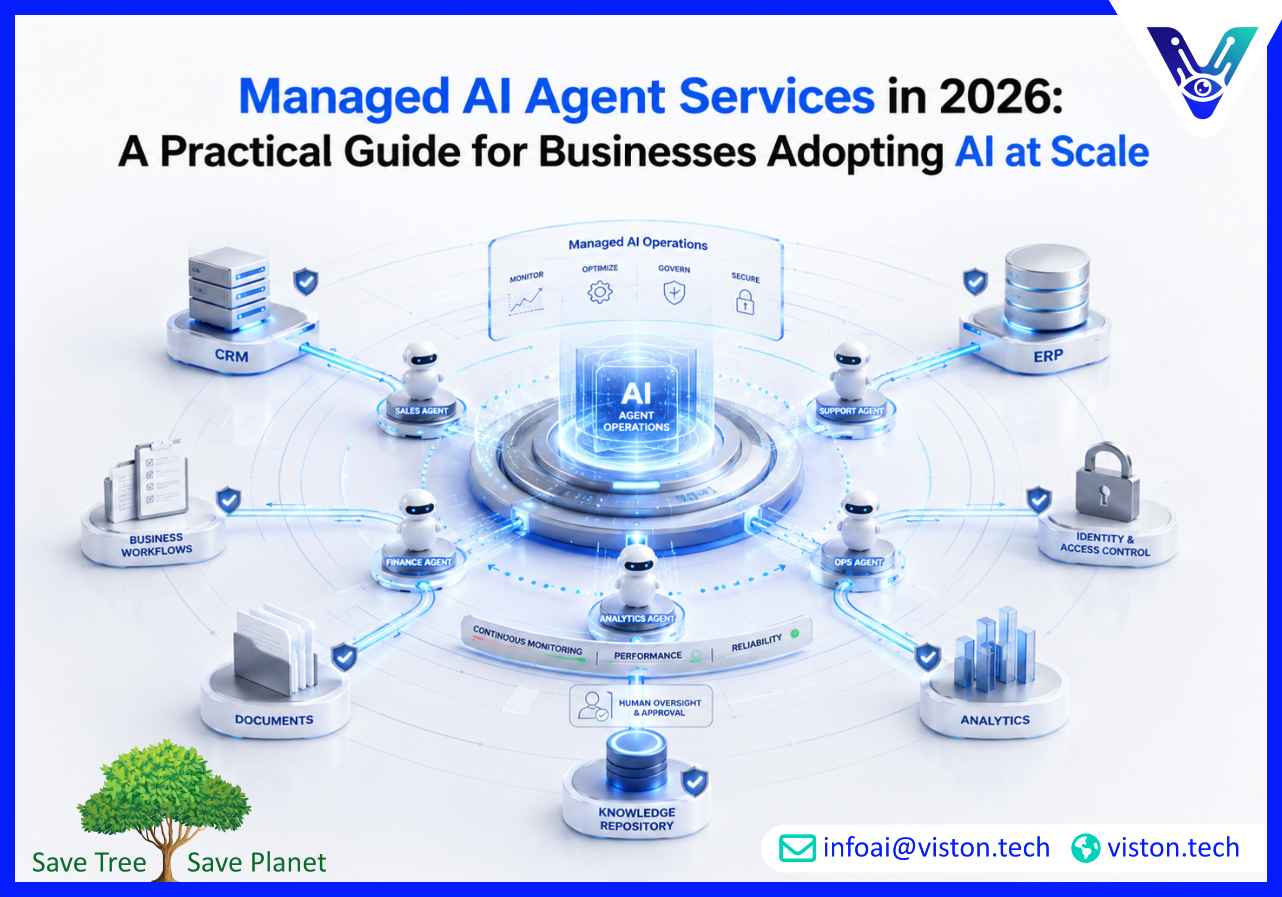
As AI adoption accelerates across industries, many organizations are discovering that building AI agents is only the beginning. Long-term success depends on monitoring, optimization, governance, security, and ongoing support. This is why managed AI agent services are becoming a strategic investment for businesses seeking reliable AI operations in 2026.
Managed AI agent services provide end-to-end support for AI agents after deployment. Instead of requiring internal teams to continuously maintain, optimize, monitor, and troubleshoot AI systems, a specialist provider manages the operational lifecycle of AI agents on behalf of the business.
These services typically cover AI agent deployment, performance monitoring, workflow optimization, model updates, integration management, security controls, governance, reporting, and technical support.
Organizations increasingly rely on managed services because AI agents interact with business-critical systems, customer data, internal workflows, and operational processes. Maintaining reliability requires specialized expertise that many businesses do not have in-house.
Managed AI agent services help organizations move from experimental AI projects to stable, production-ready AI operations.
AI agents are becoming more autonomous and capable of handling complex tasks across customer support, sales operations, data processing, workflow automation, knowledge management, and business intelligence.
However, increased capability also introduces new operational responsibilities.
Businesses must ensure that AI agents:
Without proper oversight, AI agents can experience performance drift, outdated workflows, integration failures, inconsistent outputs, or security risks.
Managed AI agent services address these challenges through continuous operational support and proactive management.
AI agents require ongoing monitoring to ensure they perform as expected. Managed service providers track agent activity, workflow completion rates, response quality, system uptime, escalation frequency, and operational efficiency.
Performance monitoring allows businesses to identify issues early before they impact customers or internal operations.
Business processes evolve over time. AI agents must evolve with them.
Managed services include regular optimization of prompts, workflows, decision logic, knowledge sources, integrations, and orchestration frameworks to improve performance and business value.
This helps organizations maximize their return on AI investments.
Modern AI agents often connect with:
Managed AI agent services ensure these integrations remain functional, secure, and aligned with business requirements as systems change over time.
Security remains a major concern for organizations deploying AI agents.
Managed services typically include:
These controls help organizations maintain confidence in AI-driven operations.
Even well-designed AI systems can encounter unexpected situations.
Managed service providers offer technical support, troubleshooting, issue resolution, workflow recovery, and escalation management to minimize operational disruption.
Organizations often underestimate the ongoing effort required to maintain production AI systems. Managed AI agent services provide several practical advantages.
Internal teams can focus on strategic initiatives rather than AI maintenance activities. Businesses gain access to specialized expertise without expanding internal headcount.
Managed support accelerates implementation timelines by providing proven operational frameworks, deployment practices, and monitoring processes.
Continuous oversight helps reduce workflow failures, performance issues, and operational disruptions.
As AI usage grows, managed services help organizations scale agents across departments, workflows, and business units while maintaining performance standards.
Structured management processes improve transparency, accountability, compliance, and operational control.
Ongoing optimization ensures AI agents continue delivering business value as requirements evolve.
This often leads to improved efficiency, reduced costs, faster response times, and better customer experiences.
Selecting the right provider requires more than reviewing technical capabilities.
Organizations should evaluate whether a provider can support long-term operational success.
Providers should understand the workflows, challenges, and operational requirements relevant to the business environment.
Strong managed services require deep experience in AI agent architecture, deployment, orchestration, integrations, and optimization.
Businesses should assess how providers address access controls, monitoring, compliance requirements, auditability, and risk management.
Providers should be able to support growth as organizations expand AI adoption across departments and use cases.
Clear service-level expectations, support processes, monitoring frameworks, and reporting capabilities are important indicators of maturity.
A successful managed AI agent partnership focuses on long-term business outcomes rather than simply maintaining technology.
Organizations implementing AI agents often require more than deployment support. They need ongoing management, optimization, monitoring, and operational guidance to ensure AI systems continue delivering value.
Viston AI specializes in AI Agent Development & Deployment, helping businesses design, implement, integrate, and manage AI-driven solutions that support real operational requirements.
Its expertise aligns naturally with managed AI agent services because effective AI operations require continuous oversight across workflows, integrations, performance monitoring, governance, and optimization.
Businesses adopting AI agents for customer service, workflow automation, operations support, data processing, knowledge management, or internal productivity can benefit from structured management practices that help maintain reliability and scalability.
By combining AI development expertise with operational support capabilities, Viston AI helps organizations move beyond pilot projects and establish sustainable AI environments. This approach allows businesses to focus on strategic growth while maintaining confidence that AI systems remain aligned with business goals, security expectations, and operational standards.
Managed AI agent services provide ongoing support, monitoring, optimization, governance, and maintenance for AI agents operating in production environments.
AI agents require continuous oversight to maintain performance, reliability, security, compliance, and alignment with evolving business requirements.
Yes. Many providers can manage, optimize, and improve AI agents that were previously developed internally or by another vendor.
Organizations across finance, healthcare, retail, technology, logistics, manufacturing, professional services, and customer support operations can benefit from managed AI environments.
They improve reliability, reduce downtime, optimize workflows, support scalability, and help ensure AI systems continue delivering measurable business value over time.
Yes. Viston AI’s expertise in AI Agent Development & Deployment aligns with businesses seeking ongoing support, optimization, integration management, and operational oversight for AI-driven systems.
Managed AI agent services are becoming an essential part of successful AI adoption in 2026. While AI agents can automate complex business processes and improve operational efficiency, their long-term effectiveness depends on continuous monitoring, optimization, governance, and support. Organizations that invest in managed AI operations are better positioned to achieve reliable performance, stronger security, improved scalability, and sustainable business outcomes. For businesses seeking expert guidance in AI Agent Development & Deployment, Viston AI offers capabilities that align with the operational requirements of modern AI-driven environments.
