
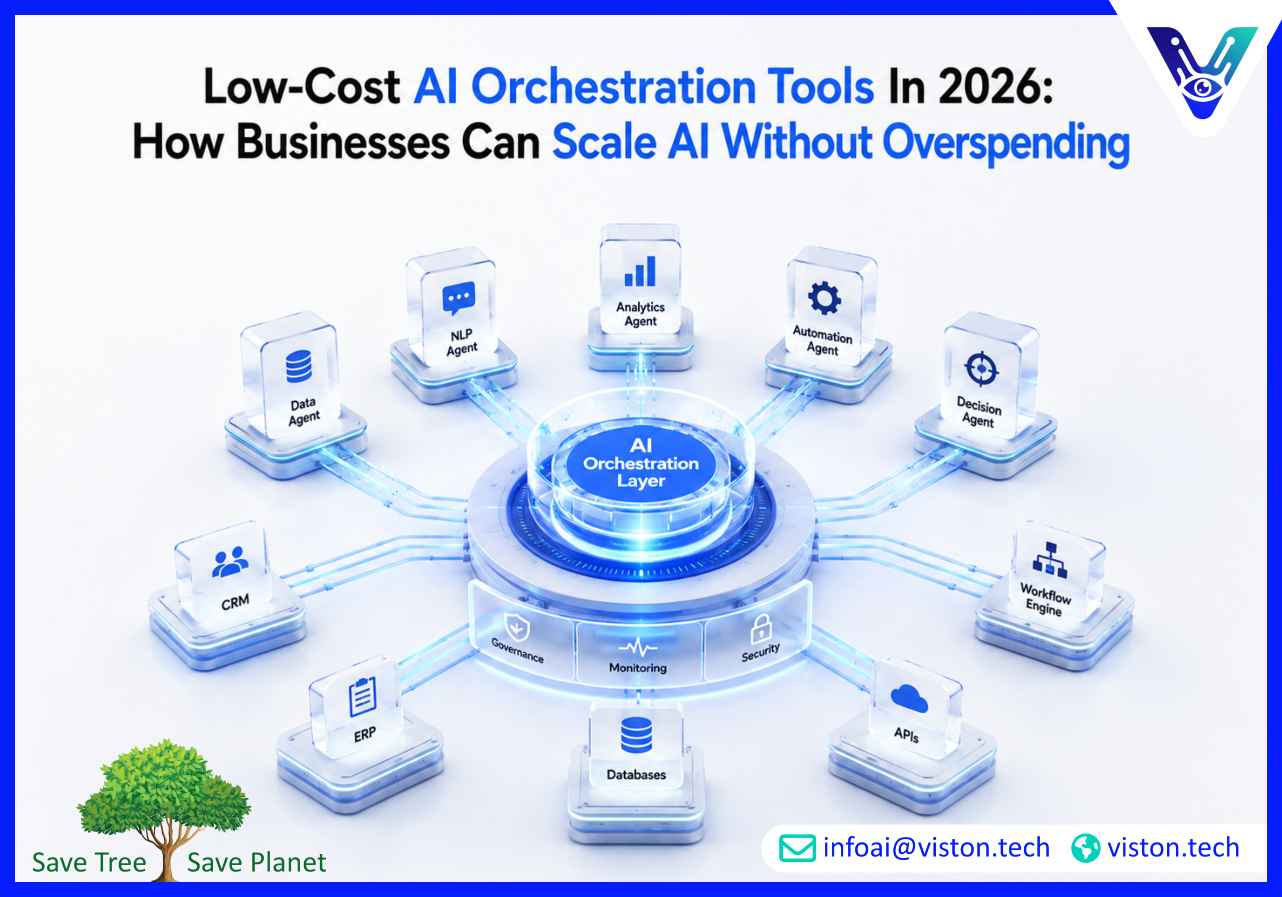
As AI adoption accelerates, many organizations face a common challenge: how to coordinate multiple AI models, agents, workflows, and business systems without creating unsustainable costs. Low-cost AI orchestration tools are helping businesses build scalable AI operations while maintaining budget control, governance, and operational efficiency in 2026.
AI orchestration tools are platforms that help businesses manage, coordinate, monitor, and automate interactions between AI models, agents, workflows, data sources, APIs, and business applications. Rather than building complex integrations manually, orchestration platforms provide a structured environment for connecting AI capabilities across operations.
Low-cost AI orchestration tools focus on delivering essential orchestration functionality without the high licensing fees often associated with enterprise AI platforms. They allow organizations to deploy AI workflows, automate processes, integrate business systems, and manage AI-driven operations while maintaining predictable spending.
In practical terms, these tools help organizations:
For many organizations, orchestration has become the missing layer between AI experimentation and operational deployment.
Many businesses have already invested in AI models, copilots, automation tools, and data platforms. However, these systems often operate independently, creating fragmented workflows and limited business impact.
In 2026, organizations increasingly need orchestration to connect AI investments into unified business processes. At the same time, economic pressure continues to drive demand for cost-efficient technology solutions.
Low-cost orchestration platforms help bridge this gap by enabling businesses to:
Building orchestration capabilities from scratch requires significant engineering resources. Affordable orchestration tools provide reusable components, workflow builders, integrations, monitoring, and governance features that reduce implementation effort.
Organizations can move from proof-of-concept projects to production workflows faster when orchestration capabilities already exist within the platform.
Businesses can optimize how AI models, APIs, agents, and automation services are used across departments instead of maintaining isolated solutions.
As AI adoption expands, orchestration becomes essential for maintaining consistency, visibility, and operational control without dramatically increasing costs.
Price alone should not determine platform selection. The most effective solutions balance affordability with functionality, security, scalability, and operational reliability.
The platform should allow organizations to create, manage, and automate workflows involving AI models, business systems, APIs, databases, and users.
Many businesses are adopting agent-based architectures where specialized AI agents handle different responsibilities. Orchestration tools should support task routing, agent collaboration, escalation paths, and workflow control.
AI orchestration delivers the greatest value when connected to existing business systems. Look for platforms that support CRM systems, ERP software, communication platforms, document repositories, analytics tools, and custom APIs.
Visibility is critical. Organizations need workflow monitoring, audit logs, performance tracking, usage reporting, and operational dashboards to ensure reliability and accountability.
AI workflows often access sensitive business information. Permission management, access controls, encryption, authentication, and compliance support should be considered even when evaluating low-cost solutions.
Businesses should assess whether cloud-based, hybrid, or self-hosted deployment options align with their operational and compliance requirements.
Choosing an orchestration platform should begin with business objectives rather than product features.
Organizations often achieve better outcomes when they evaluate orchestration tools based on practical operational requirements.
Before selecting a platform, define the process you want to improve. Common examples include customer support automation, lead qualification, document processing, reporting workflows, internal knowledge management, and operational task automation.
The lowest subscription fee does not always represent the lowest long-term cost. Consider implementation effort, training requirements, maintenance, integrations, monitoring needs, and future scalability.
Many organizations use multiple AI providers. A strong orchestration platform should allow flexibility rather than locking workflows into a single model vendor.
The orchestration layer should support the systems your teams already rely on. Limited integration capabilities often create hidden costs later.
As AI usage expands, governance becomes increasingly important. Workflow visibility, approval processes, monitoring, and auditability should be considered early rather than after deployment.
Affordable orchestration platforms can support a wide range of operational and customer-facing workflows.
Organizations can orchestrate ticket classification, knowledge retrieval, response generation, escalation management, and service reporting through coordinated AI workflows.
AI orchestration can connect lead enrichment, prospect research, qualification workflows, CRM updates, follow-up generation, and pipeline reporting.
Businesses handling contracts, invoices, forms, and compliance documents can automate extraction, validation, categorization, routing, and approval workflows.
Organizations increasingly use AI orchestration to connect internal documentation, knowledge bases, policies, and business systems, making information easier to access and maintain.
AI workflows can gather information from multiple systems, generate reports, identify trends, and distribute insights automatically to stakeholders.
The most successful implementations focus on measurable outcomes such as faster processing times, reduced manual effort, improved accuracy, and greater operational visibility.
Organizations exploring low-cost AI orchestration tools often discover that selecting software is only one part of the challenge. Successful AI initiatives require workflow design, integration planning, governance strategies, operational alignment, and long-term scalability.
As a provider of AI & ML Strategic Consulting services, Viston AI helps businesses evaluate how orchestration fits within broader AI transformation goals. This includes assessing existing workflows, identifying automation opportunities, evaluating orchestration architectures, and defining practical implementation roadmaps.
Many organizations struggle with fragmented AI deployments, disconnected automation projects, and unclear operational ownership. Strategic consulting can help establish governance frameworks, technology selection criteria, integration requirements, security considerations, and measurable business objectives before significant investments are made.
For businesses considering affordable orchestration solutions, the focus should not simply be finding the cheapest platform. The goal is identifying a sustainable orchestration approach that supports business growth, operational efficiency, and responsible AI adoption. Viston AI’s consulting expertise helps organizations align technology decisions with practical business outcomes while minimizing implementation risk.
Low-cost AI orchestration tools are platforms that help businesses coordinate AI workflows, agents, models, integrations, and automation processes without requiring large enterprise software budgets.
Many affordable solutions offer capabilities that support enterprise workflows. The suitability depends on scalability requirements, security needs, governance controls, and integration complexity.
AI orchestration connects separate AI capabilities into structured business workflows, improving efficiency, consistency, visibility, and operational scalability.
No. Organizations can gain value from orchestration even when using a single AI model by automating workflows, integrating systems, and managing business processes more effectively.
Yes. Through AI & ML Strategic Consulting services, Viston AI helps organizations assess orchestration opportunities, technology options, governance requirements, and implementation approaches aligned with business objectives.
Organizations should focus on workflow requirements, integration capabilities, governance features, security controls, scalability, operational support, and total cost of ownership rather than subscription pricing alone.
Low-cost AI orchestration tools are becoming a critical part of enterprise AI strategies in 2026. They help organizations move beyond isolated AI experiments and build coordinated, scalable workflows that deliver measurable business value. While affordability is important, successful orchestration depends on selecting tools that align with operational requirements, integration needs, governance expectations, and long-term growth objectives. Combined with effective AI & ML Strategic Consulting, businesses can make informed orchestration decisions that support sustainable automation, improved efficiency, and responsible AI adoption. Viston AI can help organizations evaluate these opportunities and develop practical AI orchestration strategies that align with real business goals.
