
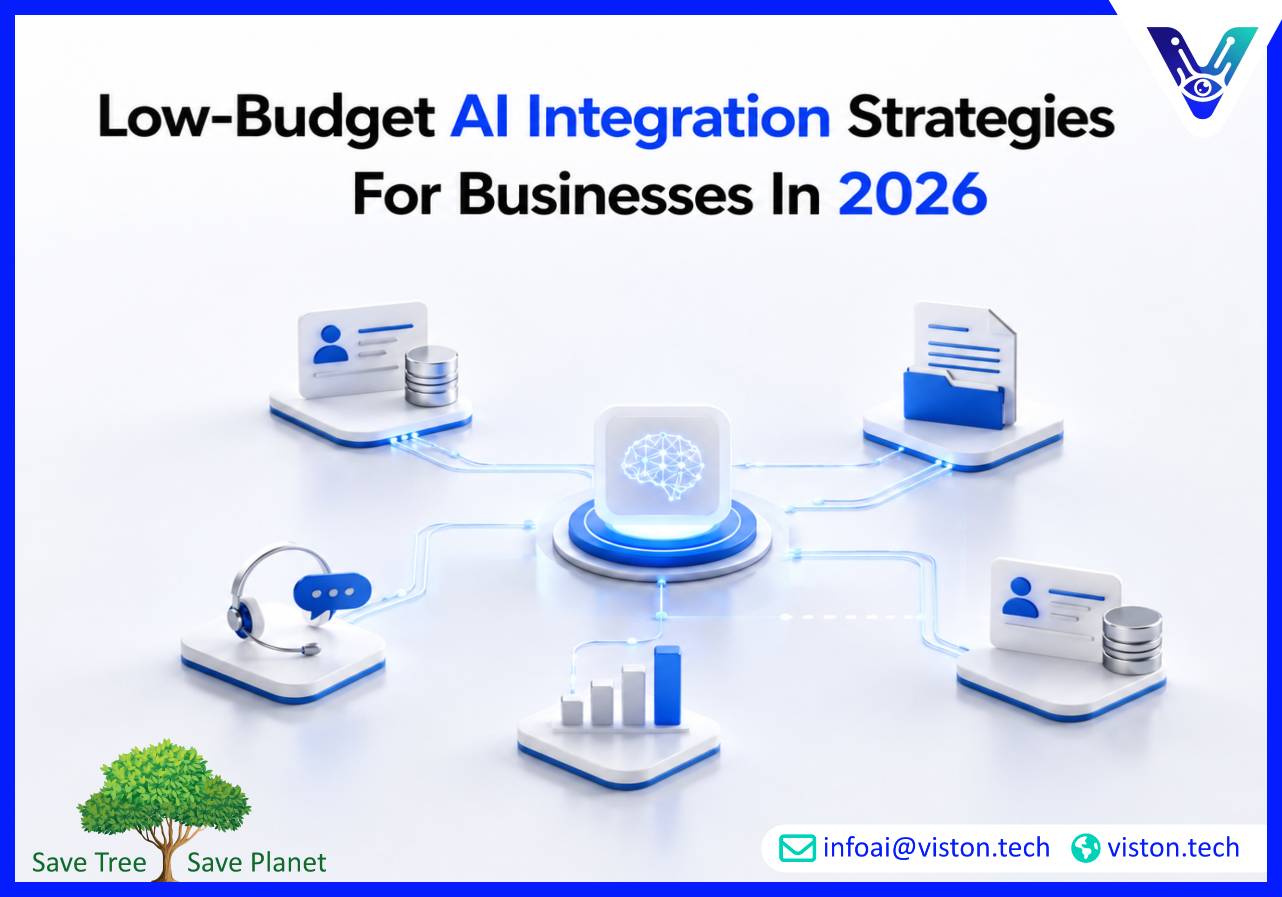
AI adoption is no longer limited to large enterprises with significant technology budgets. In 2026, businesses of all sizes can integrate AI into operations, customer service, sales processes, and internal workflows without major infrastructure investments. The key is choosing practical, low-budget AI integration strategies that focus on measurable business outcomes rather than large-scale transformation projects.
Many organizations recognize the potential of artificial intelligence but hesitate because they assume implementation requires substantial spending. In reality, modern AI technologies, cloud-based platforms, APIs, and agent frameworks have lowered the barrier to entry significantly.
Businesses can now start with targeted AI integrations that address specific operational challenges while maintaining control over costs. This approach reduces risk, delivers faster results, and creates a foundation for future expansion.
Low-budget AI integration is particularly valuable for organizations seeking to:
Rather than attempting enterprise-wide deployment immediately, successful businesses often begin with focused projects that solve clear operational problems.
One of the biggest mistakes organizations make is adopting AI before understanding where it can create value. Budget-conscious AI integration begins with identifying workflows that consume significant time, involve repetitive tasks, or depend on manual data processing.
Support teams often spend considerable time answering common questions, routing tickets, and gathering information. AI-powered support workflows can automate initial interactions, classify requests, and provide relevant information to customers and agents.
Sales teams frequently handle lead qualification, CRM updates, meeting preparation, and follow-up communication. AI integrations can automate many of these activities, allowing teams to focus on revenue-generating conversations.
Organizations dealing with invoices, forms, contracts, applications, or reports can use AI to extract information, validate data, and organize records with minimal manual effort.
Employees often spend significant time searching for information across documents, knowledge bases, and internal systems. AI-powered retrieval solutions can improve productivity while requiring relatively modest implementation costs.
The most cost-effective projects are usually those that deliver immediate operational benefits while leveraging existing systems and data.
Businesses do not need extensive custom development to benefit from AI. Several practical approaches allow organizations to integrate AI while maintaining budget discipline.
Many CRM platforms, helpdesk solutions, productivity suites, and business applications now include AI capabilities. Before purchasing new tools, businesses should evaluate features already available within their current software ecosystem.
Leveraging existing platforms often reduces implementation costs, training requirements, and integration complexity.
Trying to automate every process simultaneously increases costs and complexity. A better strategy is selecting one workflow with clear business value and measurable outcomes.
Examples include:
Successful pilot projects can justify future investment while minimizing initial risk.
Modern AI agents can perform targeted responsibilities such as data collection, information retrieval, CRM updates, customer communication, and workflow coordination.
Rather than building complex autonomous systems immediately, organizations can deploy specialized agents that address a single operational need. This reduces development costs while improving reliability.
Many businesses already use cloud-based platforms that support API connectivity. AI integration through APIs can often be implemented faster and more affordably than large-scale software replacement projects.
API-driven integrations allow businesses to connect AI capabilities directly with existing tools while preserving established workflows.
Low-budget AI projects are often more successful when AI assists employees rather than attempting full autonomy.
Human-in-the-loop models allow AI to:
Employees remain responsible for final approvals, reducing operational risk and simplifying implementation.
Budget-conscious AI adoption requires avoiding common mistakes that can increase project expenses without improving outcomes.
Many organizations pursue advanced AI architectures before validating basic business value. Complex systems often increase development costs, maintenance requirements, and implementation timelines.
Starting simple typically delivers faster returns.
AI effectiveness depends heavily on data quality. Inaccurate, incomplete, or inconsistent information can reduce performance and increase troubleshooting costs.
Businesses should assess data readiness before implementation.
AI systems rarely operate independently. They often need access to CRMs, databases, support systems, documents, and communication platforms.
Understanding integration requirements early helps prevent unexpected expenses later.
Without measurable objectives, organizations may struggle to determine whether AI investments are generating value.
Common metrics include:
Clear metrics support informed decision-making and future investment planning.
Low-budget AI implementation should not be viewed as a temporary solution. The most successful organizations use initial projects as building blocks for broader automation strategies.
Identify and automate simple, repetitive tasks with immediate business impact. Focus on projects that can demonstrate value within weeks rather than months.
Once initial integrations prove successful, expand AI capabilities into adjacent processes and departments. This allows businesses to scale gradually while maintaining budget control.
As AI maturity increases, organizations can introduce multiple agents that collaborate across workflows, systems, and business functions.
Continuous monitoring, workflow refinement, and performance optimization help maximize return on investment while supporting long-term scalability.
This phased approach helps businesses avoid large upfront expenditures while steadily increasing automation capabilities.
For organizations exploring low-budget AI integration strategies, selecting the right implementation approach is often more important than selecting the most advanced technology. Viston AI provides Agent Integration Services designed to help businesses connect AI capabilities with existing workflows, systems, and operational processes in a practical and scalable manner.
Many businesses do not need large-scale AI transformation projects to generate value. Instead, they need focused integrations that address specific operational challenges, improve efficiency, and support measurable outcomes. Viston AI’s expertise in AI agent deployment, workflow automation, system integration, and orchestration helps organizations identify opportunities where AI can deliver results without unnecessary complexity.
Its approach aligns with businesses seeking controlled implementation costs, scalable architectures, and integrations that fit within existing technology environments. Whether supporting customer service workflows, sales operations, internal process automation, or data-driven tasks, Agent Integration Services can help organizations adopt AI incrementally while maintaining operational stability and budget discipline.
The most affordable approach is usually automating a single high-value workflow using existing business systems and targeted AI capabilities rather than pursuing enterprise-wide deployment.
Yes. Many modern AI tools, APIs, and cloud platforms make AI accessible to small and medium-sized businesses without requiring large technology budgets.
Requirements vary by project, but many integrations can be implemented using existing cloud-based platforms, APIs, and business applications without significant infrastructure investments.
Customer support, lead qualification, document processing, knowledge retrieval, reporting, and workflow automation are common starting points because they often deliver measurable value quickly.
Businesses should focus on clear objectives, start with small projects, leverage existing systems, define success metrics, and expand only after validating results.
Yes. Viston AI’s Agent Integration Services support practical AI adoption strategies that align technology investments with operational goals, helping businesses prioritize high-impact opportunities while controlling implementation costs.
Low-budget AI integration strategies allow businesses to capture the benefits of artificial intelligence without committing to large-scale technology investments. By focusing on targeted workflows, leveraging existing systems, implementing specialized AI agents, and expanding gradually, organizations can achieve meaningful operational improvements while managing risk and costs. Agent Integration Services play an important role in helping businesses connect AI with real-world processes and measurable outcomes. For companies seeking practical AI adoption, Viston AI offers expertise that supports scalable, business-focused integration strategies designed for sustainable growth in 2026.
