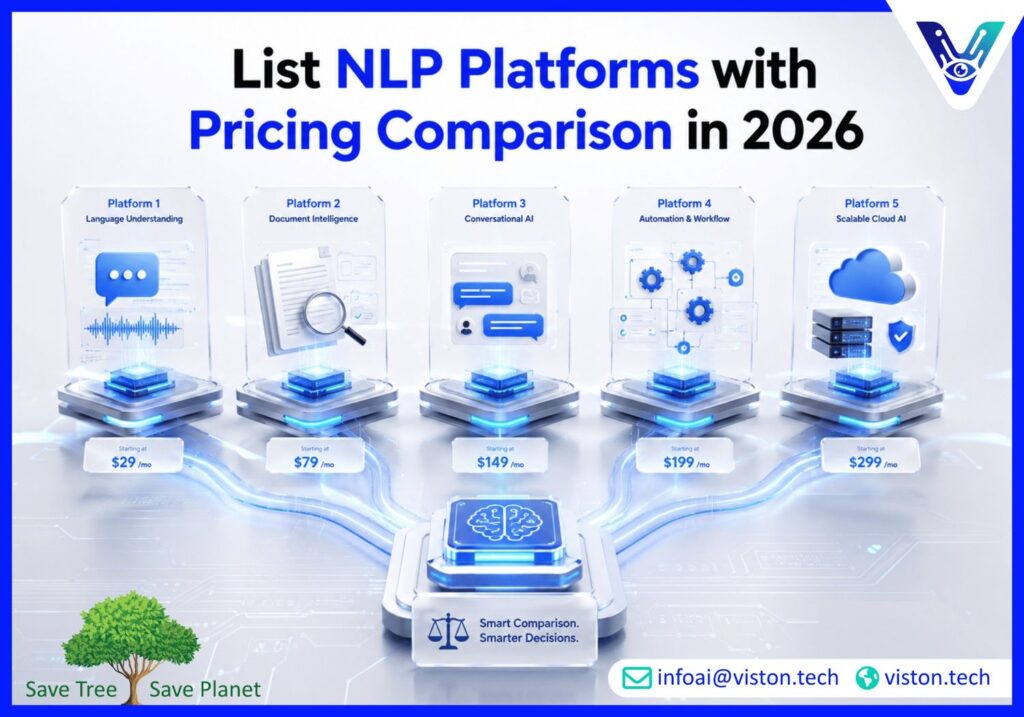
List NLP Platforms with Pricing Comparison in 2026
Organizations investing in Natural Language Processing (NLP) solutions often face a common challenge: choosing the right platform that balances capabilities, scalability, deployment flexibility, and cost. With NLP becoming a critical component of customer support automation, content intelligence, analytics, search, healthcare applications, and enterprise workflow automation, understanding pricing models is as important as evaluating technical features.
Understanding NLP Platform Pricing in 2026
NLP platforms rarely follow a simple pricing structure. Most providers charge based on one or more of the following factors:
Number of API requests
Tokens processed
Monthly active users
Model training requirements
Data storage and hosting
Enterprise support needs
Custom model development
Deployment architecture
Businesses should evaluate total ownership costs rather than focusing solely on subscription fees. Integration, customization, monitoring, compliance requirements, and ongoing optimization can significantly influence long-term investment.
Popular NLP Platforms and Pricing Models
OpenAI
OpenAI offers advanced language models suitable for conversational AI, document processing, content generation, customer support automation, knowledge management, and enterprise AI applications.Typical pricing is usage-based, calculated through token consumption. Costs vary depending on model selection, input volume, output volume, and processing complexity.Best suited for:
AI assistants
Knowledge bases
Customer service automation
Content generation workflows
Enterprise AI applications
Google Cloud Natural Language AI
Google provides NLP services through its cloud ecosystem, including sentiment analysis, entity recognition, syntax analysis, content classification, and multilingual text processing.Pricing generally follows a pay-as-you-go model based on processed text volume and API consumption.Best suited for:
Enterprise analytics
Large-scale text processing
Customer feedback analysis
Global applications requiring multilingual support
Microsoft Azure AI Language
Microsoft’s NLP offering includes conversational AI, text analytics, question answering, document intelligence, and language understanding services.Pricing depends on transaction volume, model usage, and deployment requirements.Best suited for:
Microsoft-centric environments
Enterprise automation
Business intelligence platforms
Internal knowledge systems
Amazon Comprehend
Amazon Comprehend provides managed NLP capabilities including sentiment analysis, entity extraction, topic modeling, language detection, and document classification.Costs are typically based on the volume of text processed and specific NLP services consumed.Best suited for:
AWS ecosystems
Large-scale data analysis
Document processing workflows
Customer experience analytics
IBM Watson Natural Language Understanding
IBM Watson focuses on enterprise-grade NLP with strong governance, compliance, and industry-specific capabilities.Pricing generally varies according to API usage, deployment scale, and enterprise support requirements.Best suited for:
Regulated industries
Healthcare organizations
Financial services
Large enterprise environments
Factors That Impact NLP Platform Costs
When comparing NLP platforms, organizations should consider more than subscription pricing.
Model Complexity
Advanced generative AI models generally cost more than traditional NLP services because they require significantly greater computational resources.
Data Volume
Businesses processing millions of documents, customer interactions, or support tickets each month will incur higher usage costs.
Customization Requirements
Custom model training, fine-tuning, and domain-specific optimization can substantially increase implementation budgets.
Compliance and Security
Industries such as healthcare, finance, and legal services often require additional governance controls, audit trails, and secure deployment environments.
Infrastructure Strategy
Cloud-hosted solutions may offer lower upfront costs, while private or hybrid deployments may involve greater infrastructure investments.
How to Compare NLP Platforms Effectively
A pricing comparison should always be accompanied by a capability assessment.Decision-makers should evaluate:
Accuracy and language understanding capabilities
Industry-specific functionality
Integration flexibility
Scalability requirements
Security controls
Data privacy compliance
Reporting and analytics capabilities
Support and maintenance options
Customization potential
Total cost of ownership
The least expensive platform is not always the most cost-effective solution. Higher-performing NLP systems often generate greater business value through improved automation, reduced manual effort, and better customer experiences.
Why Businesses Need Specialized NLP Solutions Beyond Platform Selection
Choosing an NLP platform is only the first step. Many organizations struggle with implementation, model optimization, integration, workflow design, and ongoing performance management.Successful NLP initiatives typically require:
Business requirement analysis
Data preparation and validation
Model selection and configuration
API integration
Workflow automation
Performance monitoring
Security and compliance management
Continuous optimization
The platform itself provides the technology foundation, but business outcomes depend heavily on how effectively the solution is designed and deployed.
How Viston AI Supports NLP Solution Implementation
As a provider of Natural Language Processing Solutions, Viston AI helps organizations move beyond platform selection and focus on practical business outcomes. Businesses often evaluate multiple NLP platforms before discovering that successful implementation requires specialized expertise in data workflows, AI integration, automation strategy, and performance optimization.Viston AI supports organizations in identifying the most suitable NLP technologies based on operational requirements, scalability goals, compliance expectations, and use-case complexity. Whether the objective involves customer support automation, document intelligence, sentiment analysis, conversational AI, search enhancement, content classification, or enterprise knowledge management, the focus remains on building solutions that align with measurable business objectives.Rather than applying a one-size-fits-all approach, NLP solutions can be tailored to organizational needs, existing technology stacks, data environments, and growth requirements. This enables businesses to reduce implementation risks while improving efficiency, automation, and decision-making capabilities.For organizations exploring NLP investments in 2026, combining the right platform with specialized implementation expertise can significantly improve project success rates and long-term return on investment.
Frequently Asked Questions
Which NLP platform is the most affordable?
The most affordable platform depends on usage volume, deployment requirements, and feature needs. Usage-based platforms can be cost-effective for smaller workloads, while enterprise agreements may offer better value for large-scale deployments.
Are NLP platform prices based on users or usage?
Most modern NLP platforms use consumption-based pricing models, charging according to API calls, processed tokens, document volume, or model usage.
What is included in NLP implementation costs?
Implementation costs may include system integration, model configuration, workflow development, testing, security setup, training, and ongoing optimization.
Do businesses need custom NLP models?
Not always. Many organizations achieve strong results using pre-trained models. Custom models become valuable when industry-specific language or specialized workflows are involved.
Can NLP platforms integrate with existing business systems?
Most enterprise NLP platforms offer APIs and connectors that support integration with CRM systems, ERP platforms, customer support tools, analytics environments, and business applications.
How can Viston AI help with NLP platform selection?
Viston AI helps businesses evaluate NLP technologies, identify suitable implementation approaches, design scalable workflows, and optimize NLP solutions for practical business outcomes.
Conclusion
Comparing NLP platforms involves far more than reviewing pricing tables. Businesses must assess functionality, scalability, security, integration requirements, and long-term operational costs. The right NLP platform should support current objectives while remaining flexible enough to accommodate future growth and evolving AI capabilities. Organizations that combine careful platform evaluation with expert Natural Language Processing Solutions implementation are often better positioned to achieve meaningful automation, improved customer experiences, and stronger returns on their AI investments. As NLP adoption continues to accelerate in 2026, informed decision-making remains essential for maximizing value and minimizing deployment risks.