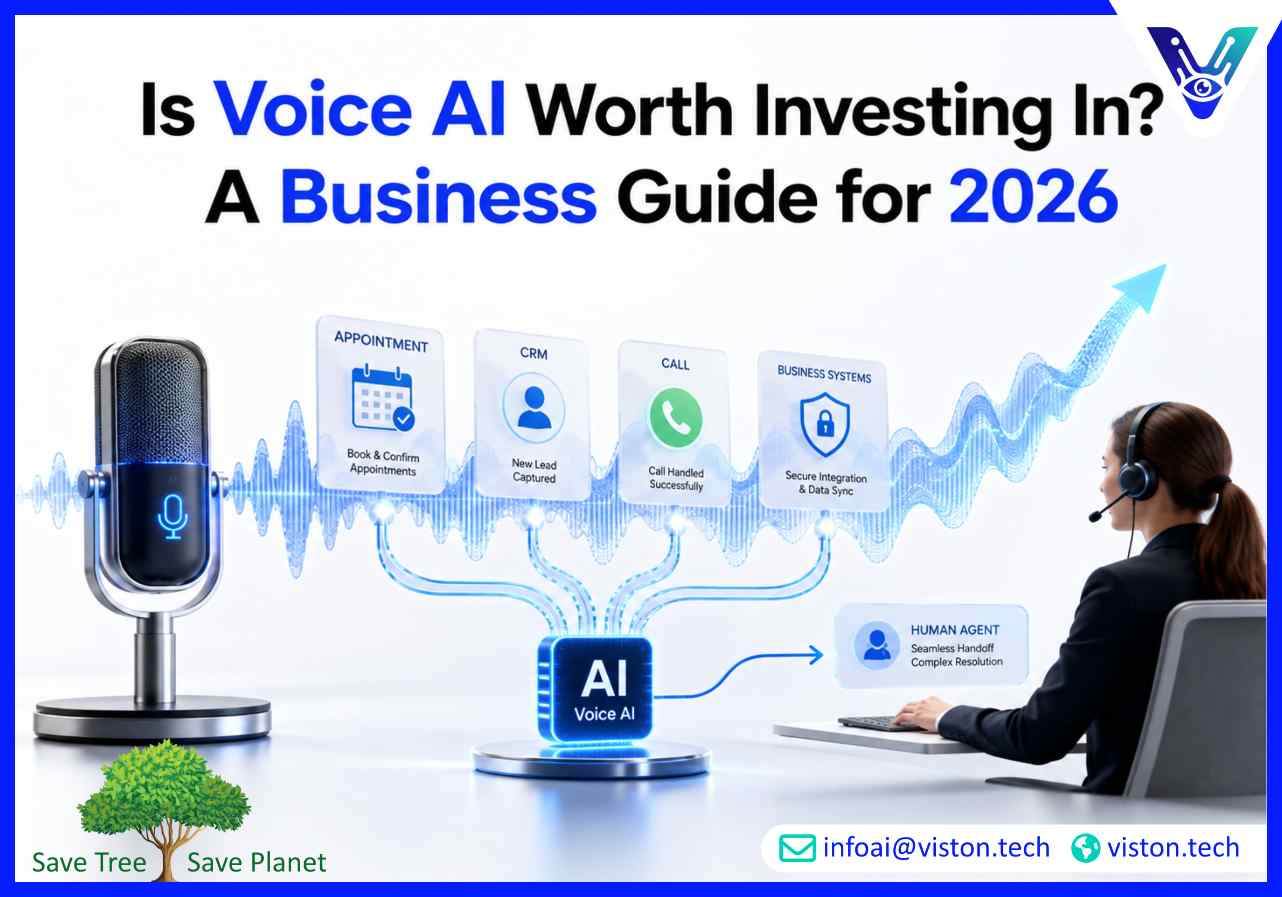
Is Voice AI Worth Investing In? A Business Guide for 2026
Is voice AI worth investing in? For businesses managing frequent calls, repetitive enquiries, appointment requests, lead qualification, or customer support, the answer can be yes—but only when the technology solves a defined operational problem and delivers measurable value.
Is Voice AI Worth Investing In for Businesses in 2026?
Voice AI is worth investing in when it improves the speed, availability, consistency, or cost-effectiveness of spoken interactions. It can help businesses answer routine calls, collect information, qualify prospects, schedule appointments, provide account updates, route enquiries, and support employees through natural conversation.Modern voice-enabled assistants are more capable than traditional interactive voice response systems. Instead of forcing callers through rigid menus, a voice AI system can interpret natural speech, identify intent, maintain context across multiple turns, retrieve approved information, and trigger actions in connected business systems.The investment case is strongest for organizations with repeatable, high-volume conversations. A business receiving hundreds or thousands of similar calls may gain more value than a company that handles a small number of highly complex or sensitive conversations.Voice AI should not be treated as an automatic replacement for customer service teams. Its value usually comes from handling predictable tasks, supporting human agents, extending service availability, and reducing avoidable administrative work.
Business conditions that support a voice AI investment
Voice AI is more likely to generate a practical return when a business has:
A significant volume of inbound or outbound calls
Repeated questions that follow identifiable patterns
Long hold times or missed calls outside business hours
Manual appointment booking, verification, or follow-up processes
Customer information stored in systems that can be accessed through secure APIs
Clear escalation paths for conversations requiring human judgment
Defined performance indicators for measuring service quality and efficiency
The commercial question is therefore not simply whether voice AI is advanced enough. Businesses need to determine whether their call volume, workflows, data, integrations, and customer expectations make voice automation useful.
Where voice AI may not be the right first investment
A voice-enabled assistant may offer limited value when call volumes are low, processes are undocumented, customer data is fragmented, or most conversations require negotiation, empathy, specialist judgment, or regulatory approval.In these situations, businesses may need to improve their knowledge base, CRM data, call routing, or operational processes before introducing automation. Automating a poorly designed process usually makes the underlying weaknesses more visible rather than resolving them.
What Business Value Can Voice AI Deliver?
The return from voice AI depends on what the assistant is designed to accomplish. A successful implementation connects conversational performance to a business outcome rather than measuring success only by the number of calls answered.
Improved availability and response speed
A voice assistant can provide immediate assistance during peak periods, after normal working hours, or when human teams are occupied. This can reduce unanswered calls and help customers complete straightforward tasks without waiting in a queue.Availability is particularly valuable for businesses that receive time-sensitive enquiries. A prospect requesting a consultation, a customer checking an order, or a patient seeking an appointment may move to another provider when nobody answers.
Lower repetitive workload
Many service teams spend a substantial part of their day answering the same questions, confirming basic information, creating records, or transferring calls. Voice AI can handle suitable repetitive tasks while allowing employees to focus on exceptions, complaints, negotiations, and complex cases.The objective should not be to prevent every caller from reaching a person. A better objective is to ensure that human time is used where it adds the most value.
More consistent customer interactions
Voice-enabled assistants can follow approved workflows and provide consistent answers based on authorized information. This is useful when a business needs to communicate service details, eligibility requirements, opening hours, booking instructions, or troubleshooting steps in a controlled manner.Consistency still requires strong knowledge management. If the source information is outdated or contradictory, the voice assistant may repeat those weaknesses at scale. Content ownership and regular review are therefore essential.
Better lead capture and qualification
A sales-focused voice assistant can ask structured questions, collect contact details, determine the reason for an enquiry, identify buying intent, and arrange an appropriate next step. When connected to a CRM, it can create or update records and route qualified opportunities to the relevant sales representative.This is especially useful for businesses that lose leads because calls arrive outside working hours or sales teams cannot respond immediately. The assistant can maintain engagement without pretending that every conversation can be completed without human involvement.
Scalable multilingual support
Voice AI can help organizations serve customers across languages and regions, provided the selected speech recognition and voice generation technologies perform reliably for the required accents, dialects, terminology, and code-switching patterns.Multilingual capability must be tested with real users. Supporting a language on a technical specification does not guarantee accurate performance in noisy environments or industry-specific conversations.
Operational data and conversation insight
Voice systems can create structured records from spoken interactions, helping businesses analyze common intents, unresolved questions, escalation patterns, customer sentiment, and recurring service issues.This information can support workforce planning, knowledge-base improvement, product decisions, and customer experience optimization. Appropriate consent, retention controls, access restrictions, and sensitive-data handling must be built into the process.
How to Calculate Whether Voice AI Will Produce a Return
Evaluating a voice AI investment requires more than comparing software prices. Businesses should assess the total cost of implementation against the operational and commercial value created.
Identify the current cost of the process
Start by documenting how the existing voice process works. Useful baseline measurements include:
Monthly inbound and outbound call volume
Average handling time
Call abandonment and missed-call rates
Percentage of calls involving repetitive requests
Number of transfers or repeat contacts
Administrative time spent updating systems
Cost of after-hours or overflow coverage
Revenue lost through delayed responses
Without a baseline, it is difficult to prove whether the voice assistant has improved anything.
Define which calls should be automated
Businesses should classify conversations by volume, complexity, risk, and business value. High-volume, low-risk tasks are normally the strongest starting point.Suitable initial use cases may include appointment scheduling, order-status checks, basic account enquiries, lead intake, frequently asked questions, delivery updates, reminders, and internal helpdesk requests.Complex complaints, vulnerable-customer situations, regulated advice, emergency matters, contract negotiations, and unusual exceptions should normally include clear human escalation.
Account for the full cost of ownership
Voice AI costs can include discovery, conversation design, speech recognition, language model usage, text-to-speech generation, telephony, system integration, security testing, analytics, monitoring, maintenance, and ongoing optimization.Usage-based charges may change as call volume and conversation length increase. Businesses should model normal demand, seasonal peaks, failed interactions, transfers, and unexpected usage before estimating the financial return.
Measure outcomes rather than activity
Important voice AI performance indicators include:
Task completion rate
First-contact resolution
Containment and appropriate escalation rates
Average response latency
Speech recognition and intent accuracy
Call abandonment rate
Customer satisfaction
Lead qualification or appointment conversion rate
Workflow completion and CRM update accuracy
Cost per successfully completed conversation
A high automation rate is not automatically positive. If callers receive incorrect answers, repeat information, or struggle to reach a person, the apparent cost saving may lead to lower satisfaction and more expensive follow-up work.
Use a focused pilot to validate the investment
A pilot should target one measurable use case, a defined customer group, and a controlled call volume. The goal is to test speech quality, latency, task completion, integration reliability, customer response, and escalation performance before scaling.Current enterprise voice-agent development commonly uses streaming components to reduce the delay between a caller speaking and the assistant responding. Research published in 2026 also emphasizes that reliable real-time performance depends on the complete speech recognition, language processing, voice generation, and integration pipeline—not one model alone.
Risks and Decision Factors Before Investing in Voice AI
Voice AI can create business value, but a weak implementation can frustrate callers, expose sensitive information, or damage trust. The quality of execution matters as much as the underlying technology.
Conversation accuracy and latency
A voice interaction must feel responsive enough for natural conversation. Delays, interruptions, poor turn-taking, or incorrect transcription can make the system difficult to use.Testing should include different accents, speaking speeds, background noise, phone connections, technical terminology, names, numbers, and unexpected phrasing. A controlled demonstration in a quiet environment is not sufficient evidence of production readiness.
Business-system integration
A voice assistant creates greater value when it can retrieve accurate information and complete authorized actions. This may require integration with CRM, helpdesk, scheduling, payment, order management, ERP, identity, or knowledge systems.Integration should be designed around permissions and validation. The assistant must confirm critical details, avoid unauthorized changes, manage failed API calls, and create traceable records of completed actions.
Privacy, consent, and security
Voice interactions may contain personal, financial, health, employment, or account information. Businesses need clear rules for recording, transcription, storage, access, retention, redaction, and deletion.Legal and compliance requirements depend on the countries, industries, and types of data involved. Organizations should obtain appropriate professional guidance rather than assuming that one consent notice or security control applies to every deployment.
Human handover
A reliable voice assistant must recognize when it should stop automating. Escalation may be required because of low confidence, repeated misunderstanding, negative sentiment, sensitive content, a customer request, or a process requiring approval.The human agent should receive the conversation summary, caller details, identified intent, completed verification steps, and attempted actions. A poor handover forces the caller to begin again and removes much of the convenience the assistant was intended to create.
Ongoing monitoring and improvement
Voice AI is not a one-time installation. Products, policies, customer language, regulations, integrations, and call patterns change. Teams need to review failed conversations, update knowledge, test new releases, monitor costs, and refine escalation rules.Investment in the initial build without investment in governance and optimization usually leads to declining performance.
How Viston AI Supports Business-Focused Voice AI Investment
Viston AI provides Voice-Enabled Assistants as part of its conversational AI and enterprise automation services. Its stated service approach combines speech recognition, natural language understanding, generative AI, speech synthesis, analytics, and model operations to support multi-turn voice interactions.This capability is relevant to businesses evaluating whether voice AI is worth investing in because the commercial result depends on more than creating a voice interface. A production system needs conversation design, suitable model selection, reliable integrations, security controls, monitoring, escalation workflows, and continuous improvement.Viston AI also describes support for multilingual voice experiences, business-system connectivity, role-based access, audit trails, performance analytics, and lifecycle management. These capabilities can help organizations build assistants that retrieve business information, complete defined workflows, and transfer complex conversations to human teams with context.For customer support, sales, appointment management, internal assistance, retail, financial services, healthcare, manufacturing, and other service environments, Viston AI’s offering is most relevant when implementation begins with a measurable use case. A focused assessment and pilot can help a business validate call quality, workflow reliability, customer acceptance, operational impact, and expected return before expanding voice automation across departments or markets.
Frequently Asked Questions
Is voice AI worth investing in for a small business?
Voice AI may be worthwhile for a small business that receives frequent repetitive calls, misses enquiries after hours, or relies heavily on appointment scheduling and lead capture. A narrowly scoped assistant is usually more practical than attempting to automate every call.
How long does it take to see a return from voice AI?
The timeline depends on call volume, use-case complexity, integration requirements, operating costs, and customer adoption. Businesses should estimate the return using baseline call data and validate assumptions through a controlled pilot rather than relying on a standard payback period.
Can voice AI replace human call-center agents?
Voice AI can handle suitable routine tasks, but it should not be expected to replace human judgment, empathy, negotiation, or specialist expertise. The strongest model combines automated self-service with fast, contextual human escalation.
What is the best first use case for a voice-enabled assistant?
The best first use case is usually a high-volume, clearly defined, low-risk process such as appointment booking, order tracking, lead intake, basic FAQs, reminders, or call routing. It should have measurable completion criteria and reliable source data.
How should voice AI ROI be measured?
Measure changes in completed tasks, first-contact resolution, missed calls, handling time, lead conversion, appointment bookings, workflow accuracy, customer satisfaction, and cost per successful interaction. Compare these outcomes with the full cost of implementation and operation.
Can Viston AI help assess whether voice AI is suitable for a business?
Viston AI’s Voice-Enabled Assistants service is aligned with use-case assessment, conversational design, integration, multilingual support, analytics, deployment, and ongoing optimization. A focused evaluation can determine whether the expected operational value justifies implementation.
Conclusion
Is voice AI worth investing in? It can be when a business has sufficient conversation volume, clearly defined workflows, reliable data, and measurable service or revenue goals. Voice-Enabled Assistants can improve availability, reduce repetitive work, capture opportunities, and support more consistent interactions, but results depend on integration quality, security, human handover, and continuous monitoring. Businesses should begin with a focused use case, calculate the complete cost, and validate performance through a pilot. Viston AI offers relevant voice AI development and integration capabilities for organizations seeking a practical, scalable approach to conversational automation.