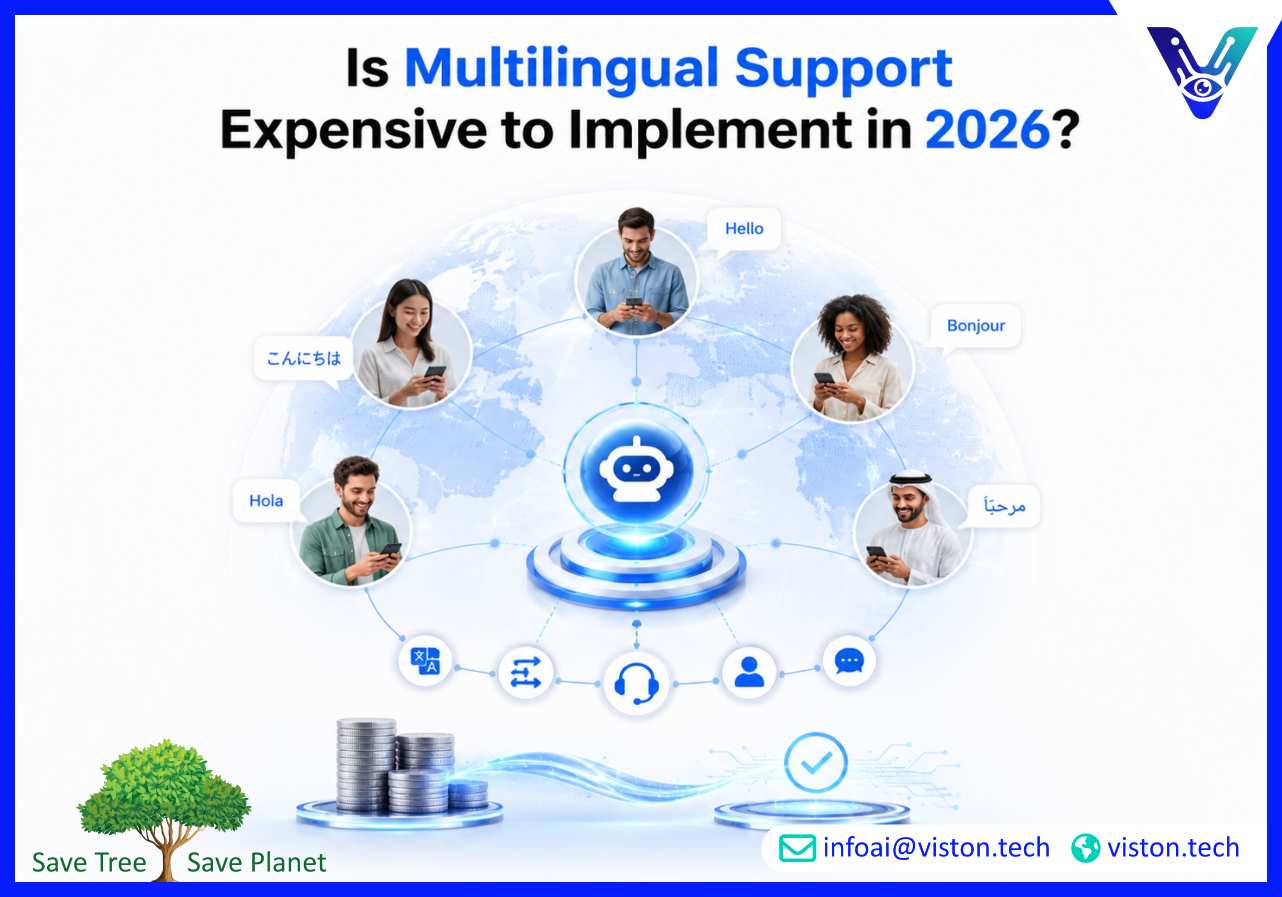
Is Multilingual Support Expensive to Implement in 2026?
Is multilingual support expensive to implement? It can be, but it does not have to be. Cost depends on language coverage, support volume, channels, content quality, integrations, compliance needs, and the balance between automation and human service. A phased approach can keep it practical.
What Determines the Cost of Multilingual Support?
Multilingual support is not a single product with one fixed price. It combines people, translated knowledge, customer-service technology, workflow design, quality control, and ongoing optimization. Supporting two languages by email has a very different cost profile from providing 24/7 service across chat, voice, social messaging, and mobile apps.
Number of languages and regional variants
Every additional language creates work beyond translating a welcome message. Businesses may need localized help articles, chatbot responses, product terminology, policy explanations, escalation scripts, and quality reviews. Regional variants also require different vocabulary, tone, policies, or workflows.The most cost-effective strategy is to prioritize languages using actual demand. Ticket history, website traffic, sales enquiries, customer locations, and conversion data show where language barriers affect revenue or service quality.
Support channels and service hours
Email and web forms are simpler to introduce because they allow time for translation and review. Live chat, messaging, and voice require faster responses, language detection, stronger routing, and reliable handover. Human-led round-the-clock coverage also raises cost.AI-assisted translation and multilingual chatbots can reduce the need to duplicate full support teams for every language. Current customer-service platforms increasingly provide automatic translation, multilingual knowledge access, and AI-assisted responses, allowing agents to work in a preferred language while customers receive replies in theirs.
Content readiness and knowledge quality
A company with a clean, current, well-structured knowledge base can implement multilingual support more efficiently than one with scattered documents, outdated policies, and inconsistent answers. Translation cannot fix weak source content. If the English help centre contains contradictions, those contradictions will be reproduced across other languages.Preparation may include content audits, duplicate removal, terminology standardization, approval workflows, and identification of authoritative sources. This reduces inaccurate answers and repeated translation later.
Integration and workflow complexity
Simple multilingual support may only answer general questions. More advanced implementations need access to CRM records, order management, billing systems, booking platforms, helpdesk software, account data, or internal knowledge bases. These integrations allow customers to check an order, update a reservation, troubleshoot an account, or submit a service request in their preferred language.Integration raises initial cost but also creates more value. Without system access, a chatbot may answer fluently while still forcing customers to contact an agent for every account-specific action.
Common Multilingual Support Cost Models
Businesses can implement multilingual support through several delivery models. The right choice depends on conversation volume, risk, required response time, language complexity, and internal resources. Most successful programmes use a blended model rather than relying entirely on either human agents or automation.
Dedicated multilingual agents
Hiring fluent agents provides strong language quality, cultural awareness, and human judgment. It is especially valuable for complex complaints, negotiations, regulated conversations, high-value customers, and sensitive issues. The cost includes recruitment, salaries, training, management, scheduling, quality assurance, and coverage during holidays or absences.This model becomes expensive when a business needs low-volume coverage in many languages. Dedicated staffing is most economical when demand is consistent enough to justify a permanent team.
Outsourced language support
Business-process outsourcing providers can offer multilingual agents without the company building every team internally. Costs may be based on agent hours, tickets, conversations, service levels, or reserved capacity. Outsourcing can provide faster market entry, but buyers should evaluate terminology training, data handling, escalation quality, reporting, and brand consistency.The lowest quote is not always the lowest operating cost. Clear service levels, terminology training, escalation rules, and routine quality reviews are essential.
Human translation tools for existing agents
Translation tools allow a central support team to read and respond across multiple languages. This can be a practical option for moderate volumes and routine enquiries. Pricing may be per user, per translated character, per conversation, or part of a wider helpdesk subscription.This approach reduces staffing duplication but still needs language-aware quality control. Product terminology, legal wording, tone, and ambiguous messages may require fluent review. Businesses should also check data-processing terms.
Multilingual AI chatbots and automated support
AI chatbots can handle repetitive questions, retrieve approved information, collect details, route cases, and support customers outside business hours. They are most cost-effective when the business has repeatable enquiries and reliable knowledge. Modern systems can combine multilingual responses with knowledge-grounded answers, omnichannel delivery, analytics, and human escalation.Costs may include discovery, conversation design, data preparation, platform fees, model usage, integration, testing, monitoring, and optimization. A simple FAQ assistant costs less than a system that completes transactions and connects to several platforms.
When Multilingual Support Becomes Expensive
Multilingual support becomes expensive when scope grows without a clear business case. Cost overruns often come from implementation choices rather than language technology itself.
Launching too many languages at once
A broad launch increases translation, testing, training, and maintenance requirements before the business has learned what customers actually need. A phased rollout gives teams time to validate terminology, identify failed intents, improve escalation, and confirm whether each language generates enough value.
Treating translation as the entire solution
Literal translation does not guarantee useful support. Customers expect correct policies, local date and currency formats, culturally appropriate tone, and workflows that match their region. If the operating process remains English-only, translated conversations may still end in delays and manual work.
Ignoring ongoing maintenance
Products, prices, policies, interfaces, and regulations change. Every supported language needs a process for updating content and testing automated answers. Without ownership and review dates, multilingual content becomes inaccurate. The resulting cost appears through complaints, refunds, avoidable tickets, and loss of trust.
Using automation without clear escalation
Automation should not trap customers in a loop. Complaints, payment disputes, account security issues, legal requests, and complex technical problems need reliable handover. The system should pass the original message, translated summary, customer context, detected intent, and attempted resolutions to the agent.
Measuring activity instead of outcomes
Conversation volume alone does not show whether multilingual support is financially effective. Businesses should measure resolution rate, repeat contact, escalation rate, customer satisfaction, conversion, response time, cost per resolved conversation, and performance by language. These metrics reveal whether the implementation is reducing workload or simply adding another channel to manage.
How to Implement Multilingual Support Without Overspending
A controlled implementation starts with a narrow, measurable scope. The aim is not to support every language immediately. It is to remove the most commercially important language barriers while building an operating model that can scale.
Start with demand and business value
Rank languages by support volume, revenue opportunity, customer retention risk, strategic market importance, and regulatory need. Choose one or two high-priority languages and a limited set of common enquiries. This creates a realistic pilot and makes quality easier to assess.
Automate repetitive, low-risk enquiries first
Good starting points include order tracking, opening hours, account access, booking confirmations, product availability, onboarding guidance, subscription questions, and standard return procedures. These topics are usually well documented and easier to test. Sensitive or highly variable cases should remain human-led until controls are proven.
Create one approved source of truth
Before translating content, identify the authoritative version of each policy, product explanation, and troubleshooting process. Build a terminology glossary and define who approves updates. A structured source of truth reduces duplicate translation and keeps human and automated responses aligned.
Use a blended service model
Automation can provide first-line support, language detection, translation, information retrieval, and data collection. Human agents can handle exceptions, nuanced conversations, and decisions requiring judgment. This combination usually offers better cost control than staffing every language fully or automating every case.
Budget for continuous improvement
The implementation budget should include post-launch review. Teams need to analyze failed conversations, check language quality, update knowledge, refine routing, and monitor integrations. A lower initial price can become expensive if the system is not maintained. Total cost of ownership is a better decision measure than launch cost alone.A practical business case compares implementation and operating costs with outcomes such as fewer repetitive tickets, shorter handling time, greater availability, higher international conversion, and reduced duplicate staffing. Each benefit should be measurable.
How Viston AI Helps Businesses Control Multilingual Support Costs
Viston AI provides Multilingual AI Chatbot Support for organizations that need language-aware customer service connected to business workflows. Its published capabilities include multilingual intent recognition, translation and localization, omnichannel deployment, intelligent routing, performance analytics, knowledge management, and integration with customer and operational systems.This service is relevant to cost-conscious implementation because multilingual support can be introduced in stages. A business can begin with selected languages, priority customer journeys, and routine enquiries, then expand after reviewing demand and performance. That approach avoids paying for unnecessary coverage before the operating case is proven.Viston AI also describes a structured delivery methodology covering discovery, data preparation, model selection, testing, integration, deployment, monitoring, and continuous improvement. For buyers, these steps matter because cost control depends on defining scope early, preparing reliable knowledge, testing language-specific scenarios, and measuring results after launch.The practical value is not simply translation, but language support combined with context, routing, system access, analytics, and human escalation. Buyers should define required languages, channels, integrations, service volumes, security needs, and success metrics before scoping.
Frequently Asked Questions
How much does multilingual support cost?
There is no universal price. Cost depends on languages, channels, volume, service hours, integrations, content quality, security, and the balance between agents and automation. A focused pilot is usually less expensive than a global rollout.
Is AI multilingual support cheaper than hiring bilingual agents?
AI can be more economical for repetitive, high-volume enquiries and low-volume language coverage. Bilingual agents remain important for complex, sensitive, or high-value conversations. A blended model often delivers the best balance of cost, quality, and scalability.
What is the cheapest way to start multilingual support?
Start with one or two high-demand languages, localize the most-used help content, use translation assistance for existing agents, and automate a small group of routine enquiries. Measure results before expanding languages or channels.
What hidden costs should businesses consider?
Hidden costs may include content cleanup, terminology management, integration, security review, testing, agent training, quality assurance, translation corrections, knowledge updates, analytics, and ongoing optimization. These should be included in total cost of ownership.
Can small businesses afford multilingual support?
Yes. Small businesses do not need separate teams for every language. They can prioritize commercially important languages, use self-service content, add AI-assisted translation, automate suitable enquiries, and escalate complex cases to people.
Can Viston AI implement multilingual support in phases?
Viston AI’s published delivery approach supports scoped discovery, integration, deployment, monitoring, and optimization. This is compatible with a phased rollout that starts with selected languages and use cases before expanding according to demand and measured performance.
Conclusion
Is multilingual support expensive to implement? It becomes expensive when businesses launch too broadly, rely on poor source content, ignore integration, or fail to maintain quality. A focused multilingual support strategy can be cost-effective when it prioritizes real demand, automates suitable enquiries, preserves human escalation, and measures outcomes by language. Businesses should evaluate total cost of ownership rather than software price alone. Viston AI offers relevant multilingual chatbot, routing, integration, and analytics capabilities for organizations seeking a phased, practical approach to international customer service.