
The gap between artificial intelligence ambition and execution is closing rapidly. Through the first half of 2026, enterprise adoption of agentic AI has surged, yet roughly half of all AI agent projects remain stuck at the pilot stage, unable to deliver measurable business value . For business owners, operations managers, and technology leaders, the most persistent barrier hasn’t been strategy—it has been the perceived need for deep development resources to integrate AI agents into existing workflows.
That assumption is no longer accurate. Organizations across retail, supply chain, customer service, and document management are now deploying production-ready AI agents using no-code approaches, achieving measurable ROI in weeks rather than quarters. This shift fundamentally changes what’s possible for mid-market and enterprise businesses evaluating agent integration services.
Integrating AI agents without coding refers to the ability to connect, configure, and deploy autonomous AI workers into existing business systems using visual interfaces, natural language instructions, and pre-built connectors—rather than writing custom API code or managing complex integrations. This represents a significant departure from traditional automation projects that required dedicated engineering resources and months of development time.
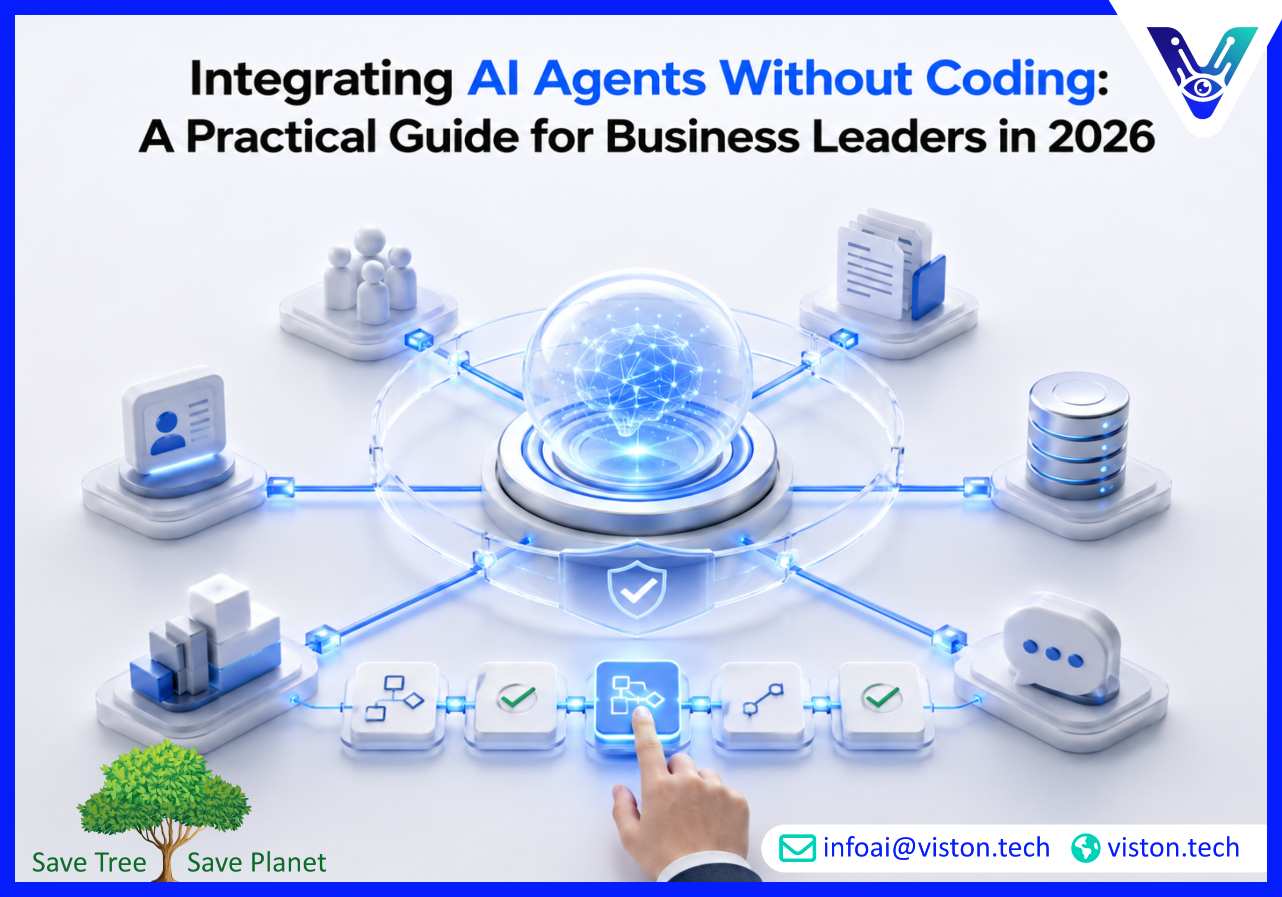
The core enabling technologies include drag-and-drop workflow builders, natural language configuration interfaces, and libraries of prebuilt connectors to common enterprise systems . Teams that understand their business processes can now define what an AI agent should do, what data it can access, and how it should escalate exceptions—all without writing a single line of code.
What distinguishes true no-code agent integration from simpler automation tools is the agent’s ability to reason, adapt, and take action across multiple systems. Unlike rules-based robotic process automation (RPA) that follows rigid scripts, AI agents can interpret context, make decisions based on business rules, and handle variation in how work arrives .
The economics of AI agent deployment have shifted decisively toward no-code approaches. Research indicates that operations teams can typically automate 60–70% of repetitive task volume using AI agents, freeing human workers for exception management, relationship work, and strategic decisions . For a five-person operations team, this effectively adds the equivalent of three full-time employees’ worth of capacity—delivered at a fraction of the cost of hiring.
Beyond direct cost savings, organizations are achieving meaningful improvements in error reduction and processing speed. AI agents executing routine work consistently reduce error rates by 80–90% compared to manual processing . Response times compress from hours or days to minutes. Perhaps most significantly, businesses can scale operations without the hiring lag that typically constrains growth—new workflows can be configured and deployed in days rather than waiting for next quarter’s headcount approval.
Major enterprise software vendors have validated this shift. Zendesk recently replaced deflection-based bots with autonomous AI agents priced on verified resolutions rather than seats . Dialpad’s Agent Studio enables governed, enterprise-grade AI agent creation for both digital and voice channels with no coding required . Box Automate, now generally available, provides a drag-and-drop workflow builder that routes work across AI agents, people, and enterprise systems without code .
For organizations evaluating agent integration services, understanding the typical deployment timeline is essential. The no-code approach compresses what once required six to twelve months into a matter of weeks.
Weeks one and two focus on workflow mapping and configuration. Business teams identify three to five high-volume, rule-based workflows for initial automation—invoice processing, supplier portal data extraction, inventory reconciliation, or customer inquiry routing. Using visual interfaces, they define trigger conditions, data sources, business rules, and exception handling logic . No developer involvement is required at this stage.
Weeks three and four involve pilot deployment in a supervised mode. AI agents begin executing workflows while human operators review outputs, identify edge cases, and refine rules. This learning phase is critical for building confidence in the agent’s decision-making before expanding scope .
Weeks five through eight see expanded deployment to additional processes. Each new workflow builds on patterns established in earlier deployments. By week eight, core workflows are running autonomously, and the focus shifts to monitoring performance and exception rates.
By the ninety-day mark, most organizations report handling two to three times their previous workload with the same headcount . The deployment model is iterative rather than monolithic—teams can start small, demonstrate value, and expand based on proven ROI.
Not all no-code agent platforms deliver the same capabilities. For organizations serious about production deployment, several features distinguish enterprise-ready solutions from pilot-stage experiments.
Governance and permission controls are non-negotiable. AI agents must operate within defined boundaries—able to access only approved data, execute only authorized actions, and maintain complete audit trails of their decisions . The ability to assign role-based permissions to agents, set outreach frequency limits, and maintain human-in-the-loop review for sensitive actions separates enterprise platforms from consumer tools.
Native integration with existing systems determines whether deployment is feasible at all. Leading platforms provide prebuilt connectors to common enterprise systems—ERPs, CRMs, document management platforms, and communication tools—eliminating the need for custom API development . For systems without prebuilt connectors, browser automation capabilities allow agents to work with any web-based interface, though governance becomes more complex.
Multi-LLM flexibility ensures organizations aren’t locked into a single AI provider. Platforms that support models from OpenAI, Anthropic, Google, and others allow businesses to choose the best model for each use case and adapt as the technology landscape evolves .
Any discussion of integrating AI agents without coding must address the governance question directly. Organizations concerned about AI reliability need frameworks for ensuring quality and managing risk. The no-code deployment model actually enables stronger governance in several respects.
Real-time monitoring capabilities allow teams to observe agent decisions as they happen, with complete logging of every action taken . When exceptions occur—edge cases the agent hasn’t encountered before—workflows can escalate to human operators with full context preserved. This human-in-the-loop pattern ensures that automation expands gradually, with humans remaining responsible for ambiguous or high-stakes decisions.
Organizations implementing agentic AI have reported measurable operational improvements. According to industry analysis, autonomous AI systems have achieved a 28% improvement in issue resolution time and a 19% increase in first-contact resolution rates . Gartner has predicted that by 2029, agentic AI will independently handle 80% of routine contact center inquiries, cutting operational costs by 30% .
The key insight is that governance becomes easier, not harder, with no-code deployment. Because business users—not just engineers—can configure agent permissions, review decision logs, and refine business rules, accountability remains with the teams that understand the work.
Viston AI specializes in agent integration services that bridge the gap between powerful AI models and real business workflows. Rather than requiring clients to build custom integrations or hire specialized engineering talent, Viston AI’s approach focuses on practical deployment—connecting AI agents to the systems businesses already use, configuring them to follow established business rules, and ensuring they operate within appropriate governance boundaries.
For organizations evaluating how to move from AI ambition to production value, Viston AI provides the expertise that turns no-code platforms from theoretical possibilities into deployed solutions. The firm’s integration services encompass workflow analysis, platform selection and configuration, governance framework design, and ongoing optimization. Clients benefit from deployment timelines measured in weeks rather than quarters, with measurable ROI documented at each stage. Whether automating document processing, customer inquiry routing, supplier data integration, or internal workflow orchestration, Viston AI’s specialist focus on agent integration services helps businesses capture value without the technical debt and development bottlenecks that derail so many AI initiatives.
The landscape for integrating AI agents without coding has matured significantly in 2026. What required deep development resources just eighteen months ago can now be configured by business teams in weeks using visual interfaces and prebuilt connectors. For organizations evaluating agent integration services, the key insight is practical: the barrier to entry is no longer technical capability but rather clear workflow definition, governance frameworks, and deployment discipline. Businesses that start with high-volume, rule-based processes, deploy iteratively with human oversight, and scale based on proven outcomes are capturing real economic value. The companies that delay, waiting for perfect conditions or internal development capacity, will watch competitors accelerate ahead. The technology is ready. The question is whether your organization is ready to act.
