
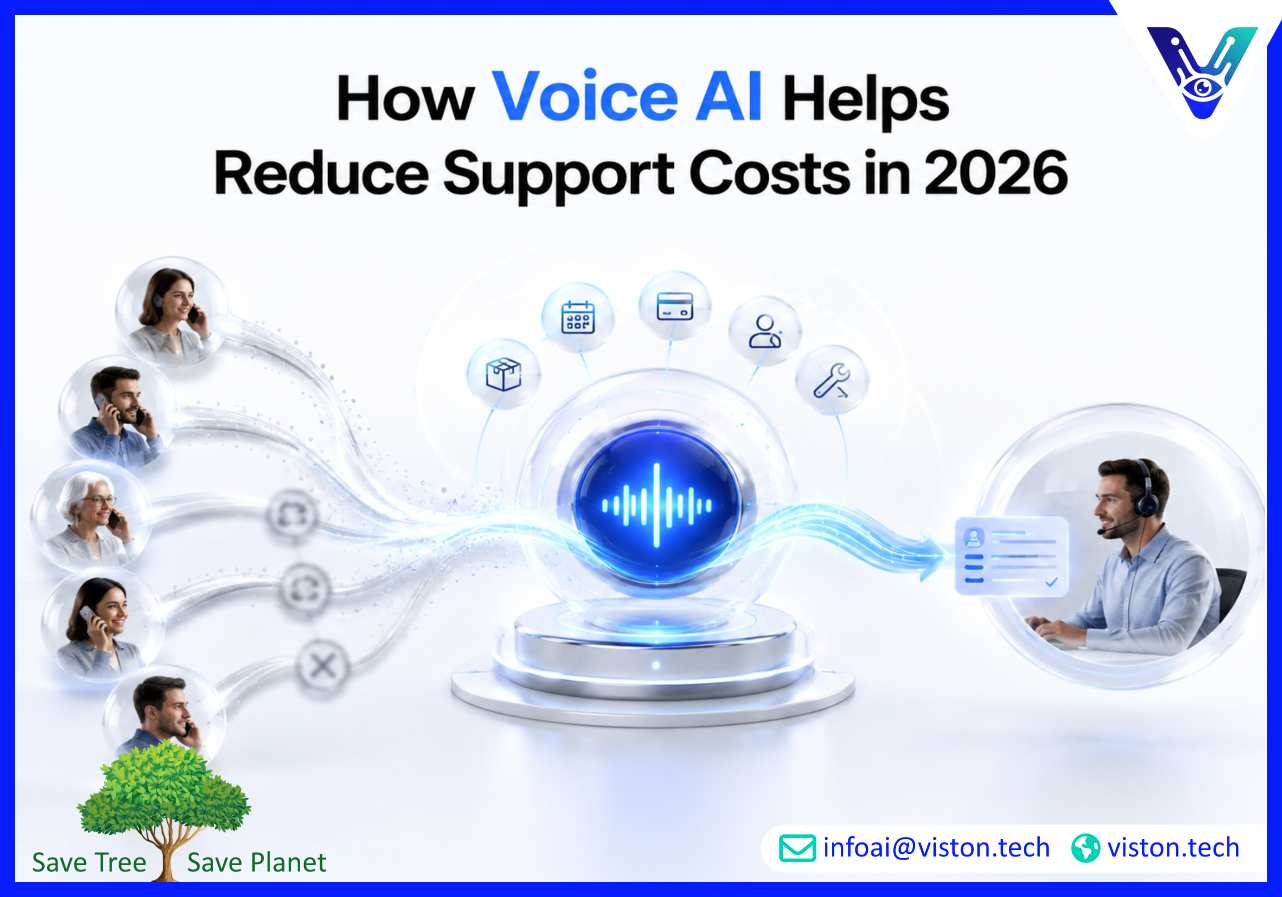
Understanding how voice AI helps reduce support costs is now important for businesses dealing with high call volumes, long wait times, rising staffing pressure, and customer expectations for faster service. Voice-enabled assistants can reduce repetitive workload while improving consistency, routing, and service availability.
Voice AI reduces support costs by automating routine phone-based interactions that would otherwise require human agents. Instead of relying only on traditional IVR menus or live agents for every call, businesses can use voice-enabled assistants to understand spoken requests, respond conversationally, collect information, complete simple workflows, and escalate complex issues with context.
The cost benefit does not come from replacing every support role. It comes from reducing avoidable manual effort across the support journey. Many customer calls are predictable: order status, appointment confirmation, billing questions, password reset guidance, refund policy questions, account updates, delivery information, store hours, claim status, and basic troubleshooting. When these interactions are handled accurately by voice AI, human teams can focus on higher-value conversations that require judgment, empathy, negotiation, or exception handling.
In 2026, support leaders are under pressure to manage service quality while controlling operating costs. Hiring more agents for every increase in call volume is often expensive and difficult to scale. Voice AI gives businesses a more flexible way to handle demand spikes, after-hours inquiries, multilingual questions, and repetitive support tasks without increasing headcount at the same rate.
Voice AI can reduce costs across several areas of support operations:
The strongest results usually appear when voice AI is connected to business systems. A standalone voice bot may answer basic questions, but an integrated voice assistant can check account details, update a ticket, book an appointment, verify an order, trigger a workflow, or route a caller based on real customer context.
Support costs rise when businesses depend on manual handling for every customer interaction. As call volumes increase, companies often need more agents, more supervisors, more training, more quality reviews, and more workforce planning. Even when agents are productive, repetitive calls consume time that could be used for complex problem-solving.
Traditional phone support is also vulnerable to demand spikes. A product issue, delivery delay, billing change, marketing campaign, seasonal rush, or service outage can create sudden call surges. If the support team is not staffed for that peak, customers wait longer. If the team is staffed for the peak all the time, costs increase during normal periods. Voice AI helps smooth this imbalance by handling predictable demand at scale.
Many support costs are not obvious in a simple staffing budget. A routine call may seem inexpensive, but at scale it creates cumulative cost through agent time, system lookup, call documentation, follow-up work, quality checks, and repeat contact if the issue is not resolved properly. Voice-enabled assistants reduce this burden by standardizing how common requests are handled.
For example, a voice AI assistant can confirm identity, ask the reason for the call, retrieve relevant information, provide an approved answer, and create a support record without requiring an agent for every step. If the caller still needs a human, the agent receives the context instead of starting from zero.
Incorrect call routing is another major cost driver. When customers are transferred between teams, call duration increases and satisfaction drops. Agents also lose time handling calls that belong to another department. Voice AI can identify intent through natural language and route callers more accurately than rigid menu-based systems when it is designed well.
Instead of forcing callers to press numbers through a long menu, a voice assistant can ask what they need and classify the request. This improves routing for sales, billing, technical support, renewals, complaints, appointment management, and account questions. Better routing reduces unnecessary transfers and helps agents spend more time on work they are trained to handle.
Customers increasingly expect support outside standard business hours. For many companies, providing full live-agent coverage overnight, on weekends, or across time zones is costly. Voice AI can offer 24/7 support for routine questions and urgent triage while escalating only the cases that genuinely require human attention.
This does not mean every business should automate sensitive or high-risk calls. Instead, voice AI should be used where the process is clear, the answer is approved, and the escalation path is reliable. The goal is controlled automation that reduces avoidable cost without weakening customer trust.
Voice-enabled assistants reduce workload by handling specific support tasks that are frequent, structured, and measurable. The best use cases are not chosen only because they are easy to automate. They are chosen because they create meaningful operational savings and improve the customer experience at the same time.
Many support calls involve basic questions that already have approved answers. These may include pricing information, service availability, delivery timing, warranty rules, cancellation steps, payment options, documentation requirements, or location details. Voice AI can answer these questions consistently without making customers wait for an agent.
This reduces the number of calls that reach live teams and improves consistency across the organization. It also helps new agents because they receive fewer repetitive inquiries and can focus on cases that require deeper training.
Cost reduction becomes stronger when voice AI can complete tasks, not just answer questions. A well-integrated voice assistant can help customers reschedule appointments, check order status, update contact details, start a return request, create a ticket, confirm a booking, collect missing information, or send a follow-up message.
These workflows reduce agent handling time because the assistant performs the early steps automatically. Even when a human agent becomes involved, the agent receives a cleaner summary and can resolve the issue faster.
First-contact resolution is a key support cost factor. When customers need to call again, the business pays for the same issue more than once. Voice AI can improve first-contact resolution for common requests by giving customers immediate access to the right information and workflow.
For example, if a customer calls about a delayed order, the assistant can identify the order, check status, explain the next step, and create a follow-up record if needed. If the situation is unusual, the assistant can escalate with the order number, customer details, issue type, and call summary already prepared.
Agents often spend time after calls writing summaries, updating CRM records, tagging tickets, or logging outcomes. Voice AI can support this process by capturing caller intent, summarizing conversation details, assigning categories, and preparing structured notes. This reduces after-call work and improves data quality.
Better documentation also supports reporting. Support leaders can see which issues are increasing, which workflows are failing, where customers need more help, and which topics should be improved in self-service content.
Voice AI can help businesses serve customers who prefer speaking over typing or who need support in different languages. Multilingual support can reduce the need to maintain separate live-agent capacity for every language at all times. It can also improve accessibility for users who find web forms, chat interfaces, or email support difficult.
The cost benefit depends on implementation quality. Speech recognition, language support, pronunciation handling, regional accents, and fallback design must be tested carefully. Poor voice AI can increase frustration and repeat calls, so accuracy and escalation rules are essential.
Voice AI support cost reduction depends on strategy, data quality, integration, testing, governance, and ongoing optimization. Businesses should not treat voice-enabled assistants as a plug-in replacement for agents. They should treat them as part of the support operating model.
The best starting point is usually a focused set of high-volume, low-risk support interactions. These may include FAQs, order status, appointment changes, ticket creation, account verification, payment reminders, delivery updates, or basic troubleshooting. Starting with clear use cases helps teams measure impact and avoid over-automation.
Complex, emotional, regulated, or complaint-heavy interactions should be handled carefully. Voice AI can still assist by collecting information and routing calls, but full automation may not be suitable unless the process is thoroughly tested and compliant.
Integration is essential for real cost reduction. A voice assistant should connect with systems such as CRM, helpdesk platforms, ecommerce systems, booking tools, ERP, knowledge bases, payment platforms, and customer data systems where appropriate. Without integration, the assistant may only provide generic responses, limiting its impact.
Connected systems allow the assistant to retrieve information, update records, trigger workflows, and pass context to human agents. This reduces repeat questioning and prevents support teams from manually entering information that the assistant already collected.
Cost reduction should not come at the expense of customer experience. A good voice AI system knows when to escalate. It should transfer calls when the issue is sensitive, the caller is frustrated, confidence is low, the request is outside policy, or a human decision is needed.
Handover quality matters. The assistant should provide agents with caller identity, issue summary, detected intent, previous steps, relevant system records, and recommended next action. This helps agents resolve escalated calls faster and prevents customers from repeating themselves.
Businesses should track voice AI performance through cost and quality metrics. Useful KPIs include containment rate, first-contact resolution, average handling time, transfer rate, customer satisfaction, repeat contact rate, successful workflow completion, escalation accuracy, and cost per resolved interaction.
A high automation rate is not always a success if customers are dissatisfied or issues remain unresolved. The right goal is efficient, accurate, and trusted resolution. Ongoing monitoring helps teams improve prompts, knowledge content, call flows, integrations, and fallback rules.
Viston AI is relevant to this topic because its Voice-Enabled Assistants service focuses on enterprise-grade conversational AI that combines natural language processing, speech recognition, and scalable AI infrastructure for voice-based interactions. For businesses asking how voice AI helps reduce support costs, this type of capability matters because cost savings depend on more than a natural-sounding voice. The assistant must understand intent, handle multi-turn conversations, integrate with business workflows, and support measurable outcomes.
Viston AI’s broader service portfolio includes voice-enabled assistants, enterprise AI chatbots, AI chatbot integration, multilingual support, NLP and text analysis, AI automation workflows, agent integration, and strategic AI consulting. These capabilities are useful for organizations that want voice automation connected to real support operations rather than isolated call scripts.
For support teams, Viston AI can help design voice assistant use cases around repetitive call handling, customer routing, FAQ automation, workflow completion, CRM or helpdesk integration, and escalation support. This makes the service relevant for companies looking to reduce support workload while maintaining practical control over accuracy, handover quality, and customer experience. Its approach is especially suitable for businesses that need scalable voice automation across customer service, sales support, operations, internal helpdesks, and multilingual support environments.
Voice AI reduces support costs by automating repetitive calls, collecting caller information, improving routing, completing simple workflows, reducing wait times, and lowering the amount of manual work required from agents. The biggest savings usually come from high-volume, predictable support requests.
Voice AI should not replace every human support function. It is best used to handle routine, structured, and repeatable interactions while human agents manage complex, sensitive, emotional, or exception-based issues. A balanced model usually delivers better cost control and better customer experience.
Good use cases include order status, appointment scheduling, FAQ handling, account verification, ticket creation, delivery updates, payment reminders, lead qualification, basic troubleshooting, and call routing. These tasks are common, measurable, and easier to standardize.
Yes, when implemented properly. Voice AI can reduce wait times, provide 24/7 availability, answer common questions quickly, and route callers more accurately. Customer experience can suffer, however, if the assistant gives inaccurate answers or makes escalation difficult.
Voice AI may need integration with CRM, helpdesk software, ecommerce platforms, booking systems, ERP, knowledge bases, payment systems, and customer data platforms. Integration allows the assistant to retrieve information, update records, and complete workflows.
Yes. Viston AI’s Voice-Enabled Assistants service aligns with support cost reduction because it focuses on conversational voice automation, NLP, system integration, multilingual support, and workflow automation for business use cases.
How voice AI helps reduce support costs comes down to practical automation, not surface-level novelty. Voice-enabled assistants can handle repetitive calls, improve routing, shorten wait times, support after-hours service, collect information, update systems, and help agents work more efficiently. In 2026, businesses need support models that can scale without simply adding more manual workload. The strongest results come from focused use cases, reliable integrations, clear escalation rules, and continuous performance measurement. For companies evaluating Voice-Enabled Assistants, Viston AI offers relevant capabilities for building voice automation that supports cost control, customer experience, and operational scalability.
