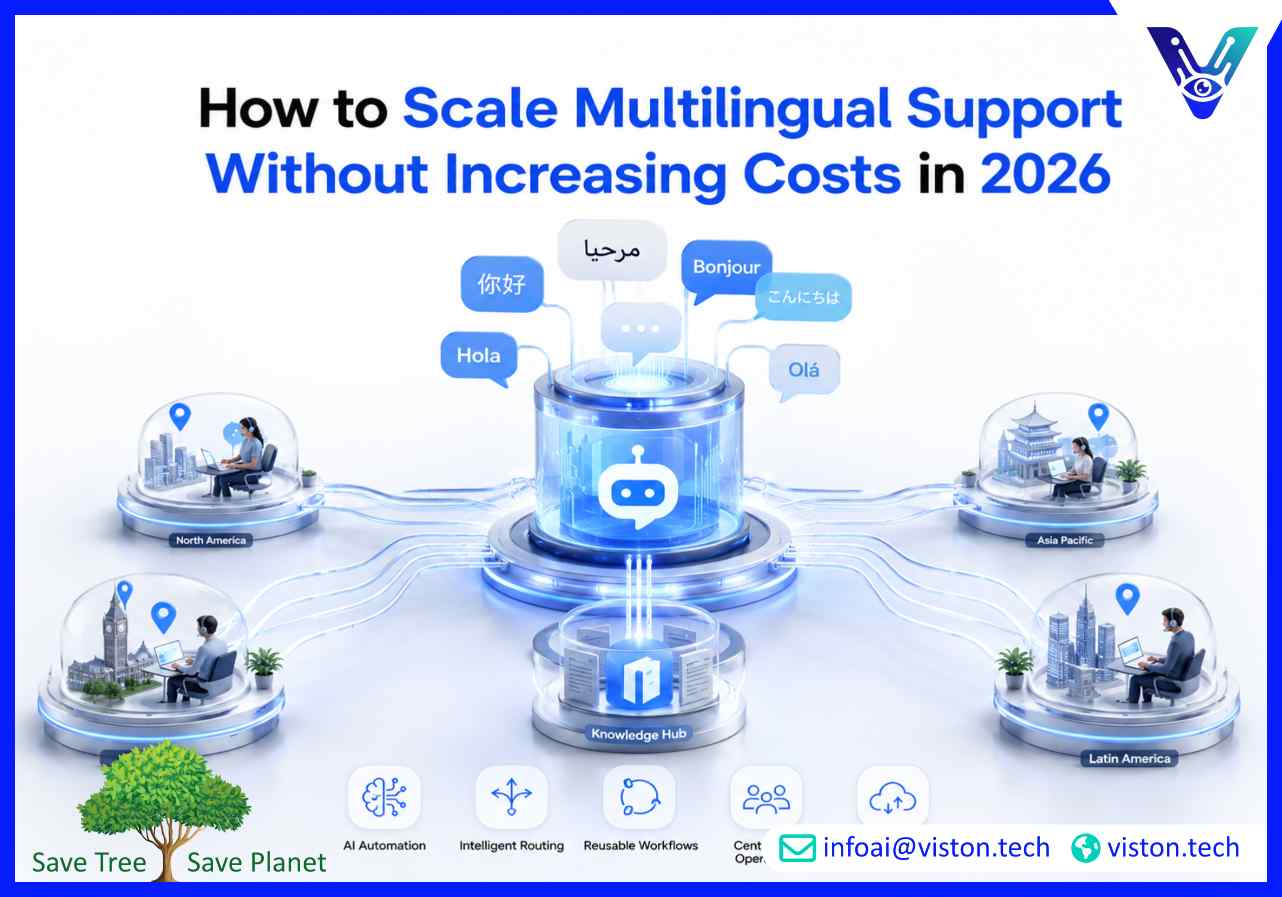
How to Scale Multilingual Support Without Increasing Costs in 2026
Scaling multilingual support does not have to mean hiring a separate team for every language. The practical goal is to absorb more customers, markets, and conversations within a controlled cost base by combining focused language coverage, reusable knowledge, AI-assisted automation, intelligent routing, and disciplined quality management.
Why Multilingual Support Costs Rise as a Business Expands
Multilingual customer service becomes expensive when every new language is treated as a separate operation. Companies duplicate help content, workflows, training, quality assurance, reporting, and staffing. As ticket volume grows, they add agents linearly instead of redesigning how enquiries are resolved.The first step is to separate language demand from support complexity. Many conversations across different markets concern the same underlying intents: order status, password resets, billing questions, appointment changes, product information, returns, onboarding, or account access. The wording changes, but the business process often does not.
Cost-neutral scaling is not the same as free support
“Without increasing costs” should be understood as scaling within an existing or tightly controlled service budget. There may still be implementation, localization, integration, and governance costs. The objective is to prevent support expenditure from rising at the same rate as customer volume or language coverage.
The most common cost drivers
Hiring dedicated agents before language demand is proven
Translating every document instead of prioritizing high-use content
Maintaining separate knowledge bases for each market
Using people to answer repetitive, low-risk enquiries
Failing to connect support channels with CRM, helpdesk, order, or account systems
Escalating too many conversations because automated answers lack context
Measuring total ticket volume without tracking cost and quality by language
How to Scale Multilingual Support Without Increasing Costs
The most effective approach is to scale in layers. Begin with real demand, automate suitable enquiries, centralize knowledge, and preserve human attention for cases where judgment matters. This lets the support operation grow without creating a matching increase in headcount.
Prioritize languages using commercial and service data
Do not launch ten languages because a platform technically supports them. Review customer locations, browser language, sales enquiries, support tickets, revenue, abandoned conversations, refund requests, and market expansion plans. Rank languages by current demand, business value, service risk, and likely volume.A phased rollout usually starts with the languages responsible for the largest share of non-primary-language contacts. Lower-volume languages can initially use translated self-service content and AI-assisted agent replies. Dedicated coverage becomes justified only when demand, revenue, or service risk supports it.
Automate high-volume, low-risk intents first
Automation creates savings when it resolves repetitive work rather than merely greeting users. Good starting points include order tracking, booking confirmations, account recovery, subscription guidance, delivery information, product availability, opening hours, basic troubleshooting, and standard policy questions.Each automated flow should have a defined source of truth, completion condition, confidence threshold, and escalation path. The system should not improvise on refunds, legal complaints, regulated advice, fraud concerns, safety issues, or emotionally sensitive cases. These require human review or tighter controls.
Build one governed knowledge layer
A multilingual support operation should maintain a central set of approved answers, policies, process steps, product terms, and escalation rules. Language versions should be linked to the same underlying content so that a policy change can be updated systematically rather than corrected in several disconnected documents.Start by cleaning the source content. Remove duplicates, resolve conflicting instructions, assign content owners, and record review dates. Then localize the highest-use material. This reduces translation waste and improves consistency across chat, email, help centres, mobile apps, and messaging channels.
Use AI translation with human review based on risk
Not every message needs the same level of linguistic review. Routine questions can often be handled through AI translation, approved response blocks, or a multilingual chatbot. High-value sales discussions, complaints, legal terms, healthcare information, financial explanations, and culturally sensitive communication need stronger human oversight.A risk-based review model controls cost because fluent specialists are used where mistakes carry real consequences. Native or professional reviewers can also audit samples, update terminology, and correct recurring issues instead of manually handling every conversation.
Design a Lean Multilingual Support Operating Model
Technology reduces cost only when the operating model is clear. Businesses need defined ownership for knowledge, automation, translation quality, integrations, escalation, and reporting. Without this structure, automated support creates more corrections, duplicate work, and customer frustration.
Centralize operations while localizing customer experience
Keep core processes, data, workflow logic, and reporting centralized. Localize the customer-facing elements that genuinely vary, such as tone, terminology, currencies, date formats, regional policies, shipping rules, and cultural expectations. This “central control, local adaptation” model avoids unnecessary duplication.
Connect support to business systems
A multilingual chatbot or translated agent workspace becomes more useful when it can access relevant context. Integrations with CRM, helpdesk, ecommerce, billing, scheduling, knowledge, and identity systems allow the support channel to retrieve order details, account status, subscription plans, previous tickets, or appointment information.
Use intelligent routing instead of language-only routing
Routing every non-primary-language conversation to a bilingual agent can create queues and underuse specialist capacity. A better model considers language, intent, urgency, customer value, sentiment, compliance risk, and required expertise.
Give agents AI assistance rather than replacing judgment
Agent-assist tools can translate incoming messages, summarize long conversations, recommend knowledge articles, draft replies, and create handover notes. This allows an existing team to support more languages while retaining human control over sensitive or unusual cases.Clear approval rules are essential. Agents should know when they can send an assisted response, when a fluent reviewer is required, and when the conversation must be escalated. The aim is faster, more consistent work—not unchecked automation.
Measure Whether Multilingual Growth Is Truly Cost-Efficient
A company cannot prove cost-neutral scaling by counting languages or automated messages. It needs metrics that connect service volume to resolution quality, customer experience, and operating cost. Results should be reviewed separately for each language because strong performance in one language can hide failures in another.
Track a balanced set of KPIs
Cost per resolved conversation by language
Self-service resolution rate
First-contact resolution
Fallback and unrecognized-intent rate
Human escalation rate and escalation reason
Average handling time for agent-assisted cases
Customer satisfaction and repeat-contact rate
Translation correction rate
Workflow completion and integration error rate
Support cost as a percentage of revenue from each market
The most important relationship is between cost and quality. A lower cost per conversation is not a success if customers receive inaccurate answers or must contact the company repeatedly. Review savings alongside resolution, satisfaction, complaint, refund, and retention indicators.
Optimize from failed conversations
Fallbacks, abandoned flows, repeated contacts, negative feedback, and unnecessary escalations provide the best improvement data. Classify each failure as a knowledge gap, translation issue, unclear intent, workflow error, integration failure, policy conflict, or valid need for human judgment.Fix the highest-volume causes first. A single corrected knowledge article or workflow can improve service across several languages simultaneously. This compounding effect is what allows multilingual support to scale without proportional cost growth.
Protect trust, privacy, and transparency
Cost reduction should not weaken data protection, access controls, retention policies, or human oversight. Customers should understand when they are interacting with an automated system, and businesses should provide a practical route to human help when automation is unsuitable. For organizations serving the European Union, AI chatbot transparency obligations under the EU AI Act take effect in August 2026.Governance should include approved data sources, role-based access, audit logs, testing by language, and documented escalation rules. These controls reduce the risk of fluent but incorrect responses, inappropriate disclosure, and inconsistent treatment across markets.
How Viston AI Supports Cost-Efficient Multilingual Support
Viston AI provides Multilingual AI Chatbot Support designed to manage conversations across languages, channels, and operational workflows. Its published capabilities include multilingual intent recognition, real-time translation and localization, centralized omnichannel delivery, intelligent routing and escalation, language-specific analytics, and continuous optimization.These capabilities are relevant to businesses that want to expand language coverage without creating a separate manual support operation for every market. A deployment can begin with selected languages and high-volume intents, then extend as ticket data, customer demand, and commercial priorities become clearer.Viston AI also describes integrations and centralized control over conversation flows, knowledge management, escalation protocols, and compliance rules. This supports the operating model required for cost-efficient scaling: one governed knowledge foundation, automated handling for suitable enquiries, contextual access to business systems, and structured handover to people when judgment is required.For ecommerce, SaaS, travel, financial services, healthcare, manufacturing, and other internationally active organizations, the practical value is not simply adding more languages. It is building a measurable support system that can maintain consistency, route work intelligently, and improve from language-level performance data without tying growth directly to headcount.
Frequently Asked Questions
Can multilingual support really scale without hiring more agents?
Yes, when growth is absorbed through self-service, automation, AI-assisted translation, better knowledge, and smarter routing. Human hiring may still be needed for complex or regulated work, but headcount does not have to rise in direct proportion to conversation volume.
Which languages should a business add first?
Prioritize languages using customer demand, revenue potential, ticket volume, service risk, and expansion plans. Start with the languages generating the most valuable or frequent interactions rather than trying to support every market at once.
What support enquiries should be automated?
Automate repetitive, well-documented, low-risk enquiries such as order tracking, account access, appointment confirmation, subscription guidance, standard returns, and basic troubleshooting. Preserve human review for sensitive, high-value, ambiguous, or regulated cases.
Is machine translation enough for customer support?
Machine translation is useful for routine interactions and agent assistance, but it should operate within approved knowledge and escalation rules. Professional or native review remains important for legal wording, complaints, technical terminology, brand-sensitive content, and high-risk communication.
How can a business measure multilingual support cost savings?
Track cost per resolved conversation, self-service resolution, handling time, escalation rate, repeat contact, translation corrections, and customer satisfaction by language. Savings are credible only when service quality remains stable or improves.
How can Viston AI help control multilingual support costs?
Viston AI’s multilingual chatbot, translation, routing, analytics, integration, and optimization capabilities can support phased automation and centralized operations. This can help businesses handle more languages and conversations without building separate support structures for every market.
Conclusion
Learning how to scale multilingual support without increasing costs requires more than adding translation software. Businesses need to prioritize languages, centralize trusted knowledge, automate suitable intents, connect support with operational systems, and route complex cases to the right people. The goal is to decouple growth from headcount while protecting accuracy, customer trust, and service quality. With a phased, measurable multilingual support model, organizations can enter new markets and serve more customers within a controlled cost base. Viston AI offers relevant multilingual automation, integration, routing, and analytics capabilities for businesses building this type of scalable support operation.