
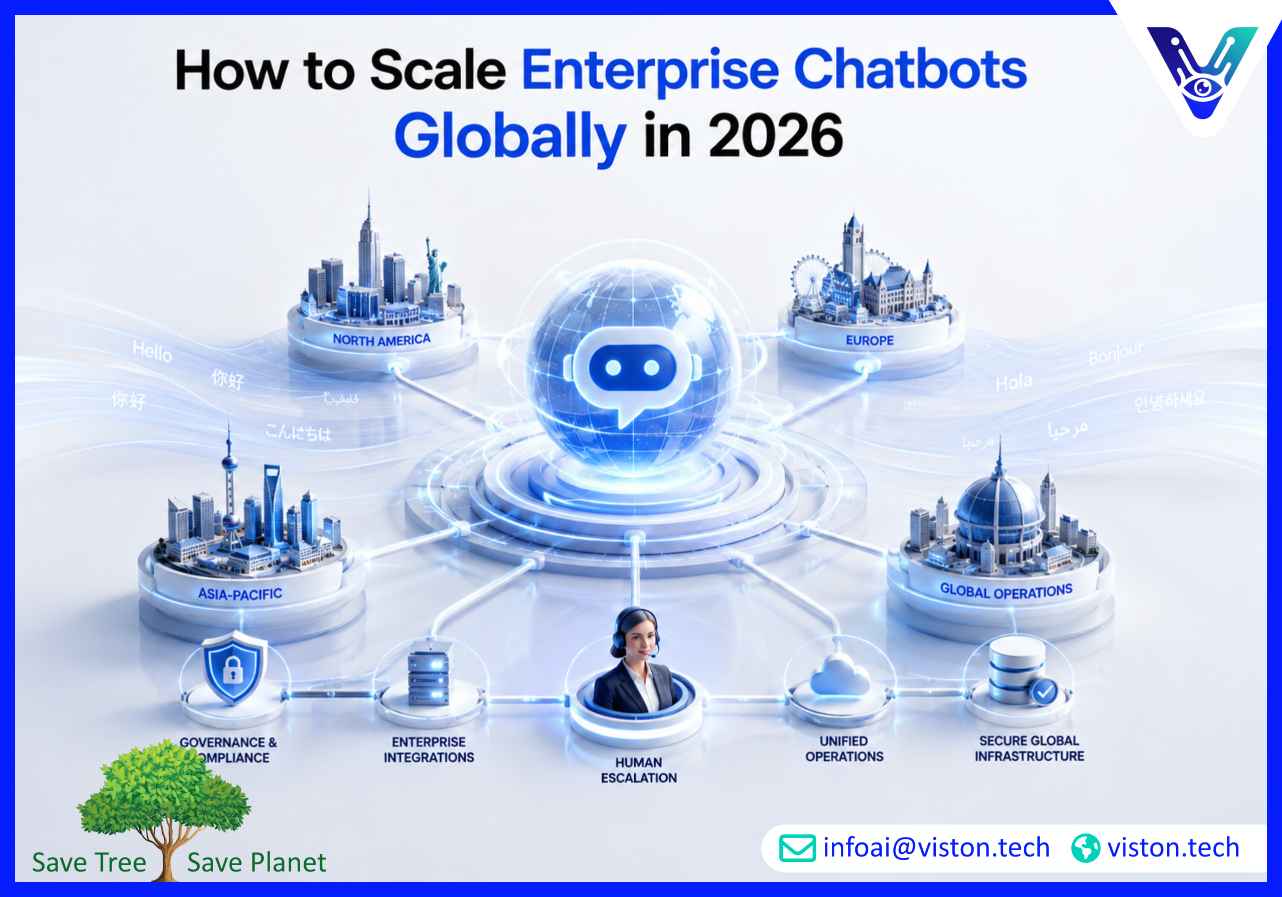
Scaling enterprise chatbots globally is no longer only a technical expansion project. In 2026, businesses need multilingual accuracy, regional compliance, reliable integrations, brand consistency, human escalation, and measurable performance across markets, channels, and customer expectations.
Global chatbot scaling means taking an enterprise chatbot beyond a single market, language, department, or customer support use case and making it work reliably across regions, business units, systems, and customer journeys. It is not simply translating a chatbot script or adding more servers. A globally scalable chatbot must understand local language, intent, culture, policies, regulations, product availability, service rules, and operational workflows.
For enterprise teams, this usually means supporting customers, employees, partners, or sales teams across multiple time zones and digital channels. The chatbot may need to answer product questions in Europe, qualify leads in North America, support order updates in Asia-Pacific, assist internal IT teams across offices, or help service agents with knowledge retrieval in several languages.
The challenge is that every region has different expectations. A customer in Germany may care about data handling and documentation. A buyer in the United States may expect fast escalation and CRM-driven personalization. A user in France may need localized language quality. A support team in Australia may need after-hours coverage. Global scaling requires one core chatbot strategy with enough flexibility to adapt locally.
A chatbot deployment proves that the system can work for a defined use case. Global scaling proves that it can keep working when the environment becomes more complex. More languages, more workflows, more integrations, more compliance rules, and more user behavior patterns all increase operational risk.
Businesses should treat global scaling as a structured transformation program. The goal is to create a chatbot ecosystem that remains accurate, secure, governed, and useful even as usage volume grows across markets.
A globally scalable enterprise chatbot needs a strong architecture before expansion begins. Many companies start with a simple chatbot for FAQs or lead capture, then struggle when they try to extend it across countries or departments. The technical foundation must support scale, localization, integrations, analytics, and governance from the beginning.
The most practical model is a centralized chatbot foundation with local adaptation layers. The central layer manages shared capabilities such as natural language understanding, brand tone, security policies, analytics, core workflows, and integration standards. Regional layers manage market-specific content, local product rules, language variations, compliance requirements, and escalation paths.
This structure avoids two common problems. First, it prevents every region from building a separate chatbot with inconsistent quality and reporting. Second, it avoids forcing every market into one rigid system that ignores local needs. A scalable model gives headquarters control where consistency matters and gives regional teams flexibility where localization matters.
Multilingual chatbot support should not rely only on direct translation. Enterprise conversations include industry terminology, product names, internal process language, legal phrases, abbreviations, and local idioms. A phrase that works in English may sound unclear, too formal, or commercially inappropriate in another language.
Global chatbot scaling requires language-specific training, localized intent mapping, regional content review, and testing with native or market-aware users. This is especially important for customer service, healthcare, finance, education, ecommerce, travel, logistics, and public-facing service environments where misunderstanding can damage trust.
A global chatbot becomes valuable when it can work with real business data. That means integrating with systems such as CRM, ERP, helpdesk platforms, order management tools, HR systems, knowledge bases, identity providers, payment systems, inventory platforms, and analytics dashboards.
Without integration, the chatbot can only give generic answers. With proper integration, it can check order status, create tickets, update customer records, qualify leads, route requests, verify account details, retrieve policy information, and trigger workflows. For global operations, integration must also account for regional system differences. One country may use Salesforce, another may use Microsoft Dynamics, and another may rely on a legacy database or local helpdesk tool.
Global usage increases technical pressure. The chatbot may receive traffic during regional business hours, marketing campaigns, product launches, seasonal peaks, or service outages. Infrastructure should support high availability, load balancing, caching, monitoring, fallback responses, and reliable API performance.
Response speed matters, but accuracy matters more. A fast chatbot that gives the wrong answer at scale can create bigger business problems than a slower chatbot with strong confidence controls. Enterprises should define performance standards for latency, uptime, system failure handling, and escalation when connected services are unavailable.
Global chatbot scaling creates governance responsibilities that smaller deployments often overlook. Once a chatbot operates across regions, it may process personal data, sensitive business information, transaction details, employee records, or regulated customer requests. Enterprises need policies that define what the chatbot can answer, what it can do, what data it can access, and when it must involve a human.
Compliance should be considered during architecture and workflow design, not added at the end. Data privacy laws, sector regulations, consent requirements, retention rules, and automated decision-making restrictions can vary by market. Businesses operating in Europe, North America, the UK, Australia, and Asia-Pacific may need different controls for data collection, storage, access, deletion, and user disclosure.
For chatbot teams, this means defining consent flows, data minimization rules, audit logs, retention periods, access permissions, and escalation triggers. If the chatbot handles healthcare, financial services, insurance, government, legal, or employment-related workflows, governance must be even more disciplined.
A global enterprise chatbot should not treat every user the same. Customers, employees, partners, agents, managers, and administrators need different levels of access. Role-based permissions help prevent the chatbot from exposing internal content, confidential pricing, restricted policies, or account-specific information to the wrong user.
Authentication and authorization should be connected to enterprise identity systems where appropriate. For internal chatbots, this may include single sign-on and department-level permissions. For customer-facing chatbots, it may include secure account verification before showing private data or processing sensitive requests.
Governance defines who owns the chatbot after launch. A global chatbot needs clear ownership across business, technical, content, compliance, and operations teams. Without ownership, content becomes outdated, intents drift, regional teams make inconsistent changes, and performance problems go unnoticed.
A practical governance model should define:
Scaling enterprise chatbots globally does not mean removing people from the process. Human oversight is essential for quality control, sensitive cases, complex decisions, complaints, compliance issues, and exceptions. The chatbot should know when to answer, when to clarify, when to retrieve more information, and when to escalate.
Human handoff should include conversation history, user intent, detected sentiment, account details where permitted, attempted resolutions, and priority level. This prevents users from repeating themselves and helps regional support teams respond faster.
Global chatbot scaling works best when expansion is phased. Trying to launch across every language, country, workflow, and channel at once creates unnecessary risk. A controlled rollout allows teams to test performance, improve training data, validate integrations, and learn from regional usage patterns before expanding further.
The first global chatbot use cases should be valuable, repeatable, and measurable. Common examples include customer support FAQs, order status, appointment scheduling, lead qualification, product guidance, internal IT support, HR policy search, knowledge base retrieval, and ticket creation.
These use cases are strong candidates because they often involve high volume, clear intent, and measurable outcomes. More complex workflows such as claims processing, financial eligibility, medical guidance, contract support, or regulated decision-making should be added only after the chatbot has strong governance, testing, and escalation controls.
There are several practical rollout models. Some companies scale by region, starting with one market and expanding to similar markets. Others scale by language, adding multilingual support in stages. Some scale by business unit, beginning with customer support before adding sales, operations, HR, or IT.
The right model depends on business priorities. A company with urgent support volume may scale customer service first. A SaaS company expanding internationally may prioritize multilingual lead qualification. A manufacturing enterprise may focus on internal knowledge support across plants and technical teams.
Global chatbot testing should include real conversation examples, regional terminology, edge cases, integration failures, escalation scenarios, and compliance-sensitive questions. Internal testing alone is not enough. Regional users may phrase questions differently, use mixed languages, ask unexpected follow-ups, or expect answers based on local service rules.
Testing should cover intent recognition, answer accuracy, tone, workflow completion, fallback handling, human handoff, and system update accuracy. Teams should also test what happens when the chatbot cannot answer confidently. A safe, clear fallback is better than an uncertain automated response.
Global chatbot performance should not be measured only at an overall level. A global average can hide regional problems. One market may have strong resolution rates while another has poor fallback performance. One language may produce high satisfaction while another creates confusion. One channel may convert leads well while another struggles with abandonment.
Useful KPIs include self-service resolution rate, fallback rate, escalation rate, customer satisfaction, average response time, workflow success rate, lead qualification rate, ticket deflection, handoff quality, language performance, and integration error rate. These metrics help teams improve the chatbot continuously as it scales.
Viston AI is relevant to global chatbot scaling because its Enterprise AI Chatbots service is built around complex business environments where conversational AI must work across channels, languages, business units, and enterprise systems. Its service offering includes enterprise AI chatbot development, multilingual support, AI chatbot integration, NLP and text analysis, voice-enabled assistants, automation workflows, and ongoing optimization.
For organizations expanding chatbot operations globally, this matters because scale depends on more than a chatbot interface. Businesses need language-aware design, secure system connectivity, knowledge base integration, workflow automation, analytics, compliance controls, and reliable human handoff. Viston AI’s Enterprise AI Chatbots service is aligned with these requirements by supporting CRM, knowledge base, transactional system, and workflow integration for enterprise use cases.
The company’s broader AI service portfolio also includes strategic AI consulting, AI readiness assessment, MLOps and model monitoring, business intelligence, generative AI solutions, and industry-focused AI services. This gives global teams a practical foundation for planning chatbot architecture, prioritizing use cases, managing performance, and adapting deployments across regions.
For companies that want to scale enterprise chatbots globally without losing accuracy, brand consistency, or operational control, Viston AI can be positioned as a specialist partner for designing, integrating, and optimizing chatbot systems that support multilingual customer experience, internal service automation, and measurable business outcomes.
The best approach is to use a centralized chatbot foundation with regional localization. This allows the business to maintain consistent security, analytics, brand tone, and integration standards while adapting language, content, workflows, and compliance rules for each market.
Yes. Translation alone is not enough for global chatbot performance. Enterprise chatbots need multilingual intent training, local terminology, native-language testing, cultural adaptation, and region-specific content review to deliver accurate and natural conversations.
Common integrations include CRM, ERP, helpdesk platforms, knowledge bases, ecommerce systems, HR systems, identity providers, order management tools, and analytics platforms. The right integrations depend on the chatbot’s use case and regional business processes.
Businesses should define regional data rules, consent flows, access controls, audit logs, retention policies, and escalation triggers. Compliance teams should review chatbot workflows before launch, especially when the bot handles personal data, regulated requests, or sensitive business information.
Important KPIs include resolution rate, fallback rate, escalation rate, customer satisfaction, workflow success rate, language performance, response time, integration error rate, ticket deflection, lead qualification rate, and human handoff quality.
Viston AI’s Enterprise AI Chatbots service is aligned with global scaling needs because it supports chatbot development, multilingual capability, enterprise system integration, workflow automation, NLP, analytics, and ongoing optimization for complex business environments.
Learning how to scale enterprise chatbots globally is essential for businesses that want conversational AI to support customers, employees, and operations across regions. Successful scaling requires more than translation or higher traffic capacity. It depends on multilingual training, localized content, secure integrations, governance, compliance, analytics, and phased rollout planning. In 2026, Enterprise AI Chatbots should be treated as long-term business infrastructure, not a standalone automation tool. With the right architecture and operating model, companies can expand chatbot capability across markets while maintaining accuracy, trust, and measurable performance. Viston AI offers relevant expertise for organizations seeking a structured, enterprise-focused approach to global chatbot scaling.
