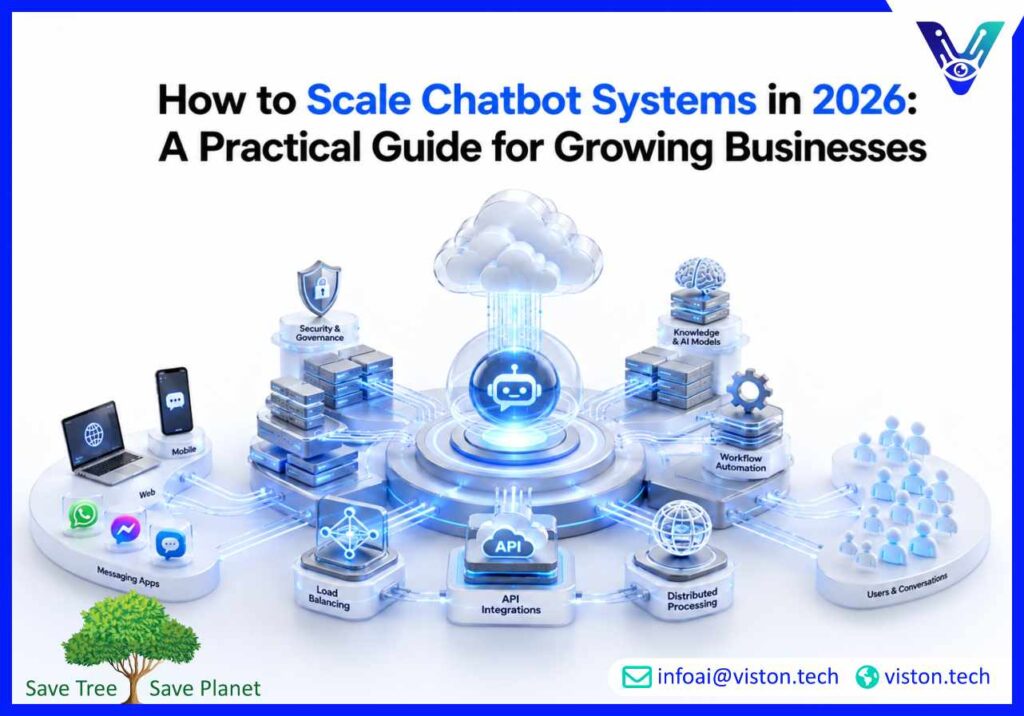
How to Scale Chatbot Systems in 2026: A Practical Guide for Growing Businesses
As AI adoption accelerates across industries, businesses are increasingly moving beyond basic chatbot deployments and focusing on long-term scalability. A chatbot that performs well for a few hundred conversations may struggle when handling thousands of users, multiple channels, complex workflows, and growing data requirements. Understanding how to scale chatbot systems has become essential for organizations that want to maintain performance, customer satisfaction, and operational efficiency while supporting business growth.
Why Chatbot Scalability Matters in 2026
Scalability refers to a chatbot system’s ability to handle increasing workloads, users, conversations, integrations, and business requirements without compromising performance or user experience.As businesses expand their use of conversational AI, chatbot systems often become responsible for:
Customer support automation
Lead generation and qualification
Sales assistance
Customer onboarding
Appointment scheduling
Knowledge management
Employee support services
Multichannel customer engagement
Without proper scaling strategies, organizations may experience slower response times, inconsistent answers, integration failures, increased operational costs, and declining user satisfaction.In 2026, scalability is no longer simply a technical requirement. It is a business requirement that directly affects customer experience, productivity, and revenue growth.
Key Challenges Businesses Face When Scaling Chatbot Systems
Growing Conversation Volumes
As chatbot adoption increases, systems must process significantly more requests while maintaining fast response times. High traffic periods can quickly expose infrastructure limitations if scalability has not been planned in advance.
Expanding Knowledge Bases
Growing businesses continuously add products, services, policies, documentation, and support resources. Chatbots must efficiently access and retrieve information from larger and more complex datasets.
Multiple Integration Requirements
Modern chatbots rarely operate independently. They often connect with CRM platforms, ERP systems, customer support tools, marketing automation software, ecommerce platforms, and internal databases.Each additional integration introduces complexity that must be managed carefully.
Consistency Across Channels
Customers increasingly interact with businesses through websites, mobile apps, messaging platforms, social media channels, and customer portals.Maintaining a consistent chatbot experience across all touchpoints becomes more challenging as organizations scale.
Security and Compliance Demands
As chatbot systems process larger volumes of business and customer data, security, privacy, and compliance requirements become increasingly important.Scalable systems must incorporate governance frameworks that support secure operations without reducing usability.
Core Strategies for Scaling Chatbot Systems Successfully
Build on a Flexible Architecture
Scalable chatbot systems start with a strong architectural foundation.Businesses should prioritize architectures that support:
Cloud-native deployment
API-driven integrations
Microservices-based development
Load balancing capabilities
Distributed processing
Containerized deployment environments
A flexible architecture allows organizations to expand capabilities without rebuilding the entire system.
Implement Modular Development Practices
Rather than creating one large chatbot application, businesses can develop modular components that manage specific functions.Examples include:
Support automation modules
Lead qualification modules
Knowledge retrieval modules
Appointment scheduling modules
Product recommendation modules
Modular development simplifies updates, maintenance, testing, and future expansion.
Optimize AI Training and Knowledge Management
As chatbot usage grows, maintaining response accuracy becomes critical.Organizations should establish processes for:
Knowledge base updates
Intent optimization
Prompt refinement
Conversation analysis
Response quality monitoring
Continuous AI model evaluation
Well-managed training data helps ensure chatbot performance remains consistent even as information volumes increase.
Leverage Automation and Workflow Orchestration
Scalable chatbots should not simply answer questions. They should execute business processes.Workflow automation allows chatbots to:
Create support tickets
Update CRM records
Schedule appointments
Trigger marketing campaigns
Process customer requests
Route conversations intelligently
Automated workflows reduce manual effort while improving operational efficiency.
Best Practices for Enterprise-Level Chatbot Growth
Monitor Performance Continuously
Organizations should establish clear performance metrics to identify scaling opportunities and potential issues.Key metrics include:
Response times
Conversation completion rates
Escalation rates
Customer satisfaction scores
System uptime
API performance
User engagement levels
Regular monitoring enables proactive optimization rather than reactive troubleshooting.
Design for Omnichannel Expansion
Many chatbot projects begin on a website but later expand to additional communication channels.Businesses should plan for integration with:
Web applications
Mobile applications
WhatsApp
Microsoft Teams
Slack
Facebook Messenger
Email automation systems
A unified conversational framework helps maintain consistency as deployment channels increase.
Maintain Human Escalation Processes
Even highly advanced AI chatbots cannot resolve every situation independently.Scalable systems should include well-defined escalation workflows that connect users with human agents when necessary.This ensures service quality remains high while preventing customer frustration.
Prioritize Security and Governance
Scaling chatbot systems often involves handling larger volumes of sensitive information.Organizations should implement:
Role-based access controls
Data encryption
Authentication mechanisms
Audit logging
Compliance monitoring
Responsible AI governance policies
Strong governance frameworks support sustainable growth while protecting business and customer data.
Future Trends Shaping Chatbot Scalability
Several developments are influencing how businesses approach chatbot scalability in 2026.
Retrieval-Augmented Generation (RAG)
RAG architectures help chatbots access real-time business knowledge without relying solely on static training data. This improves accuracy while supporting larger knowledge repositories.
Agentic AI Systems
Advanced chatbot systems are increasingly capable of coordinating multiple tasks, workflows, and tools autonomously. These capabilities support more sophisticated business automation at scale.
Multimodal Interactions
Modern chatbot platforms increasingly support text, voice, documents, images, and structured data inputs, creating richer customer experiences while expanding operational capabilities.
Advanced Analytics and Predictive Insights
Businesses are using chatbot analytics to identify customer trends, optimize operations, and improve decision-making through actionable insights generated from conversational data.
How Viston AI Supports Scalable AI Chatbot Development
Scaling chatbot systems requires more than deploying AI technology. It requires careful planning, architecture design, system integration, workflow automation, security controls, and ongoing optimization. Through its AI Chatbot Development services, Viston AI helps businesses build chatbot solutions designed to support long-term growth and evolving operational requirements.Organizations often need chatbot systems that integrate seamlessly with CRM platforms, support systems, knowledge bases, business applications, and customer engagement channels. As usage grows, maintaining performance, reliability, and user experience becomes increasingly important.Viston AI focuses on developing scalable chatbot solutions that align with business objectives while supporting automation, personalization, data accessibility, and operational efficiency. By combining conversational AI capabilities with practical business workflows, organizations can create chatbot ecosystems that continue delivering value as customer interactions, business complexity, and service demands increase.For businesses investing in AI initiatives in 2026, scalable chatbot development helps create a strong foundation for future growth, digital transformation, and customer engagement strategies.
Frequently Asked Questions
What does it mean to scale a chatbot system?
Scaling a chatbot system means expanding its ability to handle increased users, conversations, integrations, workflows, and business requirements while maintaining performance and reliability.
When should businesses start planning for chatbot scalability?
Scalability should be considered during the initial design and development stages. Retrofitting scalability later is often more expensive and complex.
What technologies support scalable chatbot development?
Cloud infrastructure, API integrations, microservices architectures, workflow automation platforms, knowledge management systems, and modern AI frameworks commonly support scalable chatbot deployments.
How can businesses maintain chatbot accuracy as systems grow?
Regular knowledge base updates, conversation monitoring, AI model optimization, prompt refinement, and continuous performance testing help maintain accuracy at scale.
Can Viston AI help businesses build scalable chatbot systems?
Yes. Viston AI provides AI Chatbot Development services focused on building scalable, integrated, and business-oriented chatbot solutions that support growth, automation, and customer engagement objectives.
Conclusion
Understanding how to scale chatbot systems is essential for organizations that want to maximize the long-term value of conversational AI. Successful scalability requires the right architecture, strong integrations, effective governance, workflow automation, and continuous optimization. As businesses expand their use of AI-driven customer interactions in 2026, scalable AI Chatbot Development becomes a critical component of operational efficiency and customer experience strategy. Organizations that invest in scalable chatbot foundations today will be better positioned to support future growth, innovation, and digital transformation initiatives. Viston AI can help businesses develop chatbot solutions designed to evolve alongside changing business requirements.