
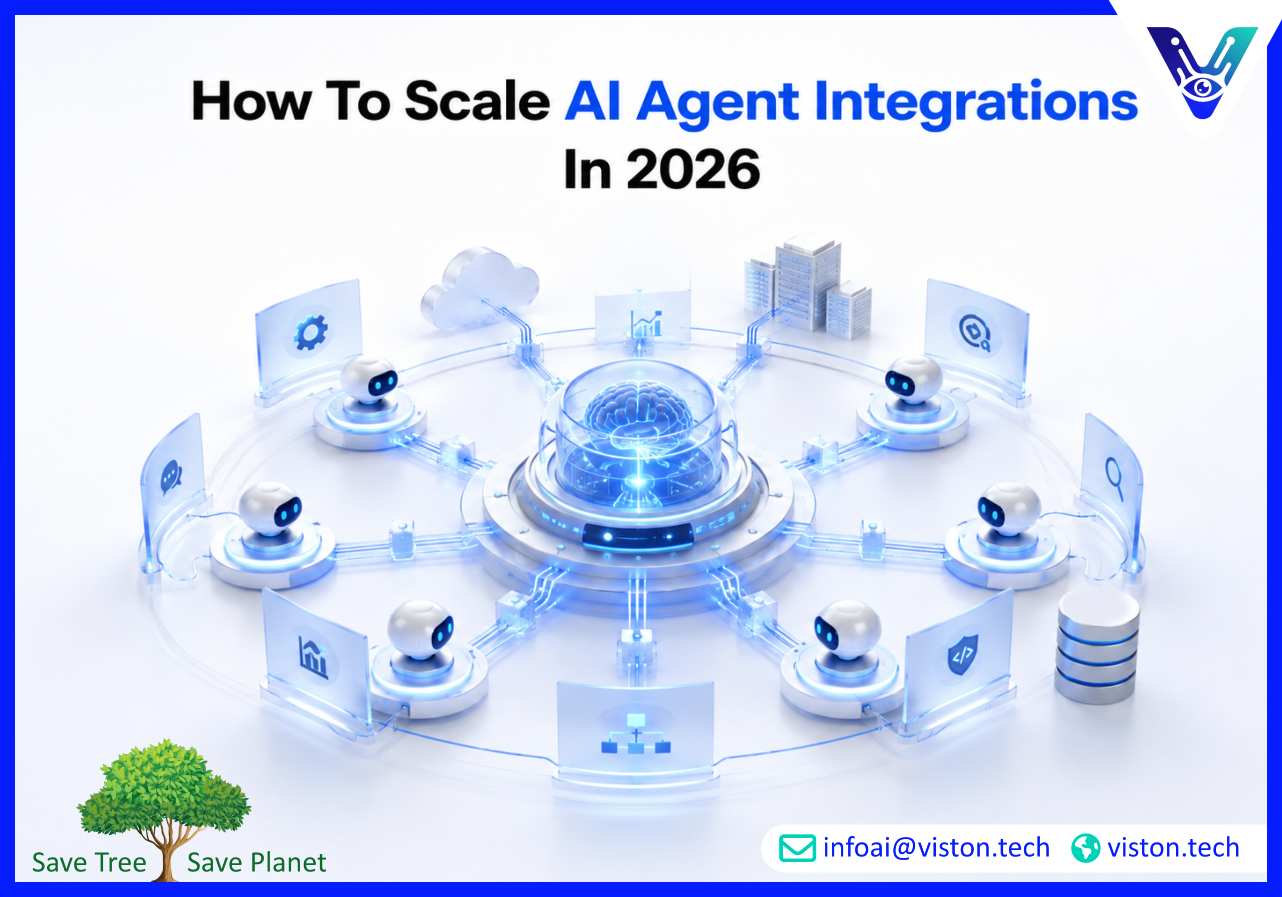
Many businesses successfully deploy their first AI agent but struggle when they attempt to scale across multiple departments, workflows, and systems. Scaling AI agent integrations requires more than adding additional agents. It involves building a reliable integration architecture, governance framework, orchestration strategy, and operational model that can support long-term business growth.
In 2026, organizations are moving beyond pilot projects and proof-of-concepts. AI agents are increasingly being integrated into customer support, sales operations, finance processes, HR workflows, internal knowledge management, and business automation initiatives.
While a single AI agent may deliver value within a specific process, enterprise-wide adoption introduces new challenges. Businesses must ensure agents can access the right systems, maintain context, follow business rules, handle increasing workloads, and operate securely across multiple environments.
Organizations that successfully scale AI agent integrations often achieve:
The challenge is creating a scalable foundation that supports growth without introducing complexity, risk, or performance issues.
Many AI initiatives perform well in controlled environments but encounter difficulties when expanded across the business.
As additional agents are deployed, organizations often discover that integrations have been built inconsistently. Different teams may use separate APIs, data sources, authentication methods, or workflows, creating operational complexity.
AI agents require accurate and current information to perform effectively. Scaling becomes difficult when agents access outdated, duplicated, or disconnected data sources.
Every new integration introduces potential security concerns. Organizations must ensure agents only access approved systems, data, and actions while maintaining compliance requirements.
As multiple agents interact with various business systems, coordination becomes increasingly important. Without orchestration, agents may duplicate tasks, create conflicting outputs, or fail to complete workflows efficiently.
Growing usage volumes can expose bottlenecks in infrastructure, APIs, data pipelines, and workflow automation platforms. Systems that perform adequately at small scale may struggle under enterprise workloads.
Businesses that achieve sustainable growth typically follow a structured approach to AI agent integration rather than expanding organically without governance.
A scalable architecture provides a consistent framework for connecting AI agents with business systems.
This often includes:
A centralized approach reduces maintenance complexity and improves operational visibility.
Each AI agent should have clearly defined responsibilities, permissions, objectives, and workflows.
Specialized agents generally scale more effectively than attempting to create one agent that handles every business function.
Common agent categories include:
Clear role definitions improve maintainability and performance.
As organizations deploy more agents, orchestration becomes essential.
Orchestration frameworks coordinate:
Rather than operating independently, agents work together as part of a structured business process.
Data quality directly impacts AI performance.
Organizations should establish governance policies covering:
Strong governance improves reliability while reducing operational and regulatory risks.
Not every decision should be fully automated.
Businesses should define clear escalation rules for situations involving:
Human-in-the-loop processes help maintain accountability while supporting automation at scale.
Technology selection plays an important role in long-term scalability.
Modern AI agents rely heavily on APIs to interact with business systems. Organizations should prioritize platforms that support reliable API connectivity and future expansion.
Cloud environments provide the flexibility needed to support growing workloads while maintaining performance and availability.
As AI ecosystems expand, monitoring becomes critical. Organizations should track:
Comprehensive monitoring enables proactive optimization and troubleshooting.
Security should be embedded into every integration layer rather than added later. Authentication controls, encryption, role-based permissions, and audit logging should form part of the core architecture.
Scaling efforts should focus on measurable business outcomes rather than simply increasing the number of deployed agents.
Key performance indicators may include:
Organizations that continuously measure performance can identify optimization opportunities and justify further AI investments.
Scaling AI agent integrations requires a combination of integration expertise, workflow design, orchestration planning, governance, and operational strategy. Through its Agent Integration Services, Viston AI helps organizations connect AI agents with existing business systems while creating architectures that support sustainable growth.
This includes designing integration frameworks, implementing secure API connectivity, enabling workflow orchestration, supporting multi-agent environments, and establishing governance processes that align with business objectives. Rather than focusing solely on individual AI agents, the emphasis is placed on building connected ecosystems that deliver measurable operational value.
For organizations expanding AI initiatives across multiple departments, Viston AI’s approach helps address common scaling challenges such as fragmented integrations, workflow complexity, system interoperability, and long-term maintainability. The goal is to ensure AI agents become reliable components of everyday business operations rather than isolated technology projects.
Scaling AI agent integrations involves expanding AI agents across multiple workflows, systems, departments, and business functions while maintaining performance, security, governance, and operational efficiency.
As more agents and systems are added, organizations often face challenges related to workflow coordination, data consistency, security, infrastructure performance, and integration complexity.
Multi-agent orchestration is the process of coordinating multiple AI agents within a structured workflow, ensuring tasks are assigned correctly, information is shared effectively, and business processes are completed reliably.
Data governance is critical because AI agents depend on accurate, secure, and properly managed information. Poor governance can reduce performance and increase operational risk.
Many existing systems can support AI integration through APIs, middleware, and modern integration platforms. However, architecture planning is often necessary to ensure scalability.
Through Agent Integration Services, Viston AI helps businesses design scalable integration architectures, connect AI agents with enterprise systems, implement orchestration strategies, and establish governance frameworks that support long-term growth.
Understanding how to scale AI agent integrations is becoming increasingly important as organizations expand AI adoption across their operations. Success requires more than deploying additional agents. Businesses need structured integration architectures, secure system connectivity, effective orchestration, governance controls, and continuous performance monitoring. Agent Integration Services play a vital role in helping organizations build scalable AI ecosystems that deliver consistent business value. For companies seeking a practical and sustainable approach to growth, Viston AI provides expertise that supports reliable AI agent integration and long-term operational scalability.
