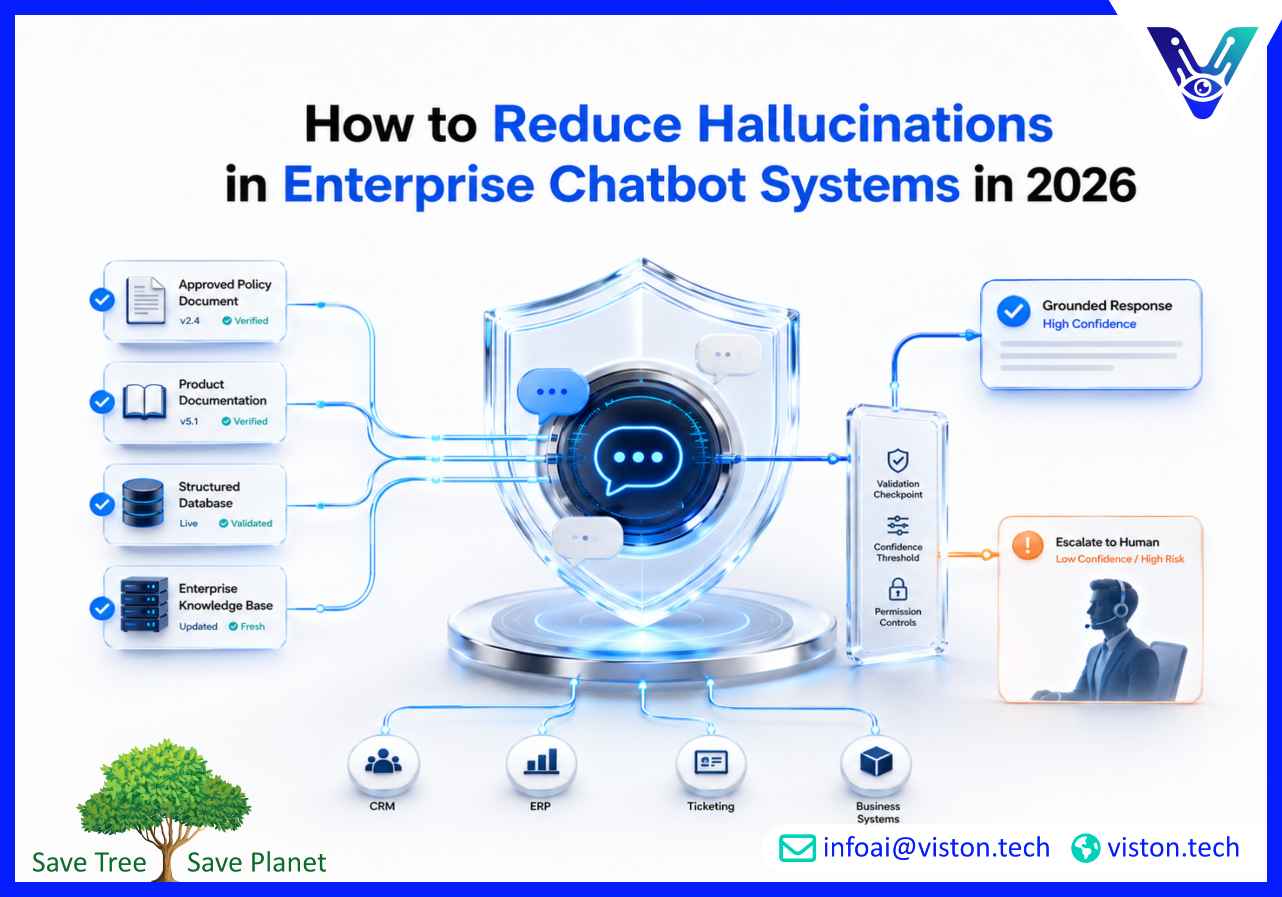
How to Reduce Hallucinations in Enterprise Chatbot Systems in 2026
Knowing how to reduce hallucinations in enterprise chatbot systems is now essential for organizations using AI to support customers, employees, sales teams, and operations. In 2026, chatbot reliability depends on controlled knowledge access, strong governance, testing, integration quality, and clear escalation paths.
What Hallucinations Mean in Enterprise Chatbot Systems
A hallucination happens when an AI chatbot gives an answer that sounds confident but is incorrect, unsupported, outdated, incomplete, or irrelevant to the user’s actual need. In consumer use, this may be inconvenient. In enterprise environments, it can create operational risk, customer frustration, compliance exposure, poor decision-making, and loss of trust.Enterprise AI Chatbots often support complex tasks such as customer service, IT helpdesk automation, HR policy guidance, lead qualification, product support, order tracking, claims assistance, account servicing, and internal knowledge search. These systems may interact with CRM platforms, ERP systems, ticketing tools, document repositories, product databases, and workflow automation tools. When a chatbot fabricates information or misinterprets context, the impact can spread beyond the chat conversation.Hallucinations usually appear in several forms. A chatbot may invent a policy, misquote a product feature, provide an outdated price, summarize a document incorrectly, apply the wrong eligibility rule, or suggest an action that the business does not support. In some cases, the chatbot may retrieve the right document but use the wrong section, creating an answer that appears relevant but does not match the user’s situation.
Why hallucination reduction matters more in 2026
Businesses are no longer treating chatbots as basic FAQ widgets. Enterprise AI Chatbots are expected to support multi-step workflows, multilingual users, personalized answers, real-time data retrieval, and service automation across multiple channels. As chatbot responsibility increases, the tolerance for inaccurate answers becomes lower.Reducing hallucinations is not about making an AI system perfect. It is about designing a controlled, measurable, and business-safe chatbot system that knows when to answer, when to retrieve verified information, when to ask a clarifying question, and when to escalate to a human team.
Why Enterprise Chatbots Hallucinate
Enterprise chatbot hallucinations usually come from a combination of model behavior, weak knowledge management, poor integration design, unclear prompts, insufficient testing, and missing governance. A chatbot may be built on a capable language model, but if the surrounding system is poorly designed, inaccurate answers can still occur.
Uncontrolled knowledge sources
Many hallucination problems begin with unclear source control. If a chatbot has access to outdated PDFs, duplicate knowledge base articles, old product pages, archived policy documents, and unverified internal notes, it may generate answers from conflicting information. Enterprise chatbot systems need defined sources of truth for each business area.For example, customer-facing pricing should come from approved pricing content or a live pricing system, not from old sales decks. HR policy answers should come from current policy repositories, not informal manager notes. Product troubleshooting should come from maintained technical documentation, not unresolved support tickets.
Weak retrieval design
Many enterprise chatbots use retrieval-augmented generation, often called RAG, to pull information from approved documents before generating an answer. RAG can reduce hallucinations, but only when retrieval is accurate. If the chatbot retrieves irrelevant documents, incomplete chunks, or low-quality content, the final answer may still be wrong.Retrieval quality depends on document structure, metadata, chunking strategy, embeddings, indexing, ranking, query rewriting, access permissions, and source freshness. A chatbot that retrieves “similar” content is not always retrieving the “correct” content. Enterprise teams must test retrieval accuracy separately from answer quality.
Prompts that encourage over-answering
Some chatbots hallucinate because their instructions push them to be overly helpful. If the system prompt says the bot should always answer, the chatbot may fill gaps with assumptions. Enterprise prompts should instead define safe behavior: answer only from approved sources, disclose uncertainty, ask clarifying questions, avoid unsupported claims, and escalate when confidence is low.
Insufficient business context
Enterprise users rarely ask questions in perfect language. They use abbreviations, product nicknames, internal terms, incomplete sentences, and industry-specific references. Without proper intent mapping and entity recognition, the chatbot may misunderstand the request and generate an answer for the wrong scenario.For example, “reset my access” may mean password reset, MFA reset, system role restoration, customer portal access, or employee account reactivation. A reliable chatbot should identify the missing context before answering or triggering a workflow.
Excessive automation permissions
Hallucinations become more dangerous when the chatbot can take action without validation. If a chatbot can create tickets, update CRM records, change account settings, send emails, issue refunds, approve requests, or trigger backend workflows, inaccurate reasoning can lead to real operational damage. Enterprise systems need permission boundaries, approval rules, and action-level validation.
Practical Ways to Reduce Hallucinations in Enterprise Chatbot Systems
The most effective way to reduce hallucinations in enterprise chatbot systems is to design reliability into the full architecture, not only the language model. A strong enterprise chatbot combines trusted knowledge, retrieval controls, prompt discipline, system integration, evaluation, monitoring, and human oversight.
Build a verified knowledge foundation
The chatbot should use approved, current, and well-structured knowledge sources. This includes help center articles, product documentation, policy manuals, SOPs, CRM fields, ticket resolution notes, service catalogs, and compliance-approved answer libraries. Before connecting content to a chatbot, teams should remove outdated pages, duplicates, contradictions, and informal content that was never meant for automated use.Each knowledge source should have an owner, update schedule, version history, and approval process. This matters because many hallucinations are not caused by the AI model itself. They are caused by poor business knowledge hygiene.
Use retrieval-augmented generation with source constraints
RAG helps reduce hallucinations by grounding chatbot answers in retrieved enterprise content. However, the chatbot should not simply retrieve any similar document. It should retrieve from approved collections based on user role, topic, region, customer type, product line, and use case.Good retrieval design includes metadata filters, source ranking, document freshness checks, permission-aware search, and fallback behavior when evidence is weak. The chatbot should be instructed to answer only when retrieved content supports the response. If the available source does not answer the question, the system should say so clearly or route the query to the right team.
Create answer policies for uncertainty
Enterprise chatbots should have clear response rules for uncertain situations. These rules may include:
Ask a clarifying question when the user’s request is ambiguous.
Do not invent policy, pricing, legal, medical, financial, or technical details.
Use approved source content for regulated or high-impact answers.
Escalate when confidence is low or when the user disputes an answer.
Show the relevant next step instead of guessing.
This approach improves trust because users receive fewer confident wrong answers. In enterprise service environments, a well-timed clarification is often better than a fast but unsupported response.
Separate conversational responses from business actions
A chatbot may be allowed to explain information, but action execution should require additional validation. For example, the chatbot can help a user understand a refund policy, but refund approval should depend on verified order data, eligibility rules, role permissions, and workflow confirmation.Action safety is especially important for enterprise AI Chatbots connected to CRM, ERP, billing, HRIS, ticketing, or customer account systems. The bot should confirm key details before taking action, log the transaction, and apply business rules outside the language model wherever possible.
Use structured workflows for high-risk tasks
Free-form AI responses are useful for general guidance, but high-risk enterprise tasks should use structured flows. These flows can include decision trees, required fields, validation checks, API lookups, approval steps, and escalation rules. This reduces reliance on open-ended generation.For example, an IT helpdesk chatbot should not freely invent troubleshooting steps for a security-sensitive issue. It should follow approved diagnostic flows, check device or identity context where permitted, and escalate when the issue involves privileged access, suspicious activity, or repeated authentication failure.
Limit the chatbot’s scope
A chatbot that tries to answer everything is more likely to hallucinate. Enterprises should define the bot’s supported intents, excluded topics, escalation conditions, and approved knowledge domains. Scope control helps teams improve accuracy faster because they can test a clear set of tasks rather than an unlimited range of questions.As the chatbot matures, scope can expand. The safest path is to begin with high-volume, low-risk use cases, then move into more complex workflows after evaluation, monitoring, and governance processes are stable.
Testing, Monitoring, and Governance for Hallucination Control
Hallucination reduction is not a one-time launch task. Enterprise chatbot systems need continuous evaluation because content changes, user behavior changes, products change, regulations change, and new failure patterns appear after deployment.
Test answers before launch
Pre-launch testing should include real user questions, edge cases, ambiguous prompts, adversarial inputs, multilingual queries, incomplete requests, and regulated scenarios. Teams should test whether the chatbot answers correctly, refuses appropriately, asks clarifying questions, retrieves the right sources, and escalates when needed.Testing should not focus only on whether the chatbot sounds natural. A fluent answer can still be wrong. Enterprise evaluation should score factual accuracy, source relevance, completeness, tone, policy alignment, workflow success, and safe handoff quality.
Measure hallucination-related KPIs
Businesses should track chatbot reliability through specific performance indicators. Useful KPIs include unsupported answer rate, fallback rate, retrieval precision, escalation rate, user correction rate, answer rejection rate, repeated contact rate, source coverage, and human review findings.These metrics help identify whether hallucinations are caused by missing content, poor retrieval, weak prompts, integration errors, or unclear user intent. A strong monitoring dashboard should connect chatbot conversations to ticket outcomes, CRM records, customer satisfaction, and workflow completion data.
Review failed and disputed conversations
Failed conversations are valuable training signals. Teams should regularly review cases where users abandoned the chat, clicked negative feedback, corrected the bot, asked for a human, repeated the same question, or received inconsistent answers. These reviews often reveal missing intents, outdated content, unclear policies, or retrieval gaps.Conversation review should involve both technical teams and business owners. Engineers can improve retrieval and system behavior, while subject matter experts can correct policy, product, compliance, or process content.
Apply human-in-the-loop controls
Human oversight is critical for sensitive workflows. Enterprise chatbots should route high-impact topics to trained agents, managers, compliance teams, or subject matter experts. In some cases, the chatbot can prepare a summary or recommendation, but the final decision should remain with an authorized person.This is especially important for regulated industries, legal requests, financial decisions, healthcare guidance, security incidents, employee relations, contractual questions, and customer complaints. The chatbot should support humans with context, not replace judgment where risk is high.
Maintain AI governance and auditability
Reliable chatbot systems need governance. This includes role-based access control, data retention rules, audit logs, prompt versioning, model change records, content approval workflows, incident response processes, and regular risk reviews. Governance makes hallucination control measurable and accountable.In 2026, enterprise buyers increasingly expect AI systems to align with responsible AI practices, security expectations, privacy controls, and operational transparency. A chatbot that cannot explain where its answers came from or how failures are reviewed will be difficult to trust at scale.
How Viston AI Helps Businesses Reduce Hallucinations in Enterprise AI Chatbots
Viston AI is relevant to this topic because reducing hallucinations in enterprise chatbot systems requires more than a chat interface. It requires strong AI chatbot architecture, enterprise knowledge integration, natural language understanding, workflow automation, security controls, and ongoing optimization. Viston AI’s Enterprise AI Chatbots service is aligned with these needs through capabilities such as contextual dialogue design, business system integration, real-time knowledge integration, multilingual support, enterprise security, and AI chatbot development for complex business environments.For organizations deploying Enterprise AI Chatbots, this matters because hallucination control depends on how the chatbot accesses trusted data, interprets user intent, handles uncertainty, and connects to operational systems. A chatbot that is integrated with CRM, knowledge bases, transactional systems, and support workflows can provide more grounded answers than a standalone chatbot trained on disconnected content.Viston AI also provides related services such as AI chatbot integration, NLP and text analysis, AI strategy development, automation workflows, MLOps and model monitoring, and multilingual AI chatbot support. These capabilities support a practical hallucination reduction strategy: define the right use cases, connect verified knowledge sources, design safe workflows, monitor performance, and continuously improve the chatbot based on real user interactions.For enterprises that need scalable chatbot systems across customer support, sales operations, internal helpdesk, ecommerce, finance, healthcare, manufacturing, or service teams, Viston AI can help structure chatbot delivery around reliability, usability, integration quality, and measurable business outcomes.
Frequently Asked Questions
What is the best way to reduce hallucinations in enterprise chatbot systems?
The best approach is to combine verified knowledge sources, retrieval-augmented generation, strict answer rules, confidence thresholds, structured workflows, human escalation, and continuous monitoring. Hallucination reduction should be handled as a system design and governance challenge, not only a model selection issue.
Can RAG completely stop chatbot hallucinations?
No. RAG can reduce hallucinations by grounding responses in approved knowledge, but it does not guarantee accuracy by itself. Retrieval quality, document structure, source freshness, permissions, prompts, and evaluation all affect the final answer. A poorly configured RAG system can still produce incorrect responses.
Should enterprise chatbots always cite sources?
For internal knowledge search, policy guidance, regulated workflows, technical support, and compliance-sensitive answers, source visibility is highly useful. Showing source references helps users and reviewers verify where an answer came from. For simple transactional updates, source citations may be less important than verified system data and clear workflow confirmation.
How do confidence thresholds help reduce hallucinations?
Confidence thresholds help decide when the chatbot should answer, ask a clarifying question, retrieve more information, or escalate to a human. They prevent the chatbot from responding confidently when the system does not have enough reliable evidence to support the answer.
How often should chatbot hallucinations be reviewed?
During launch and early rollout, failed or disputed conversations should be reviewed frequently. After the system stabilizes, businesses should continue monthly performance reviews and periodic audits. Reviews should increase whenever products, policies, pricing, regulations, or major workflows change.
Can Viston AI help reduce hallucinations in enterprise chatbot projects?
Yes. Viston AI’s Enterprise AI Chatbots service is relevant to hallucination reduction because it supports chatbot development, enterprise knowledge integration, NLP, workflow automation, system integration, multilingual support, and ongoing optimization for business-focused chatbot deployments.
Conclusion
Learning how to reduce hallucinations in enterprise chatbot systems is essential for building trustworthy Enterprise AI Chatbots in 2026. The most reliable systems are grounded in approved knowledge, connected to business systems, tested against real scenarios, monitored after launch, and governed with clear escalation rules. Businesses should avoid treating hallucination control as a single feature. It is a delivery discipline that includes data quality, retrieval design, prompt control, workflow safety, human oversight, and continuous improvement. With the right architecture and implementation partner, enterprise chatbots can become accurate, scalable, and practical tools for customer and employee support.