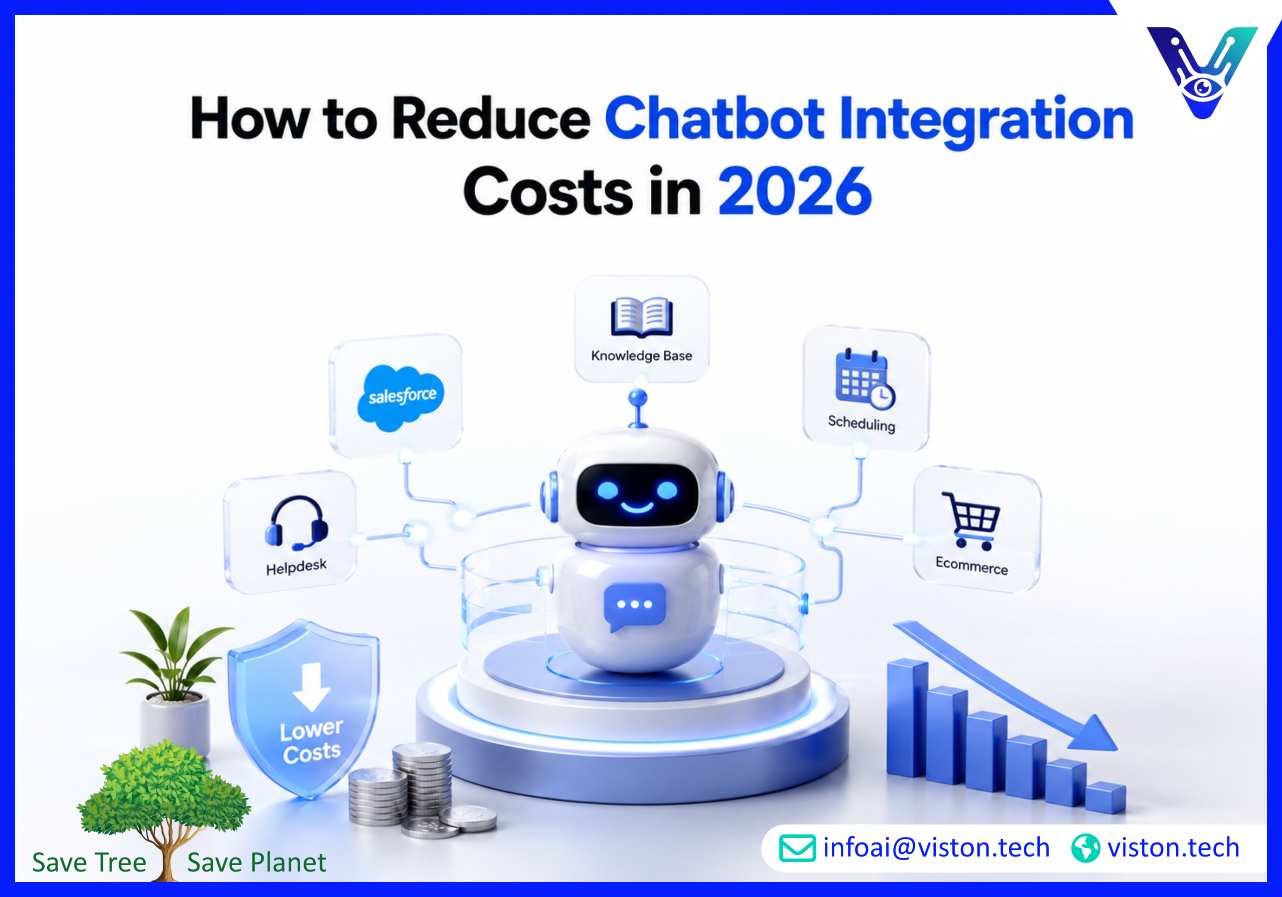
Businesses across industries are investing in AI chatbot integration to improve customer service, automate workflows, and increase operational efficiency. However, integration costs can quickly escalate when projects lack planning, involve unnecessary customizations, or require extensive system modifications. Understanding how to reduce chatbot integration costs without sacrificing performance is essential for organizations seeking sustainable AI adoption in 2026.
What Drives Chatbot Integration Costs?
Before reducing costs, businesses must understand where chatbot integration expenses originate. Chatbot implementation involves far more than deploying a conversational interface.Common cost drivers include:
Custom development requirements
Complex API integrations
CRM and ERP connectivity
Data migration and preparation
Security and compliance implementation
Conversation design and testing
Third-party software licensing
Ongoing maintenance and optimization
Multi-channel deployment requirements
Many organizations overspend because they attempt to build highly complex chatbot ecosystems before validating actual business needs.
Start with Clearly Defined Business Objectives
One of the most effective ways to reduce chatbot integration costs is to avoid unnecessary functionality during the initial deployment.Businesses should identify:
The primary problem the chatbot will solve
The users who will interact with it
The systems it must access
The measurable outcomes expected
For example, if the goal is customer support automation, integrating dozens of internal systems may not be necessary initially. Focusing on core support workflows helps reduce development time, integration complexity, and project costs.A phased implementation strategy often delivers faster ROI while minimizing upfront investment.
Prioritize High-Impact Integrations First
Many chatbot projects become expensive because businesses attempt to connect every platform simultaneously.Instead, prioritize integrations that generate the greatest operational value.
High-Priority Integrations
Customer Relationship Management (CRM) systems
Helpdesk platforms
Knowledge bases
Appointment scheduling tools
Order tracking systems
Lower-Priority Integrations
Advanced analytics platforms
Internal departmental systems
Legacy databases with limited usage
Custom reporting environments
By focusing on the most valuable integrations first, businesses can reduce initial project scope while still delivering meaningful results.
Choose Integration-Friendly Platforms
The choice of chatbot platform significantly affects overall integration costs.Modern AI chatbot platforms often provide:
Prebuilt API connectors
CRM integrations
Ecommerce integrations
Helpdesk integrations
Workflow automation tools
Low-code deployment options
Using platforms that support native integrations can eliminate large portions of custom development work and accelerate deployment timelines.Organizations should evaluate integration capabilities before selecting a chatbot solution rather than treating integrations as an afterthought.
Reduce Custom Development Wherever Possible
Custom development remains one of the largest contributors to chatbot integration expenses.While some customization may be necessary, businesses can often reduce costs by:
Using standardized workflows
Leveraging existing APIs
Utilizing built-in automation features
Adopting preconfigured templates
Implementing common conversation patterns
Custom development should focus only on requirements that create genuine business value or competitive differentiation.Every custom feature increases implementation costs, testing requirements, maintenance overhead, and future upgrade complexity.
Improve Data Readiness Before Integration
Poor data quality frequently causes integration projects to exceed budgets.Before implementing chatbot integrations, businesses should assess:
Data consistency
Database structure
Knowledge base quality
Customer information accuracy
API documentation completeness
Well-organized data reduces development effort and improves chatbot performance from the start.Organizations that invest in data preparation often experience faster deployments and fewer post-launch issues.
Adopt a Phased Integration Strategy
Large-scale chatbot deployments can create significant financial risk when implemented all at once.A phased rollout approach helps organizations control costs while validating business value.
Phase 1
Website chatbot deployment
Knowledge base integration
Basic support automation
Phase 2
CRM integration
Lead qualification workflows
Customer personalization
Phase 3
Omnichannel deployment
Advanced workflow automation
Enterprise system integration
This approach spreads costs over time and allows businesses to make informed investment decisions based on real performance data.
Focus on Automation Opportunities with Measurable ROI
Not every chatbot capability produces the same business value.Organizations should prioritize automation opportunities that deliver measurable returns, such as:
Frequently asked question handling
Customer onboarding assistance
Lead capture and qualification
Appointment booking
Order status inquiries
Password reset workflows
Automating repetitive, high-volume interactions typically generates the fastest cost savings and justifies future expansion.A ROI-focused integration strategy helps businesses allocate budgets more effectively.
Build Security and Compliance into the Initial Design
Many organizations underestimate the costs associated with retrofitting security controls after deployment.In 2026, businesses must address:
Data privacy requirements
Access controls
Authentication mechanisms
Encryption standards
Audit logging
AI governance policies
Implementing these requirements during the planning phase is typically far less expensive than making major architectural changes later.Proactive compliance planning also helps reduce operational and regulatory risks.
How Viston AI Helps Businesses Optimize Chatbot Integration Costs
Reducing chatbot integration costs requires balancing technical efficiency with business objectives. Viston AI specializes in AI Chatbot Integration solutions that help organizations implement practical, scalable chatbot ecosystems without unnecessary complexity.Successful integrations depend on selecting the right architecture, identifying high-value use cases, connecting essential business systems, and avoiding costly overengineering. Viston AI focuses on helping businesses integrate conversational AI with CRM platforms, customer support tools, knowledge bases, communication channels, and operational workflows while maintaining scalability and performance.Rather than treating chatbot deployment as a standalone technology project, Viston AI emphasizes integration strategies that align with measurable business outcomes. This approach helps organizations control implementation costs, improve operational efficiency, and create sustainable foundations for future automation initiatives.As AI adoption continues to expand across industries, businesses that implement structured, cost-conscious integration strategies are better positioned to maximize long-term value from their chatbot investments.
Frequently Asked Questions
What is the biggest factor affecting chatbot integration costs?
Custom development, complex system integrations, and poor project planning are often the largest contributors to chatbot integration expenses.
Can small businesses reduce chatbot integration costs?
Yes. Small businesses can lower costs by starting with limited use cases, using prebuilt integrations, and adopting phased deployment strategies.
Do API integrations increase chatbot implementation costs?
API integrations can increase costs, but they often provide significant long-term value through automation, personalization, and improved operational efficiency.
How can businesses avoid unnecessary chatbot integration expenses?
Organizations should define clear objectives, prioritize essential integrations, reduce custom development, and focus on automation opportunities with measurable ROI.
Can Viston AI help reduce chatbot integration costs?
Yes. Viston AI helps businesses develop practical AI Chatbot Integration strategies that focus on business value, scalable architecture, and efficient system connectivity while avoiding unnecessary complexity.
Conclusion
Understanding how to reduce chatbot integration costs is essential for organizations seeking efficient and sustainable AI adoption in 2026. Successful projects focus on clear business goals, phased implementation, integration prioritization, data readiness, and scalable architecture. By avoiding unnecessary customization and concentrating on high-impact automation opportunities, businesses can achieve strong returns on their AI investments. When supported by a structured AI Chatbot Integration strategy, organizations can improve customer experiences, streamline operations, and control implementation costs. For businesses seeking expert guidance, Viston AI offers specialized support in building practical and cost-effective chatbot integration solutions.