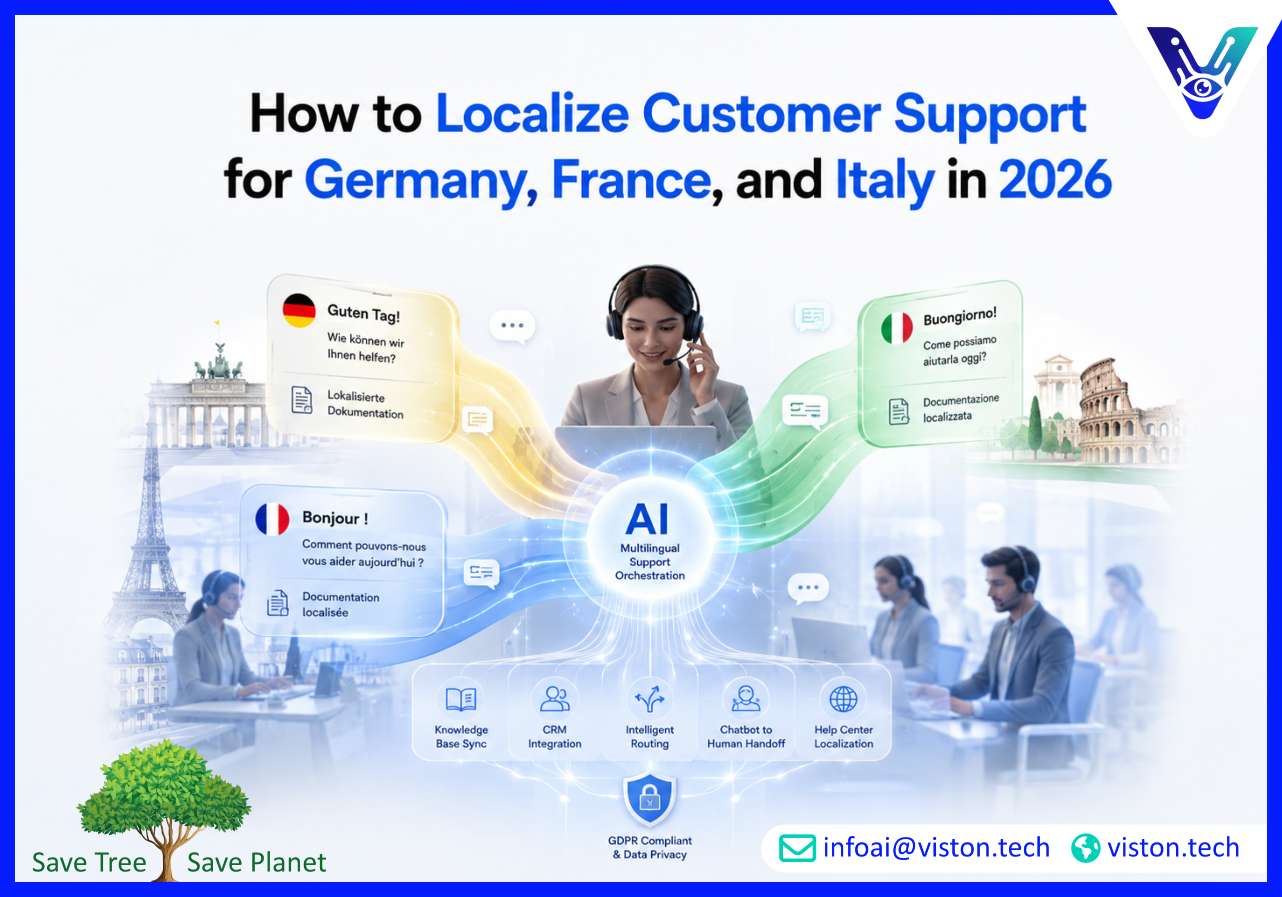
How to Localize Customer Support for Germany, France, and Italy in 2026
Learning how to localize support for Germany, France, and Italy requires more than translating English responses. Businesses need country-specific terminology, communication styles, knowledge content, escalation workflows, compliance controls, and quality measurement that make each customer experience feel locally designed.
What Localized Support Means Across Germany, France, and Italy
Localized customer support adapts the complete service experience to the language, expectations, and operating requirements of a market. Translation is part of the process, but it is not the final outcome.A translated response may be grammatically correct while still using the wrong tone, product terminology, date format, return instructions, legal wording, or level of formality. Effective multilingual support ensures customers can understand information, complete tasks, resolve problems, and reach a qualified person without language becoming an obstacle.For Germany, France, and Italy, localization should cover every important point in the support journey:
Website chat, email, helpdesk, social messaging, and telephone support
Help-centre articles, troubleshooting guides, and onboarding content
Order, subscription, payment, delivery, refund, and cancellation messages
Chatbot prompts, menus, fallback responses, and escalation notices
Customer-facing forms, confirmation messages, and automated notifications
Agent workspaces, translated conversation summaries, and internal routing rules
Businesses should first create one approved source of truth for policies and product information. Localized content can then be developed from that source rather than translating inconsistent answers from different departments.
Localize complete customer journeys, not isolated messages
A customer who starts a conversation in German should not be transferred to an English-only form. A French customer should not receive a translated chatbot answer followed by untranslated refund instructions. An Italian customer should not need to repeat account information after escalation because the human agent cannot access the earlier conversation.Map common journeys from beginning to end, including product discovery, onboarding, account access, billing, technical assistance, complaints, returns, and cancellation. Identify where language changes, missing translations, or disconnected systems create friction.The objective is consistency. Customers should receive the same policy outcome and service quality in all three markets, while the wording and interaction style remain appropriate for each country.
How Support Expectations Differ in Germany, France, and Italy
German, French, and Italian customers should not be treated as one interchangeable European audience. Each market requires native-language testing and country-specific decisions about tone, terminology, channels, and escalation.
Localizing customer support for Germany
German-language support generally benefits from direct, precise, and well-structured communication. Customers often expect clear steps, accurate technical detail, transparent conditions, and dependable follow-through.Use consistent German terminology across the website, chatbot, product interface, invoices, documentation, and support replies. Avoid switching between translated and English product terms unless the English term is an established part of the product vocabulary.Technical and B2B support should provide practical detail rather than vague reassurance. When a problem cannot be solved immediately, explain what has been identified, what action will happen next, who owns the case, and when the customer should expect an update.German localization should also account for formal and informal address. The use of “Sie” or “du” must match the brand, audience, and context. A business platform serving enterprise procurement teams may require a more formal style than a consumer lifestyle application.
Localizing customer support for France
French support content should sound naturally written in French rather than translated sentence by sentence. Particular attention should be paid to product names, subscription conditions, pricing explanations, cancellation procedures, warranty information, and customer rights.France places strong practical importance on understandable consumer information. Businesses selling online should ensure commercial conditions, prices, returns, guarantees, and dispute procedures are presented clearly and consistently. EU consumer rules also require understandable contract information and transparency about important costs and conditions.French customers should be able to complete important support actions in French, not merely ask an initial question. Localize forms, knowledge articles, automated emails, ticket updates, and escalation messages. Review translated legal or contractual wording with appropriately qualified specialists rather than relying only on general machine translation.A courteous, professional tone is usually appropriate. Agents and automated systems should avoid literal translations of English expressions that may sound unnatural, overly casual, or imprecise in French.
Localizing customer support for Italy
Italian-language support should combine clarity with a natural and approachable conversational style. Customers may use more descriptive messages than the short keyword-based queries found in an English knowledge base, so intent recognition must be tested with realistic Italian phrasing.Localize payment, invoicing, delivery, returns, appointment, and subscription terminology carefully. Regional expressions and different ways of describing the same problem may affect chatbot understanding and ticket categorization.Support teams should also ensure that translated messages preserve the customer’s emotional context. A complaint, urgent delivery problem, or account-access issue may require a different response from a routine information request. Sentiment detection can assist with prioritization, but human escalation rules should remain available for sensitive or high-value cases.Testing should involve native Italian reviewers who can identify unnatural wording, ambiguous instructions, and terminology that is technically correct but rarely used by customers.
How to Build a Multilingual Support Operating Model
The most reliable approach is a phased operating model that combines localized self-service, multilingual automation, trained agents, and controlled escalation. Businesses do not need identical staffing structures in all three countries, but they do need defined service levels and ownership.
Prioritize support use cases by volume and risk
Review historical tickets, website searches, sales enquiries, chatbot fallbacks, refunds, and customer locations. Identify the most common requests from Germany, France, and Italy.Suitable early localization priorities may include:
Account access and password recovery
Order or delivery status
Product and service information
Subscription and billing questions
Appointment scheduling
Basic troubleshooting
Return and cancellation processes
Automate predictable, well-documented requests first. Complaints, legal enquiries, unusual refunds, security incidents, negotiations, and complex technical problems should have clear human-review routes.
Create country-specific knowledge layers
Maintain a shared core knowledge base for facts that apply everywhere, such as product functionality and standard troubleshooting. Add separate market layers for local prices, taxes, delivery partners, operating hours, payment methods, policies, legal wording, and escalation contacts.Assign an owner to every important article or policy. Record when it was approved, which markets it applies to, and when it must be reviewed. When the source content changes, the German, French, and Italian versions should enter an update workflow automatically.A terminology glossary is equally important. It should define approved translations for product features, technical concepts, plan names, error messages, contractual terms, and internal categories. This reduces inconsistencies between translators, chatbots, agents, and marketing teams.
Design language-aware routing and escalation
Detect the customer’s language without forcing repeated selection, but always allow the customer to change it. Route conversations using language, intent, urgency, customer value, product, and case complexity.When no fluent agent is available, an agent-assist system can translate the customer’s message and draft a response. The agent should still see the original text, relevant account information, retrieved knowledge, and any uncertainty warnings.Human handovers should include the original conversation, a translated summary, detected intent, customer details, completed troubleshooting, and the reason for escalation. Customers should not need to restart the case after moving from automation to an agent.
Implementation, Compliance, and Performance Requirements for 2026
Multilingual support systems operating in Germany, France, and Italy may process names, contact details, order information, account records, payment-related data, and conversation histories. These workflows should follow GDPR principles such as lawful processing, data minimization, purpose limitation, appropriate security, retention control, and transparent customer information.
Prepare AI support channels for transparency requirements
From 2 August 2026, relevant EU AI Act transparency provisions require people interacting directly with certain AI systems to be informed that they are communicating with AI, subject to applicable exceptions. Businesses using customer-facing chatbots should make this disclosure clear in German, French, and Italian and provide an understandable path to human assistance.Transparency should not be limited to a small footer. Customers need to understand when an answer is automated, when personal information is being used, what the chatbot can do, and how to request a person.
Include accessibility in localization
Accessible support should work with keyboards, screen readers, text resizing, clear focus states, readable contrast, and understandable error messages. The European Accessibility Act covers several important products and services, including ecommerce, banking, electronic communications, and passenger transport services.Language localization and accessibility should be tested together. A correctly translated chatbot is still difficult to use if its buttons are not labelled, its messages disappear too quickly, or its support flow cannot be completed without a mouse.
Measure quality separately by country and language
Do not combine German, French, and Italian performance into one multilingual average. Strong results in one language can hide serious problems in another.Track metrics such as:
First-response and resolution time by language
First-contact and self-service resolution rates
Chatbot fallback and misunderstanding rates
Customer satisfaction by market and support channel
Escalation volume and handover quality
Translation corrections and terminology errors
Repeat-contact and abandonment rates
Workflow completion and CRM update accuracy
Review native-language conversation samples regularly. Automated scores may identify unusual patterns, but fluent reviewers are needed to evaluate tone, cultural appropriateness, accuracy, and whether the response genuinely solved the customer’s problem.
How Viston AI Supports Localized Customer Service in European Markets
Viston AI provides Multilingual AI Chatbot Support for organizations that need to manage customer interactions across different languages, channels, knowledge sources, and business systems. Its published capabilities include multilingual intent recognition, translation and localization, omnichannel deployment, intelligent routing, performance analytics, and integrations with CRM, knowledge-base, ticketing, and operational platforms.These capabilities are relevant to businesses expanding into Germany, France, and Italy because localized support must connect language quality with real customer workflows. A useful multilingual assistant should be able to retrieve approved country-specific information, identify the customer’s intent, access permitted account context, complete suitable tasks, and escalate complex cases with a clear summary.A phased deployment can begin with German, French, and Italian versions of priority support journeys before extending to additional channels and use cases. Language-specific analytics can then reveal where customers abandon conversations, where the chatbot lacks knowledge, and which cases require better routing or human review.Viston AI’s integration-focused approach can support businesses that want multilingual automation to work alongside existing agents rather than operate as an isolated translation tool. This provides a practical foundation for improving response availability, maintaining consistent knowledge, and scaling European customer service while retaining oversight of quality, privacy, and escalation.
Frequently Asked Questions
Should I launch German, French, and Italian support at the same time?
Not necessarily. Prioritize markets using customer demand, revenue potential, ticket volume, operational readiness, and available knowledge. A phased launch allows the business to test quality before expanding coverage.
Can machine translation handle all customer support conversations?
Machine translation can support routine and well-defined conversations, but sensitive complaints, legal matters, unusual refunds, security issues, and complex technical cases need stronger human oversight and native-language review.
Do I need native-speaking agents for all three countries?
Not for every interaction. Localized self-service, multilingual chatbots, translated agent workspaces, and centralized teams can handle many requests. Native or fluent specialists remain important for quality assurance and complex cases.
How should I test localized support before launch?
Test complete journeys using native German, French, and Italian speakers. Include slang, spelling errors, long questions, ambiguous requests, complaints, unsupported intents, accessibility scenarios, and human handovers.
What content should be localized first?
Start with high-traffic help articles, onboarding instructions, account access, billing, delivery, returns, cancellations, troubleshooting, chatbot messages, and escalation notices. Prioritize content linked to frequent or high-risk customer requests.
Can Viston AI integrate multilingual support with existing systems?
Viston AI publishes multilingual chatbot and business-system integration capabilities covering CRM platforms, ticketing tools, knowledge bases, customer data, and operational workflows. Integration scope should be defined around each organization’s systems and data requirements.
Conclusion
Knowing how to localize support for Germany, France, and Italy means designing three dependable customer experiences rather than translating one English process. Businesses should localize complete journeys, maintain country-specific knowledge, test with native speakers, integrate support channels with operational systems, and measure quality separately in each language. Multilingual Support can then improve accessibility and service capacity without weakening accuracy or human oversight. Viston AI offers relevant multilingual chatbot, integration, routing, and analytics capabilities for organizations developing a scalable support model across these European markets.