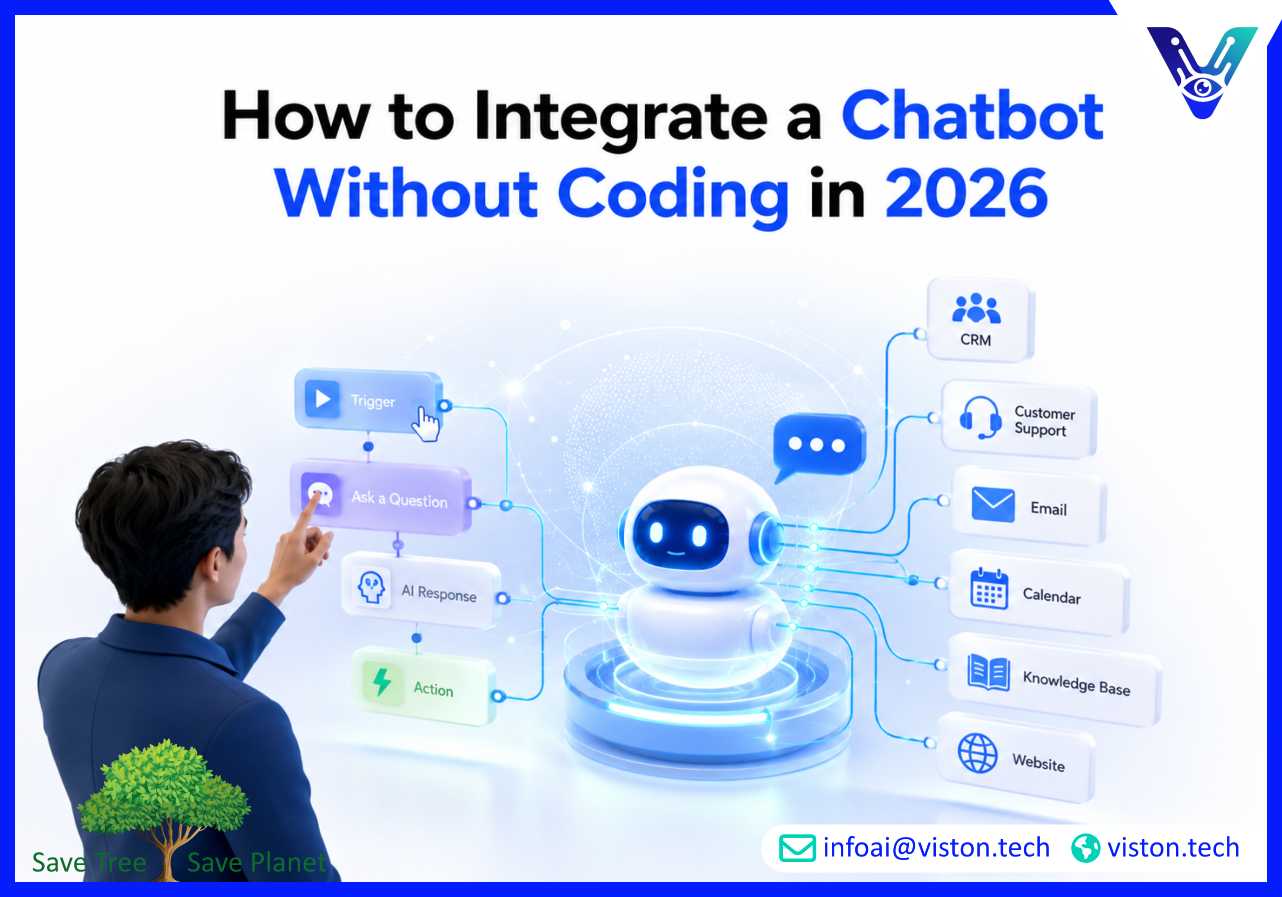
Businesses today are under constant pressure to provide faster customer support, improve lead generation, and deliver personalized experiences across multiple channels. The good news is that chatbot implementation is no longer limited to development teams. With modern no-code platforms and AI-powered automation tools, organizations can integrate a chatbot without writing a single line of code while still achieving meaningful business outcomes.
What Does It Mean to Integrate a Chatbot Without Coding?
No-code chatbot integration allows businesses to deploy conversational AI solutions using visual interfaces, drag-and-drop builders, pre-built templates, and ready-made integrations. Instead of relying on developers to build complex workflows, business teams can configure chatbot functionality through intuitive platforms.Modern AI chatbot integration solutions typically support:
Website chatbot deployment
CRM integration
Customer support automation
Lead qualification workflows
Knowledge base integration
Social media messaging channels
Email and ticketing system connectivity
Analytics and reporting dashboards
This approach significantly reduces implementation timelines while enabling organizations to benefit from AI-powered customer interactions.
Why No-Code Chatbot Integration Matters in 2026
Customer expectations continue to rise. Businesses are expected to provide instant responses regardless of time zone, channel, or support volume. At the same time, hiring large support teams is becoming increasingly expensive.No-code chatbot integration helps address several common business challenges:
Faster Deployment
Traditional chatbot development projects can take weeks or months. No-code platforms often allow businesses to launch a chatbot within days.
Reduced Technical Dependency
Marketing, customer service, sales, and operations teams can manage chatbot workflows without waiting for development resources.
Lower Implementation Costs
Businesses avoid large custom development expenses while still benefiting from AI-driven automation.
Improved Customer Experience
Modern AI chatbots can answer frequently asked questions, guide users through processes, and provide personalized responses around the clock.
Scalability
As customer inquiries increase, chatbots can handle larger volumes without requiring proportional increases in staffing.
Step-by-Step Process to Integrate a Chatbot Without Coding
Successful chatbot integration involves more than simply installing a widget on a website. Businesses should follow a structured approach to maximize results.
Define Business Objectives
Before selecting a chatbot platform, identify the outcomes you want to achieve.
Reduce support tickets
Generate more qualified leads
Improve customer engagement
Automate appointment scheduling
Provide multilingual customer support
Increase conversion rates
Clear objectives help determine chatbot features, integrations, and success metrics.
Select a No-Code Chatbot Platform
Modern chatbot platforms offer visual workflow builders and AI-powered conversation engines.When evaluating solutions, consider:
Ease of use
AI capabilities
Integration options
Security standards
Analytics features
Scalability requirements
Customer support availability
Connect Existing Business Systems
Most no-code chatbot platforms provide connectors for commonly used business applications.Popular integrations include:
CRM platforms
Helpdesk software
Email marketing tools
Ecommerce platforms
Knowledge management systems
Calendar applications
Customer data platforms
These integrations allow the chatbot to access relevant information and automate business processes.
Build Conversation Flows
Using visual workflow builders, teams can create customer journeys that guide users toward desired outcomes.Examples include:
Lead capture flows
Product recommendation journeys
Customer onboarding processes
Support request routing
Appointment booking workflows
FAQ automation
Many platforms now include AI assistants that help generate conversation flows automatically.
Train the AI Knowledge Base
Modern chatbots can learn from:
Website content
Help center articles
Product documentation
Internal knowledge bases
Frequently asked questions
Customer support resources
This enables the chatbot to provide more accurate and contextually relevant responses.
Test Before Launch
Testing helps identify gaps in conversation design and integration workflows.Evaluate:
Response accuracy
User experience
Fallback handling
Lead capture functionality
Integration performance
Escalation workflows
Thorough testing reduces customer frustration and improves adoption rates.
Common Challenges and How to Avoid Them
Even no-code chatbot implementations can encounter obstacles if not properly planned.
Overcomplicated Conversation Design
Many businesses attempt to automate every possible scenario immediately. Starting with high-volume, repetitive interactions often produces better results.
Insufficient Knowledge Sources
A chatbot can only provide useful answers when supported by accurate and comprehensive information.
Poor Human Handoff Processes
Not every inquiry should be handled by automation. Effective escalation paths ensure customers can reach human agents when necessary.
Ignoring Analytics
Chatbot performance should be monitored continuously. Conversation drop-offs, unresolved questions, and engagement metrics provide valuable optimization opportunities.
Security and Compliance Oversights
Businesses handling customer information should ensure chatbot platforms support appropriate security controls, access management, and data protection requirements.
Best Practices for Successful AI Chatbot Integration
Organizations that achieve the strongest chatbot outcomes typically follow several best practices.
Start with clearly defined business goals
Automate high-volume interactions first
Use AI alongside human support teams
Maintain an updated knowledge base
Track performance metrics regularly
Continuously optimize conversation flows
Implement proper security and governance controls
Ensure seamless integration with existing systems
In 2026, successful chatbot implementations focus on improving customer experiences rather than replacing human interaction entirely.
How Viston AI Supports No-Code AI Chatbot Integration
For organizations looking to implement AI chatbot integration without extensive technical resources, Viston AI focuses on helping businesses deploy intelligent conversational solutions that align with operational goals and customer experience requirements.AI chatbot integration involves much more than adding a chat widget to a website. Effective deployments require integration planning, workflow design, system connectivity, knowledge management, automation strategy, testing, optimization, and ongoing performance monitoring. Businesses often need support connecting chatbots with CRMs, customer service platforms, sales processes, and internal business systems.Viston AI specializes in AI chatbot integration services that help organizations streamline customer interactions, automate repetitive tasks, improve response times, and create scalable support experiences. By focusing on practical implementation requirements and business outcomes, the company supports organizations seeking reliable chatbot solutions that can evolve alongside changing operational needs.Whether the objective is lead generation, customer support automation, appointment scheduling, customer engagement, or workflow optimization, a structured integration approach helps maximize the value of conversational AI investments.
Frequently Asked Questions
Can I integrate a chatbot without any programming knowledge?
Yes. Modern no-code chatbot platforms use visual builders, templates, and pre-built integrations that allow non-technical users to create and deploy chatbots without coding.
How long does no-code chatbot integration take?
Simple chatbot deployments can often be completed within a few days, while more advanced integrations involving multiple business systems may take several weeks.
Can a no-code chatbot connect to CRM software?
Most modern chatbot platforms offer CRM integrations that enable lead capture, customer data synchronization, and workflow automation.
What business processes can chatbots automate?
Chatbots can automate customer support, lead qualification, appointment booking, FAQ responses, onboarding workflows, product recommendations, and customer engagement activities.
Are no-code chatbots suitable for growing businesses?
Yes. Many no-code platforms are designed to scale with increasing customer interactions and evolving business requirements.
How can Viston AI help with chatbot integration?
Viston AI provides AI chatbot integration services that help businesses connect conversational AI solutions with existing systems, workflows, and customer experience strategies while supporting long-term optimization and scalability.
Conclusion
Learning how to integrate a chatbot without coding has become increasingly important for businesses seeking faster automation, improved customer engagement, and operational efficiency. Modern AI chatbot integration platforms allow organizations to deploy sophisticated conversational experiences without relying heavily on development teams. By focusing on clear objectives, proper integrations, strong knowledge management, and continuous optimization, businesses can achieve meaningful results from chatbot technology. For organizations seeking expert guidance, Viston AI offers specialized AI chatbot integration services that help transform conversational AI from a simple tool into a valuable business asset.