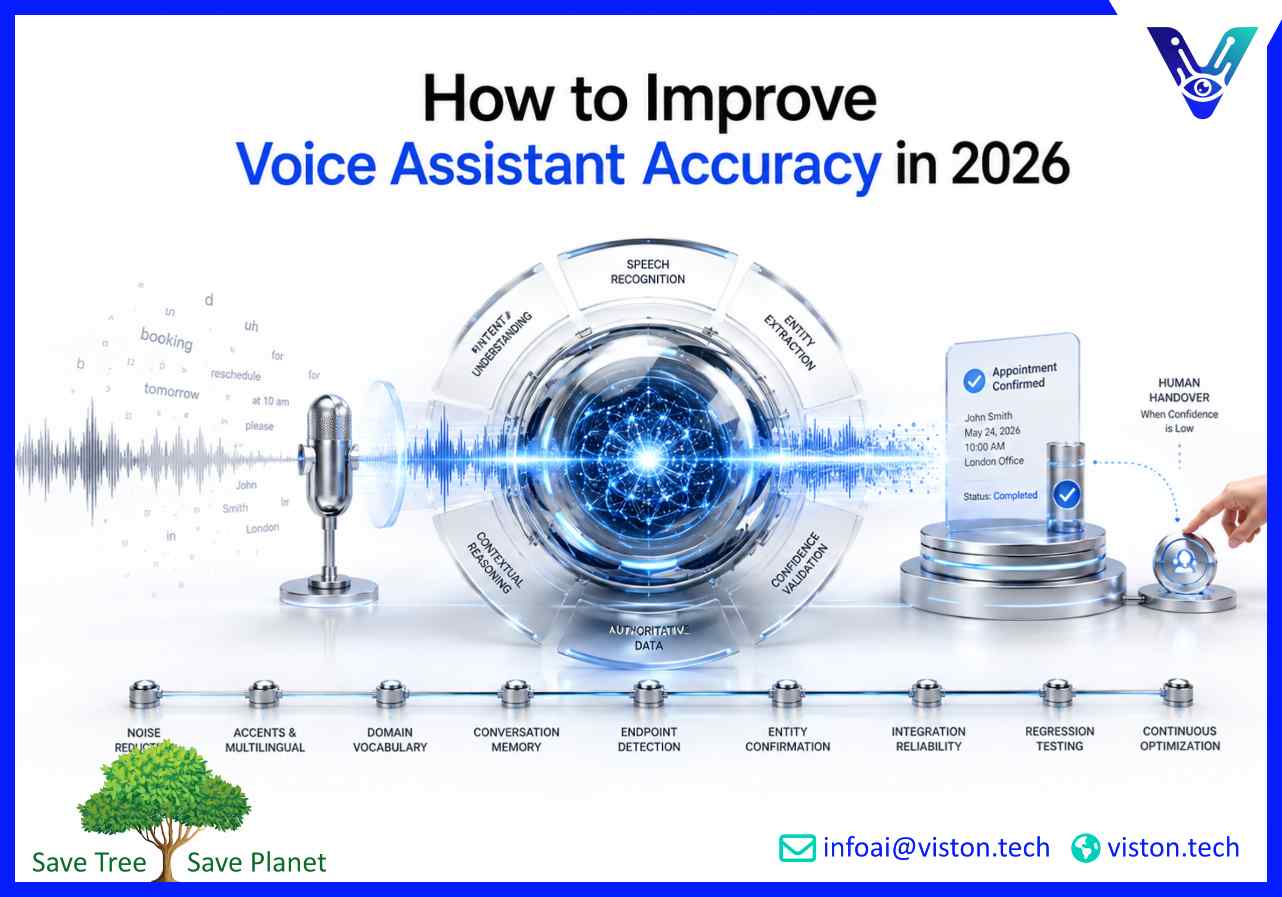
Knowing how to improve voice assistant accuracy is essential for businesses that rely on spoken interactions for customer support, sales, scheduling, internal operations, or self-service. Accuracy depends on more than speech recognition alone. It requires clear audio, relevant language data, reliable intent detection, well-designed workflows, strong integrations, and continuous performance monitoring.
What Voice Assistant Accuracy Really Means
Voice assistant accuracy is the system’s ability to hear what a user says, understand what the user intends, retrieve the correct information, complete the requested action, and respond clearly. A system may transcribe speech correctly but still produce the wrong outcome because it misunderstood the intent or accessed inaccurate business data.Businesses should therefore evaluate accuracy across the complete voice interaction rather than treating speech-to-text performance as the only measure of success.
Speech recognition accuracy
Automatic speech recognition converts spoken audio into text. Its performance is commonly measured using word error rate, which identifies substitutions, deletions, and inserted words in a transcript. Lower word error rates generally indicate better transcription quality.However, general transcription accuracy does not always reflect business performance. Misrecognizing a filler word may have little impact, while mishearing a customer name, account number, product code, address, or appointment date can cause an entire workflow to fail.
Intent recognition accuracy
Intent recognition determines what the user is trying to achieve. For example, “I need to move my booking,” “Can I change my appointment?” and “Reschedule me for Friday” may all represent the same intent.A voice assistant must identify that shared purpose despite differences in wording, tone, grammar, or sentence structure. It must also distinguish closely related requests, such as rescheduling an appointment, cancelling it, or checking its current date.
Entity recognition accuracy
Entities are the specific details needed to complete a task. These may include names, dates, quantities, locations, reference numbers, product models, currencies, or service types.A voice assistant may correctly understand that a user wants to place an order but still fail if it captures the wrong product, quantity, or delivery address. Entity-level testing is therefore essential for transactional assistants.
Task completion accuracy
The most commercially meaningful measure is whether the assistant completes the user’s requested task correctly. This may involve booking a meeting, opening a support ticket, updating a customer record, answering a policy question, routing a call, or escalating a complex issue.Task completion connects technical accuracy with customer experience and operational value. It shows whether the complete Voice-Enabled Assistant works reliably in real business conditions.
Why Voice Assistants Produce Inaccurate Results
Voice assistant errors usually come from a combination of acoustic, linguistic, data, design, and integration problems. Identifying the type of failure is the first step towards improving performance.
Poor audio quality and background noise
Traffic, office conversations, call compression, weak microphones, speakerphone echo, and unstable network connections can make speech difficult to interpret. Contact-centre audio is particularly challenging because telephone channels often contain less acoustic detail than high-quality recordings.Noise reduction can help, but aggressive filtering may remove useful parts of speech. Audio preprocessing should therefore be tested against real recordings from the channels where the assistant will operate.
Accents, dialects, speech patterns, and code-switching
Users speak at different speeds and use regional accents, informal phrases, abbreviations, hesitations, and incomplete sentences. Some users switch between languages during the same conversation. Others may have speech differences that are poorly represented in general-purpose training data.A model that performs well on controlled English recordings may struggle with multilingual calls, regional pronunciation, industry terminology, or fast conversational speech. Testing must reflect the actual user population rather than an idealized sample.
Missing domain vocabulary
General speech models may not recognize specialist terms, product names, employee names, medical terminology, financial language, technical codes, or company-specific abbreviations. Rare names and alphanumeric references are especially vulnerable to transcription errors.Accuracy decreases further when several terms sound similar. A voice assistant needs contextual information to determine which word is most likely based on the user’s account, location, current workflow, or previous statement.
Weak intent and conversation design
Some failures are caused by poorly defined intents rather than the speech model. If two intents overlap heavily, the assistant may route users to the wrong workflow. If prompts are vague, users may respond in ways the system was not designed to handle.Long questions, unclear menu choices, unnecessary confirmation steps, and rigid scripts also increase confusion. Good conversational design guides users naturally while allowing them to speak in their own words.
Outdated knowledge and unreliable integrations
An assistant can understand a question correctly and still give an inaccurate answer if its knowledge base is outdated. It may also fail when an API times out, a CRM record is incomplete, or a scheduling system returns stale availability.Voice accuracy therefore includes knowledge quality, data freshness, integration reliability, permission controls, and error handling. These operational elements must be monitored alongside speech and language performance.
How to Improve Voice Assistant Accuracy in Practice
The strongest improvement programmes address the full voice AI pipeline. Businesses should combine better audio processing, domain adaptation, conversation design, data governance, integrations, and structured testing.
Use real-world audio for testing and optimization
Begin with recordings that reflect actual operating conditions. Include different devices, call channels, accents, languages, speaking speeds, noise levels, and customer scenarios. Clean studio recordings are useful for baseline testing but rarely represent production traffic.Create separate test sets for common requests, high-value transactions, sensitive workflows, and difficult edge cases. Keep part of the data unseen during development so performance can be evaluated fairly.
Add domain-specific vocabulary and contextual hints
Provide the recognition layer with relevant product names, service terms, locations, abbreviations, and frequently used entities. Many speech platforms support custom vocabulary, phrase boosting, contextual biasing, or domain adaptation.Context should be applied carefully. Excessive boosting can cause the system to force preferred terms into unrelated speech. Vocabulary lists should be reviewed, prioritized, tested, and updated when the business introduces new products or terminology.
Improve intent training data
Each intent should include varied examples of how real users express the same goal. Training examples should cover complete sentences, short commands, informal language, indirect questions, common mistakes, and channel-specific phrasing.Avoid creating too many narrow intents that are difficult to distinguish. Where requests overlap, redesign the intent structure or ask a focused clarification question. For example, the assistant can confirm whether a user wants to cancel or reschedule instead of making an uncertain assumption.
Strengthen entity capture and confirmation
Critical details should be validated before an action is completed. Dates, amounts, phone numbers, account references, addresses, and names may need explicit confirmation.Confirmation should be proportional to risk. Repeating every detail creates friction, while skipping verification may cause costly errors. A low-risk information request may require no confirmation, whereas a payment, cancellation, or account update should use stronger checks.
Use conversation context
A capable voice assistant should remember relevant details from earlier in the conversation. When a user says, “Move it to next Tuesday,” the assistant should understand what “it” refers to and interpret the date using the conversation’s current context.Context can also include customer profile information, the page or phone number through which the user entered, previous support history, current order status, or available service options. This reduces repeated questions and helps disambiguate speech.
Improve audio capture and endpoint detection
The assistant needs to identify when a person starts and stops speaking. Poor endpoint detection can cut off the end of an answer or leave the user waiting while the system listens for speech that has already finished.Voice activity detection, echo cancellation, microphone tuning, silence thresholds, and interruption handling should be calibrated for the intended channel. Users should also be able to interrupt long responses naturally without breaking the conversation.
Connect the assistant to authoritative data
Responses should come from approved and current sources. Knowledge retrieval should prioritize active documents, structured business data, CRM records, inventory systems, service platforms, and other defined sources of truth.When information cannot be confirmed, the assistant should acknowledge uncertainty, ask for clarification, or transfer the conversation. Producing a confident but unsupported answer is more damaging than an appropriate escalation.
Design effective fallback and human handover
A fallback should do more than say, “I did not understand.” It should help the user recover by asking a simpler question, presenting a small number of relevant choices, or confirming the part of the request that was understood.After repeated failures, sensitive requests, negative sentiment, or low-confidence recognition, the assistant should transfer the user to a human. The handover should include the transcript, detected intent, captured details, attempted actions, and reason for escalation.
How to Measure and Maintain Voice Assistant Accuracy
Accuracy improvement is an ongoing operational process. Language changes, customer behaviour evolves, services are updated, and new failure patterns appear after deployment. A Voice-Enabled Assistant needs continuous evaluation rather than a one-time launch test.
Track multiple accuracy metrics
Useful performance measures include:
Word error rate for speech transcription
Intent recognition accuracy
Entity extraction accuracy
Task completion rate
Fallback and no-match rate
Repeat-question rate
Human escalation rate
Average response latency
Customer satisfaction after voice interactions
Workflow and integration success rate
Metrics should be segmented by language, accent, channel, intent, customer group, and operating environment. A single overall score can hide poor performance for specific users or high-value workflows.
Review failed conversations systematically
Failed interactions should be classified by cause. Common categories include audio problems, transcription errors, missing vocabulary, incorrect intent, entity failure, outdated knowledge, conversation-design issues, integration errors, and inappropriate fallback behaviour.This classification prevents teams from applying the wrong fix. Retraining the speech model will not resolve an API failure, while changing the conversation flow will not correct poor microphone input.
Prioritize errors by business impact
Not every error deserves equal attention. Focus first on mistakes that affect revenue, customer trust, compliance, safety, or operational workload. Misrecognizing a low-value filler word is less important than entering the wrong payment amount or failing to detect a cancellation request.Teams can combine error frequency with business impact to create a practical improvement backlog. This keeps optimization connected to measurable outcomes.
Use controlled releases and regression testing
Changes to prompts, recognition settings, training data, workflows, or integrations can improve one use case while damaging another. Maintain a regression test set covering common intents, critical transactions, edge cases, and previously resolved errors.Release changes gradually, compare performance with an established baseline, and monitor production behaviour after deployment. Version control should cover conversation logic, vocabulary, knowledge sources, prompts, and integration configurations.
Protect privacy while using conversation data
Voice recordings and transcripts may contain personal, financial, contractual, or confidential information. Businesses should define consent, retention, access, deletion, redaction, encryption, and audit requirements before using conversations for testing or model improvement.Collect only the data required for the use case. Sensitive information should be masked or anonymized where possible, and access should be limited to authorized teams.
How Viston AI Supports More Accurate Voice-Enabled Assistants
Viston AI provides Voice-Enabled Assistants as part of its conversational AI and business automation service portfolio. Its capabilities are relevant to accuracy improvement because effective voice systems require coordinated work across speech processing, natural language understanding, multilingual support, conversation logic, workflow automation, and business system integration.Rather than treating voice recognition as an isolated feature, Viston AI can help organizations design assistants around practical business tasks. This may include defining user intents, preparing domain terminology, connecting approved knowledge sources, integrating CRM or service platforms, validating captured information, and creating reliable escalation paths.The company’s related capabilities in enterprise AI chatbots, natural language processing, multilingual support, AI chatbot integration, custom AI agents, and integration with business systems can support voice assistants that need to retrieve data or complete actions rather than only answer general questions. This broader implementation approach is important because many apparent accuracy problems originate in weak workflow design, incomplete data, or disconnected systems.For businesses developing or improving a Voice-Enabled Assistant, Viston AI offers relevant technical and conversational capabilities for planning, integration, testing, deployment, and ongoing optimization. The objective is to create a voice experience that understands real users, handles uncertainty responsibly, and delivers dependable business outcomes.
Frequently Asked Questions
What is the fastest way to improve voice assistant accuracy?
Start by reviewing failed production conversations. Classify whether each failure came from audio quality, transcription, intent detection, entity capture, knowledge, conversation design, or integration problems. Fixing the most frequent high-impact failure category usually provides the fastest improvement.
Does adding more training data always improve accuracy?
No. Relevant, accurate, and representative data is more valuable than a large volume of unstructured examples. Incorrect labels, duplicated phrases, outdated transcripts, and unbalanced language samples can reduce performance. Training data should reflect real users and clearly defined intents.
How can voice assistants understand accents more accurately?
Test and optimize the system using speakers who represent the target user population. Use speech models with suitable language and accent coverage, add regional vocabulary, include varied pronunciation examples, and measure results separately across user groups rather than relying on one average score.
What is a good accuracy metric for a business voice assistant?
Word error rate is useful for transcription, but task completion rate is usually more meaningful for business use. Organizations should also track intent accuracy, entity accuracy, fallback rate, escalation rate, workflow success, response latency, and customer satisfaction.
How often should voice assistant accuracy be reviewed?
Performance should be reviewed frequently during launch and at regular intervals after stabilization. High-volume or high-risk systems may require weekly monitoring, while mature deployments can use monthly optimization reviews supported by automated alerts and periodic regression testing.
Can Viston AI help improve an existing voice assistant?
Viston AI’s Voice-Enabled Assistants, NLP, multilingual support, integration, and automation capabilities are relevant to improving existing systems. Support may include analyzing failure points, refining conversation flows, connecting business data, strengthening workflows, and establishing ongoing performance monitoring.
Conclusion
Understanding how to improve voice assistant accuracy requires looking beyond speech transcription. Reliable Voice-Enabled Assistants combine strong audio processing, representative language data, precise intent and entity design, authoritative knowledge, contextual conversations, dependable integrations, and appropriate human escalation. Businesses should measure success through completed tasks and user outcomes, not one technical accuracy score. By reviewing failures, prioritizing high-impact errors, protecting conversation data, and testing changes continuously, organizations can create voice experiences that are more useful, inclusive, and operationally dependable. Viston AI provides relevant conversational AI and integration capabilities for businesses seeking a structured approach to voice assistant development and optimization.