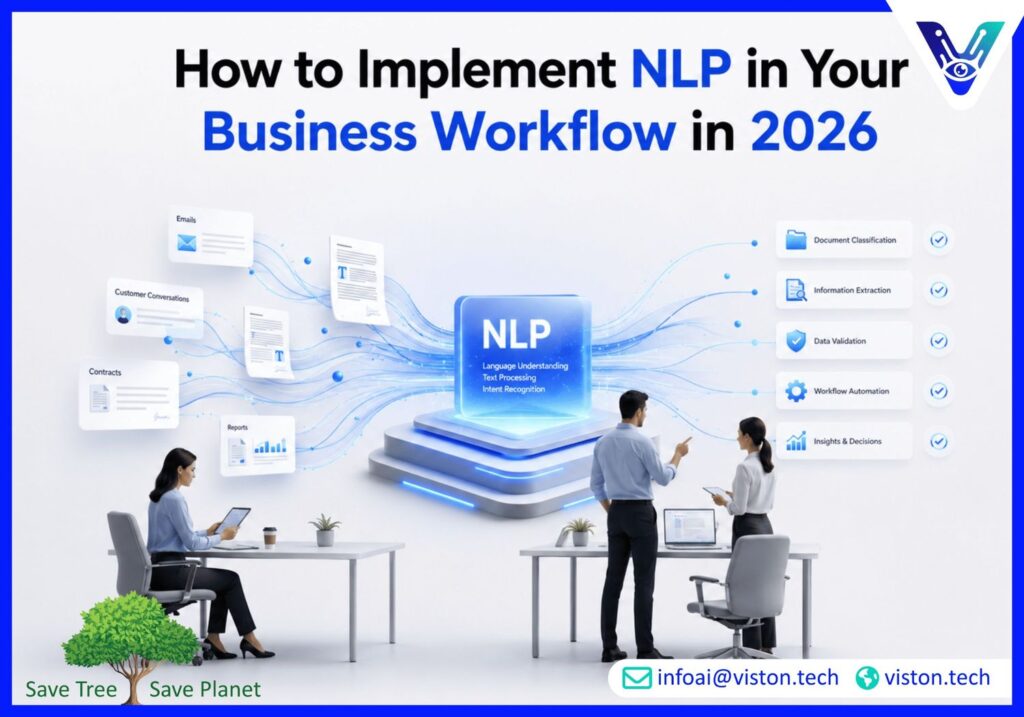
How to Implement NLP in Your Business Workflow in 2026
Businesses are generating and processing more text-based data than ever before. Emails, support tickets, customer reviews, surveys, contracts, chat conversations, and internal documents contain valuable information that often remains underutilized. Implementing Natural Language Processing (NLP) in business workflows helps organizations automate repetitive tasks, improve decision-making, enhance customer experiences, and unlock actionable insights from unstructured data.
What Does NLP Implementation Mean for Businesses?
Natural Language Processing is a branch of artificial intelligence that enables computers to understand, analyze, interpret, and generate human language. When integrated into business workflows, NLP helps organizations automate language-driven processes that traditionally require significant manual effort.NLP implementation is not simply about deploying a chatbot. Modern NLP solutions can support a wide range of operational functions across departments.
Common NLP Applications in Business Workflows
Customer support automation
Document classification and tagging
Sentiment analysis
Email routing and prioritization
Knowledge management
Contract and legal document analysis
Survey and feedback analysis
Data extraction from unstructured documents
Virtual assistants and conversational AI
Content recommendation systems
The objective is to reduce manual processing, improve accuracy, accelerate response times, and help employees focus on higher-value activities.
Key Steps to Implement NLP in Your Business Workflow
Successful NLP adoption requires a structured approach that aligns technology with business objectives. Organizations that begin with clear use cases and measurable outcomes often achieve better results than those pursuing AI initiatives without a defined strategy.
1. Identify High-Impact Business Processes
The first step is determining where language-related tasks create bottlenecks or inefficiencies.Examples include:
Large volumes of customer support requests
Manual document review processes
Time-consuming data entry tasks
Difficulty analyzing customer feedback
Knowledge retrieval challenges
Content moderation requirements
Focus on workflows where NLP can deliver measurable improvements in productivity, accuracy, cost reduction, or customer satisfaction.
2. Define Business Objectives
Before selecting tools or models, establish clear goals.Examples include:
Reducing support response times by 40%
Automating document categorization
Improving lead qualification accuracy
Extracting key information from contracts
Enhancing customer sentiment monitoring
Well-defined objectives help guide implementation decisions and performance measurement.
3. Assess Data Availability and Quality
NLP systems rely heavily on quality data.Businesses should evaluate:
Available text datasets
Data consistency
Language requirements
Historical records
Data privacy considerations
Compliance obligations
Clean, structured, and representative datasets significantly improve NLP model performance.
4. Select Appropriate NLP Technologies
Different use cases require different NLP capabilities.
Named Entity Recognition (NER)
Sentiment Analysis
Text Classification
Language Translation
Topic Modeling
Intent Recognition
Question Answering Systems
Generative AI Integration
Speech-to-Text Processing
The technology stack should align with workflow complexity, scalability requirements, and operational objectives.
5. Integrate NLP into Existing Systems
Implementation becomes most valuable when NLP solutions are embedded directly into existing business platforms.This may include:
CRM systems
Customer support platforms
ERP software
Document management systems
Business intelligence tools
Knowledge bases
Internal collaboration platforms
Seamless integration helps employees adopt NLP capabilities without disrupting established workflows.
Business Benefits of NLP Workflow Automation
Organizations increasingly invest in NLP because of its ability to create measurable operational improvements.
Improved Operational Efficiency
Routine language-processing tasks can be automated, reducing workload and accelerating business processes.
Better Customer Experiences
NLP-powered systems can provide faster responses, personalized interactions, and consistent service quality across communication channels.
Enhanced Decision-Making
Businesses gain deeper insights from customer feedback, market sentiment, employee communications, and operational data.
Scalable Information Processing
NLP solutions can analyze thousands of documents, conversations, or requests simultaneously, enabling organizations to manage growing data volumes efficiently.
Reduced Human Error
Automated classification, extraction, and routing processes often improve consistency and reduce manual mistakes.
Challenges to Consider During NLP Implementation
While NLP offers significant opportunities, businesses should prepare for common implementation challenges.
Data Quality Issues
Incomplete, inconsistent, or biased datasets can affect model accuracy and reliability.
Integration Complexity
Connecting NLP systems with existing software infrastructure may require technical planning and custom development.
Domain-Specific Language Requirements
Industries often use specialized terminology that generic language models may not fully understand without customization.
Compliance and Security
Organizations handling sensitive information must ensure NLP solutions support privacy regulations, access controls, and secure data processing practices.
Ongoing Optimization
NLP models require monitoring, retraining, and performance evaluation to maintain accuracy as business requirements evolve.
Best Practices for Successful NLP Adoption in 2026
Businesses implementing NLP in 2026 should focus on practical deployment strategies rather than pursuing technology for its own sake.
Start with a clearly defined business problem.
Prioritize measurable outcomes.
Use high-quality training data.
Ensure strong governance and security controls.
Integrate NLP into existing workflows.
Monitor model performance continuously.
Maintain human oversight where necessary.
Plan for scalability from the beginning.
Combine NLP with automation and analytics platforms.
Align implementation with long-term business goals.
Organizations that treat NLP as part of a broader digital transformation strategy often achieve greater operational value and long-term returns.
How Viston AI Supports NLP Implementation for Businesses
Implementing NLP successfully requires more than selecting a language model. Businesses need solutions that align with operational objectives, integrate with existing systems, support scalability, and deliver measurable outcomes.Viston AI specializes in Natural Language Processing solutions designed to help organizations transform language-intensive workflows into efficient, data-driven processes. Its approach focuses on identifying practical business use cases, developing customized NLP capabilities, and integrating intelligent automation into existing business environments.Whether organizations need customer support automation, document processing, sentiment analysis, conversational AI, information extraction, or workflow optimization, NLP solutions must be tailored to operational requirements rather than relying on one-size-fits-all implementations.By combining advanced language technologies, workflow integration capabilities, automation frameworks, and ongoing optimization practices, Viston AI helps businesses unlock value from unstructured data while maintaining reliability, scalability, and operational efficiency. As organizations continue to expand their AI adoption strategies in 2026, specialized NLP expertise becomes increasingly important for achieving sustainable business outcomes.
Frequently Asked Questions
How long does it take to implement NLP in a business workflow?
The timeline depends on project complexity, data availability, integration requirements, and business objectives. Smaller implementations may take a few weeks, while enterprise-scale deployments can require several months.
What business functions benefit most from NLP?
Customer service, operations, sales, marketing, legal, compliance, and knowledge management teams often see significant benefits from NLP-driven automation and insights.
Do businesses need large datasets for NLP implementation?
Not always. Modern NLP models can often be adapted using smaller domain-specific datasets, although data quality remains critical for performance.
Can NLP integrate with existing business software?
Yes. Most modern NLP solutions can integrate with CRM platforms, helpdesk systems, ERP software, document management tools, and analytics platforms through APIs and workflow integrations.
How can Viston AI help with NLP implementation?
Viston AI provides Natural Language Processing solutions that help businesses automate language-based workflows, improve operational efficiency, extract valuable insights from data, and deploy scalable AI-driven automation strategies.
Conclusion
Implementing NLP in business workflows enables organizations to automate repetitive language-based tasks, improve operational efficiency, enhance customer experiences, and gain deeper insights from unstructured data. Success depends on selecting the right use cases, ensuring data quality, integrating solutions effectively, and maintaining ongoing optimization. As businesses continue to expand their AI initiatives in 2026, Natural Language Processing solutions are becoming a critical component of modern digital operations. Organizations seeking long-term value from language intelligence can benefit from specialized expertise and practical implementation strategies that align technology with measurable business outcomes.