
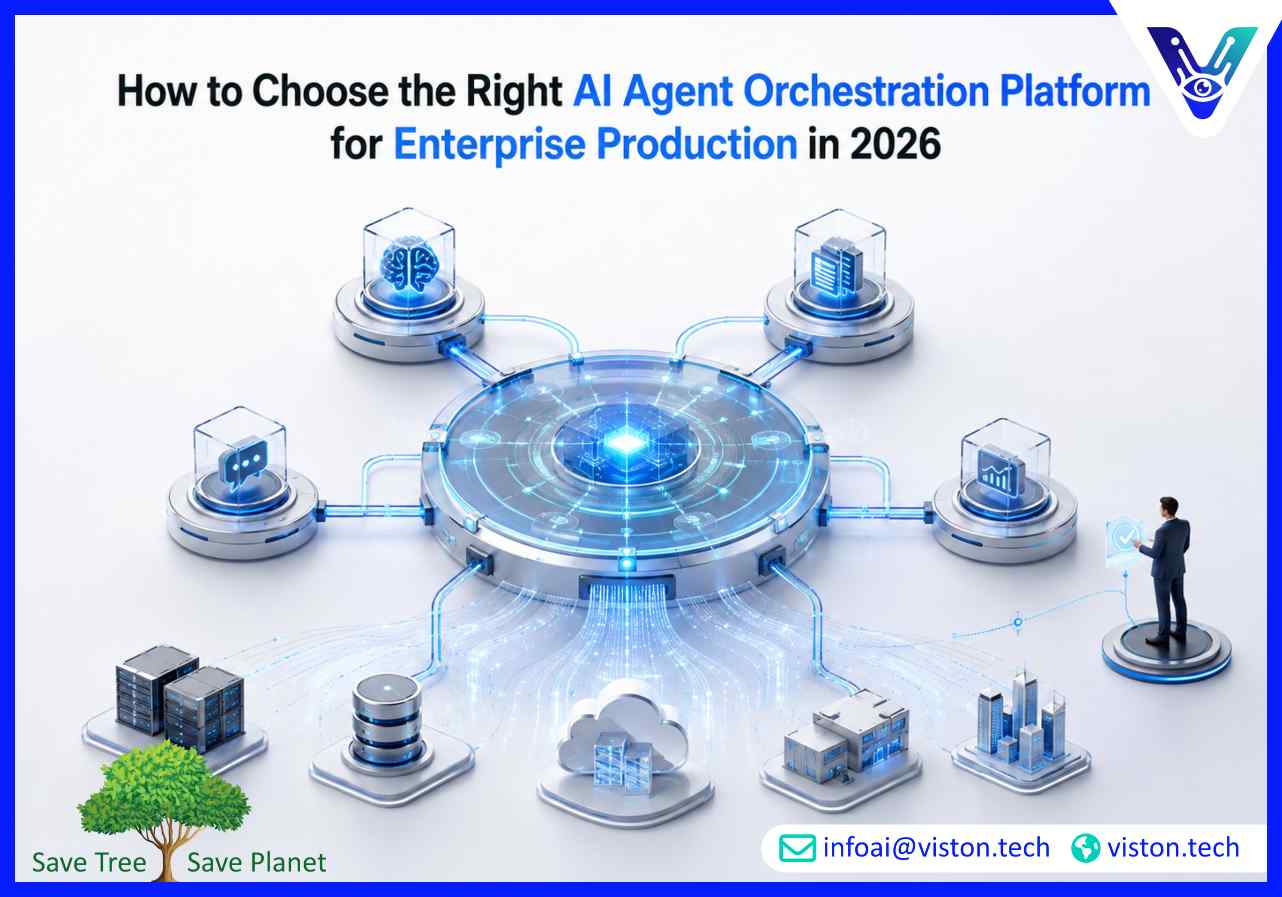
For business and technology leaders, the question is no longer if you should deploy AI agents, but how to coordinate them effectively across your enterprise. Choosing the right orchestration platform is the single most critical decision separating experimental pilot projects from reliable, scalable, and governed production systems.
The market for agentic AI has matured dramatically. Gartner projects that 40% of enterprise applications will include task-specific AI agents by the end of 2026, up from less than 5% in 2025 . But here is what experienced engineering leaders have learned: model performance has largely stabilized. The differentiating factor is the harness—the orchestration layer that governs how agents run, communicate, access data, and recover from failure.
Orchestration is fundamentally different from basic automation. Automation streamlines individual tasks or workflows. Orchestration coordinates entire processes across multiple systems, data sources, teams, and AI agents without requiring you to rip and replace what you already own . It is the connective tissue that prevents “agent islands” and unpredictable outcomes.
When evaluating orchestration platforms, focus on capabilities that directly impact production reliability and business outcomes. The following dimensions represent non-negotiable requirements for enterprise deployment.
Not all orchestration platforms handle agent coordination the same way. Some excel at multi-agent parallel execution across departments, while others focus on single-agent sequential task automation . For enterprise use cases, you need platforms that support conditional branching, fallback paths, and multi-step workflows with explicit state management. LangGraph, for example, achieves an 87% task success rate in comparative benchmarks through its graph-based state model .
Ask potential vendors: Can agents chain multi-step tasks with conditional logic? Can multiple specialized agents coordinate and share context across different systems?
Governance is now a procurement-level requirement, not an IT afterthought . Every agent you deploy makes decisions, accesses sensitive data, and affects business operations. Your orchestration platform must provide:
IBM watsonx Orchestrate and Kore.ai are noted for strong centralized governance controls, while OpenAI Frontier offers enterprise IAM with per-agent identity tracking .
Your orchestration platform cannot operate in isolation. It must connect bidirectionally with your CRM, ERP, data warehouse, and existing engagement tools. Look for native connectors, not webhook-only integrations. The platform should support multi-model flexibility, allowing you to work with agents from different providers—OpenAI, Anthropic, Google, Microsoft, or custom-built solutions—without lock-in .
Teams with existing system complexity should prioritize platforms that offer pre-built connectors to common enterprise software like Salesforce, SAP, ServiceNow, and major cloud providers.
This is where many orchestration evaluations fall short. Every framework in the market assumes the data fed to agents is trustworthy. None of them verify it. Yet 80% of agentic AI implementation time is consumed by data engineering and governance work, and 8 in 10 companies cite data limitations as their primary roadblock .
Your orchestration strategy must include a governed data substrate—active metadata, data contracts, lineage tracking, and certification of sources. Otherwise, you will spend your time debugging agent failures caused by schema drift, stale tables, or uncertified data sources, not framework configuration issues.
Different organizations need different orchestration approaches. Match your profile to the right platform category.
Large enterprises with complex, multi-system environments should prioritize platforms with hybrid deployment support, centralized governance, and broad integration surfaces. IBM, Kore.ai, and Oracle fit this profile with enterprise-grade capabilities for regulated industries .
Organizations needing strategic services and implementation support may benefit from partners like GlobalLogic or Capgemini, who provide consulting and engineering depth to move from pilot to production . This services-led approach works well when internal architecture expertise is limited.
Operations and business process teams focused on embedding agents into structured, repeatable workflows should evaluate process-centric platforms like Pipefy, which offers no-code workflow design and operational visibility across departments .
Teams prioritizing speed to prototype with role-based agent collaboration can start with high-adoption frameworks like CrewAI (45,900+ GitHub stars, 1.8-second latency) before migrating to more production-hardened orchestration .
The gap between vendor claims and production reality remains significant. Protect your organization with a structured evaluation process.
First, establish a pre-deployment baseline across three metrics relevant to your use case: cycle time, straight-through processing rate, and human touchpoints per workflow . Second, require vendors to demonstrate platform-enabled improvements against that baseline in a time-bound pilot—typically 30 to 60 days. Third, score vendors consistently across orchestration depth, governance controls, integration quality, and consolidation potential .
If a platform cannot demonstrate measurable improvement within the pilot window or answer governance questions with live product demonstrations, eliminate it from consideration.
Choosing the right orchestration platform is only half the equation. Successful deployment requires deep expertise in agent architecture, production infrastructure, and governance implementation. Viston AI specializes in enterprise AI agent development and deployment, helping organizations navigate platform selection, build custom agent solutions, and operationalize orchestration at scale.
Viston AI works with business and technology leaders to assess agent readiness, design governed multi-agent systems, and deploy production infrastructure that aligns with compliance requirements and existing technology stacks. Rather than forcing a one-size-fits-all platform recommendation, Viston AI evaluates your specific use cases, data environment, and risk tolerance to determine the optimal orchestration approach. Their delivery focus includes implementing the data quality layer that most frameworks overlook—active metadata, lineage tracking, and certified data sources that prevent agent failures before they occur.
For organizations in regulated industries or those moving from pilot to production, Viston AI provides the engineering rigor and strategic guidance needed to make agentic AI a reliable business asset, not an experimental liability.
What is the difference between an AI agent framework and an orchestration platform?
Frameworks like AutoGen, CrewAI, and LangGraph help you build and prototype agents. Orchestration platforms specialize in deploying, coordinating, and scaling those agents in production environments with event-driven architectures, governance controls, and enterprise system integration . Most enterprises need both, but orchestration becomes critical at scale.
How long does it take to see ROI from an agent orchestration investment?
Research indicates measurable results typically appear within 30 to 60 days of deployment when focused on a single, high-impact workflow . Organizations should structure a pilot around one business process—inbound lead enrichment, claims processing, or IT ticket triage—before expanding across departments.
Do I need to replace my existing systems to adopt agent orchestration?
No. Effective orchestration integrates with your current ERP, CRM, data warehouse, and other systems, acting as a connective layer that unifies data and actions without requiring replacements . This reuse of existing investments is a primary financial justification for orchestration platforms.
What compliance certifications should I look for in an orchestration platform?
For regulated environments, verify SOC 2 Type II, ISO 27001, and CSA STAR certifications . Additional requirements may include HIPAA for healthcare, PCI DSS for payments, or FedRAMP for government work, depending on your industry and data types.
How do I evaluate data quality readiness for agent orchestration?
Assess whether your data sources have active metadata management, schema stability, lineage tracking, and certification processes. If 80% of your agent implementation time would be consumed by data engineering, address data governance before selecting an orchestration platform .
Choosing the right AI agent orchestration platform requires looking beyond feature checklists to evaluate governance depth, integration capability, data quality readiness, and execution model fit for your specific use cases. The platforms that succeed in production are those that treat agents as governed digital workers with audit trails, permissions, and human oversight, not as autonomous black boxes.
As you evaluate options, prioritize structured pilots over marketing claims, and remember that the orchestration layer is where enterprise agentic AI succeeds or fails. For organizations seeking specialized guidance in AI agent development and deployment, Viston AI offers the technical expertise to navigate platform selection, implement production infrastructure, and build governed agent systems that deliver measurable business outcomes.
