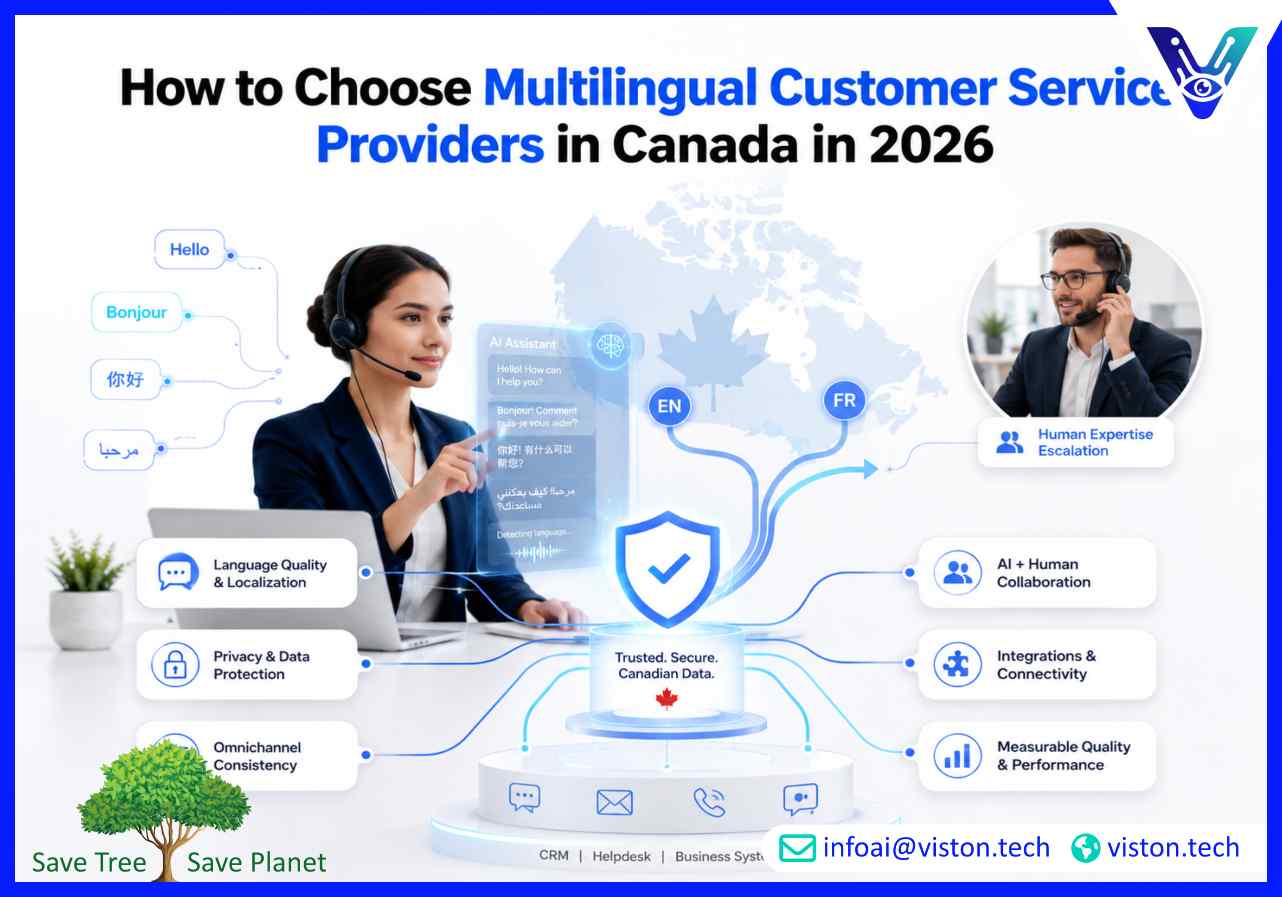
How to Choose Multilingual Customer Service Providers in Canada in 2026
Choosing among multilingual customer service providers in Canada requires more than checking a language list. Businesses need re data handling, strong human escalation, and measurable quality. The right provider should help customers receive clear, consistent support while giving internal teams the control needed to scale.
What Canadian Businesses Need from Multilingual Customer Service Providers
Canada is officially bilingual, but its customer base is considerably more linguistically diverse. English and French remain essential, while Spanish, Mandarin, Punjabi, Arabic, Tagalog, Hindi, and other languages matter in major urban and regional markets. Statistics Canada reported that 30% of the population could speak a non-official language in the 2021 Census, showing why language strategy should reflect actual customer demand rather than a generic bilingual model. provider should help a business support customers in the languages they use, on the channels they prefer, without creating disconnected service operations. That may involve live agents, AI chatbots, translation workflows, multilingual knowledge bases, voice support, messaging channels, CRM integration, or a blended model.
Language coverage must match customer demand
The best starting question is not “How many languages do you support?” but “Which languages matter for our customers, products, regions, and service volumes?” A retailer serving Toronto may have different requirements from a financial services company operating across Quebec, Ontario, and New Brunswick. A travel company may need seasonal coverage, while a software business may need technical support across time zones.Providers should explain how they determine language priorities, forecast demand, maintain specialist coverage, and add languages without lowering quality. Buyers should also confirm whether each language is available for voice, chat, email, social messaging, and self-service.
French service requires operational depth
French-language support should be treated as a complete capability, not a translated script. Customers may use Canadian French terminology, regional expressions, or sector-specific language. Quality depends on localized knowledge, appropriate tone, accurate terminology, and agents or AI systems that understand context.Language obligations vary by organization and jurisdiction. In April 2026, the federal government tabled draft regulations for the Use of French in Federally Regulated Private Businesses Act, intended to establish French-language rights for consumers and employees of certain federally regulated businesses in Quebec and regions with a strong Francophone presence. Procurement teams should assess language capability alongside their own regulatory requirements. o Evaluate Multilingual Customer Service Providers in CanadaA long language list has limited value if responses are inaccurate, handovers fail, customer data is poorly protected, or service levels vary between channels. Buyers should assess the complete delivery model.
1. Native-level quality and localization
Translation and customer service are not the same discipline. Effective support requires understanding product terminology, intent, sentiment, urgency, and the action needed to resolve an issue. Ask how the provider validates language proficiency, maintains glossaries, reviews content, and adapts responses for Canadian markets.For regulated, technical, or high-value interactions, conversations should be routed to people with both language ability and subject knowledge. A fluent agent without domain understanding may still give an incomplete answer.
2. Omnichannel consistency
Customers expect the same answer through web chat, email, phone, mobile app, WhatsApp, SMS, or social messaging. Providers should use a shared knowledge framework so policies, product details, troubleshooting guidance, and escalation rules remain consistent across languages.Conversation history should also follow the customer between channels. A customer who starts in French on chat and continues by phone should not have to repeat the issue.
3. Human and AI service design
In 2026, many providers combine human agents with AI-assisted translation, automated chat, agent copilots, intent detection, knowledge retrieval, and workflow automation. The strongest model applies automation to suitable tasks and transfers complex, sensitive, or uncertain conversations to trained people.Buyers should examine confidence thresholds, fallback behaviour, escalation rules, quality review, and human oversight. Testing should include spelling errors, mixed-language messages, code-switching, informal phrasing, and regional vocabulary rather than only polished translated examples.
4. Security, privacy, and outsourcing controls
Customer service providers may process names, account information, order histories, recordings, and other personal data. Under PIPEDA, organizations remain accountable for personal information transferred to third-party providers for processing and should use contractual or other measures to provide comparable protection. Implementation teams should ask where data is processed, which subcontractors are involved, how access is controlled, how long conversations are retained, and how incidents are managed. Relevant controls may include encryption, role-based access, audit logs, data minimization, retention rules, and documented breach response.
5. Integration and reporting capability
A multilingual provider should connect with CRM, helpdesk, order management, ecommerce, booking, identity, knowledge, and workforce systems. Without integration, agents may duplicate records or rely on incomplete information.Reporting should be available by language, channel, intent, region, and outcome. Useful measures include first-contact resolution, customer satisfaction, response time, abandonment, escalation, fallback rate, quality score, repeat contact, and cost per resolved case.
Choosing the Right Multilingual Service Delivery Model
The right approach depends on interaction volume, language mix, risk, operating hours, channel demand, and the complexity of customer requests.
Dedicated or shared multilingual agents
Dedicated agents suit predictable demand in priority languages and conversations requiring empathy, judgment, sales skill, or specialist knowledge. Shared teams offer flexible coverage for moderate volumes, overflow, seasonal demand, and extended hours. Buyers should confirm how product knowledge is maintained and whether service levels remain stable during peaks.
AI-led self-service with human escalation
AI chatbots and virtual assistants can handle common questions, order updates, appointment changes, account guidance, basic troubleshooting, and lead capture in multiple languages. This model can improve availability and absorb repetitive demand, but it requires governed knowledge, integration, monitoring, and clear handoff paths.Automated translation can help an agent support a language they do not speak, but it is not suitable for every situation. Sensitive complaints, complex financial matters, healthcare interactions, contractual questions, and nuanced retention conversations may require a fluent specialist.
Hybrid delivery
For many Canadian businesses, a hybrid model is practical. High-volume English and French interactions may be handled by dedicated teams, selected languages by shared specialists, and routine requests by multilingual AI. Unresolved or high-risk cases can then be routed to the appropriate human team with the conversation context intact.The model should be designed around customer outcomes rather than cost reduction alone. Poorly managed automation can increase repeat contact; well-designed automation gives customers faster answers while allowing agents to focus on cases requiring judgment.
A Practical Procurement and Implementation Checklist
Before selecting a provider, document current contact volumes, languages, channels, response times, resolution rates, seasonal peaks, top inquiry types, escalation patterns, and compliance requirements. This gives vendors enough information to propose a realistic operating model.
Questions to ask shortlisted providers
Which languages are delivered by fluent agents, AI, translation tools, or a combination?
How do you test language proficiency and domain knowledge?
How do you localize Canadian French and regional language variants?
Which channels and operating hours are supported for each language?
How are complex or low-confidence conversations escalated?
Where is customer data processed and which subcontractors can access it?
How do you integrate with our CRM, helpdesk, and knowledge systems?
Which KPIs can we review by language and channel?
How do you update terminology, knowledge, and AI behaviour?
What is the process for adding a language or handling a demand spike?
Run a representative pilot
Use real service scenarios, not only polished demonstrations. Test common requests, complaints, ambiguous questions, mixed-language messages, unsupported intents, authentication steps, system failures, and human transfers. Review linguistic accuracy, task completion, escalation quality, system updates, and customer effort.
Agree on governance before launch
Define ownership for knowledge updates, quality audits, privacy reviews, language expansion, incident response, and continuous improvement. Establish regular language-level scorecards and sample conversation reviews so service quality does not become fragmented as the program grows.
How Viston AI Supports Multilingual Customer Service in Canada
Viston AI is relevant to businesses evaluating multilingual customer service providers in Canada because its published Multilingual Support offering combines conversational AI, natural language processing, translation and localization, omnichannel deployment, intelligent routing, and performance analytics. Its service scope includes multilingual experiences across web chat, mobile applications, messaging, SMS, voice assistants, and social channels, supported by centralized knowledge and conversation controls. integration-led approach can support Canadian organizations that need more than a standalone translation tool. A multilingual assistant can retrieve approved information, recognize intent, connect with business systems, and escalate conversations when automation is not suitable. Viston AI also describes capabilities for language-specific analytics, sentiment-aware routing, system integration, and ongoing model improvement.For organizations serving English, French, and additional language communities, the practical value lies in creating one governed service framework rather than separate experiences. Viston AI’s offering may suit businesses seeking scalable self-service, agent assistance, workflow automation, and consistent knowledge delivery. Canadian buyers should still validate required language variants, data-processing arrangements, integration needs, security controls, and service-level expectations during procurement.
Frequently Asked Questions
What should I look for in multilingual customer service providers in Canada?
Prioritize language quality, Canadian French localization, channel coverage, human escalation, privacy controls, integrations, reporting by language, and scalability. The provider should demonstrate resolution quality, not just translation capability.
Do Canadian businesses need both English and French customer service?
Requirements depend on the organization, sector, jurisdiction, and location. English and French are commercially important, while specific legal duties may apply to public bodies and certain regulated or Quebec-based businesses.
Can AI provide reliable multilingual customer support?
Yes, for defined use cases supported by approved knowledge, realistic testing, monitoring, and human escalation. Complex, sensitive, or uncertain cases should be routed to qualified agents.
How much do multilingual customer service providers cost?
Pricing depends on languages, hours, channels, agent skill, volume, service levels, integrations, AI usage, and compliance needs. Models may include per-agent, per-hour, per-interaction, subscription, implementation, or blended pricing.
How should multilingual support quality be measured?
Track first-contact resolution, satisfaction, response time, repeat contact, abandonment, escalation, language quality, task completion, and cost per resolution. Segment results by language and channel.
Can Viston AI support a hybrid multilingual service model?
Viston AI’s published capabilities align with hybrid delivery through multilingual AI assistants, omnichannel support, routing, integrations, and analytics. Businesses should confirm their specific language, human-support, hosting, and service-level needs.
Conclusion
Choosing among multilingual customer service providers in Canada requires a balanced review of language expertise, technology, operational delivery, privacy, integration, and measurable quality. The strongest provider will align coverage with real customer demand, maintain consistent answers across channels, and use automation without weakening human support. A structured pilot and clear governance model can expose risks before rollout. For organizations considering AI-enabled multilingual support, Viston AI offers relevant capabilities in conversational automation, localization, routing, system integration, and performance monitoring.